Funereal IRA
Eel IRA
Ambiguity IRA
Frivolity IRA
Campanology IRA
Imbecility IRA
Diagonal IRA
Confessional IRA
Digressional IRA
Irish Rational Divination Army
Irish Fashionable Celebration Army
Wiry Publican Calibration Army
Fiery Snatching Lubrication Sarnie
Category: Other
Time Out on my phone.
I could only find one iPhone app with UK cinema listings and it didn’t have my local cinema listed, so that’s one thing I’d pay for on its own. But if I could get something with the whole lot — cinema listings, exhibitions, restaurant reviews, TV schedules, comedy, poetry readings — all optimised for use on my phone and location-aware, well, that would be brilliant. Actually, it’s a good rule of thumb: any way I can replace something I might otherwise carry around with me, that’s a winner. That’s why buying the A-Z was a no-brainer, why I want field guides on my phone, and why I want Time Out. Anything under £10 would be a bargain, and I’d probably pay more. I might even be willing to pay an annual subscription.
I was interested to read Chris Clarke enthusing about iBird Explorer Plus, a field guide to North American birds for the iPhone, because it’s just about the first application I thought of when the phone was released. There doesn’t seem to be an equivalent piece of software for Europe yet, but hopefully it will come.
It also seems relevant to a discussion that has been rumbling on in various places (e.g. this post which I found via Daring Fireball) about pricing for iPhone applications, about whether all the crappy applications for a couple of dollars will crowd out better software and prevent people from paying a more serious price for them.
Well, I paid £17 (about $30 at the time) for this book, probably the best field guide ever written, and I would cheerfully pay the same again just to have exactly the same information available on my phone. I paid £35 for a 4 CD set of the bird songs and calls of Europe. And I bought an iPod Nano just so I could have those bird songs with me when I was birdwatching. For a really well-designed application for the iPhone that combined the information and illustrations from the Collins guide with added audio and photographic reference, I would pay £40 without thinking and would probably go higher.
And that’s despite the fact that I don’t think the iPhone is ever going to make an ideal field guide: the advantages like portability and multimedia will never quite compensate for the small screen size. For proper birding I would want the book as well. But to have that information with me at all times, I’d certainly pay good money. And why stop there? I also own field guides to British wild flowers, butterflies, moths, trees, fungi, and insects. Since I don’t want to break my back, I don’t normally carry them around with me; I would love to have iPhone versions of them.
The thing is, I have difficulty thinking of pure functionality that you could add to the iPhone that I would spend a lot of money on. I’m not saying it doesn’t exist, just that I don’t have the imgination to think what it is. But I would certainly pay for content.
Another example: amazing though Google Maps is, for walking in the UK, it’s no substitute for the appropriate Ordnance Survey map with all the footpaths and pubs marked on it. And while it would be nice to think that OS could sell digital versions of their maps slightly cheaper than the paper ones, I would pay the full price, grumbling a little, if I could. I paid £6 for a buggy version of the London Mini A-Z, so I guess I couldn’t complain about paying the same for an OS map. For a package that gave me coverage for the whole of, say, Sussex, Kent and Surrey at multiple resolutions, £50 or £60 wouldn’t seem like an unreasonable price.
from The Spectator
The original Addison and Steele version of The Spectator from 1711, that is, which I downloaded from Project Gutenberg to read on my phone. I thought this was amusing:
As I was walking [in] the Streets about a Fortnight ago, I saw an ordinary Fellow carrying a Cage full of little Birds upon his Shoulder; and as I was wondering with my self what Use he would put them to, he was met very luckily by an Acquaintance, who had the same Curiosity. Upon his asking him what he had upon his Shoulder, he told him, that he had been buying Sparrows for the Opera. Sparrows for the Opera, says his Friend, licking his lips, what are they to be roasted? No, no, says the other, they are to enter towards the end of the first Act, and to fly about the Stage.
[ long passage snipped ]
But to return to the Sparrows; there have been so many Flights of them let loose in this Opera, that it is feared the House will never get rid of them; and that in other Plays, they may make their Entrance in very wrong and improper Scenes, so as to be seen flying in a Lady’s Bed-Chamber, or perching upon a King’s Throne; besides the Inconveniences which the Heads of the Audience may sometimes suffer from them. I am credibly informed, that there was once a Design of casting into an Opera the Story of Whittington and his Cat, and that in order to it, there had been got together a great Quantity of Mice; but Mr. Rich, the Proprietor of the Play-House, very prudently considered that it would be impossible for the Cat to kill them all, and that consequently the Princes of his Stage might be as much infested with Mice, as the Prince of the Island was before the Cat’s arrival upon it; for which Reason he would not permit it to be Acted in his House.
One passing observation: I knew they used capital letters a lot more in the C18th, but I don’t think I realised that they capitalised every single noun, however important or trivial. As German still does, I think.
Things I have learnt from Twitter
Will Carling punctuates like a fourteen year old girl.
Um… that’s about it.
That letter
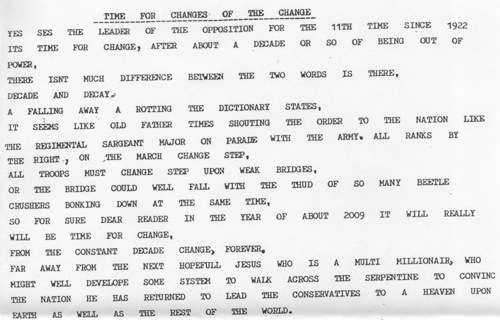
I was considering what it was about that weird political letter that made me put in the effort to blog it. I think it’s two things, really. The first is that we are increasingly surrounded by the mass produced and mechanically produced, and I find amateur, hand-made things more and more appealing. Of course, even a hundred years ago, people lived their lives surrounded by mass-produced stuff, but as technology improves, more and more things can be done by machines. It’s now rare to see a hand-painted shop sign, for example. Concert flyers, fanzines, even posters about lost cats, have usually been run up on someone’s computer, and have the generic similarity that comes from everyone having the same few typefaces and little idea about how best to use them.
It may seem slightly odd to be talking about the handmade in the context of a letter which is typewritten, photocopied, and stapled together, but I guess ‘hand made’ is sort of relative: each technology looks laborious and hands-on in the light of the next one. Hell, even things from the first generation of home printing look that way: I got a flash of nostalgia the other day because there was a sign in the optician’s window printed in Algerian.
The other thing about the letter which caught my attention, I think, was that slight whiff of paranoia to it. I think there’s an incredible pathos to these public displays of paranoia, not least because they are often superficially quite funny, like the killed by freemasons guy, or the graffiti that appeared at Charing Cross reading
ARE THEY Putting
Nanotechnology in your
Food & Water?STOP THEM EXPERIMENTING
ON Benefit
Claimants
&
The Mentally
ill
I once stumbled on an internet discussion forum for people who believed they were being spied on by the US government: it was about the saddest thing I’ve ever read, but the sheer bizarreness of the delusions just seemed to be crying out to be made a joke of.
My letter-writer isn’t quite so clearly suffering from paranoid delusions as those cases, but still, distributing anonymous political tracts by hand, asking people to pass them on, to write to the queen and ask her to dissolve the political system as the last chance to save the country: I’m pretty sure that inside this person’s head is not a happy place.
