Categories
Other

This financial crisis is a bit of a buzzkill.

I haven’t commented much, because I don’t think my political instincts are that brilliant even for the UK, let alone a country I haven’t visited for over a decade. But I’ve been enjoying the US elections ever since the primaries: the Americans always do democracy on a bigger scale than the rest of us, but this time round it has been more dramatic than ever. Not so much political theatre as political epic. The Cinton vs. Obama storyline alone was more exciting than anything that’s likely to happen in our own next general election; and it kept on getting more remarkable. I mean really: Sarah Palin! You couldn’t make it up. It adds to the fun, of course, that it definitely means the end of Bush and probably a Democrat in the White House.

But since the world’s financial sector apparently started circling the plughole, I’ve been unable to take the same kind of simple pleasure in the whole thing.
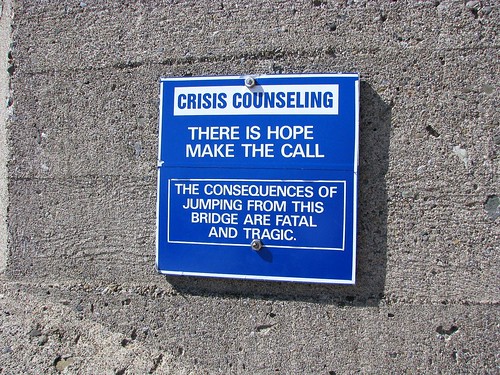
This is genuinely scary. When apparently well-informed people start making comparisons with the Great Depression: eep. Even if they’re saying things like ‘with the right government intervention we should be able to prevent this turning into anything like the Great Depression’: still eep. What Sir Alex Ferguson once called ‘squeaky bum time’.

Neither candidate has exactly covered themselves in glory over this issue. McCain’s stunt of ‘suspending’ his campaign and rushing back to Washington was the undoubted low point, but neither of them has said anything that convinces me that they have exceptionally clear insights or solutions to offer. Neither of them has made a strong and unambiguous case either for or against government intervention. I understand that since they are not in office and are in the middle of an election campaign, they are in the worst possible position to be unbiassed and pragmatic; perhaps it’s too much to expect to ask them to rise above the politics of the moment. But they haven’t. Neither of them has managed to step in and fill the leadership void left by the complete disintegration of Bush’s credibility.

When asked in the debate how the crisis would affect their spending plans, both of them fluffed the issue: Obama just restated all the things he wants to spend money on, and McCain came out with some ludicrous crap about cutting earmarks. I’m not expecting them to come up with new plans on the fly, several months in advance and without knowing how the situation will change, but it would have been nice to see them engaging seriously with the question.

And that leads me onto the last point: this is a horrible time to become President. I will be thrilled to see Obama elected, insha’Allah, but I think the job may be a poison chalice. Just to take healthcare: there’s no doubt at all that America can afford a proper healthcare system, since Americans already pay more than everyone else for healthcare as it is. But it is money that will have to come from somewhere, and the state of the economy will not make the politics of it any easier.

Frankly, even if it wasn’t for the economy, the next President would have enough on their plate dealing with Iraq. It may be that there there is no good exit strategy from Iraq, but we who invaded the country have some responsibility for what happens to it. As the shop sign says: you break it, you’ve bought it. I would vote for Obama, if I had a vote, at least partially from a belief that he wouldn’t have invaded Iraq in the first place, and therefore that he is hopefully less likely to get into some new foreign adventure of his own. But I don’t have any faith that he knows how to sort out the mess in Iraq now. Would McCain do any better? I don’t know. I suspect that to do the job properly would take decades, and I don’t think there’s the political will in America to commit to that kind of timescale anyway. The Iraqis might not be thrilled either.

All of which adds up to: It’s a lot harder than it was a few months ago to look forward to the election with a sense of optimism.

» the picture, Last Chance, is © huangjiahui and used under a by-sa licence.

Categories
Other

Another one bites the dust

Sad to see the nonist, always a reliable source of neat stuff, is going the way of all blogs. Still, it’s an opportunity to do a quick greatest hits post — ‘greatest hits’ in this case defined as ‘stuff I linked to earlier’.

antique microscopic slidesfire markswatermarks — eugenics materials —  Native American totem symbolsx-rays of paintings — hand guards from Japanese swords — old scissors — science fairs — C19th tonic wine — nuclear fallout calculatorscarousels — Native American costumehornbooksPolynesian stick chartslibraries 

When so much of the designy/visual culture blogosphere deals with such a limited range of material (retro Americana, mid-C20th graphic design, the latest quirky bit of typography, music videos, objets d’interior design and so on), you’ve gotta love someone who digs out pictures of renaissance scissors.

Categories
Other

On Sarah Palin

Scanning over the basic facts of Sarah Palin’s life, I was immediately struck by the fact that 40% of her children are named after witches.* This may say more about me than it does about her.

Piper and Willow.

Categories
Culture Other

Occupational Hazards by Rory Stewart

Occupational Hazards is Stewart’s account of trying to administer Maysan province in southern Iraq. He’s obviously an interesting character; to quote his author bio: ‘After a brief period in the British army, he studied at Balliol College, Oxford, and then joined the Foreign Office, serving in Indonesia and Montenegro, Yugoslavia. From 2000 to 2002 he walked six thousand miles across Iraq, Afghanistan, Pakistan, India and Nepal. In 2003, he was posted to Iraq as CPA Deputy Governate Coordinator of the provinces of Maysan and later Dhi Qar.’

He explains that, after being away from the Foreign Office for some time, he approached them and asked to be sent to Iraq. He never quite says why; he clearly finds the work fascinating and loves the Middle East and central Asia (he has now returned to working on regeneration in Afghanistan, at the Turquoise Mountain Foundation); even so, there can’t have been many people whose immediate reaction to the invasion of Iraq was to send off a CV and ask for a job. His reward was to be given the job as supreme civilian authority in Maysan.

US Army soldiers and Iraqi hosts

The book is an account of his time trying to do that job; trying to set up some kind of administration, get reconstruction projects started, and prepare the province for handover to Iraqis. And the overwhelming impression is of chaos. The kind of broad brush stuff we’re all now familiar with — Sunni vs. Shia, moderates vs. extremists — is just the tip of the iceberg. Apparently 54 new political parties appeared in Maysan in the immediate aftermath of the invasion. There were conflicts between different tribes; there seem to have been endless different clerics, all with their own supporters; the educated urban Iraqis looked down on the rural population. Stewart had to try to achieve some kind of balance of their competing claims while also favouring the kind of moderate, secular government that the CPA aspired to producing. He also had to deal with the central administration in Baghdad, which was disorganised, ideological and unhelpful; and with the local British Army commanders, who he theoretically outranked, but who had their own priorities and were not under his direct command.

He writes well, and the book is in turns depressing, funny and, mostly, interesting. I don’t think I’m giving away the ending when I say that, despite some successes, he didn’t manage to establish a model secular democracy in his chunk of Iraq. On the other hand, if you read the book hoping to understand why the occupation hasn’t been more successful, it doesn’t provide any simple answers. He recognises the reasonableness of many of the criticisms aimed at the administration: the failure to prevent the looting immediately after the invasion, the disbanding of the Iraqi army, the lack of planning generally. But his own feeling is that actually, even if all those thing had been done right, it still would not have been enough to create a peaceful, stable, democratic Iraq; that we overestimate our own powers if we think we can shape a country that way. And that we could never have planned for all the complexities anyway.

» The picture, US Army soldiers and Iraqi hosts, is taken inside the traditional Marsh Arab reed-built mudhif. I don’t know if it was taken in Maysan, but it’s certainly the right kind of building. It was taken by James Gordon and is used under a CC attribution licence.

Categories
Other

Final Olympic round-up

Well, I thought the London 2012 segment of the closing ceremony was… OK.

The whole bus stop routine was underwhelming, and the presence of David Beckham seemed a bit random, but the moment when the bus opened up like a flower was a striking image, as was Leona Lewis raising up into the air with her frilly dress trailing down behind her. And while Led Zep isn’t my kind of music — or indeed remotely contemporary, by pop standards — it did just about manage to cut through the slightly oppressive grandiosity of the Chinese ceremony. So I’ll give it a solid 6½/10. For the London opening ceremony they need to bring that up to at least 8½, but for the time being I can live with that.

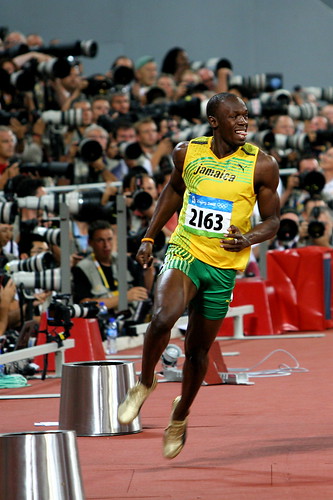
Usain Bolt on Flickr, used under a CC by-sa licence.

My sporting highlight of the games was Usain Bolt. No points for originality there. I know I said the other day that the sprint events were overrated, but for once they really lived up the hype. Watching someone beat the field by such a large margin and apparently so easily was almost surreal. It just shouldn’t be possible to do that.

I suppose I ought to name-check Michael Phelps, although as all his races were on in the middle of the night, I never really engaged with his story in the same way. Is he now The Greatest Olympian Ever? Well, I suppose he might be. It’s not that he won 8 medals in Beijing: sure, that’s incredible, but I still think the greatest individual achievement at a single Games was Emil Zátopek winning the 5000m, 10000m and marathon in 1952. But if you add the five golds from Athens, Phelps has completely dominated the swimming at two Olympics now, and that might be enough to secure his place as The Greatest. Apparently he’s planning to compete in 2012: if he could come to London and win another three or four golds, that really would put him in a class of his own.

Speaking of Zatopek: OMG, the Ethiopians in the long-distance running. To have Tirunesh Dibaba and Kenenisa Bekele both manage the 5000/10000 double was amazing. And particularly the women’s 10k and the men’s 5k; to see them sprint so easily away from the rest of the field at the end of a very fast-run race was almost as impressive in its way as Usain Bolt in the sprints. Bekele ran the last mile in under four minutes; I know the four-minute mile isn’t a big deal any more to a professional athlete, but to run one at the end of a fast 5000m… lawks.

And there’s Britain coming in fourth place on the medals table. Fourth! In Atlanta we came 36th. So three cheers for Christine Ohuruogu, Rebecca Adlington, Chris Hoy, Bradley Wiggins, Rebecca Romero, Nicole Cooke, and all the other medal winners whose names don’t spring to mind.

» photo credit: Beijing Olympics: Usain Bolt Breaks The World Record (Men’s 100 Meters) by Richard Giles, used under a Creative Commons by-sa licence.

Categories
Other

Just as a matter of record

As of close of play today, Great Britain is third on the Olympic medal table. It’s like, it gives you a warm glow, innit.

Advert for Olympic Cycles, from the British Library

» The advert for Olympic Cycles of Wolverhampton is from the Evanion Collection of Ephemera at the British Library.