Categories
Other

Congratulations Spain

A much deserved win.

Which, incidentally, means that there are now 10 countries who have won a major international football tournament since England last did it. Germany, Italy and Brazil have won 10 between them in that period.

» Winners Spain, uploaded to Flickr by mwboeckmann and used under a CC by-nc-sa licence.

Categories
Other

Dispatches from the Uncanny Valley

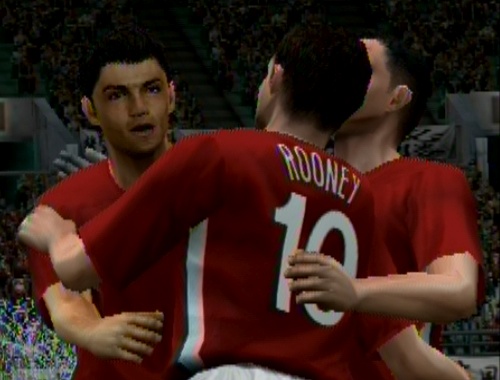
I’ve just bought Pro Evolution Soccer 2008 for the Wii, and I’m thoroughly enjoying it, but it does take you into a weird parallel world. Not just because of the licensing restrictions that mean the English league is full of clubs called things like ‘Man Red’ and ‘Lancashire Athletic’, and Germany has players called ‘Fnich’ and ‘Harmey’, or the fact that you can play matches like England vs. Barcelona*, or even the robotic, repetitive commentary from Jon Champion and Mark Lawrenson. No, it’s the strange, shiny looking, dead-eyed players with faces that look like they’ve been painted onto blocks of wood from memory. Here’s Christiano Ronaldo, congratulating Rooney on scoring a goal for Man Red.

And yet for all the little bits of clunkiness, it feels enough like football that there’s a real joy to be had from scoring a good goal. It doesn’t feel like playing football, but it does feel like watching-football-on-telly-but-I-can-control-the-players. And even if they look a bit peculiar, I still want to use my favourite players in the game.

If Coleridge came back from the grave and encountered computer games, I wonder how it would affect his concept of the willing suspension of disbelief. He only had theatre as a subject; I wonder what he would have made of a game where you control a little Italian plumber as he jumps up scaffolding, avoiding flaming barrels thrown at him by a gorilla, in order to rescue a princess? Because at some level I think you do have to ‘believe’ in computer games, even the most primitive ones.

 *I lost 7-1: Ronaldinho had Gary Neville on toast.

Categories
Other

The iPhone, Top Trumps, and widescreen TV

The BBC’s tech blog has posted a piece about the new iPhone, and, inevitably, the comments are full of people whining about how the iPhone is rubbish because it lacks some feature that competing phones have, or has inferior specs, and that people only buy it because of they are stupid fashion victims. 

This comment provides a particularly classic example:

What about MMS support -sure no one really uses MMS, but it’s kind of a missing feature don’t you think?

I’m not sure that people outside the UK ever had the pleasure of playing ‘Top Trumps’. The way it worked was that you had a themed deck of cards, which might be cars or footballers or whatever. And each card was scored with various qualities:

from the Pointless Museum

You had to turn over your next card and try to win your opponent’s card by challenging him to beat a particular score. With this set, the Horror Top Trumps (which I remember playing at primary school, incidentally), the scores are out of 100, so it’s very obvious that if it’s your turn to play and you have Dracula, you should challenge on ‘Horror Rating’. The winner gets both cards and gets to play again. Naturally enough, different sets had different kinds of scores. I assume that for Prehistoric Monsters, older is better.

from the Pointless Museum

This was all good clean fun, but it wasn’t a very subtle or nuanced way of evaluating which prehistoric monster (or sports car, or footballer) was really ‘better’. And I can’t help feeling that all those BBC blog commenters are just playing technology Top Trumps.

The idea that a technology product is more than the sum of its features is not a new insight. I’m just one of the many people who have been banging on about it for years. But it’s always worth reiterating because  those who are most fascinated by technology, and are the most vociferous about it, are exactly the kind of people who don’t get it. They are, in fact, the kind of people who would probably rather enjoy playing Tech Specs Top Trumps.

I have a favourite new example of the distance between those technology enthusiasts and the bulk of the public. I watched the Champions’ League final in a pub in Wales. The football was on a nice big widescreen plasma TV, and the signal was coming from Sky, so I know it was being broadcast in widescreen — but the picture was distorted. Presumably, at some stage there had been something on TV which was in a 3:4 ratio and they had changed the TV settings so that the picture was stretched to fill the screen, and had never changed it back.

I tried to explain what was wrong and offered to fix it, but unsurprisingly the barman was reluctant to hand over the remote control to a random stranger just before the biggest match of the season started. So Wayne Rooney looked even shorter and squatter than usual, and the ball was oval.

In other words, they’ve spent many hundreds of pounds on a TV, and however much it costs to get a Sky subscription for a pub, and are using it to distort the picture and cut off the edges. Because they can’t tell the difference? Because they don’t care? Or the most worrying possibility: perhaps they think that’s what widescreen is — a normal picture, stretched a bit.

There are probably many many people, all around the country, doing the same thing: using their expensive new equipment to distort the TV they watch. And the biggest favour you could do those people is not to provide them with more features: it’s to make sure they can use the features they have. If that’s true for something as simple as a TV, it’s even more true for a sophisticated smartphone. Ease of use and good interface design are so much more important for most people than the sheer number of features.

Look, it’s a good thing that there are people who go over these kind of technical specifications with a fine tooth comb and compare products against each other. It’s a valid kind of critique and provides useful information. But brandishing these numbers as though they are irrefutably The Final Answer is like saying “obviously the woolly rhinoceros is better than the archaeopteryx, because it weighs more”.

» All the pictures are taken from The Pointless Museum.

Categories
Other

What I want to see at WWDC

WWDC, for those of you who don’t avidly follow Apple’s annual publicity cycle [for shame!], is the Worldwide Developer’s Conference. Which is being held next week in California.

Everyone’s expecting a new iPhone with slightly better specs, but I’m not quite geeky enough to get excited about wireless data standards. Obviously faster=better, but it’s not suddenly going to persuade me that I can afford to shell out £270 for a phone. What I think is potentially much more exciting is to see new iPhone app demonstrations. That has potential to have a real ooh factor.

What I would like to see is an Apple e-reader. I have become more and more convinced that sooner or later we will be doing much more of our reading on some kind of handheld device; much as I like books as physical objects, I have too many of them already. And it would be great to be able to take six or seven books on holiday with me — or just around town — without the bulk and weight of dead trees. And to be able to read newspapers and blogs on the tube.

This device doesn’t have to be made by Apple, of course, but I’d love to see what they could achieve if they tried. The only problem is that there isn’t even the hint of a smidgen of a whiff of it on any of the Apple gossip sites. And I suspect that the nice people at Apple have had their hands full recently with Leopard and the iPhone. 

» Transgenic Apple, posted to Flickr by dujarandille. I’s not actually transgenic, I don’t think, that’s just what the photographer has called it.

Categories
Other

Why Obama won the nomination

That post title probably ought to have a question mark at the end.

It is ridiculous to suggest that there was a single reason why Obama won it — or why Clinton lost it — but I’m going to do it anyway. I really think that a lot of it came down to timing. Politicians tend, when they first arrive on the scene, to have a honeymoon period; few people have managed to have it quite so precisely when they need it as Obama. His moment as flavour of the month, when he was at his most shiny and new and exciting, seemed to just coincide with Super Tuesday. The news media has the attention span of a three-year-old and is always attracted to ‘news’; to newness.

Clinton had great difficulty competing for the spotlight at the crucial moment because however historic her candidacy was, it wasn’t news. She has been an international figure for nearly two decades; everyone has known she was going to run for president for years; she entered the race as the candidate to beat, with a huge campaign fund and a high public profile. She was expected to do well; any other narrative was always going to be more exciting and more newsworthy.

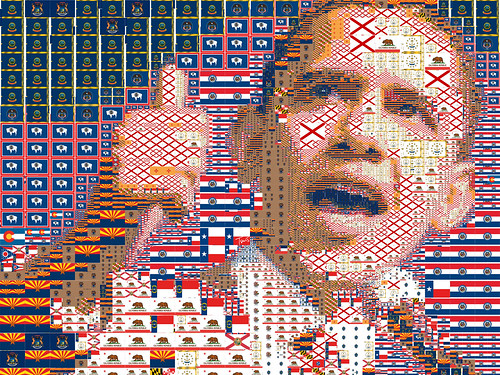
Obama as a mosaic of US state flags; used under a CC by-nc-nd licence

That’s not to say that newness was the only thing Obama had going for him; novelty value will only get you so far. Ask Mike Huckabee. There are lots of reasons why Obama excites people: he’s an excellent public speaker, if a slightly ponderous gravitas is your thang; he’s young, he’s intelligent, he looks good; and lots of people are excited by the idea of a black candidate. I just think if he had come into the race as a more familiar figure, perhaps from a failed run for president four years ago, or from a prominent job in national government — someone the public had already had a chance to form opinions about and get used to, in fact — he would have found the campaign noticeably heavier going.

I’m not suggesting that there’s some appalling skeleton in the Obama closet which would have come out in the meantime. And I’m not trying to make some kind of accusation or complaint; I don’t suppose anyone has ever made it to be a presidential candidate without a few slices of luck along the way. I just think it’s an observation worth making.

» ‘Barack Obama made out of US flags‘ posted to flickr by tsevis and used under a by-nc-nd licence.

Categories
Other

Going Dutch by Lisa Jardine

Full, slightly overblown title: Going Dutch: How England Plundered Holland’s Glory. This is a book about the relationship between England and Holland in the C17th. It’s an interesting period, of course: the C17th was Holland’s ‘Golden Age’, when the country was not only a wealthy global power but at the intellectual and especially artistic forefront of Europe. For me, the art is especially remarkable: there are three of the all-time greats in Rembrandt, Rubens and Vermeer, and a huge number of other important artists like Gerrit Dou, Pieter de Hooch, Frans Hals, Jan Steen, and Aelbert Cuyp.

Indeed, not only were the Dutch producing lots of their own great artists: they exported them over the channel; most notably but not only Anthony Van Dyck and Peter Lely, who between them seem to have painted most of the society portraits in England at the time. And of course the other most notable Anglo-Dutch connection was that by the end of the century, England had acquired a Dutch king: William of Orange.

That acquisition is usually referred to by the British as ‘The Glorious Revolution’, a name which combines just the right amounts of grandeur and vagueness to discourage too much analysis. But as Jardine makes clear, seen from an outside perspective, and especially perhaps from a Dutch perspective, it looks an awful lot like the Dutch conquest of England. William sailed across the channel with a fleet of 500 ships and 40,000 men, including 20,000 armed troops, marched on London and took power. The only reason it can be remembered as anything Glorious, rather than a bloody conquest or yet another Anglo-Dutch war, is that James II didn’t put up a fight. He was unpopular with just about everyone, not least because he was Catholic, and not really getting on with his own army, and he decided to flee rather than press the issue. Who knows what would have happened if he’d been a little more forceful and decisive.

This was, in some ways, a family affair: William and his wife Mary were both grandchildren of Charles I.* In fact they probably would have been most likely to succeed James II anyway, except that James’s wife, after a long string of miscarriages, unexpectedly produced a male baby and screwed everything up for the Oranges.

The strength of William-and-Mary’s claim to the throne made it easier for the English to accept them as joint monarch; Lisa Jardine’s books sets out to demonstrate that the tangled relationship between the Stuarts and the House of Orange is actually typical of a very strong cultural link between England and Holland throughout the C17th; that much of what became typically English, and much of the groundwork that enabled England to became a great power in the C18th and C19th, came from Holland.

She certainly successfully demonstrates an enormous amount of interaction between the two countries: in art, music, gardening, science and indeed socially. One of the most striking examples was the testing of Christian Huygens’s clock design on a British ship; Huygens had been corresponding with members of the Royal Society in London, who arranged for his new clock to be tested as a possible solution to the longtitude problem by a captain in the Royal Navy. On the very mission where he was testing this Dutch clock design, the captain plundered all the Dutch trading posts along the coast of Ghana, triggering the Second Anglo-Dutch War in the process. You might think this would interfere with relations between London and the Hague, but no, the correspondence carried on as though nothing had happened.

I suppose the only question a sceptical reader might have is whether you would find similar levels of influence and connection if you studied, say, Anglo-French relations at the same time. Is there a specific and exceptional connection between England and Holland at this period, or just the normal amount for two neighbouring countries? She seems pretty convincing to me, but I’m not in a position to judge.

* I’ll try to explain, but the same names keep coming up attached to different people, so you’ll need to concentrate. Charles I’s daughter Mary married William II of Orange; her son William is the one who became king of England. He, William III of Orange, married another Mary, the daughter of James II and thus the granddaughter of Charles I (and his own first cousin). So when he invaded England, he was deposing his uncle and father-in-law.

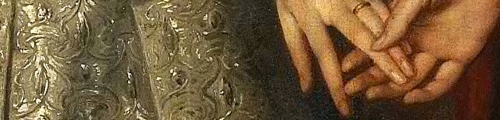
» The pictures are all details from the wedding portrait of the fourteen-year-old William to the nine-year-old Mary, painted in London by Anthony Van Dyck and now in the Rijksmuseum. Both because that picture seems appropriate and because there’s a high-quality reproduction of it in the Wikimedia Commons.