Categories
Other

Presidents and small gods

I’m always puzzled by the fact that, in discussions about abolishing the monarchy, so many people assume it would be necessary to replace the monarch with some kind of president.

To me, ‘king’ suggests a small god. A slight odour of divinity attaches to the idea of a monarch which is sets it apart from other kinds of leader. Many cultures have made this explicit: Egyptian pharoahs were believed to be reincarnations of the god Horus, Roman emperors were often declared as gods after their death, and the Japanese imperial family are descended from the goddess Amaterasu.

Christianity makes it theologically awkward to claim that the king or queen actually is a god, but much of the symbolism remains. The royal touch is no longer regarded as a cure for the King’s Evil, and you don’t often hear anyone arguing for the Divine Right of Kings, but the monarch is still anointed by the Archbishop of Canterbury during the coronation*. For that matter, the throne, crown, orb and scepter are hardly subtle.

[Coronation portrait of Elizabeth I]

The government is known as ‘Her Majesty’s Government’, and the Queen is also Supreme Governor of the Church of England, Head of the Armed Forces and, best of all, Fount of Justice (really, I’m not making this up). So that makes her ultimate source of all power, justice, and temporal and spiritual authority in the country. And of course she’s the Head of State: the very physical embodiment of the United Kingdom. If these are not the characteristics of a god, it’s hard to know what would qualify.

Since, by convention, the Queen does not in fact attempt to govern the church, order the army around or interfere with the decisions of the government or the courts, this is all pretty harmless. What I don’t understand is why anyone feels that, if we got rid of the monarchy, all this symbolism would need to replicated.

For me, that’s what a president to act as Head of State would be: a king substitute. You can see it to some extent in the American convention that while it’s acceptable to criticise the President as an individual, you have to respect the office of President of the United States. Really, what does that even mean? If the presidency is just a (very important) job, what does it mean to ‘respect’ it in some abstract way? Things like the imperial-looking presidential seal which gets plastered all over the place, and the way that ‘President’ is retained as a title for life, suggest that it’s not just a job; that the inauguration is a lot like a coronation.†

People criticising the institution of the monarchy tend to focus on the fact that the monarch is unelected — which is, of course, appallingly undemocratic. But would an elected monarch be any better? Perhaps the problem isn’t that the Queen is unelected, it’s that she’s a queen.

I’m actually not in a hurry to abolish the monarchy, just because of the fuss that would be involved in doing it. In eight years since they got rid of the hereditary peers, Parliament still hasn’t managed to come to an agreement about the composition of the House of Lords. Can you imagine how much discussion it would need for them to decide how to replace the monarch? But if we did decide to ditch the monarchy, I can’t see any need to replace it at all. The Prime Minister can keep running the government, and we can just declare that we don’t have a Head of State. What do we need one for anyway? There’s the occasional state dinner that needs to be hosted, but that hardly requires a monarch; a maitre d’ would be perfectly adequate.

I suppose one worry is that in the absence of a monarch to act as a decoy, there would be some pent-up reservoir of idolatry that would attach itself to the Prime Minister by default and give him ideas above his station. But I’d like to think we could get used to the idea of living as a nation of equals.

*Bonus fact: this, too, represents a kind of divine descent. The Archbishop’s authority descends from the first Archbishop of Canterbury, St. Augustine, who was granted it by the Pope, whose authority ‘descends’ from St Peter and so from Christ. It’s not quite like being a direct descendent of a sun-goddess, but I think the parallel is interesting.

† Just as a comparison, it would be really weird to talk about respecting the office of Prime Minister in the same way. And far from having an inauguration ceremony, the new Prime Minister just moves into 10 Downing street the day after the election. I’m not claiming any kind of British superiority here, btw: we’ve still got a Queen.
Categories
Other

Talking bollocks about technology

Simon Jenkins has an article in the Guardian that is so wrong-headed that it’s a little hard to grapple with. The first couple of paras give a good idea of the flavour:

I rise each morning, shave with soap and razor, don clothes of cotton and wool, read a paper, drink a coffee heated by gas or electricity and go to work with the aid of petrol and an internal combustion engine. At a centrally heated office I type on a Qwerty keyboard; I might later visit a pub or theatre. Most people I know do likewise.

Not one of these activities has altered qualitatively over the past century, while in the previous hundred years they altered beyond recognition. We do not live in the age of technological revolution. We live in the age of technological stasis, but do not realise it. We watch the future and have stopped watching the present.

I’ll leave it as an exercise for the reader to pick apart all the ways in which his examples are tendentious, highly selective or downright false and skip quickly on to pick a bit out.

No, the computer is not a stunning technological advance, just an extension of electronic communication as known for over a century. No, the internet has not transformed most people’s lives, just helped them do faster what they did before.

I can’t help feeling that he’s stretching the word ‘just’ beyond its reasonable limits.

As well as using it as a more sophisticated replacement for the mechanical typewriter, I regularly use my computer for design, photo-editing and as a print-shop. It’s a jukebox and photo display unit, and I can watch DVDs on it. I have a tuner plugged into it, so it acts as a TV, radio and video recorder as well. If I was so inclined, I could also use it to write and record music, edit sound and video, create animation, do 3D modelling, and process complicated mathematical functions. I can play games on it: an entirely new pastime and a new creative medium. I suppose you might argue that many of these things are possible without computers — I could have a print shop, darkroom, recording equipment and film editing suite in my house, after all — but I think that having all of them in one box qualifies the computer as a ‘stunning technological advance’.

And if I attach the computer to the internet, there’s a whole load of extra things it can do that I haven’t even mentioned yet. It becomes an alternative to mail, a news service, a library, an encyclopedia and a picture library. I can download music and video. If I had a camera attached to it it would be a videophone. There’s this site, which is read every day from places around the world. The numbers involved are fairly modest — I’m no Boing Boing — but even so, it would hardly be practical to distribute the same content though the post.

As for “the internet has not transformed most people’s lives, just helped them do faster what they did before”; even if that were true, it’s like saying that aeroplanes are no different to ocean liners. They both move you from one place to another, after all. Sometimes, ‘faster’ is the whole point.

I’ve seen versions of this argument in the media a few times and I just find it baffling. Jenkins has thought about this enough to have a bee in his bonnet about it; how did come to the conclusion that this is “the age of technological stasis”? I suspect a lot of it comes down to the Clarkson effect: there seem to be lots of people who are fascinated by machinery and engineering as long as it has gears and pistons but completely turn off when faced with a piece of electronics. There’s a weird cultural disconnect between the nostalgic image of the ‘boffin’ — otherwordly but admirable model of technical ingenuity — and the ‘geek’ — pasty, socially inept, caffeine-fuelled toiler in the code mines. And somewhere along the line, people seem to have lost any sense of how incredibly sophisticated these machines are. The very sophistication of them means that most people use them with very little idea of how they work: you can’t open up a computer and find out how it works by taking it apart and putting it back together.

And that’s only going to get worse. I don’t aspire to übergeek status myself; in fact I’m hardly even an untergeek despite a few geekly leanings. But at least having grown up with the first generation of home computers, I have some sense of what a very simple computer is like and how you get from there to here. If your first computer has Vista on it, and you play your first games on an XBox 360, they might as well just be magic boxes for all the insight you’re going to get about how they work.

Categories
Culture Nature Other

Steinbeck on lice

Rob posting Burns’s To a Louse reminded me of this passage. It’s from a John Steinbeck letter, but I encountered it in John Carey’s brilliant anthology, The Faber Book of Science.

The Morgan Library has a very fine 11th-century Launcelot in perfect condition. I was going over it one day and turned to the rubric of the first owner dated 1221, the rubric a squiggle of very thick ink. I put a glass on it and there imbedded deep in the ink was the finest crab louse, pfithira pulus, I ever saw. He was perfectly preserved even to his little claws. I knew I would find him sooner or later because the people of that period were deeply troubled with lice and other little beasties — hence the plagues. I called the curator over and showed him my find and he let out a cry of sorrow. ‘I’ve looked at that rubric a thousand times,’ he said. ‘Why couldn’t I have found him?’

I notice, btw, that the book now has a rather gaudy cover that makes it look like a textbook, whereas my copy has a fabulous photo of ‘Mabel and Alexander Graham Bell kissing inside the frame of a tetrahedral kite’.

Categories
Other

upgrade trauma

I just upgraded my version of WordPress, and it seems to have screwed everything up.

Hopefully I’ll have it sorted out sooner rather than later, but bear with me.

EDIT: well, it’s getting a bit better, but after a sequence of painless upgrades, this one is doing my head in.

Categories
Nature Other

Food with a face

BBC News has the story of a hunter who shot a duck, and took it home and put in the fridge thinking it was dead. According to the BBC:

The plucky duck was taken first to a local animal hospital, and then to an animal sanctuary for more specialised treatment. A veterinarian at the sanctuary said he thinks the duck will live, but will probably never be well enough to be released into the wild.

There’s something odd about taking a duck to the animal hospital when you yourself were the one who went out and intentionally shot it. Presumably the hunter knows how to wring a bird’s neck? Why not just put the poor maimed bird out of its misery and then eat it?

Categories
Other

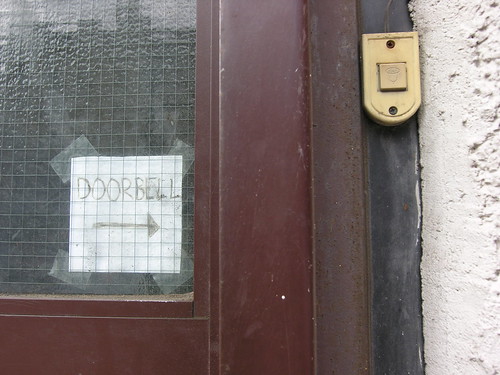
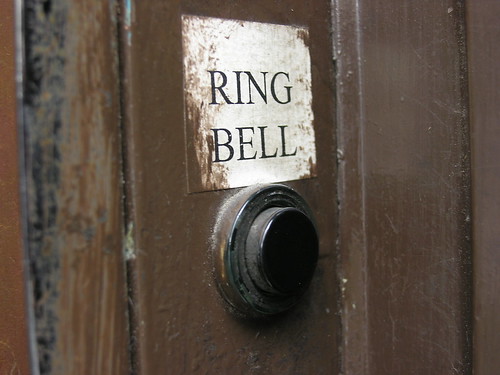
FSotW: Doorbell Instructions

Flickr set of the week is Doorbell Instructions by, of all people, Dave Gorman.

“When the presence of a doorbell isn’t enough and instructions are deemed necessary.”