Categories
Other

Barbecue weather and frozen breakfast

It’s a measure of how thoroughly miserable the weather has been that I just used the barbecue for the first time this year. But today it feels like summer.
blue sky

I just did some lamb, tomato salad and potato salad. The lamb was marinated in olive oil, garlic, lemon and oregano for that Greek flavour. I came up with what seemed like quite a cunning trick for the salads, though: I boiled some Anya potatoes, drained the pan and left them sitting for a while in a French dressing (olive oil, wine vinegar, Dijon mustard, honey, salt and pepper). Then I poured that vinaigrette off the potatoes to use in the tomato salad, and chopped the potatoes and mixed them with mayonnaise and a bit of parsley. That way the potatoes absorbed some of the flavour of the dressing, and the dressing got some extra savoury flavour from the potatoes. I don’t know how much difference it made to the tomato salad; it was certainly tasty, but you can’t go far wrong with tomatoes, shallot, fresh basil and some French dressing. The potatoes were really good though.

Then I made some Frozen Breakfast ice cream, which would be a bit more radical if my typical breakfast was eggs, bacon, chips and beans. Or even toast and marmalade. But my current breakfast of choice is yoghurt, oats and honey; I put that in an ice cream maker and it was yummy. The freezing seems to bring out the sourness of the yoghurt, which I quite like. I toasted the oats a bit first in a dry frying pan to add a bit more flavour (which I don’t do at breakfast time), but I don’t think it was strictly necessary.

I suppose you could call it frozen yoghurt instead of ice cream, but that seems desperately 1980s to me. And it sounds a bit joyless and health-foody, which wasn’t the point at all. I certainly didn’t use low-fat yoghurt, which I think is the devil’s work.

Mmm. Toast and marmalade ice-cream. Now that’s an intriguing idea. Made with lightly toasted brioche, maybe.

Categories
Daily Links

Links

Categories
Nature

Some local insects

Earlier in the season, most of the damselflies were blue ones; now they’re all blue-tailed:

This bit of south London is, slightly unexpectedly, a stronghold for the increasingly rare stag beetle. At this time of year you tend to see them flying overhead in the evening; but the weather has been so miserable that I haven’t really been outside much in the evenings. I did see one crawling across the pavement a couple of days ago, though. This, however, is not that species; it’s the more common lesser stag beetle, which is not nearly as big, and even the males don’t have antlers.

This is a hoverfly. Like most hoverflies, it’s a wasp mimic; they nearly all have black and yellow stripes, but they don’t sting. This is more spectacular than most, though; the large size and brownish colour are its attempt to look like a hornet. I think it does quite a good job, although looking at it closely like this it’s obviously a species of fly. We don’t actually have any hornets around here—I’m not sure I’ve ever seen one in the UK, although they do live here—so I don’t know how effective the mimicry is.

And here’s a holly blue. You can see the abdomen curled around on the ivy; presumably it’s laying eggs. It’s lives on the holly and the ivy, which is very Christmassy of it.

Categories
Daily Links

Links

Categories
Culture

The Seventh Seal

Well, I went to see The Seventh Seal. It was unusually busy for a Tuesday afternoon showing of a 50-year-old Swedish art film; presumably the cinema was full of vultures like myself.

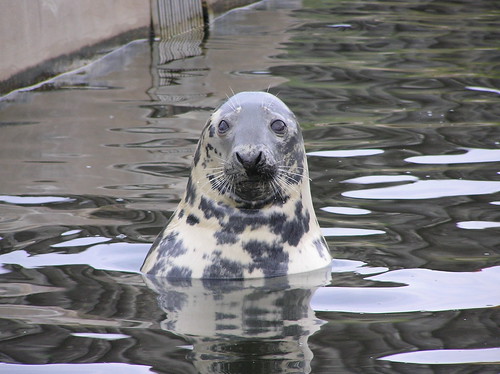
Hel – sweet seal, originally uploaded by ella19.

I was disappointed to discover there were no seals in it, although there was quite a cute squirrel.

Really though, it was, as promised, a very good film. Two fairly random thoughts: if you’re going to plunder Europe’s medieval past for material, it’s so much better to end up with The Seventh Seal than Lord of the Rings. And although it did live up to Bergman’s reputation for being a bit grim, it didn’t feel gratuitously or affectedly grim.

Categories
Culture

The Elements of Typographic Style

I’ve been reading The Elements of Typographic Style by Robert Bringhurst. When I ordered it, I noticed the mild coincidence that the author has the same name as the chap who translated the poetry of the Haida (the native inhabitants of the Queen Charlotte islands in the Pacific Northwest). As it turns out, though, it’s the same man. Which certainly explains why the books of Haida poetry are so attractively designed.

Haida mask

Alderwood mask of a woman of high rank, possibly Djiláquons. Haida, around 1830; in the British Museum.

It’s an impressive combination of talents, but there is a natural fit between poetry and typography. After spending all that time choosing and arranging words, what poet wouldn’t want them physically arranged on the page with equal care?

The parallel is marked: it’s all about the combined effect of a thousand tiny decisions. The poet and the typographer have to believe that every tiny tweak matters, that no detail is unimportant.

Now, with powerful computers at home, we all have the possibility of being our own typographers. But one thing that’s clear, reading the book, is that it’s not as simple as it sounds. There’s a lot more to it than choosing the least ugly font that came with your computer, picking a type size and a line height and letting the computer do the work. The point this was really brought home to me was where he argues convincingly that digital fonts often come from the foundries insufficiently precisely kerned, and that you will probably need to spend a couple of days with each new typeface manually adjusting the kerning so that even unusual letter pairs found in words like Ypres, Rwanda or Vázquez will be properly spaced.

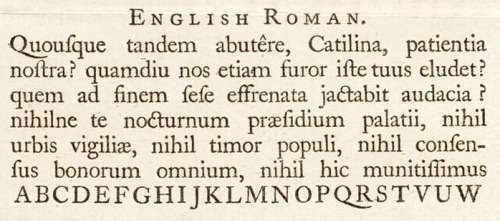
section of William Caslon’s specimen sheet

A section of a specimen sheet printed by William Caslon; from Wikipedia.

Even so, there is a lot of information and advice in the book which can be used even for the normal user of Microsoft Word; about choosing the right type size and measure, arranging the text block on the page, and creating headers which are harmonious with the body type, for example.

This is one field where the internet lets us down, of course. I can specify a typeface – from a very limited range I can rely on the reader’s computer to have – a type size, a line height and a line length, but I can’t control the way your system and browser deal with the kerning, anti-aliasing or any of the other nuances that completely transform the appearance it will have on your screen. Still, even here, some knowledge of typography can only help, and the technology is moving fast.

It’s an interesting, readable and, as one would hope, very attractive book. The Haida poetry is fascinating as well, but that would need a post to itself, methinks.