Categories
Nature

Harry’s advent calendar of birds, day 3: Secretary Bird

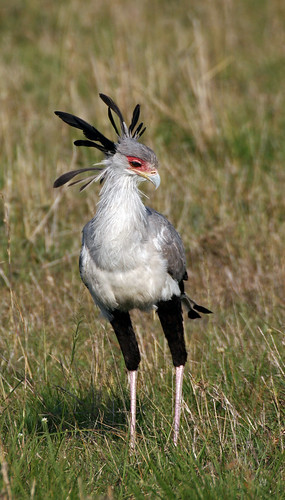
The Secretary BirdSagittarius serpentarius:

Because it’s a bird of prey which has evolved long legs like a crane; something I think is just fabulous beyond words. They stalk across the grasslands of Africa, hunting small prey like snakes and lizards.

It looks more eccentric than terrifying, and it hasn’t lost the power of flight; but as a long-legged predatory bird, it offers a faint echo of the prehistoric Phorusrhacids which once roamed South America, crunching the skulls of their prey in their huge hooked beaks.

» Secretary Bird is © Vearl Brown and used under a CC by-nc licence.

Categories
Nature

Harry’s advent calendar of birds, day 2: Japanese Bush-warbler

while I’m gone
you and the nightingale are in charge
my snail

uguisu torusu wo shite orekatatsuburi

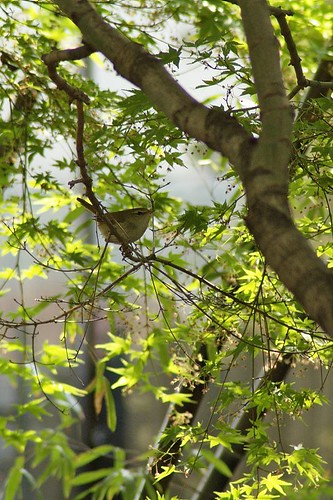
Except that the uguisu is not actually a nightingale; it’s the Japanese Bush Warbler, Cettia diphone. It has often been translated as ‘nightingale’ because it has similar poetic associations; it is famous in Japan for its song (YouTube) which announces the arrival of spring.

Similarly, the ‘nightingale floors’ found in some Japanese castles, which are designed to squeak so that intruders can be heard, are actually uguisubari — named after the bush warbler.

Bashō has a poem about the uguisu designed to undercut its poetic image:

uguisu ya mochi ni funsuru en no saki

A bush warbler
crapped on the rice cakes
on the veranda.

» The snail poem is by Kobayashi Issa, 1807; trans. David G. Lanoue and found on his enormous archive of Issa’s haiku. The photo is © a.koto and used under a CC by-nc-nd licence. I found the Bashō poem in the World Kigo Database, where there is lots more interesting stuff about the uguisu; including the traditional use of their droppings in cosmetics (!)

Categories
Nature

Harry’s advent calendar of birds, day 1: Red-breasted Goose

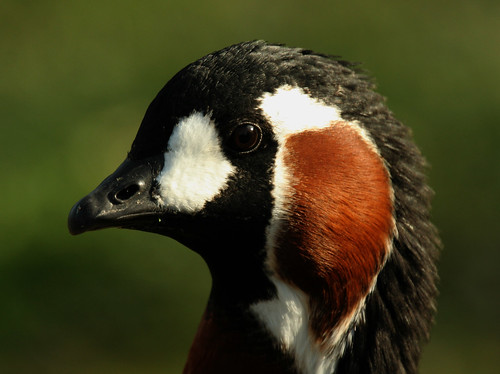
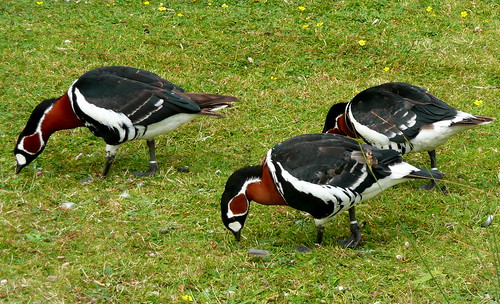
The first bird for the calendar is… Red-breasted Goose, Branta ruficollis. Because I saw some in St. James’s Park today and they are just gorgeous little birds.

I’ve never seen them in the wild, sadly. How’s this for an obscure neurosis: whenever I’m somewhere with an ornamental wildfowl collection, there’s a niggling worry at the back of my mind that I might actually be seeing a genuine rarity, wandered all the way from, in this case, Siberia — and I’m justassuming it’s part of the collection. It’s enough to keep you up at night.

The wildfowl of St. James’s Park was in the news recently when one of the pelicans showed a fine disregard for its comic persona by eating a  whole live pigeon. Which happens fairly regularly, but amusingly, every time it makes the news they find an ‘expert’ to say how remarkable and unheard of it is.

» Red Breasted Goose is © Wayne Dumbleton and Siberian Red-breasted Geese is © Purple Kitten; both pictures are used under the CC by-nc-sa licence.

Categories
Culture

Chaka by Thomas Mofolo

Chaka is a fictionalised account of the life of the C19th Zulu king Shaka. It’s unusually early for an African novel, originally published in 1925 but existing in manuscript in some form as early as 1910.

I wasn’t entirely looking forward to reading it. It has started to really bother me when those who rose to power and built empires through force are presented as Great Men, as admirable or heroic. Qin Shi Huang, Alexander the Great, Napoleon: these men were ruthless megalomaniacs who glorified themselves through the misery of others. But we are fascinated by power, and there’s never a shortage of people who are willing to read history through rose-tinted bifocals. Hell, the Russians are even doing their best to rehabilitate Stalin.

I assumed that Chaka would do the same; but part of the reason I enjoyed it so much is that, on the contrary, its portrayal of Shaka is absolutely excoriating. He is presented as a handsome man of great courage and physical and military prowess; but also as capricious, cruel, violent and terrifyingly, unswervingly power-hungry. In fact the scale of his violence, against his own people as well as his enemies, would seem ridiculously exaggerated, if you’d never heard of Stalin, or Mao, or Idi Amin.

Which isn’t to say that the novel is historically accurate. It doesn’t even pretend to be; it’s told very much in a mythic, folkloric style rather than a historically realist one, and it takes substantial liberties with the history for the sake of telling a good story, to the point of inventing major characters — including Chaka’s love interest and a sorcerer who provides him with his power. His life story is tweaked and manipulated to bring out the themes of ambition and power, and present him with decisions which are loaded with symbolic resonance. I would normally shy away from comparing a writer to Shakespeare — just too much baggage — but as a piece of myth-making based freely on a historical source, it really reminds me of Macbeth or King Lear.

I wasn’t immediately gripped by it, but as the action ramped up and Chaka developed into a more and more extreme character, I thought it was electrifying.

Chaka is my book from Lesotho for the Read The World challenge; a quick hat-tip to the translator, Daniel P. Kunene.
» The Chaka Print cloth ticket is from Trevira’s collection of cloth tickets on Flickr. She explains:

These large gummed labels – known as cloth tickets – were attached to bales of printed cotton cloth for export from Britain (read ‘Manchester’ in many cases). They were designed by British artists who depended on information from company agents in the various territories for subjects that were intended to be appealing for their markets.

It is used under a CC by-nc licence.

Categories
Daily Links

Links

  • "These large gummed labels – known as cloth tickets, shippers tickets, or bolt tickets – were attached to bales of printed cotton cloth for export from Britain (read 'Manchester' in many cases). They were designed by British artists who depended on information from company agents in the various territories for subjects that were intended to be appealing for their markets.

    Most of these probably date from around the 1920s to the 1950s (but I could be wrong) and were intended for the African market. "

    (del.icio.us tags: design labels Africa )
Categories
Daily Links

Links

  • Interesting stuff — no doubt the Americans would say one-sided, but nonetheless. The more I read about the US military in Iraq the more I get the sense that it had become dysfunctional; a kind of inward-looking, bureaucratic self-serving entity semi-detached from the US government/politics. No doubt there are plenty of thoughtful officers who have learned some hard lessons over the past few years in Iraq and Afghanistan, though. For all I know they're applying them already.
    (del.icio.us tags: US Iraq military )