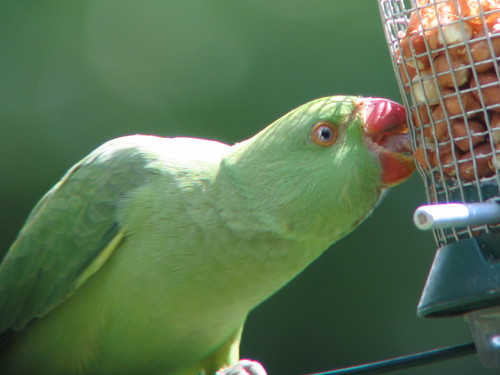
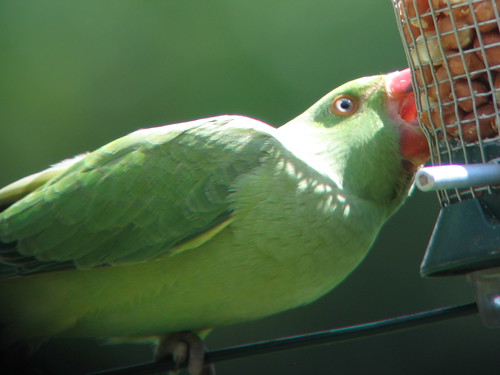
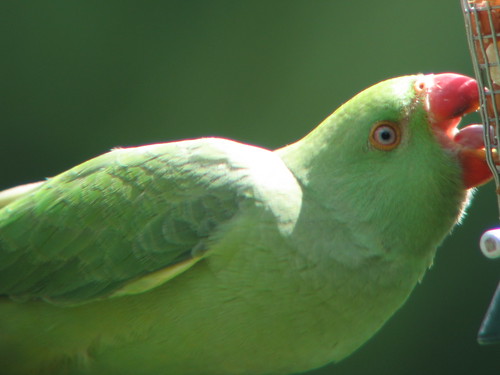
The parakeets only reached this part of London about three years ago, but now we have flocks of them every day; there are often seven or eight on the feeders and more in the surrounding trees. They’re attractive and full of character, but as ever with foreign species you worry about their impact on the native birds; they must be competing for nest-sites if nothing else.
Tag: birds
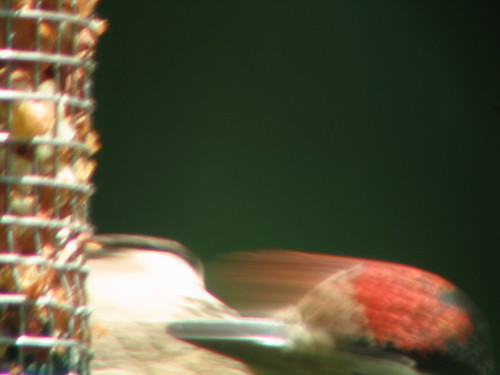
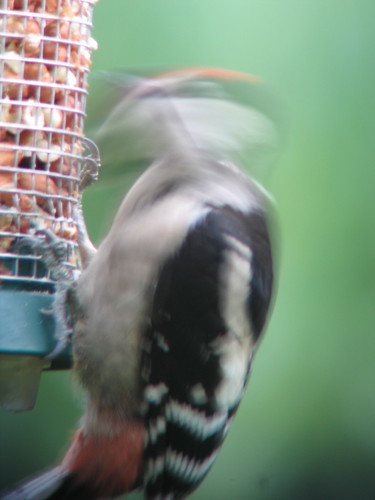
I was having a go at photographing the juvenile Great Spotted Woodpecker that comes to the birdfeeder, but it’s kind of tricky. My success rate when digiscoping is never that high at the best of times; and as you can see, it’s not temperamentally inclined to stay still:
Still, the motion blur can be a fun effect:
And it makes it all the more gratifying when one of the pictures comes out just right.
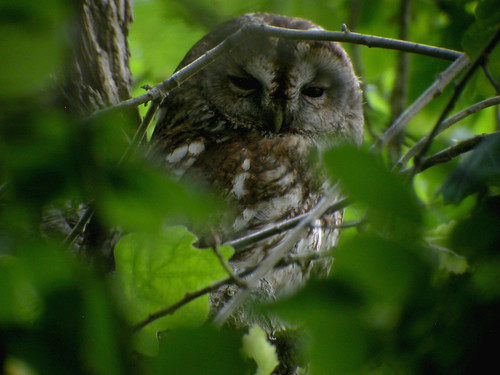
I heard an owl last night, for the first time in years. I think there are quite a few tawny owls in London—they’re a basically woodland species and fairly well suited to a suburban mix of woodland, park and gardens. A few years ago I used to hear them quite regularly here, but as I say this is the first for a long time. I guess it’s probably a young bird dispersing from its parents’ territory.
Tawny Owl, Sparham Pools (Norfolk), 24-May-07, originally uploaded by Dave Appleton.
There’s something incredibly atmospheric about hearing animal calls at night. It’s hard not to hear the quavering calls as somehow mournful, although presumably the owls aren’t actually permanently depressed. It makes a change from foxes; we’ve got a lot of young foxes around at the moment (one wandered into the house the other day) and they make a complete racket.
From Love’s Labour’s Lost:
WHEN icicles hang by the wall
And Dick the shepherd blows his nail,
And Tom bears logs into the hall,
And milk comes frozen home in pail;
When blood is nipt, and ways be foul,
Then nightly sings the staring owl
Tu-whoo!
Tu-whit! tu-whoo! A merry note!
While greasy Joan doth keel the pot.When all around the wind doth blow,
And coughing drowns the parson’s saw,
And birds sit brooding in the snow,
And Marian’s nose looks red and raw;
When roasted crabs hiss in the bowl—
Then nightly sings the staring owl
Tu-whoo!
Tu-whit! tu-whoo! A merry note!
While greasy Joan doth keel the pot.
Most of Shakespeare’s owls are referred to as screeching or shrieking; indeed he sometimes calls them ‘screech-owl’. Those are probably barn owls. But ‘tu-whit tu-whoo’ is the call of the tawny owl. In fact it’s the call of a pair of tawny owls; the female does the ‘tu-whit’ followed immediately by the male saying ‘tu-whoo’. That wasn’t what I heard last night, though; mine was saying ‘hoo… hu-hu-hu-hoo’. So it was just a male owl on its own.
And on an unexpectedly sinister note; according to Wikipedia “This species probably injures more people than any other European bird. It is fearless in defence of its nest and young, and strikes for the intruder’s face with its sharp talons. Since its flight is silent, at night in particular it may not be detected until too late.”
It just occurred to me a couple of days ago that since my digital camera has a video mode, I could try digiscoping some video. I thought it came out fairly well, considering. I just hold the camera up to the telescope, so it’s a bit wobbly, and the audio is dominated by aeroplane noise, and the YouTube conversion hasn’t improved it, but I’ll certainly consider doing it again next time I’m doing proper birding. This is a greenfinch, btw.
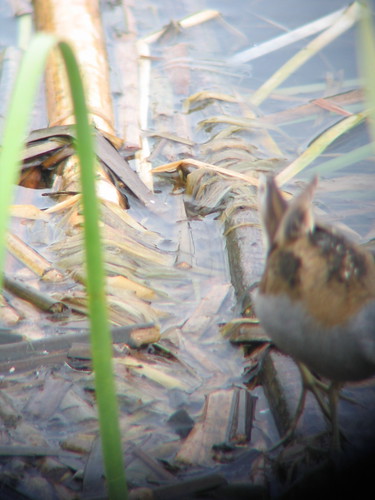
I wish I’d thought of it when I was in Crete, when there was a Little Crake walking backwards and forwards past the same spot over and over again but because of the difficulty of timing the shot, I mainly got lots of pictures like this:

And while I’m on garden wildlife, look what was in the basement light well. His price for being rescued was having his photograph taken with flash. There are lots of frogs and newts, but it’s a very long time since I’ve seen a toad here.
The last of the three locations in Crete that I bio-blitzed was the Lasithi plateau, where I was from the 27th-28th of April. The plateau is just the prettiest place in the world, as well as providing some good birding for me. Apparently, it’s formed by the build-up of silt from the surrounding rivers creating a little flat fertile area high in the mountains. It’s like someone has taken a little slice of Holland nine kilometres by five and placed it 840m up in the middle of Crete. It even has windmills—little ones for pumping water, since although it floods in winter, in summer it gets dry enough to need irrigation.
Spring was a bit less advanced here; whereas on the south coast the flowers were looking a bit sun-blasted, here they were absolutely amazing. Real alpine meadow stuff anywhere there was enough room for it; higher up the mountain, where it got really rocky, lots of tiny little flowers growing amid the rocks. I was particularly pleased to find about 7 species of orchid.
Which makes it slightly embarrassing to admit that I didn’t actually blitz the flowers; I did have a couple of flower books with me with that in mind, but I found I was only able to ID such a small proportion of them to the species level that my list would have been seriously unrepresentative. So I’ve just got a bird list. The bird I was most pleased with was Wryneck, but there were lots of good things. The list appears below, but first, a selection of photos. The first three (the wheatear, lark and warbler) weren’t actually taken on the plateau, but they were at least taken while I was in Crete.
You can either navigate using the strip at the bottom or just click on the photo to see the next one in the set.
Common Kestrel
Peregrine Falcon
Eurasian Griffon Vulture
Common Buzzard
Common Quail
Yellow-legged Gull
Eurasian Collared Dove
Woodpigeon
Common Cuckoo
Eurasian Wryneck
Crested Lark
Woodlark
Barn Swallow
Tree Pipit
Yellow Wagtail
Common Blackbird
Sardinian Warbler
Great Reed Warbler
Spotted Flycatcher
Blue Rock-Thrush
European Stonechat
Whinchat
Northern Wheatear
Black-eared Wheatear
Great Tit
Blue Tit
Woodchat Shrike
Common Raven
Hooded Crow
Eurasian Jay
House Sparrow
Linnet
European Goldfinch
European Greenfinch
Chaffinch
European Serin
Corn Bunting
Cirl Bunting
That barn owl bio blitz button is derived from a photo on Flickr by Nick Lawes used under a by-nc-sa licence; the button is available under the same licence. Not that there’s anything wrong with the Jennifer’s BBB buttons, but I wanted something to match my colour scheme.
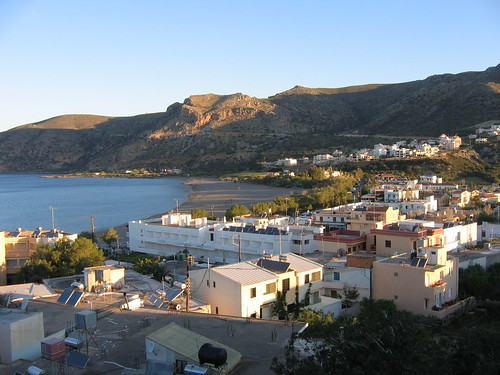
Paleohora is a little town on the south coast of the western end of Crete. It’s an expanding resort town with plenty of tavernas and cafes, but still small and quiet compared to the established resorts. Especially quiet in April, which is really before the tourist season starts in earnest. The town sits on a little headland with the ruins of (Venetian?) castle on the end. Immediately behind the town is the start of the mountains, all rocky scrubby stuff, and to one side there’s a little river valley with olive groves and trees and things, which goes down to form a little reed-lined pool. So there’s a range of habitats present and it’s well-placed to pick up migrant birds. This is a shot of the town looking back from the castle site; I haven’t got a picture of the castle because it’s just a few wall-bases and really not picturesque at all.
My best birds here were Common Quail—a species that is relatively common across Europe but very difficult to see—and, especially, European Roller, a great big blue thing I’ve wanted to see for years and is even a rarity for Crete. Oh, and a whole flock of eight Golden Orioles, spectacular yellow birds that are normally shy and reclusive, but which I had a good view of as the flew one by one across the olive groves. But I don’t have any bird pictures from here; I didn’t feel like carrying my telescope around. So here’s my bird list for April 22nd-25th with interspersed photos of the area just for local colour.
Squacco Heron
Purple Heron
Little Egret
Common Buzzard
Peregrine Falcon
Common Kestrel
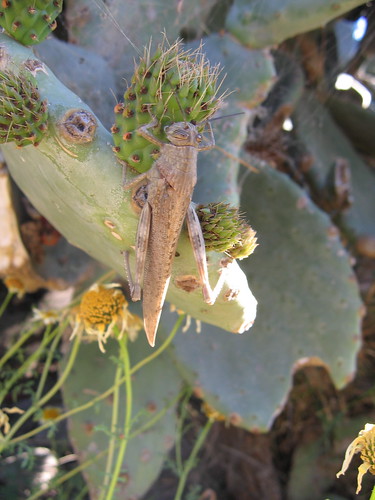
A big grasshopper/locust thing perched on a prickly pear. Prickly pear is an introduced species; from Mexico, I think? that’s fairly common in various places around the Med.
Common Quail
Common Sandpiper
Yellow-legged Gull
Collared Dove
Turtle Dove
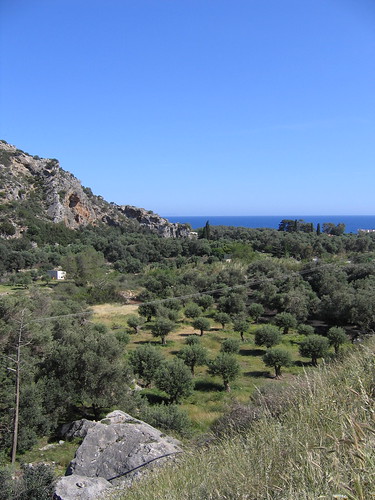
This is part of the river valley from up on the hill. You can see olive groves, obviously; the common tree tended to be some species of plane.
European Scops Owl (heard)
Common Swift
European Roller
European Bee-eater
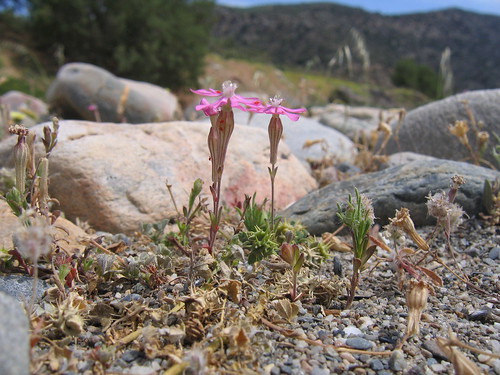
I’m pretty sure that’s some species of Silene, but I don’t know which one.
Crested Lark
Barn Swallow
Red-rumped Swallow
House Martin
Sand Martin
Tree Pipit
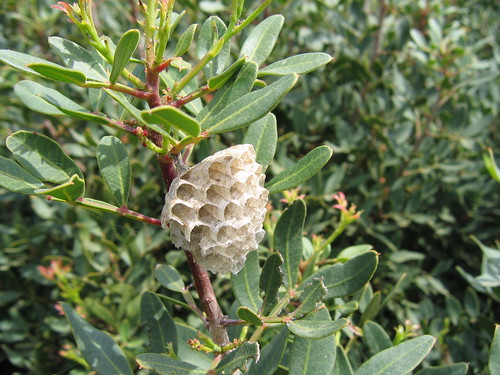
An empty wasp nest on what I think might be myrtle. Taken down on the beach.
Common Blackbird
Sardinian Warbler
Common Whitethroat
Blackcap
Garden Warbler
Wood Warbler
Cetti’s Warbler
Great Reed Warbler
Sedge Warbler
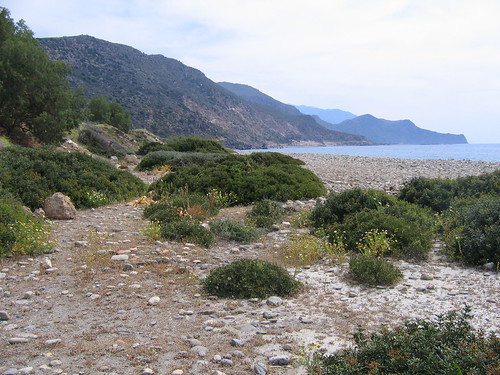
A shot of the shingle beach. There’s a sandy beach on the other side of the headland, but it seemed less productive for birdwatching so I didn’t go there much.
Spotted Flycatcher
Whinchat
Common Redstart
Common Nightingale
Blue Rock-Thrush
Great Tit
Blue Tit
Woodchat Shrike
Hooded Crow
Golden Oriole
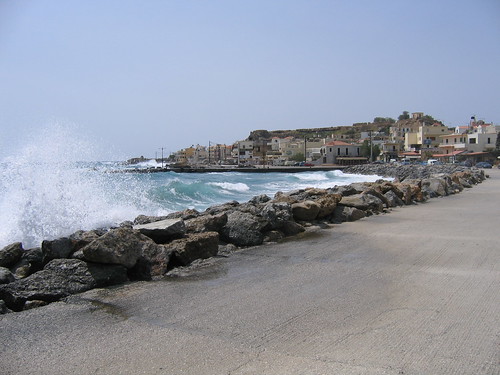
Waves breaking on the rocks.
House Sparrow
Spanish Sparrow
European Goldfinch
European Greenfinch
Chaffinch
European Serin
That barn owl bio blitz button is derived from a photo on Flickr by Nick Lawes used under a by-nc-sa licence; the button is therefore available under the same licence. Not that there’s anything wrong with the Jennifer’s BBB buttons, but I wanted something to match my colour scheme.