Categories
Nature Other

Birding the dictionary 3

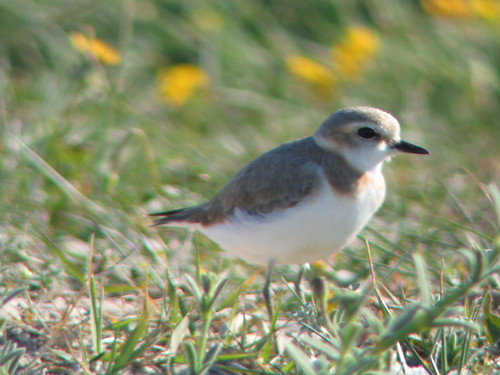
Today we start with the word ‘plover’.

plover (‘plʌvə(r)). [ME. and AF. plover = OF. plovier, later L. *plovārius belonging to rain, f. L. pluvia rain; in mod.L. pluvārius pluviārius; cf. Sp. pluvial plover, ad. L. pluviālis rainy, also Ger. regenpfeifer, lit. rain-piper, and Eng. rain-bird.]

Belon, 1555, said the birds were so called because most easily taken in rainy weather, which modern observation contradicts.

I’ve never tried to take a plover myself, so I couldn’t judge. I’d like to believe that the OED have a crack avian behavioral research squad who were sent up into the Peak District in rainy weather with strict orders not to come back until they checked this. But probably not. It carries on with more suggestions:

…because they arrive in flocks in the rainy season… because of the restlessness of the bird when rain is approaching… Others have attributed it to the appearance of the upper plumage, as if spotted with rain-drops.

The most appealing of these, the last one, strikes me as the least likely. But judge for yourself:
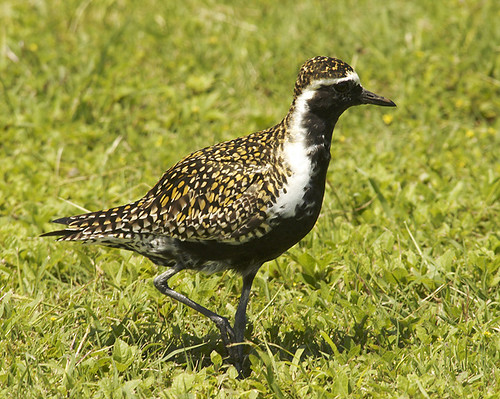
Pacific golden plover, originally uploaded by Doug Greenberg.

As the caption says, that’s actually a Pacific Golden Plover, whereas the original plover was presumably either the European Golden Plover or the Grey Plover (what Americans call Black-bellied Plover). But the appearance is very similar.

Plovers aren’t the only birds to be associated with rain, of course. In Britain, the obvious one is the Green Woodpecker, Picus viridis, known as the rain-bird because its call is supposed to mark the approach of rain. I can’t say I’ve ever noticed this to be true myself. The call is one of the classic sounds of the English countryside; you can hear it here. It’s often described as laughter, although if you heard a person laughing like that you’d be a bit worried. Their other common name—yaffle—is derived from the call. This is typical yaffle behaviour; hunting for ants in someone’s garden lawn:
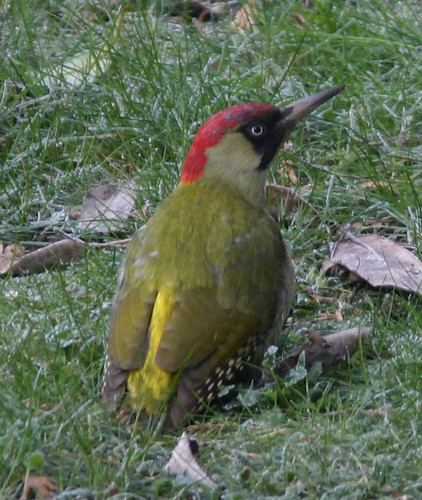
Yaffle II, originally uploaded by vlad259.

The dictionary has two other entries for ‘rain-bird’. The first is a bit vague: ‘A Jamaican cuckoo’. A little detective work narrows it down to the Jamaican Lizard-Cuckoo, Saurothera vetula. I don’t know what the connection is with lizards, but I can tell you that it’s also known as Old Woman Bird because of its cackling laugh.

Jamaican Lizard-Cuckoo, originally uploaded by Langooney.

Finally, the OED also mentions a couple of Australian usages. This is one of them, the Grey Butcherbird, Cracticus torquatus:
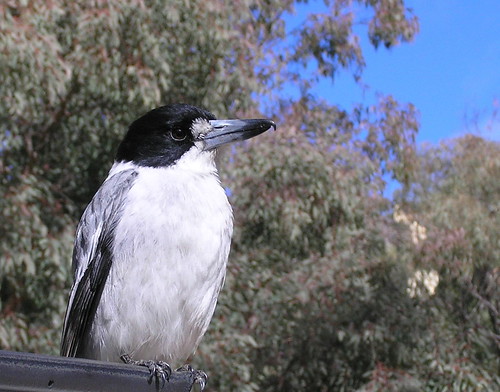
Grey butcherbird, originally uploaded by pierre pouliquin.

The other is the Channel-billed Cuckoo. In fact, though, Google turns up another Rainbird in Australia, the Asian Koel, also known as Stormbird; ‘Stormbird’ in turn can also refer to the Pheasant Coucal. For some information about the Stormbird’s place as an aboriginal storytime character, go here.

I know it might seem like I’m being too thorough here, but bear with me. Under the entry for rain, we also learn about the ‘rain crow’. Which isn’t actually a crow:
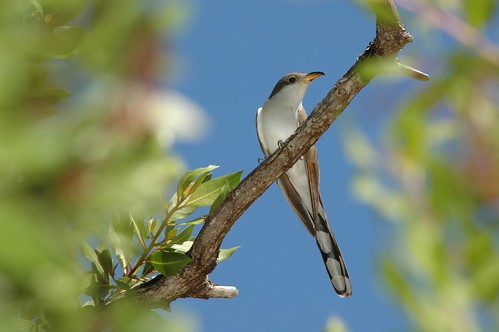
Dry Tortugas April 2006 Yellow Billed Cuckoo, originally uploaded by Jay Bass.

To quote Meriwether Lewis’s journal entry for 16th July 1806 from the Lewis and Clark expedition (which is one of the dictionary citations)

I saw both yesterday and today the Cookkoo or as it is sometimes called the rain-craw.

And yes, it does appear to be ‘craw’ unless there’s a typo in the dictionary, though all the other citations are for ‘rain-crow’. I guess you don’t employ explorers for their spelling.

As I said earlier, I am sceptical about the claim that the woodpecker’s call is an accurate predictor of rain. Some people have a disproportionate respect for traditional wisdom; in my experience it’s rather hit and miss, and weather lore is exactly the kind of area that’s likely to attract a lot of dubious theories. However, it’s very striking that of the seven birds I’ve mentioned, no less than five are cuckoos or their relatives: koels and coucals are both members of the Cuculidae. And in separate parts of the world people have, presumably independently, decided that they call more before the rain. It seems like more than a coincidence. If anyone reading this lives in one of the places where these birds live, I’d be interested to hear what you think.

Returning to plovers; the dictionary lists no less than 60 from ‘bastard plover’ to ‘yellow-legged plover’. A few of them—Crab Plover, Ringed Plover—are still standard species names, but most are old or local names for waders we now know as something else. It really makes you appreciate standardised naming. There are ten names for ‘Golden Plover’, and eleven for ‘Grey Plover’; a few can mean either. Least helpful of all is ‘stone plover’ which can apparently mean Stone Curlew, Grey Plover, Ringed Plover, Dotterel, ‘any shore plover of the genus Aesacus‘, Bar-tailed Godwit, or Whimbrel.

One last thing before I finally put an end to what was originally intended to be a short post. One of the dictionary’s citations for plover is this:

1486 Bk. St. Albans F vj b, A Falle of Woodecockis. A Congregacion of Pleuers.

The Book of St. Albans, by Dame Juliana Berners, is a book about hawking, hunting, and ‘fysshynge wyth an angle’, and is presumably one of the sources for all those irritating lists of collective nouns: a murder of crows, a heckle of alligators, a flashback of policemen. I don’t care if it does go back to the fifteenth century, I just don’t believe that anyone has ever actually called a flock of plovers anything other than a flock. All it proves is that whimsical linguistic pedantry is a 500 year old English tradition.
Categories
Culture Nature

More crakery from the canon

I didn’t want my post on rails and crakes to suffer from poetry bloat, so I didn’t quote it before, but John Clare isn’t the only Dead Famous English Poet who mentioned corncrakes in a poem.

This is the mowing scene from Upon Appleton House, to My Lord Fairfax by Andrew Marvell. I went through modernising the spelling and capitalisation, because frankly I can’t see any advantage to keeping it old-school, so if I’ve missed anything, my apologies:

And now to the abyss I pass
Of that unfathomable grass,
Where men like grasshoppers appear,
But grasshoppers are giants there:
They, in their squeaking laugh, contemn
Us as we walk more low then them:
And, from the precipices tall
Of the green spires, to us do call.

To see men through this meadow dive,
We wonder how they rise alive.
As, under water, none does know
Whether he fall through it or go.
But, as the mariners that sound,
And show upon their lead the ground,
They bring up flowers so to be seen,
And prove they’ve at the bottom been.

No scene that turns with engines strange
Does oftener then these meadows change,
For when the sun the grass hath vexed,
The tawny mowers enter next;
Who seem like Israelites to be,
Walking on foot through a green sea.
To them the grassy deeps divide,
And crowd a lane to either side.

With whistling scythe, and elbow strong,
These massacre the grass along:
While one, unknowing, carves the rail,
Whose yet unfeathered quills her fail.
The edge all bloody from its breast
He draws, and does his stroke detest;
Fearing the flesh untimely mowed
To him a fate as black forebode.

But bloody Thestylis, that waits
To bring the mowing camp their cates,
Greedy as kites has trussed it up,
And forthwith means on it to sup:
When on another quick she lights,
And cries, “he called us Israelites;
But now, to make his saying true,
Rails rain for quails, for manna dew.”

Unhappy birds! what does it boot
To build below the grasses’ root;
When lowness is unsafe as height,
And chance overtakes what scapeth spite?
And now your orphan parents call
Sounds your untimely funeral.
Death-trumpets creak in such a note,
And ’tis the sourdine in their throat.

I think it calls for a couple of  vocabulary notes. The ‘scene that turns with engines strange‘ is a reference to stage machinery in the theatre; ‘Thestylis’ is a poeticism for a female mower; ‘cates’ are delicacies, and ‘sourdine’ is some kind of musical instrument. The dictionary can’t decide whether it’s a miniature violin or a woodwind of some kind, but presumably it’s a reference to the distinctive sound made by the corncrake.

I think this passage is a fair illustration of what a magnificently odd poem Upon Appleton House  really is. Especially since the genre—a poem about a country estate designed to flatter its powerful owner and his family—seems so doomed to the formulaic. Perhaps he felt that the more remarkable the poem, the more effective the flattery. Or perhaps he was just enjoying himself. Or showing off.

Not all of this conspicuous ingenuity is equally successful, but sometimes it’s remarkable; the image of men bringing up flowers to prove they’ve sounded the depths of the grass is a brilliant way of making a relatively obvious comparison vivid and memorable. And the bit where Thestylis breaks out of character by commenting on something he’s just said is so unexpected. I can’t decide whether I think it’s effective as a literary device, but it’s certainly surprising in a C17th poem.

It’s good to be reminded occasionally that ingenious, peculiar, unconventional, clever-clever poetry isn’t just the preserve of Modernism.

Categories
Nature Other

I and the Bird #44

I and the Bird‘s latest edition is now up at The Greenbelt with links to all sorts of birdy goodness.

I particularly enjoyed the post about American Woodcocks at woodcreeper.com. Which reminds me: I think I read once that their display flight is the slowest powered flight recorded in any bird species which isn’t actually hovering.

Categories
Nature Other

Birding the dictionary 2

I’ve been investigating more avian etymologies, looking for things of interest. There isn’t much to say about most bird names, because they’re self-explanatory (oystercatcher, wagtail) obviously onomatopoeic (chiff-chaff), or just dead-ends. For example, checking up on ‘merlin’, the dictionary says:

merlin (mɜ:lın). ME. [– AFr. merilun, aphet. f. OFr. esmerillon (mod. émerillon), augment. of esmeril :– Frankish *smeril = OHG. smerlo, smiril (G. schmerl).] A small European falcon, Falco æsalon.

Which is admirably thorough (and useful if you’re ever travelling in Old High Germany and need to talk about falconry) but doesn’t actually get us any closer to an ‘original’ meaning.

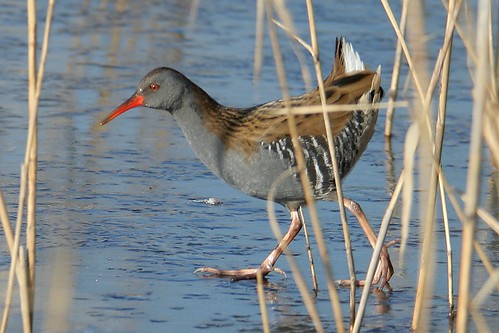
Water Rail, originally uploaded by markkilner.

Another word whose origins the OED refuses to offer an opinion on, beyond mentioning that it’s from the Norman-Picard (no relative of Jean-Luc), is ‘rail’. Fortunately for us, the American Heritage Dictionary is recklessly willing to take a guess:

rail n. Any of various marsh birds of the family Rallidae, characteristically having brownish plumage and short wings adapted only for short flights. [Middle English raile, from Old French raale, perhaps from Old French raler, racler, to scrape, from Old Provençal rasclar; see raclette.]

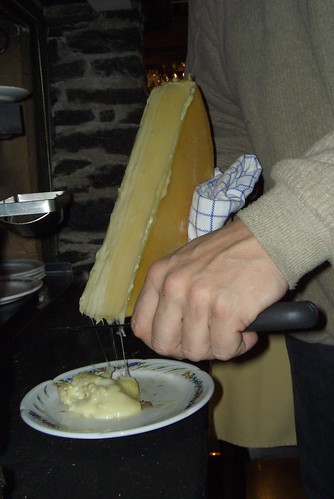
Raclette, originally uploaded by Alfesto.

Dictionary.com describes raclette as ‘a [Swiss] dish made by heating a piece of cheese, as over a hearth, and scraping off the melted part onto a plate: served with boiled potatoes[…] the cheese used in making this dish’, which is why the name is derived from ‘to scrape’. But what about ‘rail’? Well, I think it must be onomatopoeic. The only bird referred to as a rail by British birders today is the water rail, as pictured above (but also see the fabulous picture here). Water rails make all sorts of noise, including, according to the Collins Bird Guide, ‘a discontented piglet-like squeal, soon dying away’, as well as ‘a weary, ‘all in’, choking moan’, but none of them sound much like scraping. However, as well as the water rail, there is a bird which used to be known as a ‘land rail’, and now usually called a corncrake.

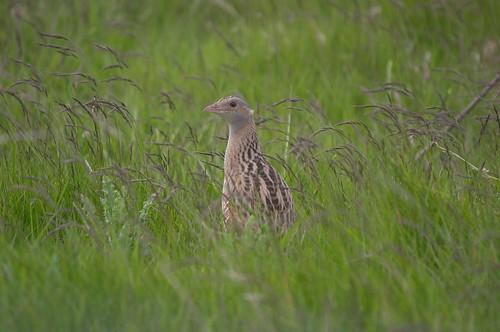
Corncrake at Balranald, originally uploaded by citrineblue.

To see a corncrake in the UK now, your best chance is to go somewhere like North Uist, where that photo was taken, but they used to be common. A poem by John Clare; it’s on the long side but I think it’s worth quoting in full. Of all the poets who have been called ‘nature-poets’, John Clare is by far the most observant and the one who comes closest to being a naturalist-poet.

The Landrail

How sweet and pleasant grows the way
Through summer time again,
While Landrails call from day to day
Amid the grass and grain.

We hear it in the weeding time
When knee deep waves the corn,
We hear it in the summer’s prime
Through meadows night and morn;

And now I hear it in the grass
That grows as sweet again,
And let a minute’s notice pass
And now ’tis in the grain.

‘Tis like a fancy everywhere
A sort of living doubt,
We know ’tis something but it ne’er
Will blab the secret out.

If heard in close or meadow plots
It flies if we pursue,
But follows if we notice not
The close and meadow through.

Boys know the note of many a bird
In their bird-nesting rounds,
But when the landrail’s noise is heard
They wonder at the sounds;

They look in every tuft of grass
That’s in their rambles met,
They peep in every bush they pass
And none the wiser yet,

And still they hear the craiking sound
And still they wonder why—
It surely can’t be under ground
Nor is it in the sky,

And yet ’tis heard in every vale,
An undiscovered song,
And makes a pleasant wonder tale
For all the summer long.

The shepherd whistles through his hands
And starts with many a whoop
His busy dog across the lands
In hopes to fright it up.

‘Tis still a minute’s length or more
Till dogs are off and gone,
Then sings and louder than before
But keeps the secret on.

Yet accident will often meet
The nest within its way,
And weeders when they weed the wheat
Discover where they lay,

And mowers on the meadow lea
Chance on their noisy guest
And wonder what the bird can be
That lays without a nest.

In simple holes that birds will rake
When dusting in the ground;
They drop their eggs of curious make,
Deep-blotched and nearly round—

A mystery still to men and boys
Who know not where they lay
And guess it but a summer noise
Among the meadow-hay.

As Clare makes clear, the corncrake is famously difficult to see, and usually found via its ‘craiking’ call. Pleasingly the corncrake’s Latin name is pretty much a transcription of the call: Crex crex. You can listen to the call of the corncrake here. I’ve heard you can attract a corncrake by scraping the spoon from a miniature tub of icecream along the zip of your waterproof jacket (and if you’re birding in the Outer Hebrides, you will have a waterproof jacket with you), or by rubbing a comb across the edge of a matchbox. But I’ve never had a chance to try either trick.

So what about the word ‘corncrake’? That’s obvious—it’s clearly derived from the call, right? Well, not directly. ‘Crake’ is derived from the Old Norse krâka, which means crow, and that’s the first meaning the OED gives:

1. A crow or raven. north. dial.
2. A name of birds of the family Rallidæ, esp. the corn-crake (also bean-crake) or landrail
3. The cry of the corn-crake

We’re told that

In sense 2, perh. orig. the same word (corn crake = corn crow), but now viewed as directly derived from the grating cry of the bird, as in sense 3

The Old Norse krâka is itself onomatopoeic (‘croak’ is derived from the same word), and if ‘corn crake’ did originally mean ‘corn crow’, it was in reference to the call, but still, I find the idea of a ‘corn crow’ surprising and appealing. The word ‘crow’ is, not surprisingly, also originally onomatopoeic but from the Old High German crâwan.

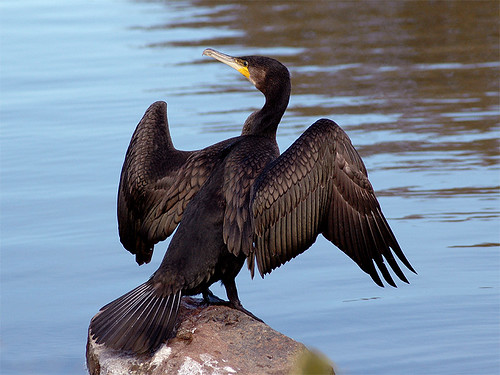
Cormorant, originally uploaded by Rune T.

One last bit of related etymology. Cormorant is from the French cormoran with a ‘parasitic t’; i.e. the ‘t’ has no particular linguistic logic, it just got glommed onto the word by analogy with words like ‘elegant’ and ‘reluctant’. The same is apparently true of ‘peasant’ and ‘pheasant’ (paysan and faisan in French). Cormaran in turn is deduced to have been something like corp marin in Old French, and is derived from the Latin corvus marinus: ‘sea raven’.

So there you are; corn-crows and sea-ravens.

[ Unless noted otherwise, dictionary extracts are from either the Shorter Oxford Dictionary or the slightly insane ‘compact’ OED (the whole 2nd edition printed in such tiny writing that it fits in one huge volume). The poem is from “I Am”: The Selected Poetry of John Clare, edited by Jonathan Bate. As ever with Clare, the punctuation is editorial, that version of the poem is presumably © Jonathan Bate. The photographs are all from Flickr and © the respective photographers. ]

Categories
Culture Nature

Digiscoping and Lomography

I was looking back at some of my old digiscoped pictures yesterday.

‘Digiscoping’ is the trick of using your birding telescope as very high-powered telephoto lens. At the simplest level, you just hold the camera up to the eyepiece and shoot through the scope; to get the best results you need more sophisticated equipment. You could do this with a film camera, of course, but it makes it a lot easier to have a screen so you can see what you’re doing, and to know that you can just delete the ones that don’t come out.

Anyway, I was vaguely wondering what they reminded me of, other than themselves.

I realised that it was ‘toy camera’ pictures. You may not have encountered this trend, but there’s a [recent?] fashion for taking pictures with very basic old mass-market compact cameras, like the Soviet Lomo, or the Chinese Holga. The poor construction of these cameras, including plastic lenses and light leaks, produce distinctive pictures with lurid colours, dodgy focus, vignetting and other technical flaws. Which sounds crap, but actually the pictures have a rough-edged immediacy which can be very attractive.

My telescope doesn’t have plastic lenses, of course. But it wasn’t designed for taking pictures, either. And my adaptor consists of the bottom of a film canister glued into the lid of a pill bottle, with a hole cut through them. It serves to keep the camera roughly in the centre of the eyepiece, but it doesn’t keep it properly lined up along the axis of the telescope or keep it steady.

When I took them, I was doing my damnedest to take the best possible pictures despite the technical limitations of my equipment. The results aren’t going to win any wildlife photography prizes, but some of them do have something of that same weird vividness that I find attractive in toy camera pictures.

This kind of lo-fi aesthetic probably doesn’t appeal to everyone. But I might as well enjoy it in my own pictures. Not that I feel defensive about them; I enjoyed the challenge of taking them and never expected them to be anything other than holiday snaps. I’d never really tried bird photography before — they don’t make an easy subject and it’s difficult enough trying to see them normally — but if birding is the main point of a trip, it’s a treat to have a record of birds instead of just places.

I liked these pictures anyway. Does a spiffy aesthetic context make me like them any more? Should it?

Perhaps it doesn’t matter. I just wanted to note the comparison.

» All pictures are from Flickr and are links so you can click through to the relevant pages. The birdy ones are by me; the child was taken with a Holga by john.makarewicz and the Peruvian valley was taken with a LOMO by phoosh.

Categories
Nature Other

Birding the dictionary

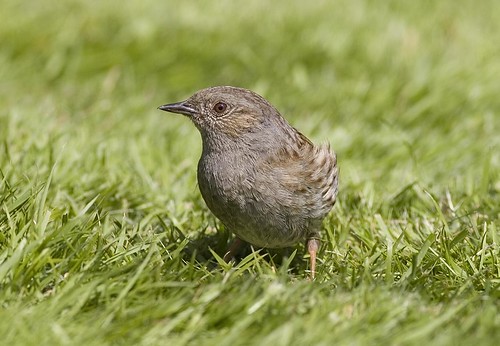
I was watching a dunnock in the garden earlier

dunnock

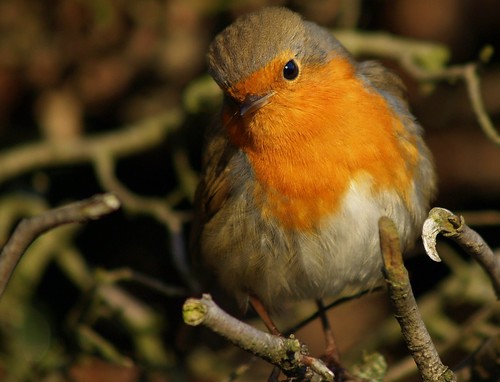
and it suddenly occured to me that there might be a parallel between the word ‘dunnock’ and ‘ruddock’ – the old name for a robin.

robin on Flickr

And having got that far, I thought maybe ‘dunnock’ derived from ‘dun cock’ and ‘ruddock’ from ‘ruddy cock’. So I got out the dictionary. Turns out I was part right.

dunnock (‘dʌnək). [app. f. dun a. + -ock dim. suffix; from the dusky brown colour of the plumage. Cf. dunlin.]

In other words, ‘dunnock’ pretty much translates as that classic birder’s term, LBJ — Little Brown Job [btw, while I was looking for dunnock photos on Flickr, I discovered that the Dutch for dunnock is ‘heggemus’ — presumably ‘hedge mouse’. But let’s stick to one language at a time].

The reference to ‘dunlin’ intrigued me.

dunlin on Flickr

And at dunlin I learnt that it’s f. dun a. + -ling. ‘ling’ is a familiar diminutive suffix of course; ‘darling’ and ‘duckling’ are the most obvious examples. But there’s another small sandpiper called a sanderling, and I was curious how that fitted in.

sanderling on Flickr

Well, pleasingly, the OED’s best guess for the origin of sanderling is the Old English sand-yrðling; i.e. ‘sand-earthling’. Not as in ‘take me to your leader’; ‘earthling’ meant ‘ploughman’. Ploughman of the sand.

Getting back to my -ock birds. I looked up ‘ruddock’, and sure enough it says

ruddock (‘rʌdək). [OE rudduc, related to rud sb., ruddy a. : see -ock.]

I also learned that a ruddleman is a digger of, or dealer in, ruddle; a raddleman. But that’s not important right now. Seeing ‘rud’ written as a word helped me make the connection that ‘ruddy’ is cognate with ‘red’. Which probably should have been obvious but I never thought about it. There was one last entry that needed to be checked out. It has such a load of great words in it I’m going to type it out in full.

-ock, suffix, forming diminutives. A few examples of dimin. –oc, –uc, occur in OE., as bealloc ballock, bulluc bullock. In mod. Eng., the chief instance of the dim. suffix is hillock (found already in Wyclif); but other examples occur in the dialects, esp in Sc., e.g. bittock, lassock, queock or queyock, whilock, wyfock, also proper names as Bessock, Jamock, Kittock. Several names of animals, esp. birds and fishes, have the same ending and are prob. orig. diminutive; among these are OE. cranoc, cornoc (dim. of cran), crane; ruddoc (read red) redbreast, ruddock; cf. the modern (some ME.) dunnock, haddock, girrock, paddock, piddock, pinnock, pollock, puttock; also, as names of things, buttock, hattock, tussock. In other words (some of which, as bannock, hassock, mattock, go back to OE.) -ock appears to be of different origin.

The actual word ‘robin’, btw, is from the habit, going back at least as far as the middle ages, of applying personal names to birds: Robin Redbreast, Jack Daw, Mag Pie. ‘Magpie’ is especially apt because ‘mag’ was used to mean ‘chat’, ‘chatterbox’, or ‘to chatter’. ‘Mag’s tales’ were what we would call ‘old wives’ tales’.

NB. The pictures are all from Flickr and © the people who took them; you can click through to the page on Flickr. The dictionary extracts are all from the OED.