Categories
Culture

Africa Reading Challenge: finished!

It just occurred to me that I’ve now read six books from or about Africa since I learnt about the Africa Reading Challenge. Links to the reviews:

  1. An African in Greenland by Tété-Michel Kpomassie
  2. Told by Starlight in Chad by Joseph Brahim Seid
  3. Waiting for the Wild Beasts to Vote by Ahmadou Kourouma
  4. The Wah-Wah Diaries by Richard E. Grant
  5. Half of a Yellow Sun by Chimamanda Ngozi Adichie
  6. We killed Mangy-Dog by Luis Bernardo Honwana

I think Waiting for the Wild Beasts to Vote is probably my favourite out of those, but they’re all worth a look for one reason or another.

Categories
Culture

An African in Greenland by Tété-Michel Kpomassie

An African in Greenland is an autobiographical book; as a teenager in Togo, Tété-Michel Kpomassie read a book about Greenland and decided to go there. It took him eight years, working a variety of jobs, to make his way up through West Africa and Europe before eventually arranging a trip to Greenland, where he stayed for about two years (in, if I’ve got my sums right, 1965).

The book’s title implies that there is some kind of different perspective that Kpomassie is going to bring because he’s African, and I have to admit that it was part of the appeal for me when I bought the book. It’s such an immediately striking juxtaposition, this young man from Togo living among the Inuit and eating seal blubber: just the title is like a pitch for a cheesy Hollywood comedy.

In fact, it’s not obvious that his Africanness makes that much difference to the book, after the first couple of chapters that take place in Africa, and in retrospect it’s hard to say what I was expecting, really. There are a couple of occasions where he compares local beliefs (about the travels of the human soul in dreams, for example) with those he grew up with; and his Africanness does make him an instant celebrity in Greenland: the first black person most of them had seen, and several inches taller than most of the locals.

It is, though, an interesting and enjoyable book about Greenland: ice-fishing and dog-sledding and eating of revolting-sounding bits of raw viscera and lumps of animal fat. Whale lung! Boiled sea gull! Yummy. And as with Halldór Laxness in Iceland, endless cups of coffee.

Although actually, I think it’s to his credit that he clearly made a point of eating everything that was put in front of him, and doesn’t spend a lot of time in the book dwelling on the off-putting nature of the food. Perhaps it’s nicer than it sounds; perhaps he just wanted to downplay the potential freak-show aspect of this kind of travel book. He has a fairly clear-eyed view of the harshness of life for many of the people he meets and the social problems he encounters, but he doesn’t dwell on it excessively. Perhaps even more surprising for someone who had travelled for eight years to get there to fulfil a childhood dream, he doesn’t romanticise the country either: not too much of the noble savage stuff.

Here’s a longish passage about life during the time of the midnight sun, with 24 hour daylight:

The oddest thing was that we couldn’t get to sleep any more. To fill in the time I stayed at the school, where I took notes, sometimes until three in the morning. Kield Pedersen, the Danish headmaster, kindly gave me access to the Medelelser of his establishment — many bulky volumes which contained the findings of every piece of research done in Greenland since the days of Hans Egede.

Outside, small orange or red tents sprang up, erected by children whom the endless daylight kept from sleeping. At three in the morning you could still see them playing outside. Sometimes they went on like this for two whole days without going to bed. Eventually they dropped with fatigue, and then might sleep for two days at a stretch. It was the teachers, not the parents, who complained, because most of the time their classes were half empty.

Sleep eluded the adults, too. Everyone was restless. They had hardly set foot indoors before they were longing to go out again, to tramp on and on, to run from hill to hill. They rambled around incessantly, in search of who knows what. All through the spring they’d go wandering like this, building cooking fires in the mountains with three stones for an oven, gathering parnet berries, resting no matter where when tiredness overtook them. both with humans and animals, spring here was the season of tireless frenzies of love. Groups of boys and girls ran laughing and shouting until early morning, and there was the noise of rutting huskies fighting, the deep growls of the males mingling with the bitches’ piercing yelps. The birds sang and the eiders quacked in the creeks.

The landscape seemed excluded from this general harmony, and it changed from day to day. All the filth of Christianshåb was suddenly exposed by the sun’s return and the thaw. Snow melted n the slopes, the street became a river of mud, and innumerable streams riddled the ash-grey earth and brought to light piles of of old bottles and cans, dog shit, household waste, and rotten potatoes. All the garbage which cold and snow had preserved — now swollen with melted water, rotting fast and buzzing with clouds of flies, real flies, come out to haunt us like a bad conscience. Outside the doors and under the foundations, the houses were repulsively filthy. the borrowed coat of spotless white had covered so much offal! A sickening stench hung everywhere. the dogs, some of them now moulting, slunk squalidly about the village. You really wondered whether you were still living in the same land that had once been so clean and white.

An African in Greenland is my book from Togo for the Read The World challenge. Oh, I nearly forgot: it was translated from the French by James Kirkup.

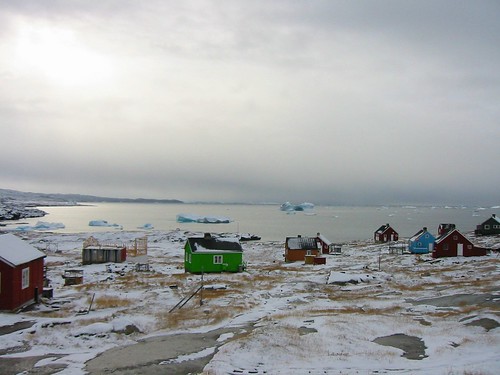
» The photo, Oqaatsut/Rodebay, Greenland, is © kaet44 and used under a CC attribution licence. Rodebay is one of the villages where Kpomassie spent a winter in Greenland.

Categories
Daily Links

Links

Categories
Daily Links

Links

  • ‘In an old stone tank near the house found the decayed head of what may be a dog but I think is a jackal. There are said to be some in this country. In either case a very complete skull, so have put it up on a stick for the insects to get it clean.’ I would never have been able to guess it was Orwell who wrote these diaries.
    (del.icio.us tags: GeorgeOrwell diaries )
Categories
Culture

The Day Lasts More than a Hundred Years by Chingiz Aitmatov

This novel tells the story of Yedigei, a worker at a remote railway junction in the middle of the Kazakh steppes. There’s a refrain which is repeated at intervals throughout the book:

Trains in these parts went from East to West, and from West to East . . .
On either side of the railway lines lay the great wide spaces of the desert — Sary-Ozeki, the Middle lands of the yellow steppes. 
In these parts any distance was measured in relation to the railway, as if from the Greenwich meridian . . .
And the trains went from East to West, and from West to East . . . 

Yedigei is taking the body of a friend to be buried at a traditional cemetery out in the steppes, and his life story is told in flashback. The railway junction is near a rocket launch site, and running in parallel to Yedigei’s story is a strange subplot about cosmonauts making contact with an extraterrestrial civilisation.
Aitmatov was from Kyrgyzstan, and The Day Lasts More than a Hundred Years is my book from Kyrgyzstan for the Read The World challenge. In some ways, though, it’s very much a book of the Soviet Union. It was written in Russian and is set in Kazakhstan, and one of the themes in the book is the tension between the traditional Kazakh culture and the Soviet bureaucracy.

Which isn’t to say it’s some kind of radically dissident novel; according to the introduction, Aitmatov (who died earlier this year) was a firmly establishment figure, a correspondent for Pravda, winner of a Lenin Prize and a State Prize for literature, and a winner of the Hero of Socialist Labour medal. The material which is most critical of the government is about things which happened under Stalin; presumably by 1980, when this novel was published, that was fair game.

Incidentally, this English edition was published in 1983 and it’s really strange to be reading all this stuff in the present tense. ‘He is a member of the Supreme Soviet, was a delegate to the last four Party Congresses…’ I wouldn’t say it makes me nostalgic exactly, but it is a bit of a throwback to my childhood.

In 1952 the summer was even hotter than usual. The ground dried out and became so hot that the Sarozek lizards did not know what to do; they lost their fear of people and were to be found sitting on the doorstep, their throats quivering, with mouths wide open, trying somehow to find shelter from the sun. Meanwhile, the kites were trying to get cool by soaring to such heights that you could no longer see them with the naked eye. Just now and again they gave themselves away with a single cry and then once more they became silent in the hot, quivering, mirage-laden air.
I really enjoyed this book. The setting is striking and atmospheric; the steppes of central Asia, punishingly hot in summer and snow-covered in winter, inhabited by foxes and eagles and camels, with just this one railway line running through it. And the fairly conventional human drama which anchors the book is intertwined with the science fiction subplot on one hand and bits of Kazakh folk myth on the other.

Here Yedigei is dealing with his magnificent but difficult camel, Burannyi Karanar:

That snowfall heralded the start of winter in the Sarozek, early and chill from the very first. With the start of the cold weather Burannyi Karanar became restless, angry and irritable, as once again his male instincts rebelled within him. No one and no thing could be permitted to encroach on his freedom. During this time even his master had to retreat on occasions and bow to the inevitable.

On the third day after the snowfall there was a frosty wind blowing over the Sarozek, and suddenly there arose a thick, chilly haze just like steam over the steppe. You could hear footsteps crunching in the snow far away, and any sound, even the faintest rustling, was carried through the air with exceptional clarity. The trains could be heard coming along the lines when they were many kilometres away. And when at dawn Yedigei heard the waking roar of Burannyi Karanar in the fold and heard him trampling and noisily shaking the fence behind the house, he knew only too well that he was in for trouble. He dressed quickly and stepping out into the darkness, walked over to the fold. There he shouted, his voice hoarse from the astringent air, ‘What’s this all about? Is it the end of the world again? You want to drink my blood? You lecherous beast!’ 

But he was wasting his breath. The camel, excited by his awakening passions, took not the slightest notice of his master. He was going to have his was, come what may. He roared, snorted and ground his teeth threateningly and broke down part of the fence.

Really it’s exactly the kind of book I hoped to find during this exercise: one I’d never heard of and would probably never have read otherwise, which introduces me to a part of the world and a culture I knew little about, but which is above all a really world-class novel. I’d recommend you buy a copy without extensive scribbles in biro all over it, though.

And one last thing, since I think it’s important to give credit to translators: translated by John French.
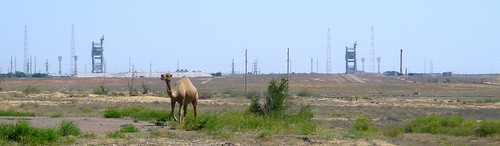
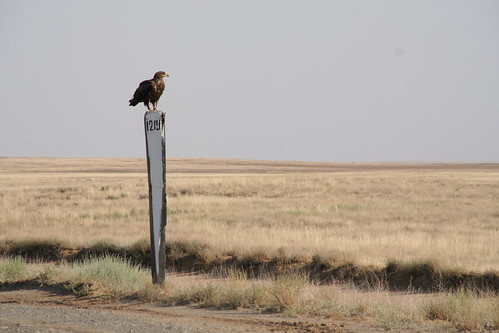
» the photo of a camel in front of Baikonur cosmodrome in Kazakhstan is © alexpgp and used under a CC by-nc-sa licence. Steppe eagle, Kazakhstan, posted to Flickr by and © rtw2007.

Categories
Culture

scribble scribble

Because I need to find rather obscure books for the Read The World challenge, I’ve been buying second-hand copies online. And that has meant an irritation I’ve barely had to deal with since university: people who write all over books.

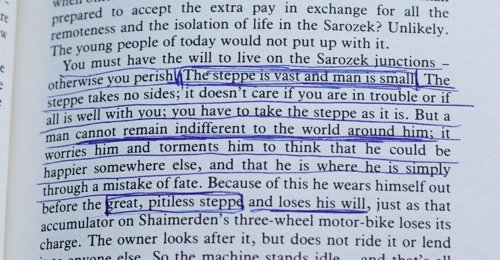
To be fair, whoever wrote in this book was presumably its owner, so they can be spared the special level of hell that I can only hope is reserved for people who write in library books. But eight lines of underlining in blue biro cannot possibly be the best way of annotating a book, even for your own use. It’s far too distracting when you come back to have a look at what you marked earlier.

Use pencil, dammit. And confine the markings to the margin, as God intended. And while I’m on the subject: one sheet of A4 can easily be torn into about 200 scraps of paper that make perfectly serviceable bookmarks; so there’s no need to turn down the page corners.

Harumph.