Categories
Culture Other

1984 by George Orwell

I picked this up to read again because I’ve just read a biography of Stalin. I think I first read 1984 when I was really quite young — certainly no older than my teens; in fact I may have made a point of reading it in 1984, when I was nine or ten — and though I was precocious and superficially well-informed for my age, I didn’t really have much sense of the reality of what life under totalitarian regimes could be like. In fact even when the Berlin Wall came down, when I was fifteen, although I knew intellectually that it was an incredibly important event, it didn’t have the emotional resonance you might expect. Knowing the basic facts isn’t enough; it’s the cumulative effect of finding out about a subject bit by bit over a period of time, of encountering lots of details and seeing it from different perspectives, that makes it seem real.

stalin_cryst.jpg

So back then I read it almost as straight fiction: dystopian and science-fictiony, and with limited relationship to the real world. I wondered if the older, better-informed me would find it more evocative and more powerful as a book about totalitarianism; I’m not sure it does quite work that way. The society Orwell creates is too highly fictionalised. One thing in particular, I think, is that the Party is just too good at what they do: the Thought Police come across as infallible and all-knowing, the Ministry of Truth manages to maintain total control of all information. To have the ring of truth, I think it needs to be a bit more capricious and random; the organisation itself, the Party, needs to have more of an edge of craziness and paranoia to it. I appreciate that it isn’t supposed to simply be a portrayal of Stalinist Russia, or any other particular regime; it’s an extrapolation of that kind of regime into something different. But even so.

One thing it did make me think of, not surprisingly in retrospect, was Guantanamo/Abu Ghraib, just because that’s what torture reminds me of at the moment. It’s a depressing thought that the Ministry of Love should remind me of US policy.
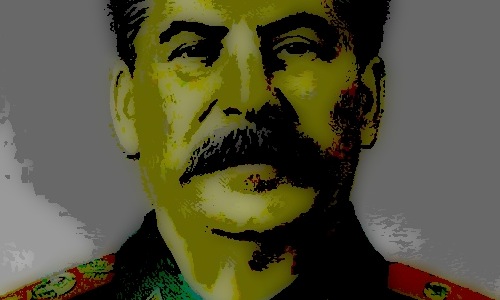
Big Brother

The least successful part of the book seems to be the romance. I didn’t find Julia to be believable: she’s just too good to be true. She seems to be completely untouched, psychologically and ideologically, by having grown up under IngSoc. In fact at times her dialogue makes her sound like she’s just wandered into the novel by mistake, having taken a wrong turn when leaving a gymkhana in 1940s Surrey. And she’s too good for Winston. Nothing we learn about him suggests he might be an attractive character, physically or in personality; so the moment when this young, sexy woman spontaneously declares her love for him at the risk of her life seems completely implausible.

As long as we’re dealing with Winston’s interactions with the Party, the bureaucracy, his neighbours, even the proles, there’s a certain kind of cohesion to the world he’s moving in. It occasionally hits a false note — the dialogue, particularly the working-class dialogue, is often a bit strained, and I’m not sure his portrayal of the proles, or the whole class system of the book, is convincing — but it’s all part of the same overall vision. The relationship with Julia seems to be happening somewhere else altogether.

comic

But then the strength of book is not really as narrative at all: it’s a combination of atmosphere and ideas. The atmosphere is in all the details: the griminess, the smell of cabbage, the physical jerks in the mornings in front of the telescreen, the red sash of the Junior Anti-Sex League, the Two Minutes Hate, the relentless drinking of Victory Gin. What really lasts about the book, though, is the ideas, and I was surprised how often they seemed topical and relevant: the citizenry under total, constant surveillance, a state of continual war maintained to keep the people fearful and patriotic, the finessing of political rhetoric, the politically motivated drive to change the very vocabulary people use. None of these are part of modern society in quite the forms they take in the book, but there are continual resonances and parallels and points of friction. Not bad for a political novel which is sixty years old next year.

Categories
Culture Other

A London particular

And a peculiarly London sun – against which nothing could be said except that it looked bloodshot – glorified all this by its stare. It hung at a moderate elevation above Hyde Park Corner with an air of punctual and benign vigilance. The very pavement under Mr Verloc’s feet had an old-gold tinge in that diffused light, in which neither wall, nor tree, nor beast, nor man cast a shadow. Mr Verloc was going westward through a town without shadows in an atmosphere of powdered old gold. There were red, coppery gleams on the roofs of houses, on the corners of walls, on the panels of carriages, on the very coats of the horses, and on the broad back of Mr Verloc’s overcoat, where they produced a dull effect of rustiness.

from The Secret Agent by Joseph Conrad

Of all the things that have changed in London, that cut us off from our ancestors’ experience of the city, perhaps the most profound, more even than the sounds and the smells, is the fog. Not just the thick pea-soupers which brought visibility down to a few feet, but the continual smokey haze from millions of coal-burning fireplaces.

Just as people go on painting holidays to Cornwall or Tuscany, Monet and Whistler used to come to London for the special quality of the light. For Whistler

when the evening mist clothes the riverside with poetry, as with a veil, and the poor buildings lose themselves in the dim sky, and the tall chimneys become campanili, and the warehouses are palaces in the night, and the whole city hangs in the heavens, and fairy-land is before us—then the wayfarer hastens home; the workingman and the cultured one, the wise man and the one of pleasure, cease to understand as they have ceased to see, and Nature, who for once has sung in tune, sings her exquisite song to the artist alone.

Chimneys become campanili, warehouses become palaces, and familiar buildings become strange to us.

Houses of parliament in the fog by Monet

The whole way the city was built was affected by the fog.

Building News, in 1881, discussed the fact that ‘the smoky atmosphere has done its best to clothe our most costly buildings in thin drapery of soot … they soon become dark and sombre masses … all play of light and shade is lost.’ That is precisely why architects decided to clothe their buildings in bright red brick and shining terracotta so that they would remain visible; the features of nineteenth-century building, which may seem vulgar or gaudy, were attempts to stabilise the identity and legibility of the city.

from London: The Biography by Peter Ackroyd

But it didn’t just apply to buildings; the city’s archetypal tree, the London Plane, which lines the streets and squares of the city and provides roosting space for the starlings, was planted because with its thick leathery leaves and flaking bark, it could survive the smoke. The classic park planting scheme — geometrical beds of brightly coloured hardy annuals — surely resulted not from a lack of imagination among park-keepers, but a need to show up in the gloom, resist the air pollution for as long as possible, and be easily replaceable if the plants died.

The sun was shining and at the end of the street between the houses the sky was blue. Gauzily the distances faded to a soft, rich indistinctness; there were veils of golden muslin thickening down the length of every vista. On the trees in Hanover Square gardens the young leaves were still so green that they seemed to be alight, green fire, and the sooty trunks looked blacker and dirtier than ever. It would have been a pleasant and apposite thing if a cuckoo had started calling. But though the cuckoo was silent it was a happy day. A day, Gumbril reflected, as he strolled idly along, to be in love.

from Antic Hay by Aldous Huxley

It’s easy to forget just how physically dirty the city used to be. There was a general griminess over the whole city; you get a sense of it looking at old photos, but you didn’t quite appreciate how dirty the buildings were until you saw them being cleaned. The process of cleaning away the smoke stains from central London has been pretty much finished now, but there was a time when you often found a newly cleaned building next to a filthy one, and the contrast was almost black and white. The Houses of Parliament used to be a gloomy, almost sinister-looking building; now it’s delicate and honey-coloured. It has shifted from vampire gothic towards fairy-princess gothic.

view of the Thames from the Savoy by Whistler

Searching for references to fog in the British Library collections, I found this, an account in the Penny Illustrated from 12th October 1861 of a display given by the great tightrope walker Blondin at Crystal Palace:

Blondin on the terrace rope, illuminating himself and the palace, was justly expected to outshine all former spectacles. Unhappily, the mist that had hung about all day and woven itself with the twilight into a veil that wrapped every every statue, tree, and tower in early darkness, thickened into fog soon after sunset. At half-past six, when Blondin started in his basket for the mast, he could be seen only a few yards off, until he lighted the pan of blue fire he carried in each hand. On reaching the mast he kindled the lights fixed there; but they did not suffice to show even the outline of his form. For the next half-hour or so he was completely invisible–at any rate, to our eye. Yet he must have traversed the rope right and left for a considerable distance; for he exploded the fireworks in his barrow, as announced, and made as brilliant an exhibition as the fog would permit. Here and there arose from the grounds an applauding recognition as he made his way back to the mast, and he was warmly greeted on his return to the palace.

The Chinese government will not doubt be praying that nothing similar happens in Beijing this summer.

» The photo is of Hyde Park corner, taken by Alvin Langdon Coburn and found on the British Library website. Other foggy pictures from his 1909 book London: Houses of Parliament, Trafalgar Square, Kingsway, Paddington Canal, Kensington Gardens. The Monet painting of the Houses of Parliament in the fog is one of several on Wikipedia. The lithograph of the Thames seen from the Savoy is by Whistler and is from the Tate’s Turner Whistler Monet exhibition from a few years ago. And as a reward for reading the small-print: Animal from the Muppets Animal sings Gershwin.

Categories
Culture Other

Stalin: The Court of the Red Tsar by Simon Sebag Montefiore

Stalin: The Court of the Red Tsar is a biography of Stalin, focussed on his domestic life and the tightly-knit group of people around him: his own family, and politicians, bodyguards, and their families.

As a piece of history, it’s very impressive. It’s clearly the result of a huge amount of research by Montefiore: he seems to have personally interviewed just about every living relative of the major figures, quite apart from the endless reading of archives and memoirs that must have been involved. As a casual reader I found it slightly hard going at times. I didn’t do it any favours by largely reading it in bed at night, but even allowing for that, I found it hard to keep track of all the people involved. I found I was having difficulty remembering which was which even of the most important figures, like Molotov, Mikoyan and Malenkov.

I don’t know if that’s an inevitable result of a book with quite so many people in it — it’s not a subject I’ve read about before, and all the unfamiliar Russian names didn’t help — or if it’s my fault for reading it while drowsy, or if there’s more Montefiore could have done to fix the various people in my mind. I didn’t find I got much sense of their various personalities that would have helped me keep them separate. Still, what I did get was a strong sense of Stalin himself, and his trajectory from a charming (though ruthless) young man living an almost campus lifestyle at the Kremlin, surrounded by the young families of his colleagues, to a sickly, garrulous old despot wandering nomadically from dacha to dacha and living in a vortex of terror and awe.

But even a sense of what Stalin was like to live and work with doesn’t get you much closer to understanding his motivations and the motivations of people around him. Was it just about power or did he believe to the end that he was acting in the interests of Russia and the party? The inner clique around Stalin clearly knew at some level that all the denunciations and show trials were arbitrary and could attach to anyone: they saw the process happen over and over again. And when colleagues they had known for years confessed to ludicrously unlikely accusations, they surely can’t have believed it. But the things they said and wrote suggest that at the same time they sort of did believe it, and remained theoretically committed to the ideology to the end. It made me inclined to reread 1984, because the concept of ‘doublethink’ is so startlingly apt.

In some ways the Stalinist purges are even more incomprehensible than the Holocaust. The Holocaust at least has a kind of simple central narrative: an attempt to exterminate the Jews. It fits into a thousand year history of European anti-Semitism as well as a broader human history of racism and genocide. The purges don’t offer any kind of similarly clear story: at different times they focussed on different things. It might be a whole social class, a profession, an ethnicity, or it might start with one or two individuals that Stalin was suspicious of and spread out through their colleagues and families to take in hundreds of people. Targets included kulaks, engineers, doctors, army officers, Poles, Jews, ethnic Germans, Chechens, Estonians, Latvians, Ukrainians, Koreans: in fact any ethnic minority that could provide a possible focus for dissent. The total number of deaths, including not just those executed but those who died in slave labour camps or famine, is disputed; but 20 million is apparently a plausible ballpark figure.

At one stage Stalin was setting two quotas for the different regions: the number to be shot and the number to be arrested. These numbers were in the tens or hundreds of thousands, but the regions were soon writing back and requesting that their quotas be extended — out of ideological zeal? In an attempt to demonstrate their loyalty? Or just because these things have a momentum of their own?

It’s a staggering story and despite the slight reservations I expressed earlier, this is a very impressive book.

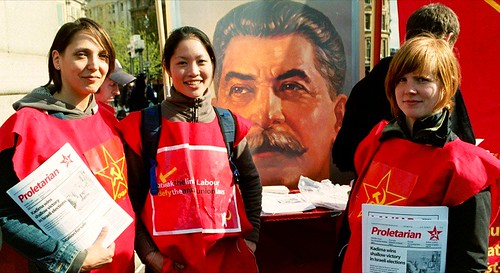
» The photo, Posing for communisim, was posted to Flickr by famous boxer and is used under a by-nc-nd licence. It was taken at the 2006 May Day protest in London and shows members of the Communist Party of Great Britain (Marxist-Leninist). The CPGB-ML website has a link to the Stalin Society, “formed in 1991 to defend Stalin and his work on the basis of fact and to refute capitalist, revisionist, opportunist and Trotskyist propaganda directed against him.” Which just goes to show… well, I don’t know what, really.

Categories
Culture

book meme

Ooh, I’ve been meme-tagged by Sherry Chandler.

Look up page 123 in the nearest book, look for the fifth sentence, then post the three sentences that follow that fifth sentence on page 123.

Well, the actual closest book is Brewer’s Dictionary of Phrase and Fable. Yay. So I’m going to ignore mere physical proximity and pick the first book which caught my eye after reading the meme, because it’s on a bookshelf directly behind the computer: Judith Thurman’s A Life of Colette.

Poverty plays a central role in the fall of Luce, as it did in the lives of so many provincial girls who sold themselves to the rich old lechers of Paris. Poverty also played a central role in Colette’s version of her marriage to Willy, and it’s very wishfully that she provides her heroine with a dowry from her dead mother—a hundred thousand francs prudently invested with the notary in Montigny. It is telling, too, that Claudine is shocked when Luce declares with smug vindictiveness that she would rather see her mother starve than send her any money.

Which is mildly more interesting than Brewer’s definition of ‘blank cartridge’, but not particularly gripping out of context. So let’s cheat even further, and pick another book from the shelf: the autobiography of Benvenuto Cellini.

After the necromancer had completed his ceremonies he took off his robes and gathered up a great pile of books that he had brought with him; then we all left the circle, pressing tightly together – especially the boy, who had got in the middle and was clutching the necromancer by his robe and me by the cloak. While we were walking towards our homes in the Banchi, he kept crying out that two of the demons he had seen in the Colosseum were leaping along in front of us, on the roof-tops and along the ground.

The necromancer said that he had often entered magic circles but that he had never before witnessed anything on such a scale, and he tried to persuade me to join him in consecrating a book to the devil.

Good old Benvenuto. I knew he wouldn’t let me down.

Categories
Culture

Housekeeping by Marilynne Robinson

I bought Housekeeping because of an article at the end of last year where Bryan Appleyard made some suggestions of great artists working today. One of his two greatest living novelists was Marilynne Robinson; I don’t always find myself in sympathy with Appleyard, but with a recommendation like that it seemed worth a punt.

detail of Hiroshige’s ‘Two men by a gate in the mountains’

It is a remarkable novel. It’s a first-person story of a girl growing up in a bleak town somewhere in the north-western US in a household that gradually dissolves around her. It’s humane and atmospheric and deeply sad.

Most of all, it’s beautifully written: full of striking images and unexpected, often bleakly humorous details. And elusive and gradual and minor-key.

Is she one of the two greatest living novelists IN THE WORLD? Umm, I don’t know. But I’m willing to consider the possibility that she might be.

» the picture is a detail from Hiroshige’s Two men by a gate in the mountains, found on Wikimedia.

Categories
Culture

The Leopard by Giuseppe Tomasi di Lampedusa

The Leopard has been on my to-read list for some time and I’m glad I finally got round to it. It’s a novel, written by a Sicilian prince in the 1950s, about the declining aristocracy in Sicily in the second half of the nineteenth century.

The leopard of the title is the Prince of Salina, whose heraldic emblem is a leopard. The novel is centred around him, but he is a curiously passive figure. The world he grew up in crumbles around him and he gloomily but pragmatically goes with the flow.

stuffed leopard

The book is nostalgic and melancholy in tone—in so far as a writer can be nostalgic for something that happened before he was born—and it exhibits a kind of regret for a lost world; but crucially, it doesn’t read, to me, as wishing to turn the clock back. The aristocratic world represents a special kind of elegance and sophistication in the book and the shift of power to a nouveau riche class of merchants as a coarsening of society, but the book doesn’t attempt to claim the aristocrats as especially virtuous or deserving of their position. It reminds me a bit of Proust: not immune to snobbery and the glamour of the aristocracy, but just a bit too clear-sighted to fully buy into it.

It’s low-key and atmospheric and rather wonderful.

» The photo is a stuffed leopard in the Crystal Palace and is from the British Library collection.