Categories
Culture Nature

Moby Dick

I thought I ought to reread some of those Great Novels which are sitting on my shelves and I haven’t read for years. I’m not sure why I picked up Moby Dick in particular, but after a few pages I was thinking oh, man, I’d forgotten how funny this book is, and so brilliantly written. But after a couple of hundred pages I remembered why it has a reputation for being unreadable, or at least unfinishable.

whaling scene

The opening scenes, where he meets Queequeg, and goes to the whaling chapel, and joins the Pequod, and the crew are all introduced, are truly superb: grotesque and funny. But then after they get to sea, the book loses forward momentum. Partially because there’s not much plot going on, and it’s very episodic, but especially because of Melville’s (or, I suppose, Ishmael’s) long discourses on whales and whaling. Even those are interesting, and frequently well-written and entertaining. But there’s an awful lot of it, and it’s just rather pale and conventional compared to the weirdness of the narrative stuff. It’s as though Bram Stoker had decided that Dracula would be greatly improved by a few chapters about folk customs in Romania and the best techniques for garlic cultivation.

So the book is rather becalmed. But towards the end it picks up again and builds to a suitably grotesque crescendo when they finally track down Moby Dick.

In all seriousness, although I do think this is a great novel, I also think you could greatly improve it by judicious editing. You could cut it down to about the half and length and change it from a sprawling, discursive tome into something short, dark, strange and intense. Like Heart of Darkness with whales.

Since it’s out of copyright, I suppose I could do it myself. As a public service.

Categories
Culture

Books of the year, 2007

Since I’ve recorded [nearly all] the books I’ve read since March this year on a special book page, and it’s possible to view them ordered according to my rating, I hardly need to to do a books of the year post. Here are some links to some of the longer posts I did about books:

The Beak of the Finch by Jonathan Weiner is a fabulous book about a long-term study of Galapagos finches and what it revealed about natural selection.

Large Cactus Ground finch

Imperial Life in the Emerald City by Rajiv Chandrasekaran is about life in the Green Zone in Baghdad; what was then the base of the US administration of Iraq and is now the embassy complex.

The Elements of Typographic Style by Robert Bringhurst is a very good book about typography.

George III and the Mad-Business by Ida Macalpine and Richard Hunter is about George III’s illness and its broader cultural context.

The Utility of Force, by the eminent British general Rupert Smith, is about modern warfare and how it’s different.

» The Galapagos finch photo is one taken by putneymark which I found on Flickr and am using under a Creative Commons by-sa licence.

Categories
Culture

American Pastoral by Philip Roth

According to the blurb, this is Roth’s masterpiece. To which all I can say is… meh.

I don’t know. It’s a good book, a broad-sweep fat novel of the old school, but I wasn’t blown away by it. I don’t think Roth is much of a prose stylist, for a start. Perfectly competent, and sporadically rather better than that, but not one of the magicians.

And it’s just a bit… shouty. Perhaps that’s what the Guardian had in mind when they described it as ‘raging and elegiac’. He’s like the Bellman in the Hunting of the Snark: ‘what I tell you three times is true’. And he does say everything three times, hammering away at each point. Bang. Bang. Bang.

There may be a bit of trans-Atlantic disconnect going on here, but for whatever reason, this didn’t push my buttons.

Categories
Culture Other

The Bible by Karen Armstrong

The full title is The Bible: The Biography, which at least clears up any possible implication that Karen Armstrong might be claiming authorship for the actual Bible.

I finished this last week sometime, but I’ve been putting off writing about it, mainly because reading a book by someone who knows vastly more about the subject than I do and then arguing with it seems like bad intellectual karma.

It traces the history of the Bible; both the accumulation and arrangement of the contents and the different ways people have read it. For these purposes ‘the Bible’ includes the Jewish version as well as the Christian one.

For me the most interesting part of it was the process by which the Bible was written and arranged; the various early religious traditions in Judah and Israel, the theological impact of the destruction of Temple first by Nebuchadnezzar and then later by the Romans, the religious and social context of the early Christian church and the various movements within early Chistianity. I did find it slightly unnerving, though, that Armstrong never gives any hint about how we come to know any of this stuff about what happened up to three thousand years ago. Obviously to explain every detail thoroughly would make the book much much less approachable, but a few examples of the kinds of sources being drawn on would have been interesting.

I suspect she was focussed on producing a popular account of what I imagine is a pretty dry field, and I can’t say I wanted to wade through too much in the way of textual criticism of obscure Assyrian chronicles, or whatever, but for me she whizzes through almost too quickly. The whole book is only just over 200 pages, which isn’t much for three millennia of history and theology (especially since it’s set in large, generously leaded type; unattractively large for my taste). So it’s a useful introduction to the subject but it’s hard to engage with properly. I suppose if I really wanted to know more I could check out the sources and biblical references listed in the endnotes, but I’d rather have a little more content in the actual text.

Once it gets to the point where the Bible is finalised and the book is concerned with the different ways people have read it, I found it less interesting. Partially that’s because I knew a little more about the subject already; not a huge amount more, but I’ve encountered the medieval exegetical tradition before, and I’ve read a certain amount about the Reformation. And to be honest, I tend to feel that when you’ve encountered a few different ways of finding ‘deeper’ significance in a text—Freudian analysis, various flavours of critical theory, different kinds of exegesis—they all start seeming rather similar.

But what made me uncomfortable was when she got onto modern practice. For most of the book she has presented an apparently detached, descriptive account. But once we get onto the nineteenth and twentieth centuries she starts making an argument, and it becomes apparent that there is an agenda to the whole book. The argument, basically, is that literal readings of scripture are a modern development, that in the past the Bible was always read as figurative, allegorical, and read in an open-ended way in search of spiritual, rather than literal, truth. And she goes so far as to recommend a return to these traditions.

Well, this is where my bad intellectual karma comes in, because despite my basic ignorance on the subject, I find myself deeply sceptical about her presentation of the tradition. Exegetical, allegorical, spiritual readings of scripture have obviously always existed and have always been part of the mainstream. It’s worth pointing out that the deeper spiritual truths found by exegesis can co-exist with a literal reading, but still, it’s clearly true, and a point well worth making, that most serious readings of the Bible throughout the tradition have been aimed at finding other kinds of truth than historical accuracy. Higher truths, deeper truths; pick your own spatial metaphor.

But still, I don’t believe that literal readings are new. It’s too obvious, simple and clear an idea. I just don’t believe that it never occurred to anyone to think “maybe this holy text is true”. My niggling suspicions aren’t quieted by the way Armstrong talks about modern life. Here’s the example which stuck out for me. I’ll quote at some length in an attempt to be fair:

Throughout this biography, we have considered the ways in which Jews and Christians have tried to cultivate a receptive, intuitive approach to scripture. This is difficult for us today. We are a talkative and opinionated society and not always good at listening. The discourse of politics, media and academe is essentially adversarial. While this is undoubtedly important in a democracy, it can mean that people are not really receptive to an opposing viewpoint. It is often apparent during a parliamentary debate or a panel discussion on television that while their opponents are speaking, participants are simply thinking up the next clever thing they are going to say. Biblical discourse is often conducted in the same confrontational spirit, very different from the ‘listening ear’ proposed by the Hasidic leader, Dov Ber. We also expect immediate answers to complex questions. The soundbite is all. In biblical times,some people feared that a written scripture encouraged a slick, superficial ‘knowing’. This is surely an even greater danger in the electronic age, when people are used to finding truth at the click of a mouse.

Now it must be true that, for various reasons, religion has changed in the past few hundred years. The intellectual, social and political context has changed, after all. But whenever people start claiming that modern society is uniquely awful in some way, I get suspicious, and this seems a classic example of why. Armstrong says that because we are a certain kind of society, ‘it can mean that people are not really receptive to an opposing viewpoint.’ With the implication that at some point in the past there was a moment when people were receptive to an opposing viewpoint. And that all theological debates in the past were conducted with a ‘listening ear’, something which would come as a surprise to those people burnt to death for heresy.

Or to give another example, when talking about American Rapture theology—the idea that the end of the world predicted in Revelations is coming soon—she writes

In line with the modern spirit, Darby’s theory was literal and democratic. There was no hidden truth, accessible only to a learned elite. The Bible meant exactly what it said.

Well, of course, the specific details of Rapture theology, like the association of the Antichrist with the United Nations, are modern and contingent. But the idea that the end of the world is nigh is not new. Millenarian heresies (i.e. people who believed that the Millennium, the thousand years of Christ’s rule on Earth, was coming soon) turned up pretty regularly in the medieval period. And this is part of my sense of unease with Armstrong’s presentation of modern theology as uniquely misguided; over the two thousand years of Christianity, the same ideas tended to pop up again and again. The key ideas of Protestantism, for example, were not new at the time of the Reformation; they had turned up periodically around Europe and the Catholic church had managed to crush them as heretical.

Anyway. It’s a pretty interesting book, but the fact that she’s clearly set out to make a particular case just makes it hard for me to take what she says at face value.

Categories
Culture Other

George III and the Mad-Business by Ida Macalpine and Richard Hunter

I highly recommend this fascinating book; it seems to be out of print, but there are lots of second-hand copies on Amazon. As the title suggests, it’s about poor mad George III. And even Americans, brought up to think of George III as a tyrant, might have a little sympathy for him after reading this.

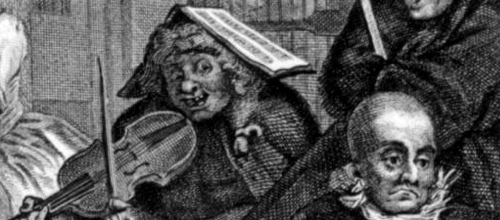
detail of Hogarth

It starts with a detailed account of his illness—or his illnesses, really, since he initially suffered from relatively brief bouts, separated by long periods of good health. Having offered a diagnosis of porphyria, which is a hereditary condition, Macalpine and Hunter examine the medical histories of George II’s relatives and demonstrate that porphyria can be identified, with varying degrees of confidence, in a startling number of them; most notably perhaps in James I, Mary Queen of Scots and Frederick the Great of Prussia.

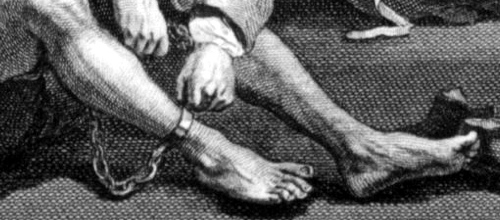
detail of Hogarth

The book then moves on to a survey of C18th psychiatry, both in terms of its theoretical basis and treatment, and looks at the way it developed. Not surprisingly, George’s illness had a huge impact on the mad-business because of the publicity surrounding it. The idea of a king being forcibly confined in a strait-waistcoat focussed people’s minds on the treatment of the insane. The book traces developments in the treatment of patients and the law surrounding insanity, both in terms of treatment and things like criminal responsibility. Finally it looks at the way developments in psychiatry have affected historians’ portrayal of George III.

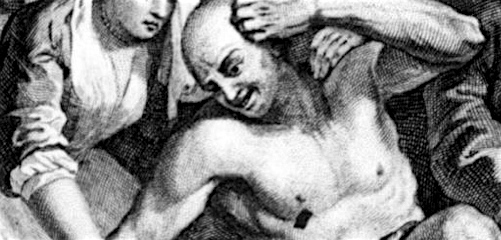
mad ‘king’ in Bedlam

It is, as I say, fascinating. The account of his illness is remarkable, not least because of the political chaos around it. It was just the moment when, although Britain was increasingly recognisable as a modern democracy and decision-making increasingly rested with the Prime Minister and parliament, the king was still an important enough figure that his incapacity led to a crisis. And since the question of whether or not to establish a Regency depended on it, and a Regency would mean a change of government, his treatment was incredibly politicised. His doctors issued regular bulletins about his status, which were pored over by all concerned; his doctors themselves became associated with different political factions and found it very difficult to agree on anything.

Meanwhile the king was kept from his loved ones, frequently confined to a strait-waistcoat, and was subjected to a variety of unpleasant and intrusive treatments—bleeding, cupping, blistering, emetics—none of which, we now know, did him any good at all. And at least one aspect of his treatment, a ‘lowering’ diet without any meat in it, will have been actively making him worse.

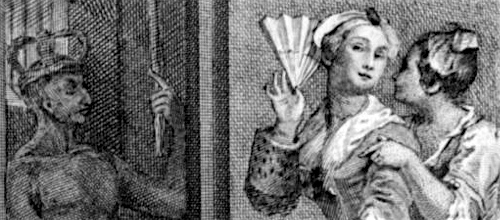
detail of Hogarth

Still, interesting though all that is, it was starting to get a bit repetitive—thoroughness is a great quality in a historian, but doesn’t always make for riveting reading—and I was glad to get past the details of George’s case and onto the broader stuff, which I found fascinating. For example, as psychiatry increasingly worked under the theory that mental illnesses are self-contained and separate from physical illnesses, the king was retrospectively diagnosed with ‘manic-depressive psychosis’ , and all of his various and violent physical symptoms—pain, fast pulse, colic, sweating, hoarseness, stupor—were interpreted as hysterical, or even as invented by the Court to disguise the truth of his condition.

detail of Hogarth

And because it was assumed that he must always have been manic-depressive, the diagnosis colours historians’ portrayals of his whole personality:

Watson, in the standard Oxford history of the reign, writes : ‘He lacked the pliability and easy virtue of less highly strung people. When his obstinacy encountered an immovable obstacle, all his resources were at an end and the black humour claimed him… Madness was but this mood in an extreme form.’

The book quotes a whole series of similar descriptions. But the king’s early biographers presented a completely different picture, and in fact, we now know that between bouts of illness, sufferers from porphyria can be very healthy. Macalpine and Hunter are pretty scathing about psychiatry generally; the book was written in 1969, and it would be interesting to know whether they thought there had been any progress in the meantime.

» the pictures are details from ‘The Interior of Bedlam’, the final scene in Hogarth’s A Rake’s Progress. It predates the king’s first bout of madness, so the fact that one of the inmates thinks he is the king is not a jibe at George III. I got the picture from this site about the history of Missouri’s first state mental hospital.

Categories
Culture Other

Erasmus Darwin by Desmond King-Hele

This is a biography of Charles Darwin’s grandfather. He was a doctor by trade, and one of the most highly rated in the country, but was one of those classic Enlightenment figures whose interests included botany, meteorology, physics, chemistry, engineering, philosophy and just about anything else that came his way. And for a few years he was the most successful and critically acclaimed poet in England.

He seems to have been effortlessly brilliant at everything; the list of inventions and discoveries which can be attributed to him is startling. The inventions include: an improved steering system for carriages, a machine for writing in duplicate, a temperature-regulated system for opening and closing the windows of a greenhouse, a machine that reproduced human speech, an artificial bird, an improved seed-drill, the gas turbine, the rocket motor, cataract surgery and the canal lift. Scientific principles include: the ideal gas law, the chemical composition of water, the structure of the atmosphere, the formation of clouds, the artesian well, and of course evolution.

rocket

Even so, there’s a touch of defiance in the book’s full title: Erasmus Darwin: A Life of Unequalled Achievement. That’s because almost everything on that list comes with a caveat of one kind or another. For example, many of them are based on a few lines or a quick sketch appearing in his Commonplace Book or in one of his letters; and while it’s undoubtedly takes a remarkably inventive mind to come up with the principle for the gas turbine a hundred years ahead of its time, if it never gets beyond a quick scribble it’s a very limited achievement. Another example is his improved steering system, which worked by just angling the wheels left and right instead of turning the whole axle. This creates a much more stable carriage and is the principle used by all modern cars. Darwin built a carriage on this model, and used it successfully for decades going over thousands of miles of bumpy roads to visit his patients; but he never made a real effort to market the idea and it died with him.

Which isn’t to say he had nothing to show for his scientific brilliance. He submitted quite a few papers to the Royal Society on subjects like meteorology and geology; he did the first English translation of Linnaeus, and wrote a major book on medicine. But there is no one major achievement you can attach his name to. Partly that’s because he was a very hard-working doctor. Not only did it take up a lot of time; he was also very worried about his professional reputation. Much of his work was published anonymously because he didn’t want to detract from that reputation, and the biggest single factor that prevented him from achieving more as a scientist was probably that he always put his career first.

And when he did commit to major works he didn’t always make the best choices. His translation of Linnaeus’s botanical taxonomy was drudgery really, the scientific equivalent of translating a phonebook, even if it did add a few words to the English language, like bract, floret and leaflet. And his major work on medicine doesn’t hold up at all because, frankly, no-one at the time knew enough about the workings of the human body. No-one knew about germs, microscopes had been invented but weren’t really used, and they had very few treatments that did any good, so they just gave everyone lots of opium.

opium poppy

Comparisons between Erasmus and Charles are inevitable, and it’s tempting to put the difference between them down to personality: to suggest that Charles was less brilliant but made up for it with dogged single-mindedness. Personally I think the financial aspect is just as important. Erasmus and his son Robert were both highly successful doctors and Robert also had a very good eye for investments, with the result that Charles was a wealthy man. If Erasmus hadn’t had to work, who knows what he would have achieved. His medical practice certainly proves he was capable of hard work; his calculations suggest he travelled about 10,000 miles a year, which on C18th roads is a hell of a long way.

I find the poetry the most interesting thing, though. Science is not a subject that has often been successfully treated in poetry, so someone like Erasmus Darwin writing poems about science is really intriguing. If you have an interest in science and poetry, it’s always fun when the two overlap, as with the reference to Galileo in Paradise Lost. But it’s rare to have poetry written by someone right at the heart of the scientific culture. Darwin’s friends and correspondents include people like Joseph Priestley, Joseph Banks, Benjamin Franklin, James Watt, Josiah Wedgwood, Matthew Boulton and Richard Arkwright. He writes about science and technology as a complete insider. And for a few years he was very successful and critically acclaimed, before being left behind by a shift in fashion—he represents everything Coleridge and Wordsworth were reacting against—and in politics. As the French Revolution turned bad, his radical views became a public liability.
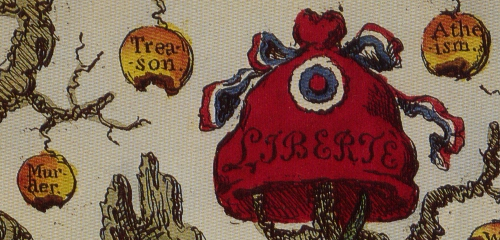
detail of Gillray cartoon, tree of liberty

So I find the idea of Darwin’s poetry fascinating. I’m undecided about the poetry itself. All the mythological trappings seem so unnecessary, and the ornate style can border on self-parody; one of his particular quirks is phrases like this:

Swords clash with swords, on horses horses rush,
Man tramples man, and nations nations crush

Still, I love the very fact that he’s applying this high style to such non-literary subject matter. In another poem, someone might only apply this kind of language to a subject like a tadpole to make a joke out of the incongruity. Darwin did have a sense of humour, and if not actually tongue-in-cheek, I think the poems are intended to have a fairly light touch; but he seems to be trying to communicate a real fascination and beauty he finds in nature, as in this passage where he is invoking tadpoles and mosquitos as a comparison with life emerging from the sea:

So still the Tadpole cleaves the watery vale
With balanc’d fins, and undulating tail;
New lungs and limbs proclaim his second birth,
Breathe the dry air, and bound upon the earth.
So from deep lakes the dread Musquito springs,
Drinks the soft breeze, and dries his tender wings,
In twinkling squadrons cuts his airy way,
Dips his red trunk in blood, and man his prey.

Is that good poetry? Maybe not. Maybe the style is just a distraction. On the other hand I think you can pick out passages which are more successful, like this:

“Yes! smiling Flora drives her armed car
Through the thick ranks of vegetable war;
Herb, shrub, and tree, with strong emotions rise
For light and air, and battle in the skies;
Whose roots diverging with opposing toil
Contend below for moisture and for soil;
Round the tall Elm the flattering Ivies bend,
And strangle, as they clasp, their struggling friend;
Envenom’d dews from Mancinella flow,
And scald with caustic touch the tribes below;
Dense shadowy leaves on stems aspiring borne
With blight and mildew thin the realms of corn;
And insect hordes with restless tooth devour
The unfolded bud, and pierce the ravell’d flower.

“In ocean’s pearly haunts, the waves beneath
Sits the grim monarch of insatiate Death;
The shark rapacious with descending blow
Darts on the scaly brood, that swims below;
The crawling crocodiles, beneath that move,
Arrest with rising jaw the tribes above;
With monstrous gape sepulchral whales devour
Shoals at a gulp, a million in an hour.
— Air, earth, and ocean, to astonish’d day
One scene of blood, one mighty tomb display!
From Hunger’s arm the shafts of Death are hurl’d,
And one great Slaughter-house the warring world!

I find that to be a strong piece of writing and a striking vision of violent nature. It’s from Canto IV of The Temple of Nature, where Darwin comes within a whisker of stating the principle of natural selection. Here’s another bit from later in the same canto:

“HENCE when a Monarch or a mushroom dies,
Awhile extinct the organic matter lies;
But, as a few short hours or years revolve,
Alchemic powers the changing mass dissolve;
Born to new life unnumber’d insects pant,
New buds surround the microscopic plant;
Whose embryon senses, and unwearied frames,
Feel finer goads, and blush with purer flames;
Renascent joys from irritation spring,
Stretch the long root, or wave the aurelian wing.

“When thus a squadron or an army yields,
And festering carnage loads the waves or fields;
When few from famines or from plagues survive,
Or earthquakes swallow half a realm alive; —
While Nature sinks in Time’s destructive storms,
The wrecks of Death are but a change of forms;
Emerging matter from the grave returns,
Feels new desires, with new sensations burns;
With youth’s first bloom a finer sense acquires,
And Loves and Pleasures fan the rising fires. —
Thus sainted PAUL, “O Death!” exulting cries,
‘Where is thy sting? O Grave! thy victories?’

I love the cheeky jabs at both royalty and religion; firstly in lumping together a monarch and a mushroom as comparable lumps of organic matter, and then the way he implies that acting as compost for plants and food for insects is what St Paul had in mind with ‘Oh Death! Where is thy sting?’ But there is also a kind of slightly nutty grandeur to the poetry.

Some bits of his poems hold up better than others, both scientifically and aesthetically. But I think the best of it is good enough to be worth reading, particularly because the subject matter makes it so unique.

» passages from The Temple of Nature are taken from this site where you can read it in full. The picture of a rocket is by jurvetson on Flickr and is used under an attribution CC licence. The opium poppy is from a C19th German herbal and is used courtesy of Missouri Botanical Garden at botanicus.org under a by-nc Creative Commons licence. The hat is a detail of a Gillray cartoon, the Tree of Liberty, from a page of cartoons from the period at the University of Lancaster.