-
Science porn.
Categories
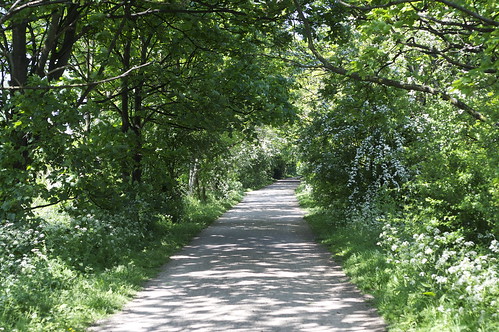
And two months later, I get back on the Thames Path again. One exciting addition to the routine: sunscreen. Yup, proper sunny weather; spring turning into summer. And it made for a very pleasant walk; this section of the path feels almost rural. Admittedly, for much of the walk the rurality consists of little more than a few trees and about five feet of weedy verge, but in the full greenness of May, that was pretty good. In November, the impression of being in the countryside would no doubt be a bit weaker.
And if I list some of the plants that were in flower, it certainly sounds rural. Cow parsley, white deadnettle, wild garlic, lady’s smock (cuckooflower), hawthorn, elderflower, forget-me-not; I just love the names. And at this time of the year, everything is so green and full of life: even the sycamores, a tree I basically think of as an exceptionally big ugly weed, looked pretty good.
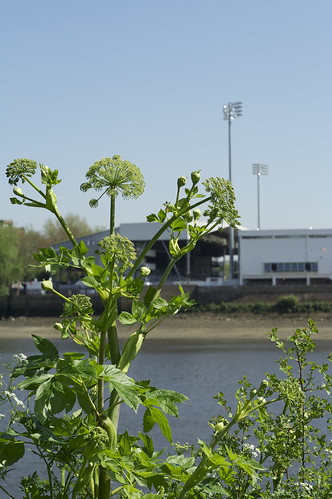
There were some non-floral points of interest, though. Soon after Putney Bridge, you start walking past the boat houses owned by various schools and rowing clubs, and people rowing on the river. In fact my walk was pretty much the route of the Boat Race. Over the river you can see Craven Cottage, the stadium of Fulham FC, the football club owned by Mohamed “Prince Philip is a Nazi Frankenstein” Al-Fayed. For non-Londoners, Fulham (both the area and the football club) are best defined by the fact that, as much as they’d like to be, they just aren’t Chelsea.
The path here was originally a towpath, I believe. In fact, I think most of the Thames path from here on up to the source of the Thames follows the old towpath: that it, the path used by horses towing the canal boats along the river. I can’t quite imagine the logistics of it: what happened if someone needed to overtake? Or two boats approached from opposite directions? Was the whole river a big cat’s cradle of towropes?
It’s odd to think that, especially before the railways, the canals were the industrial arteries of Britain. They had advantages though: apparently one reason Josiah Wedgwood was a keen investor in canal-building was that, sending his porcelain from Staffordshire to London by road, 30% of it would break on the journey.
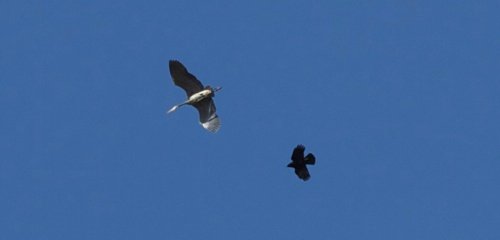
The path goes past a couple of nature reserves. One of them, the London Wetland Centre, describes itself as ‘the best urban site in Europe to watch wildlife’. I don’t know enough about the urban sites in Europe to judge that claim, but they’ve certainly done a really impressive job there. It was built on the site of a water treatment facility, I think, and they’ve created an impressive wetland area. Their headline success, I suppose, has been to attract bitterns in winter, but they also get a variety of waders and ducks, nesting terns, and a colony of sand martins (US: bank swallows). None of which is apparent from the Thames path, it has to be said, except for the sand martins which I watched for a while hunting for insects overhead. These are not sand martins; it’s a crow mobbing a heron.
While I’m writing about birds: it was mostly the usual stuff. Great views of a wren, singing beautifully with its little tail cocked up behind it; good views of a couple of blackcaps, singing even more beautifully and with impressive volume. A couple of exotics: the more unexpected was Egyptian Goose, a bird which is fairly well-established in England but I don’t see that often. No surprise at all to see Ring-necked Parakeets nesting in a tree by the path. They’ve been spreading out from further up the Thames valley for decades now, but in the last four or five years, numbers seem to have exploded: you hear them screeching in any bit of green space in London.
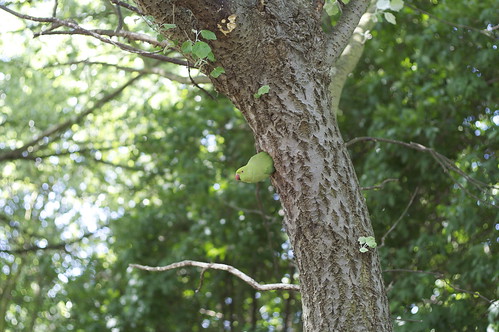
There are two marvellous urban myths about the parakeets. 1) They are all descended from a few birds kept by Jimi Hendrix when he was living in London. 2) They are all descended from parakeets used on the set of The African Queen when it was being filmed at Shepperton Studios. But no special explanation is needed for feral populations of exotic cagebirds — there are loads of them around the world. A couple of years ago, I had to resort to parrot-fancier websites to work out what species I’d seen in a park in Seville.
Rather unusually, the other nature reserve was designed to protect an exotic species: the Two-Lipped Door Snail, which, according to the informative sign, “is thought to have been originally been introduced accidentally by the Romans from mainland Europe, where it is much more common.” I support any excuse for protecting patches of urban woodland, but an exotic species of snail which is common in its native country seems like a low priority. But it has been here for a couple of millennia, so I guess we can grant it honorary native status.
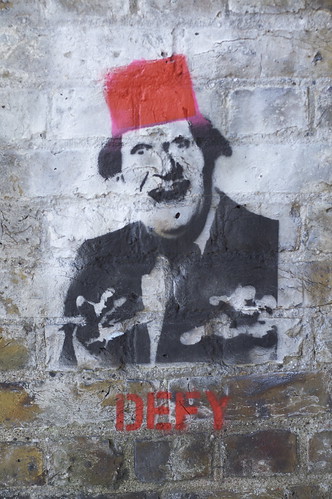
The path also goes past St Paul’s School. When I was on the school bridge team we once played a fixture against the St Paul’s E team. I think it may have been one of the few matches we won, so they can’t have been very good, but the fact the school could field five bridge teams still seems slightly extraordinary. In case you’re interested, I also represented the school at chess and fives. I was pretty rubbish at those too. No killer instinct.
» All these photos and a load of others have been posted to my Flickr account. You can see the whole Thames Path set or just the set for Putney to Kew. I’ve geotagged them so you can see them on a map but to be honest the locations are rather approximate.
There’s an article in today’s Times about the rapid decline in church attendance in the UK. The particular angle they’ve chosen to take is that within a mere 30 years, the number of people going to mosque every weekend will outnumber those going to church. This is illustrated by a dramatic graph with the Christian line sweeping down at a vertiginous angle and crossing the lines for Muslims and Hindus, which are creeping up a bit slower at the bottom.*

Leaving aside the huge uncertainties involved in extrapolating the trends forward, I can’t help feeling that the graph is missing something important: a line for the vast majority of us who don’t go to any kind of religious service. If they had included us, and changed the scale of the y-axis to accommodate us, all the religious people would be squashed down into a very flat and unimpressive bit at the bottom of the chart.
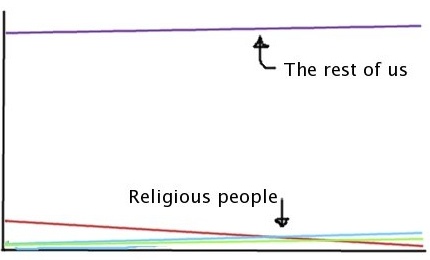
Of course it’s an interesting and significant demographic shift if the number of churchgoers changes from about 8% to 1% in 45 years, as the graph suggests. But if you say instead that the number of people who don’t go to church/mosque/temple regularly is rising from 90% to 94%, it doesn’t seem quite so dramatic.
As regular readers will know, I’m not about to lose sleep over shrinking congregations; and I certainly don’t believe there’s some kind of essential connection between Britishness and Christianity. But I was mainly annoyed by the use of statistics.
*The graph isn’t available online or I’d link to it. The Times’s consistent habit of having less in the way of pictures and graphics online than in the dead tree edition always seems to be completely missing the point, to me, but hey-ho.
I’ve actually linked to these before, but a post over at i heart photograph reminded me about them and I was browsing through them again. Sergei Mikhailovich Prokudin-Gorskii was a Russian photographer taking colour pictures in the years before the Great War. He took three black and white negatives of each subject using different coloured filters, then reassembled them using a projector and coloured light.
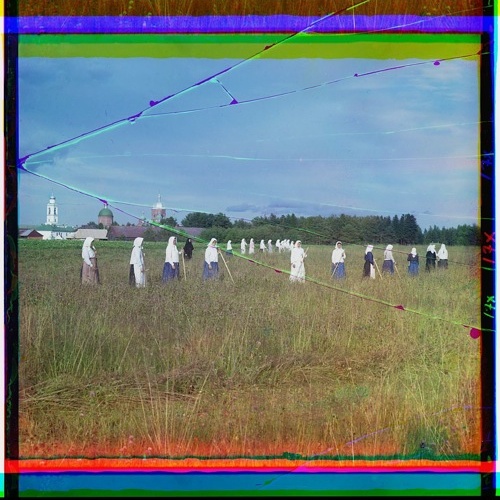
The Library of Congress have used a digital version of this process to recreate the images and have put them online. The one above is a harvest scene from 1909, but also check out i.e. Woman in Samarkand, dog, Siberian scenery, Georgian woman in national costume. [as Jean points out, those links don’t work: you’ll just have to browse the collection]
I find the particular aesthetic of the lurid coloured borders as appealing as the subjects, though those clearly have historical and ethnographic interest.