Categories
Culture

All About H. Hatterr by G.V. Desani

All About H. Hatterr is a novel I bought after seeing it recommended somewhere — the complete review, I think. It is a modernist novel written in 1948 in a colloquial Indian English laced with bits of slang, Shakespeare, legal jargon and so on. I’m not in a position to judge the relationship between the language of the book and the English of India, but Salman Rushdie is quoted on the back cover:

Hatterr’s dazzling, puzzling, leaping prose is the first genuine effort to go beyond the Englishness of the English language…. This is the ‘babu English,’ the semi-literate, half-learned English of the bazaars, transmuted by erudition, highbrow monkeying around, and the impish magic of Desani’s unique phrasing and rhythm into an entirely new kind of literary voice.

It would be interesting to read the whole article which that comes from, but it’s hidden behind the New Yorker’s pay wall.

The book is narrated by the H. Hatterr of the title, the son of a European merchant seaman and a woman from Burma, raised and educated in missionary schools in Calcutta. It’s anecdotal and episodic in structure; there isn’t, at least for me at first reading, any kind of overarching plot. Picaresque might be a good word for it.
It is somewhat ‘difficult’ — it’s not for people who like their prose plain. But googling around while writing this post I’ve seen it compared to Ulysses and Finnegans Wake, and it’s certainly not that difficult. The prose is sometimes elaborate and colourful but otherwise fairly conventional: it’s not all stream-of-consciousnessy or anything. And there’s not a great deal of vocabulary from Indian languages. There’s more English public-school slang than there is Hindi.

PRESUMPTION: ‘Kismet’, i.e., fate — if at all anything, and as potent as suspected for centuries — is a dam’ baffling thing!
It defies a feller’s rational: his entire conception as to his soma, pneuma, and psyche!
Why did a feller like me commit matrimony with a femme fatale like Mrs H. Hatterr (née Rialto), the waxed Kiss-curl?
A personal query, but I don’t mind answering…
If only I could!
All I know is that I wanted to raise a family: add to the world’s vital statistics and legitimate: have a niche in the community, for my own kid, to hand out the wager till the end. And since you can’t achieve this without a wife — the neighbours wouldn’t let you! the police wouldn’t let you! — I equipped myself with the blarney-phrases, convinced this female that she was real jam, had me led to the middle aisle and gave the ready ‘I do’ to the amenwallah her brother had hired for the occasion.
This I did, knowing, hell, that between us was all the temperamental difference in the world!
Till death us do part! this museum-piece and I! And that promise — what a stingo! — after a conflict dating back to the donkey’s Sundays!
The female — contrast? — was poles apart: though, between the cur Jenkins, me and the Duke Humphrey, it did seem once that she was going to win my regards for good, by delivering me an heir-presumptive — my own piccolo le fils — to survive me (and be added to the looney-bin). But despite days and days of biological observation and anticipation — the wasted reference to the obstetric table and pre-occupation with the signs of labour — it didn’t come off. (Backed the wrong filly, or, maybe, something the matter with me as create-or!)

You probably have a pretty good idea whether that’s the kind of thing you like. Personally I enjoyed it, stylistically; occasionally there would be a particularly dense paragraph or two and I would glaze over a bit, but more often it was lively and funny.

My only reservation really is the one I have about a lot of these less traditional novels: I think perhaps the whole is less than the sum of its parts. I think people often overstate the importance of plots, but they are at least one way of holding a book together. Still, I’m glad I read it.

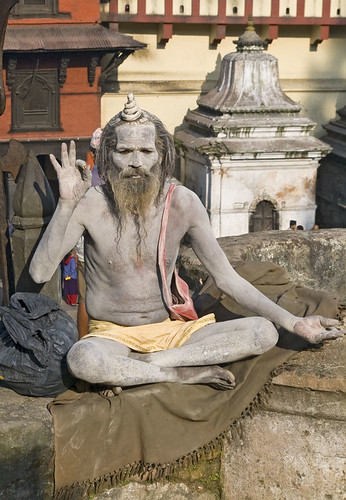
» The picture, ‘a Sadhu‘, is © Chris de Rham and used under a CC by-nc-nd licence. Sadhus feature quite heavily in the book.

Categories
Culture

Michael Jackson

Michael Jackson’s death was both completely unexpected and weirdly unsurprising. I know he was only 50, but his life had been such a train wreck for such a long time that it was hard to conceive of him somehow carrying on for another 30 or 40 years.

I’m grateful for the music. But it can rarely have been more fitting to say: rest in peace.

Categories
Nature

Dancing flies

Flies doing a little mating dance on our lily pads. I think they might be a species called Poecilobothrus nobilitatus, but that’s a provisional ID for the moment. Sorry for the camera-shake.

Categories
Other

Yay for Twenty20 cricket.

I’ve really been enjoying the Twenty20 World Cup, and the more I see of twenty-over cricket and the more it matures as a game, the the more I think it’s a brilliant invention.

Someone has finally invented a form of the game where every ball is interesting. Before it started, the assumption was that T20 would be all about sixes; but it’s equally true that it’s all about dot balls. I mean really, a form of cricket where a dot ball is an exciting event: it’s a fucking miracle.

And I love the fact that it legitimises six-hitting. Even Test-cricket purists love to see big sixes. But really, in Test cricket, it’s a self-indulgent shot; the shot of a show-off. You can argue, perhaps, that it’s a valuable weapon in the psychological battle between bowler and batsman; and there are a few situations, like hastening a declaration or when a batsman is running out of partners, where it makes more sense; but the honest truth is that usually the extra two runs are just not worth the risk.*

In 20 over cricket, though, where run rates are so important, it is an entirely reasonable calculated risk. Even in Twenty20 there’s a risk of overvaluing sixes; it’s noticeable that the most successful batsman of the tournament, Tillekeratne Dilshan, is not a big six-hitter, and has racked up most of his runs as fours. But it is certainly a legitimate shot, and as a supporter you can just enjoy the spectacle, without that queasy sense that it’s all about to go pear-shaped.

Don’t get me wrong, I love the different pleasures of Test cricket. Admittedly, it can be the most tedious game in the world. But at its best, the slowness of Test cricket is its great strength. It’s the gradual ratcheting up of tension, the shifting balance of bat and ball, the psychological endurance needed for a long innings. At its best it doesn’t just produce exciting moments, it produces engrossing passages of play that develop over an hour or an afternoon — which is why it never works that well as highlights. It’s seeing the batsman playing and missing over and over, the ball whistling past off stump, that creates the atmosphere for the release of tension when the batsmen hits a beautiful straight drive for four — or the bowler sends the off stump cartwheeling.

But if we are going to have a short form of the game, then let’s get rid of the fifty over game, which is neither one thing or the other, and so often drifts towards a result which is entirely predictable with twenty overs to go.

And incidentally, if there were ever two countries who were in need of a bit of light relief to distract them from the more dismal realities of their domestic politics, it would be Pakistan and Sri Lanka. So let’s hope for a great final.

* Kevin Pietersen has played the same number of tests, 52, as Don Bradman; Bradman scored six sixes, KP has scored 48. Bradman converted 70% of his 50s into centuries and 29% into double or triple centuries. KP has converted 53% of his 50s into 100s, which is actually pretty good, but only scored one double hundred. Admittedly, comparing anyone to Bradman is a bit harsh. But still.

» The photo, Brooding sky @ the cricket, is © Mark Elkins and used under a CC by-nc licence. I suppose it’s a bit odd to illustrate the post with a shot of the groundstaff preparing the pitch instead of the actual play, but I liked the shot.

Categories
Culture

Futurism at Tate Modern

I went along to the Futurism exhibition at Tate Modern. Having sometimes commented on the excellence of past Tate exhibition websites, I have to say they’ve fallen down on this one — nothing to see at all. And they also didn’t have any exhibition booklets, so I have no aide-mémoire at all.

EDIT: they now have a much improved website up, so they obviously just hadn’t got their act together yet. Who knows, maybe they have some booklets ready as well.

CRI_151141

The Futurists were the early Italian Modernists — most of the paintings were pre-First World War — who were keen to embrace modernity, speed, machines and suchlike. They’re probably most famous not for any of the paintings but for the Futurist Manifesto, written by Futurist poet Marinetti. And whatever its aesthetico-philosophical merits, it’s punchy stuff; this is point 4:

4.We affirm that the world’s magnificence has been enriched by a new beauty: the beauty of speed. A racing car whose hood is adorned with great pipes, like serpents of explosive breath—a roaring car that seems to ride on grapeshot is more beautiful than the Victory of Samothrace.

Admittedly some of it is a bit less appealing; this would be unpleasant anyway, but it’s even more so in the context of the upcoming war:

9.We will glorify war—the world’s only hygiene—militarism, patriotism, the destructive gesture of freedom-bringers, beautiful ideas worth dying for, and scorn for woman.
10.We will destroy the museums, libraries, academies of every kind, will fight moralism, feminism, every opportunistic or utilitarian cowardice.

Which segues neatly into the other thing that the futurists are famous for: Fascism. You can see how all the rhetoric about war and power and modernity might appeal to the same people who liked Fascism; and after the war, Marinetti founded a Futurist political party which ended up being absorbed into Mussolini’s Fascists. But the Tate makes a very reasonable case that it is unfair to tar all the Futurists with the same brush. So much happened between 1909 and the 1930s — the war, the Russian Revolution and the Great Depression, for a start — that you need to be very cautious in drawing any link between provocative aesthetic statements before the war and the politics of 25-30 years later.

bocc

And in fact many of the pre-War Futurists had left the movement by then, apparently. The reality of full-scale modern mechanised warfare left them less enthusiastic about the idea of machinery and war. And indeed some of them, like the Russian Futuro-Cubists, went in the other direction to produce Constructivist posters for collectivist farms.

One thing I rather enjoyed was one of the many manifestos: ‘Vital English Art’. This was published in the Observer in 1914:

VITAL ENGLISH ART.

FUTURIST MANIFESTO.

I am an Italian Futurist poet, and a passionate admirer of England. I wish, however, to cure English Art of that most grave of all maladies—passéism. I have the right to speak plainly and without compromise, and together with my friend Nevinson, an English Futurist painter, to give the signal for battle.

AGAINST :

1.—The worship of tradition and the conservatism of the Academies, the commercial acquiescence of English artists, the effeminacy of their art and their complete absorption towards a purely decorative sense.
2.—The pessimistic, sceptical and narrow views of the English public, who stupidly adore the pretty-pretty, the commonplace, the soft, the sweet, and mediocre, the sickly revivals of medievalism, the Garden Cities with their curfews and artificial battlements, the may-pole Morris dances, Æstheticism, Oscar Wilde, the Pre-Raphaelites, Neo-primitives and Paris.
3.—The perverted snob who ignores or despises all English daring, but welcomes eagerly all foreign originality and daring.

[…]

8.—The old grotesque idea of genius—drunken, filthy, ragged, outcast ; drunkenness the synonym of Art, Chelsea the Montmartre of London ; the Post-Rossettis with long hair under the sombrero, and other passéist filth.
9.—The sentimentality with which you load your pictures—to compensate, perhaps, for your praiseworthy utter lack of sentimentality in life.

[…]

WE WANT:

[all the usual Futurist guff; I can’t be bothered to type any of it out]

F. T. MARINETTI,
Italian Futurist Movement (Milan).
C. R. W. NEVINSON,
Art Rebel Centre (London).

Ah, what fun. You gotta love the ‘Art Rebel Centre’.

As a geeky aside, the multi-media guide (basically an audio guide with a few still photos) was excellent. Last time I got an audio guide at Tate Modern I said this:

The commentary has a kind of coy, knowing, vaguely patronising tone, as though the narrator was trying to seduce a slightly dim 12-year-old…. It was also short of insights that reached beyond the blindingly obvious. If I’m standing in front of a painting, I don’t need the guide to carefully tell me what the painting looks like; I want some kind of extra information that I can’t see for myself.

… instead of the standard audioguides with a big keypad, the Tate has got some little touchscreen devices. Which would be fine in principle, except that the touchscreen is erratically responsive, you have to carry around a stylus, and the user interface is badly designed…. I spent a couple of minutes trying to figure it out and nearly crumbled and went and asked for help. Even when it was working, some design decisions were just bad; for example, when you pressed the ‘Go’ button to start a recording, the screen changed and the play/pause appeared on exactly the same part of the screen, with the result that many times, I accidentally pressed the screen twice and found I had paused the audio by mistake. And just when I was coming to the end of the exhibition, it crashed and I lost the tour altogether.

Well, this time the guide was much better written; it actually added useful context and information I wouldn’t otherwise have. And they’ve sorted out the hardware by getting some iPod Touches. Admittedly since I have an iPhone it wasn’t a fair test of how intuitive it would be to just pick up and use, but it has to be better than the crap they were using before.

Personally I would like it even better if they would let me buy the guide through iTunes and use it on my own phone or iPod, with my own headphones: either as a stand-alone application or just as a set of audio or video files. Why not? That would save them worrying about people nicking their equipment — I had to leave some ID as a deposit — and it would mean I could listen to the introductory blurbs on the train on the way to the exhibition. Or refer to them at home later.

» Carlo Carrà’s The Funeral of the Anarchist Galli is currently in the Tate but normally lives at MoMA. Umberto Boccioni’s Unique Forms of Continuity in Space is part of the Tate’s own collection.

Categories
Culture

The Golden Boat by Srečko Kosovel

According to the dust jacket, Srečko Kosovel is ‘often called the Slovene Rimbaud’.* Mainly, as far as I can gather, because he wrote all his poetry very young; not, like Rimbaud, because he decided to run off and do something else, but because he died at 22.

I found The Golden Boat: Selected Poems of Srečko Kosovel while I was browsing through the Salt website, looking for something I could buy to support their ‘Just One Book’ campaign. I decided to kill two birds with one stone and buy it as my book from Slovenia for the Read The World challenge. As a point of geographical and historical pedantry, Kosovel wasn’t actually born in Slovenia. As far as I can gather from the Wikipedia article, Slovenia never existed as an independent nation before June 1991, so anyone born in Slovenia is still under 18 today. Kosovel was born in 1904 in Austria-Hungary and died in 1926 in the Kingdom of the Serbs, Croats and Slovenes (which became Yugoslavia three years later).

EDIT — Just to add to the historico-geographical confusion: Tom points out in the comments that Kosovel’s home town was in the part of modern Slovenia that was annexed by Italy after WWI. So he actually died in Italy.

Kosovel wrote in free verse from the start, and if I’ve understood the introduction correctly, he was the first person to do so in Slovenian. But in subject matter and language, as far as one can tell in translation, the early poems are fairly conventional: low-key, atmospheric lyrics which are rooted in the Slovenian landscape, and particularly the Karst,† a rugged limestone plateau where a wind called the burja blows down from the Alps. I rather liked this early work, but I can see that if he had died even younger and these were the only poems that survived, he might not seem to be a particularly significant poet.

On a Grey Morning

On a grey morning
I walk the streets downtown,
the fog cuts into my burning eyes,
it cuts into my throat,
and is cold around my heart.

Then, from the bakeries,
the smell of fresh rye bread,
but the bakeries are still dark,
the street silent, nobody yet around
and I feel tight in my soul.

It is the memory of the Karst:
a village strewn among the rocks
that this black bread reminds me of,
this healthy scent from the bakeries
that smells so much like a caress.

Later his poetry became more avant-garde. He called himself a Constructivist, although apparently the connection with Russian Constructivism is not especially close.‡ Whatever the terminology, he is certainly part of the broader movement of European modernism, of Dada and Surrealism and Futurism and God knows what else. The poems become more fragmented, more opaque, more aggressive, there are sprinklings of mathematical symbols and typographical experimentation with different sized text and vertical text. There is some continuity of theme; the night and moonlight which are such a feature of the Karst poems are still constantly present, the Karst landscape and the burja still appear from time to time. But the poems become wider-ranging, more political. The death of Europe becomes a recurring theme, no doubt a response to having lived through the First World War: Kosovel was too young to fight, but he didn’t have to go war because the war came to him, or the town where he lived as a teenager.

Delirium

A martyrdom of thoughts.
Blue sea.
Grey prison.
A soldier is impaling
hopeless thoughts
on his bayonet
in front of the window

Pardon me. ‘O, nothing.’
Sigaretta.
Eine Edison.

I hear the blue sea
butting monotonously
into my skull

And another example:

The Red Rocket

—–I am a red rocket, I ignite
myself and burn and fade out.
—–Yes, I in the red vestments!
—–I with the red heart!
—–I with the red blood!
—–I am escaping tirelessly, as if
I alone must reach fulfilment.
—–And the more I escape, the more I burn.
—–And the more I burn, the more I suffer.
—–And the more I suffer, the faster I fade out.
—–O, I, who want to live forever. And
I go, a red man, over a green field;
above me, over the azure lake of silence,
clouds of iron, o, but I go,
I go, a red man!
—–Everywhere is silence: in the fields, in the sky,
in the clouds, I’m the only one escaping, burning
with my scalding fire and
I can’t reach the silence.

I enjoyed the poems enough, and found them interesting enough, to be glad I bought the book, though I don’t know that many of them will really stay with me. As ever with poetry in translation, you never quite know what you’re missing, although at least with free verse you don’t have the added complication of the translator having to produce some kind of rhyme and metre in the English. Not that I have any reason to doubt the merits of this translation, by Bert Pribac and David Brooks ‘with the assistance of Teja Brooks Pribac’; I just have doubts about the whole exercise of translating poetry. But perhaps that’s a subject for another day.

*Not, as I keep hearing inside my head, the Slitheen Rambo. Though poetry written by the Slitheen Rambo might be quite interesting, as a piece of xenoanthropology if nothing else.

† Or indeed Kras. Rather like the book about Cyprus I was reading the other day, this is one of those regions where everywhere has several different names in different languages. The translators use Karst, the Germanised form of the name, perhaps for its associations with the kind of geological landscape that is named after it.

‡ I’m just repeating what it says in the introduction at this point. I don’t know enough about Constructivism or its relationship with the many other isms of the time to make that judgement.

» The photo is Škocjan, © inyucho and used under a CC attribution licence. inyucho says: ‘A large collapsed doline, typical for the Kras region from which the term “karst” is derived.’