Categories
Nature

Top ten animals – #7, Leatherback Turtle

Next up is the Leatherback Turtle, Dermochelys coriacea.

I’ve wanted to seeone of these since I saw a stuffed specimen at the Natural History Museum as a kid. I couldn’t believe how big it was. They grow to eight feet long and bulky with it. As you can see in this picture of people from the Monterey Bay National Marine Sancturay tagging a leatherback, that’s quite big:

Reptiles evolved as land animals, of course; that’s the point of having waterproof skin and laying leathery eggs. But they’ve returned to the water 16 times over the course of evolutionary history. Remarkably, although the marine turtles evolved from a tortoise-like land animal, modern tortoises are evolved from aquatic ancestors; which means they came out of the sea, went back in, then came out again.

The shells of tortoises and turtles are evolved from their ribs, rather freakily, so they’re all hollow inside:

Leatherbacks mainly eat jellyfish, which is very public-spirited of them, and so they often die after choking on plastic bags. Their distinctive appearance is due to them having lost the bony shell in favour of a thick rubbery skin stiffened with cartilage and small bits of bone (that skeleton above is some other kind of turtle). Leatherback-type turtle fossils have been found as far back as the Eocene, apparently (i.e. over 35 million years ago), but D. coriacea is the only surviving species.

Anyway, I seem to have wandered from ‘why I would like to see a leatherback’ (recap: they’re really big!) to a list of turtle-facts. So before it gets any geekier, assuming that’s even possible – finis.

Categories
Culture Other

Linkworthiness

An art-type thing at Pruned, and via Interactive Architecture dot org, the Airship to Orbit program. Check out the animation, which has the cheesiest music in the world ever. Oh, and KLF’s The Manual (How To Have A Number One The Easy Way).

Categories
Nature

Top ten animals – #8, Narwhal

I was surprised by how many cetaceans made it into my longlist. Part of it, perhaps, is that the difficulty of seeing marine animals adds to their desirability. And of course a lot of whales are *big*. Anyway, I considered Blue Whale, Killer Whale, Beluga, and Sperm Whale, and though Sperm Whale came closest (Moby Dick!) in the end, I went for the Narwhal, Monodon monoceros.

By whale standards, it’s not that big – the body’s only 4-5m [only!] – although the male’s tusk can add another 3m. What an extraordinary thing, though, that long, spiralling tooth. We tend to imagine that narwhal tusks were taken as unicorn horns because of a coincidental similarity; that one long spiralling ‘horn’ was assumed to be another. But actually, that form, the long helical tooth, is pretty much unique to narwhals. All those medieval images of unicorns were derived from the narwhal horns.

Another picture:

These are really special animals.

Categories
Culture Me

Mutant poetry

Ever since I read Mutants, I’ve been mulling over the idea of writing a group of poems around the idea of mutants and mutation.

The human (and indeed animal) stories – poor old Charles Byrne, freak-shows, the Elephant Man, court dwarves, superheroes and so on – are interesting source material; the science is somewhat interesting and provides extra source material by its connection to natural selection, ontogeny, Chernobyl, teratogens; the general idea of mutation has all sorts of metaphorical possibilties; and the word is attention-grabbing.

One possibility would be a set of ‘mutant sonnets’. The baseline of an established form would allow the formal mutation of the poems to be made apparent. Alternatively, the language could be ‘mutated’ in other ways. And the theme doesn’t have to extend to formal/linguistic considerations at all.

Something to consider. Perhaps a trip to the Hunterian is in order.

Categories
Culture Nature Other

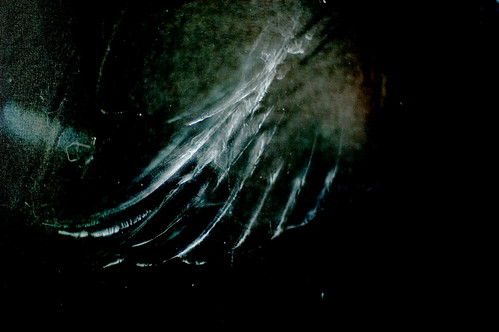
Birdstrike wing

A photo my brother took of the mark left by a bird hitting his window. You can see the whole bird in this one.


Birdstrike wing

Originally uploaded by rutherfordfamily.

Categories
Nature

Top ten animals – #9, Chimpanzee

To see any of the apes in the wild would be a big deal. In some ways, the others are more appealing; the huge but (relatively) gentle gorilla, the mournful-looking orange Orang*, and the currently trendy pan-sexual bonobo all have a glamour to them which the chimp has rather lost, with the PG Tips ads and the years spent hanging out with Ronald Reagan and Michael Jackson. I was even tempted to choose one of the gibbons; they may be ‘lesser’ apes, but they have a hell of an acrobatic way of getting through the trees.

In the end, though it had to be the Common Chimpanzee, Pan troglodytes.

(picture of chimp in the Gombe Reserve, Tanzania, from National Geographic).

The chimpanzees are our closest living relatives, of course. We’re equally closely related to common chimps and bonobos, but I picked P. troglodytes because – well, I don’t know, really.

One thing that’s not always appreciated about chimps is that if you ever see a trained chimp, in a Tarzan movie or an advert, it’s a juvenile. That’s because while a young chimp is cute, trainable and manageable, an adult male is 120 pounds of unpredictable, aggressive muscle. The one pictured above, named Frodo by Jane Goodall in one of her stupider moments, later stole, killed, and started to eat the child of a park employee. Tolkien would be proud.

Chimps aren’t nice. But they are clever. They crack nuts open with rocks, they strip leaves from twigs and use them to fish termites out of mounds, they hunt cooperatively, they’re political; you can even teach them some rudimentary language. They are nearly what we are; we are nearly what they are. They’re the point at which the mystery of evolution comes closest to home, and yet it’s still not easy to think of something like them turning into us.

Baby chimps look more human than the adults, with flatter faces:

At some stage in our evolution, the physical development of our heads became slowed or interrupted in some way. Desmond Morris called us ‘The Naked Ape’, but we’re also the baby-faced ape.

*isn’t it a pleasing coincidence that ‘orange’ and ‘orang’ are almost the same word?