Categories
Culture

poetry dialectics

The oppositional pairs that come up in discussions of poetry – difficulty vs. accessibility, or sincerity vs. knowingness – are always discussed as though they are pressing questions for our time. But these dialectics have always been present. There have always been some poets who value innovation and others who would rather produce highly finished work in the established mode; there have always been some poets whose poems are intimate, and others who seem to hold their work slightly at arms length. The dominant style changes over time, but the tensions within it are of the same type. Looked at that way, very broad classifications like Avant Garde vs. School of Quietude look more like axes on a Myers-Briggs personality test than actual movements.

Hmm. Maybe in the morning I’ll be able to decide whether that’s a brilliant insight or a statement of the obvious.

Categories
Culture Other

The New Sincerity

Anyone reading this who’s not up to speed on the poetry movement called the New Sincerity should start by digging around in the archives here and here.

I’ve cheerfully read the manifestos without reading any of the poems. I daresay I could find some poems by the central New Sincerists if I just dug around the web for a bit, but it would seem a pity to dilute the purity of the manifesto-reading experience. From these manifestos (manifesti?) I have learnt that the New Sincerists write poems which are sincere. I don’t think I’ve ever written a poem which was intended to be insincere; so perhaps I have been a New Sincerist (or at least a Sincerist) all along, without even knowing it.

But I wonder if a lack of insincerity is enough. The word ‘sincerity’ leads me to expect poems which are earnest, heartfelt, and, if not confessional, at least personal. I don’t think I’ve written a poem in the last few years which was about me in any important way. Most of them are things like this. Does it even mean anything to say that this poem is or isn’t sincere?

Bamiyan

The saints and rood screen
have been broken up and burnt,
the murals covered with limewash.
Only the stained-glass windows glow,
and the face of the transfigured Christ
has been scratched out
that the light might shine through clearer.

I guess I’m just trying to pin down what ‘sincerity’ means in poetry. The Romantics generally seem pretty sincere, except perhaps Byron. I’m pretty sure Milton was sincere; was Donne? Herrick? Are Shakespeare’s sonnets sincere? Is there any way of telling? Does it matter? What about Pope? Is The Dunciad more or less sincere than An Essay on Man?

Categories
Culture

The greatest painting in Britain shortlist

Only one of the six paintings I picked (the Hockney) got onto the final shortlist of ten. That shortlist in full:

The Arnolfini Portrait by Jan van Eyck

The Hay Wain by John Constable

A Rake’s Progress III: The Orgy (1733-4) by William Hogarth

The Fighting Temeraire tugged to her Last Berth to be broken up, 1838 by Turner

The Baptism of Christ by Piero Della Francesca

The Bar at the Folies Bergere by Manet

Sunflowers by Vincent Van Gogh

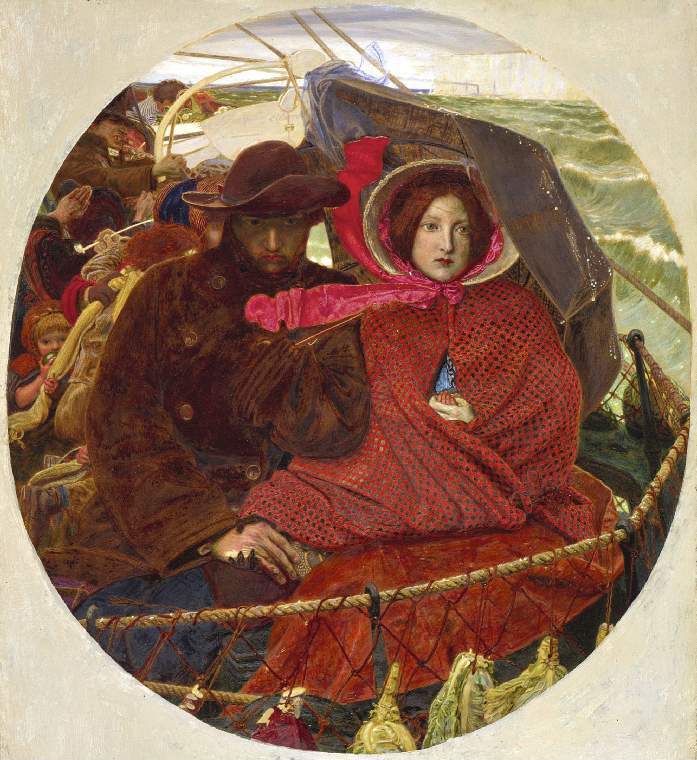
The Last of England by Ford Madox Brown

The Reverend Robert Walker Skating on Duddingston Loch by Sir Henry Raeburn

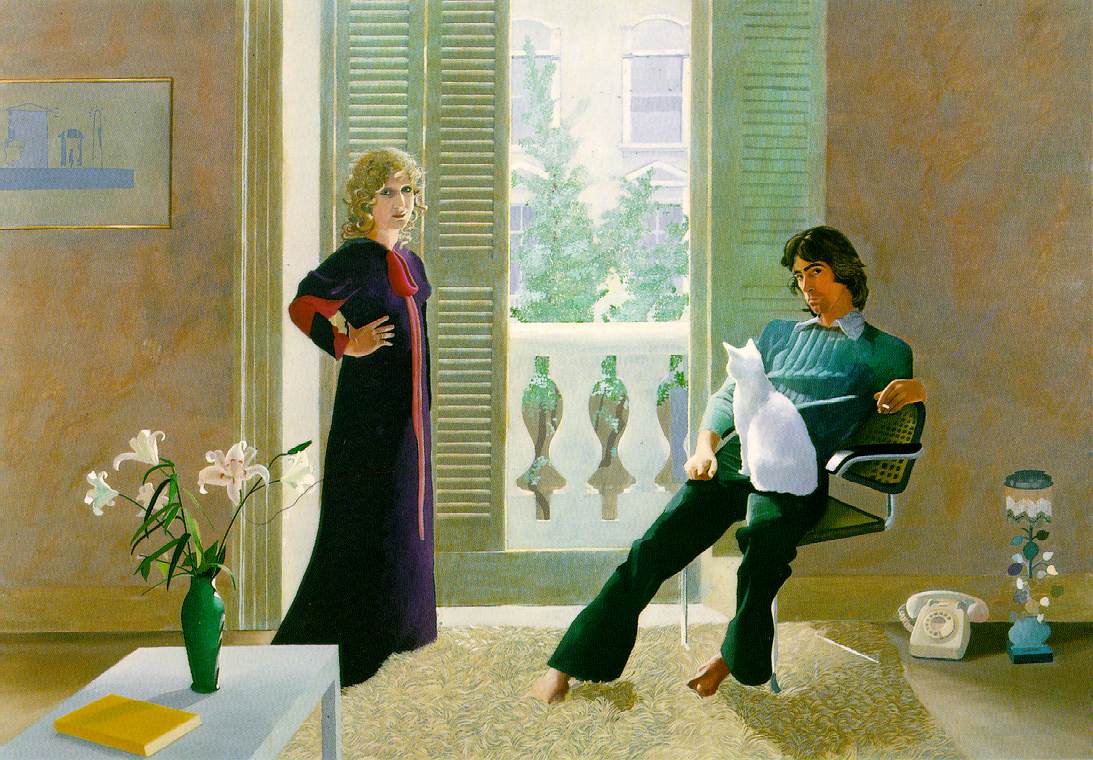
Mr and Mrs Clark and Percy by David Hockney

A lot of British paintings, not surprisingly. The only one that seems wildly out of its depth is the Madox Brown, which looks like a very ordinary piece of Victorian narrative painting to me. The van Eyck and the Turner are both paintings I considered picking – you certainly have to have something by Turner, the only question being which one. The Hay Wain is certainly a much better painting than its status as a piece of kitsch Englishiana would suggest, but I’ve never really connected to Constable, somehow. Sunflowers isn’t even the best painting by Van Gogh in the National Gallery. I’m not wild about the Manet – I said something earlier about the Impressionists not being at their best painting people; that may have been a bit sweeping, but I think this is a case in point. It’s attractive enough, but lacks the transcendant quality of the best Impressionist landscapes. The Hogarth is lively and entertaining, but those aren’t qualities I rate particularly highly in painting.

A couple of other observations. There are no paintings from between the C15th and C19th, which means no Vermeer, Velasquez, Rubens, Caravaggio, Titian, or Rembrandt for a start. And the only C20th painting is the Hockney, which means nothing abstract and nothing foreign. Britain isn’t especially rich in modern art – Tate Modern’s collection is distinctly patchy – but there are paintings by, for example, Picasso, Miro, Mondrian, Modigliani, Rothko, and Pollock. I suppose in a lot of cases there’s a sense that the very finest paintings by an artist are elsewhere; the Botticellis in the National are OK, but nothing to the ones in Florence, and similarly with Vermeer, Velasquez, Picasso, and Matisse. I would have thought the Rembrandts in the National might make the cut, though.

EDIT: Hogarth is C18th, of course. A better way of putting it might be: all the non-British paintings are either Renaissance or Impressionist.
Categories
Culture Other

Explaining Hamlet to the Tiv

A hilarious exercise in comparative literature: Shakespeare in the Bush. via Copia.

Categories
Culture Me

Why ‘Heraclitean Fire’?

The title of the blog is from the Hopkins poem That Nature is a Heraclitean Fire and of the comfort of the Resurrection.

I think Hopkins makes a good touchstone for what poetry can be. His work is difficult – both linguistically experimental and intellectually abstruse – but it is always trying to communicate something. He is nothing if not sincere. And he never stops making beautiful noises.

Categories
Culture

Stuckism

Stuckism came up in the context of the New Sincerity.

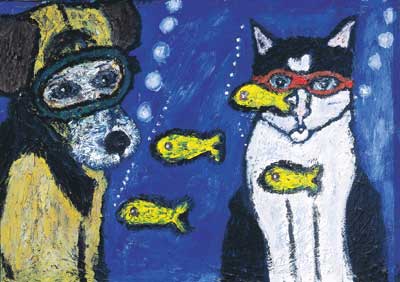
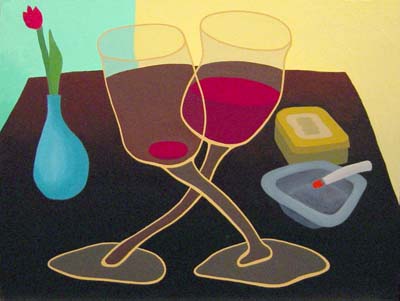
Certainly the manifesto provides parallels. The actual work turns out to be seriously disappointing. For a movement than emphasises authenticity and non-cleverness, the Stuckists seem to produce a lot of work which is jokey and shallow:


‘Dog and Cat Underwater’ – Wolf Howard


‘Two Wine Glasses Remembering that They Used To Be Very Fond Of Each Other’ – Charles Thomson

… or very image-conscious and referential. Paul Harvey, who actually looks like the pick of them in terms of producing attractive objects, does things like paintings of supermodels in the style of Alphonse Mucha. How much more PoMo can you get? He’s even done a Mucha-esque painting of a woman holding one of his own Mucha-esque paintings:


‘The Stuckists Punk Victorian’ – Paul Harvey

Others are just mediocre. Some rather clunky naive painting:


‘About Last Night’ – Philip Absolon

…some complete tat: