Categories
Culture

Chaka by Thomas Mofolo

Chaka is a fictionalised account of the life of the C19th Zulu king Shaka. It’s unusually early for an African novel, originally published in 1925 but existing in manuscript in some form as early as 1910.

I wasn’t entirely looking forward to reading it. It has started to really bother me when those who rose to power and built empires through force are presented as Great Men, as admirable or heroic. Qin Shi Huang, Alexander the Great, Napoleon: these men were ruthless megalomaniacs who glorified themselves through the misery of others. But we are fascinated by power, and there’s never a shortage of people who are willing to read history through rose-tinted bifocals. Hell, the Russians are even doing their best to rehabilitate Stalin.

I assumed that Chaka would do the same; but part of the reason I enjoyed it so much is that, on the contrary, its portrayal of Shaka is absolutely excoriating. He is presented as a handsome man of great courage and physical and military prowess; but also as capricious, cruel, violent and terrifyingly, unswervingly power-hungry. In fact the scale of his violence, against his own people as well as his enemies, would seem ridiculously exaggerated, if you’d never heard of Stalin, or Mao, or Idi Amin.

Which isn’t to say that the novel is historically accurate. It doesn’t even pretend to be; it’s told very much in a mythic, folkloric style rather than a historically realist one, and it takes substantial liberties with the history for the sake of telling a good story, to the point of inventing major characters — including Chaka’s love interest and a sorcerer who provides him with his power. His life story is tweaked and manipulated to bring out the themes of ambition and power, and present him with decisions which are loaded with symbolic resonance. I would normally shy away from comparing a writer to Shakespeare — just too much baggage — but as a piece of myth-making based freely on a historical source, it really reminds me of Macbeth or King Lear.

I wasn’t immediately gripped by it, but as the action ramped up and Chaka developed into a more and more extreme character, I thought it was electrifying.

Chaka is my book from Lesotho for the Read The World challenge; a quick hat-tip to the translator, Daniel P. Kunene.

» The Chaka Print cloth ticket is from Trevira’s collection of cloth tickets on Flickr. She explains:

These large gummed labels – known as cloth tickets – were attached to bales of printed cotton cloth for export from Britain (read ‘Manchester’ in many cases). They were designed by British artists who depended on information from company agents in the various territories for subjects that were intended to be appealing for their markets.

It is used under a CC by-nc licence.

Categories
Culture

Dona Flor and Her Two Husbands by Jorge Amado

Dona Flor and Her Two Husbands is a novel about a cooking teacher whose first husband is a charming lowlife, who is always disappearing in search of wine, women, song and roulette, and her second marriage to an upright, responsible, devoted pharmacist who, for all his good qualities, is duller and more reserved. Especially in bed.

Having read the long and mildly tedious Island Boy, I picked it up in the hope it would be a bit more fun. It’s fiction, it’s Brazilian, all the blurbs on the cover go on about it being exotic, sexy, tropical, the work of a great story-teller… all the kind of joyous clichés you’d hope for from the country that gave us Elza Soares, Ronaldinho and the caipirinha. I don’t only want to read books reinforce national stereotypes, but in a wet London November, a bit of Brazil seems quite tempting.

And more importantly, it was recommended by a friend. So after some of the deeply obscure, hit and miss books I’ve read for the Read The World challenge, I was hoping for something juicy and enjoyable. Something that was not likely to feel like a chore.

Sadly it didn’t quite hit the spot. Not because it doesn’t have all those Brazilian clichés: it starts with a character dying unexpectedly during carnival while dancing in full drag, and the whole book is full of gamblers and whores and serenades, and sex and food, and humour and social satire, and a bundle of other things besides. Just reading my own description of it almost makes me want to read it again; but the actual experience of reading it wasn’t so great.

Not that it’s a bad book, but it didn’t ever quite grab me; and after 550 pages, any book that you’re not actively enjoying is going to seem like a bit of a chore. I’d be hard pressed to identify any very glaring problems with it. The characters seemed a trifle two-dimensional — particularly the two contrasting husbands, who might as well be called Id and Superego, or Apollonian and Dionysian — and the plot is perhaps stretched a bit thin; but it might just as well be that I wasn’t in the right mood for it and tried to read too much of it when I was half asleep. So while I’m not about to give it a glowing endorsement, I wouldn’t want to be too negative, either. Pathetically wishy-washy, I know.

» NOM NOM NOM is © Capitu and used under a CC by-nc licence.

Categories
Culture

‘Points of View’ at the British Library

I just visited the slightly uninspiringly titled ‘Points of View’ exhibition at the British Library, which is an exhibition of nineteenth century photography. I’ve been very impressed with the BL’s temporary exhibitions since they moved to the new site; they obviously have an absolutely staggering amount of stuff in their collections and they do a good job of displaying it, with a thoughtful selection of material and lots of interesting information.

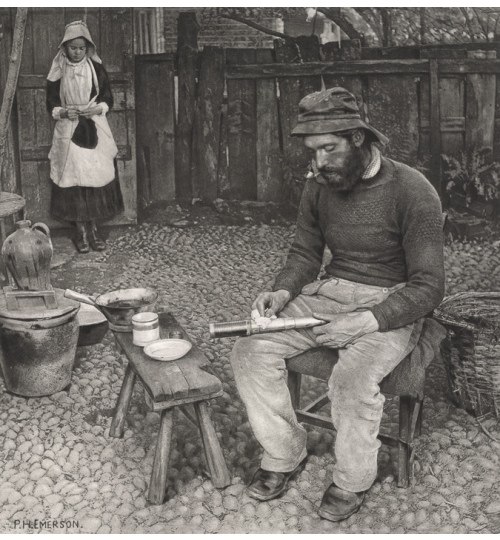
fisherman

Not all subjects are equally interesting, of course — I glazed over a bit going round their exhibition of modernist pamphlets — but C19th photography has a broader appeal. It starts with the early history, Fox Talbot and all that, and then the rest of the exhibition is arranged thematically: travel, portraits, science, industry and so on. I liked the way they manage to provide plenty of variety: some pictures chosen for artistic merit, others for historical, social or technical interest, and some a bit quirky, like spirit photographs taken by spiritualists. Or the staged picture taken by an Indian Army officer of an officer being woken by his manservant after a drunken night before.

mussucks

One thing that is striking is the explosive speed with which photography became popular: from Fox Talbot’s early experiments in the early 1840s, it was a major commercial enterprise within ten years, and being used in every conceivable way all across the world, from Brazil to the Himalayas, within twenty. Perhaps that isn’t surprising — the advantages are obvious — but when photographs were taken with fragile glass plates which had to be chemically prepared immediately before use in a portable darkroom, it is still remarkable.

The exhibition is kind of huge, but it’s also free, so you could always take a break halfway round and go for a cup of tea and a bun.

» ‘A Fisherman at Home‘ is from Peter Henry Emerson’s Pictures From Life In Field And Fen, a photographic record of life in East Anglia published in 1887.

The other picture is a section of ‘Mussucks for crossing the Beas River, Kulu‘, taken in India by Samuel Bourne in 1865. The ‘mussucks’ are inflated bullock hides used to cross the water.

Categories
Culture

‘The Sacred Made Real’ at the National Gallery

To quote their own blurb:

The Sacred Made Real’ presents a landmark reappraisal of religious art from the Spanish Golden Age with works created to shock the senses and stir the soul.

Paintings, including masterpieces by Diego Velázquez and Francisco de Zurbarán, are displayed for the very first time alongside Spain’s remarkable polychrome wooden sculptures.

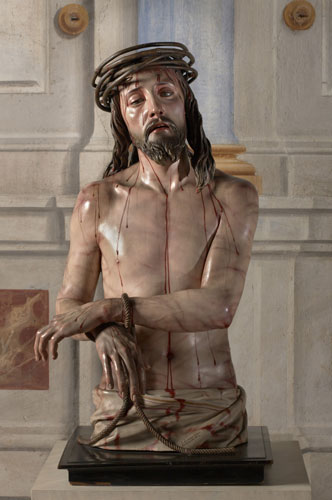
By ‘polychrome wooden sculptures’ they mean things like this, Christ as the Man of Sorrows, 1673, by Pedro de Mena (I’ve had to take the picture from the Guardian, which has a good selection, because the NG has got no images on the exhibition website at all):

Sacred-Made-Real-Christ-a-016

I find this business of coloured sculpture intriguing, because of course if you’re aiming for verisimilitude it makes perfect sense; and yet, largely by historical accident, we have come to expect sculpture in the fine art tradition to be in the bare material, whether marble, bronze or whatever.

These works looks especially foreign from a Protestant perspective. And yes, I know I keep going on about being an atheist, but I’m clearly a Church of England atheist when it comes to my religious sensibilities. And the Protestant aesthetic of whitewashed churches and plain glass is explicitly intended to contrast with this kind of art; it is sculptures like these that are processed through the streets of Seville in Holy Week by masked penitents, which must be the apotheosis of the bells and smells side of Catholicism. Protestants over the years have found that either tawdry and vulgar or solemn, dignified and mysterious, according to taste, but one way or the other it has a fascinatingly exotic quality for those of us brought up with the tea and biscuits kind of Christianity.

My initial reaction to these sculptures was ambivalent; there was something spooky or creepy or just a bit odd about them. And I don’t mean the gore; the head of John the Baptist where the cross section of the neck looks like something from the butcher’s, or Christ bruised and dripping with blood. No, even the statues of saints and the Virgin seemed a bit creepy at first encounter. St Ignatius Loyola, with his dark robes, looks like something that might lurch out of the dark at a carnival ghost train.

I’m tempted to invoke the uncanny valley, but actually I think it’s mainly simple unfamiliarity. The sculptures only seem like something from Madame Tussauds — something other than fine art — because of my expectations. Eventually, once I had been in the exhibition for a while, that sense of novelty wore off a bit; and eventually I was able to stop overthinking it and start to respond to the works as pieces of art.

And once that happened I did start to appreciate them and find them quite effective. They are not my new favourite thing, and I’m still not sure I’d say I really like them, even. But I’m certainly glad I went. Thought-provoking stuff.

There are also some fine paintings in the show as well, incidentally, by Velázquez and Zurburán particularly; but those were more familiar and less interesting to me, except in the way they provide a context for the sculptures. It is interesting, for example, that although they are recognisably part of the same religious culture, the paintings are immediately and obviously ‘art’, while my reaction to the sculptures was so much more difficult.

Categories
Culture

Island Boy by Tom Davis

…or to give him his full title: Sir Tom Davis, Pa Tuterangi Ariki, KBE. The ‘Pa Tuterangi Ariki’ bit was a title he got by marriage; the knighthood was all his own. Davis was the Prime Minister of the Cook Islands from 1978-87, and Island Boy is his autobiography. He was undoubtedly an impressive individual — he studied medicine in New Zealand, then took the job of Medical Officer of the Cook Islands, where he modernised a decrepit colonial medical service; then he sailed his young family in a small yacht from the Cook Islands to Boston to study public health; did some medical work in Alaska; then he took various research jobs in the US, including research on physiological adaptions to extreme conditions for the army and the nascent space program; raced sports cars; then returned to the Cook Islands to enter politics as a free market ideologue, eventually becoming Prime Minister.

So there’s lots of good material. However, although Davis wrote perfectly well, he was not a dazzling prose stylist, or a man with a gift for anecdote, and he clearly had no intention of sharing anything very personal; he mentions two marriages, a divorce and several children during the book but gives absolutely no details at all. So what you get is a straightforward, by the numbers autobiography which is often interesting but also often a bit of a chore. I don’t think he was terribly introspective, to be honest. His obituary, which I found while trying to learn more about his title, says (among more flattering stuff):

A driven and ambitious man, he was sometimes seen by his peers as arrogant and conceited.

And that does ring true. He is certainly really quite dismissive of most of his political colleagues and opponents.

I ordered Island Boy as my book from the Cook Islands for the Read The World challenge, before realising that the Cook Islands wasn’t actually on my list of countries, which is based on UN membership. But the list isn’t that rigid, and having bought it I may as well count it.

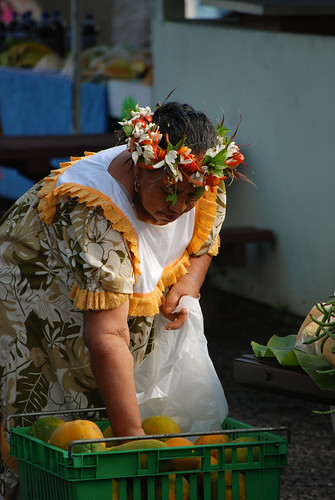
» The picture, Avarua Market, is © Daniele Sartori and used under a CC by-nc licence.

Categories
Culture

‘Pop Life’ and ‘John Baldessari’ at Tate Modern

Two superficially very different exhibitions at Tate Modern at the moment. One is Pop Life: Art in a Material World; to quote the blurb:

Andy Warhol claimed “Good business is the best art.” Tate Modern brings together artists from the 1980s onwards who have embraced commerce and the mass media to build their own ‘brands’. Pop Life includes Andy Warhol, Damien Hirst, Jeff Koons, Takashi Murakami and more.

Which is flashy, exhibitionist, loud — several rooms have music playing — and vulgar. I don’t mean to be snobby; much of it is intentionally vulgar. Not least Jeff Koons’ kitschy hardcore porn imagery.

The other is John Baldessari: Pure Beauty [which doesn’t have much of a website just yet… they may just be running a bit late]. The tone of which is much more Serious and Arty. Not that it’s humourless, there’s plenty of dry wit on show; but it’s all very restrained and low-key. Series of small photographs, made with an eye on content rather than beauty. Stills from black and white films with sections blanked out. Rather formally-constructed photocollages. The later work gets larger in scale, more complex and I think more human, in the sense that his collages refer more directly to emotions and issues and almost form proto-narratives; but it’s still very tightly controlled and visually restrained.

So stylistically, they’re quite different. It’s a distinctly different experience going round them: the Baldessari is much less likely to give you a headache, for a start. To some extent, though, I think it’s as much a difference of personality as of kind. Not everyone enjoys celebrity and celebrities, and money and noise and going to Studio 54 with Grace Jones — or whatever the equivalent was for Damien Hirst in the 90s. But if you were an art critic from Mars, or a few hundred years in the future, the similarities might seem more significant than the differences.

Though having said that, the artists brought together in the Pop Life show are themselves a slightly mixed bunch, so perhaps I should resist making any more sweeping generalisations anyway. I mean, Tracey Emin, Keith Haring and Jeff Koons don’t necessarily have a great deal in common beyond a talent for self-promotion. Perhaps the Tate thought it would be a bit blunt to just call the show ‘Masters of Hype’.

Incidentally, having been at school at the time when Keith Haring merch — bags, pencil cases, whatever — was all the rage, it seems odd to find him in the Tate. It’s like finding a room dedicated to seriously analysing the artistic importance of Hello Kitty. Or Thundercats.