Categories
Culture

Books of the Year 2008

As ever, these are books I read in 2008, not necessarily or usually books published in 2008. The selection process wasn’t terribly rigorous; I just quickly picked out titles I particularly remember enjoying. I blogged about most of the books I read this year, so rather than go over them again, I’ve provided links to those posts. In the order I read them, these are my picks for the year:

Looking at that list, I’ve had a particularly good year for fiction this year, partially because of the Read The World challenge; the Aitmatov stands out as an example of a book I thought was really good and which it’s very unlikely I would have read if I hadn’t been looking for a title from Kyrgyzstan.

The Mitford letters might be the pick of the non-fiction; I knew they’d probably be worth reading, because they were an extraordinary bunch and several of them wrote well, but I wasn’t expecting to enjoy them as much as I did. Like a sparkling, witty and very posh version of Heat magazine, only with Hitler and Evelyn Waugh instead of Amy Winehouse.

Categories
Culture

Probably not one for purists

After my recent rant about what epic poetry isn’t, I feel I ought to share the fact that Dante’s Inferno is being made into… a computer game.

Can you hear that distant buzzing sound? That’s Dante spinning in his grave.

I admit to being intrigued, though; since the poem is distinctly short of sword-wielding action, being more of a walking tour of hell than anything else, I am curious to know how they’ve turned it into a game. And it does look sort of cool.

Categories
Culture

The Butterfly’s Burden by Mahmoud Darwish

The Butterfly’s Burden is a translation of three books by the Palestinian poet Mahmoud Darwish who died earlier this year: The Stranger’s Bed (1998), A State of Siege (2002) and Don’t Apologise for What You’ve Done (2003). It’s a parallel text edition, which always makes me feel terribly learned, but in practice is just a waste of trees since I can’t even read Arabic script.

I am writing this post without having read the whole thing, which may be an admission of defeat. I’ve been having some difficulty connecting to it. I’m not inclined to blame Darwish for that: I imagine it’s partially the basic awkwardness of reading poetry in translation which is, as they say, like eating a Mars bar with the wrapper on; partially a lack of contextual knowledge on my part; and perhaps partially down to the translation by Fady Joudah, although I’m not in a position to judge it as a translation. And of course, very likely because of my own biases as a reader.

I initially picked it up and dipped in at random, which wasn’t a success, so I sat down and read A State of Siege straight through from beginning to end, and actually I did quite get into it and enjoy it. So, heartened by that, I tried the same thing with The Stranger’s Bed, but despite a few moments where I thought I was getting somewhere, I found it a bit of a chore. There were images or passages or moments that I thought were striking or effective, but I felt that on some basic level I just wasn’t getting it; the whole wasn’t cohering into more than the sum of the parts, and I found it all a bit frustrating.

I will make an attempt on Don’t Apologise for What You’ve Done as well, but whether or not I finish it I’m still going to claim Darwish as my writer from Palestine for the Read The World challenge, because I read two of the three books, and I think that’s good enough.

For an extract I’m going to pick something from A State of Siege, since that was the book I enjoyed most; in a sense, though, it’s a more difficult piece to pick extracts from because it isn’t divided into separate poems. Instead, it’s a thirty-page poem built up of short lyrical fragments, separated on the page by a little typographical squiggle. They work together cumulatively, and the poem has a kind of reflective tone; they could be the journal entries of a slightly gnomic diarist, or the contents of a notebook. The poem was written during the Second Intifada, and the conflict is the central subject, but the poem circles around it, sometimes explicitly talking about politics and violence, sometimes about poetry or love.

The mother said:
I did not see him walking in his blood
I did not see the purple flower on his foot
he was leaning against the wall
and in his hand
a cup of hot chamomile
he was thinking of his tomorrow …

The mother said: In the beginning of the matter I didn’t
comprehend the matter. they said: He just got married
a little while ago. So I let out my zaghareed, then danced and sang
until the last fraction of the night, when
the sleepless were gone and only baskets of purple flowers
remained around me. Then I asked: Where are the newlyweds?
Someone said: There, above the sky, two angels
are consummating their marriage … So I let out my zaghareed,
then danced and sang until I was struck
with a stroke.
When then, my beloved, will this honeymoon end?

This siege will extend until
the besieger feels, like the besieged,
that boredom
is a human trait

O you sleepless! have you not tired
from watching the light in our salt?
And from the incandescence of roses in our wounds
have you not tired, O sleepless?

We stand here. Sit here. Remain here. Immortal here.
And we have only one goal:
to be. Then we’ll disagree over everything:
over the design of the national flag
(you would do well my living people
if you choose the symbol of the simpleton donkey)
and we’ll disagree over the new anthem
(you would do well if you choose a song about the marriage of doves)
and we’ll disagree over women’s duties
(you would do well if you choose a woman to preside over security)
we’ll disagree over the percentage, the private and the public,
we’ll disagree over everything. And we’ll have one goal:
to be …
After that one finds room to choose other goals

» The photograph is of Mahmoud Darwish’s funeral in Ramallah and is © activestills.org.

Categories
Culture

The Unknown Matisse by Hilary Spurling

The Unknown Matisse is the first of two volumes, taking our hero from 1869-1908. I actually bought it some time ago on Jee Leong‘s recommendation, but it has taken me some time to finish, mainly I think because the simple physical size of it makes it slightly awkward to read in bed. It’s not that huge, but it’s quite a fat volume and printed on large format paper to make space for some colour reproductions of the work. Which are, of course, lovely and very welcome.

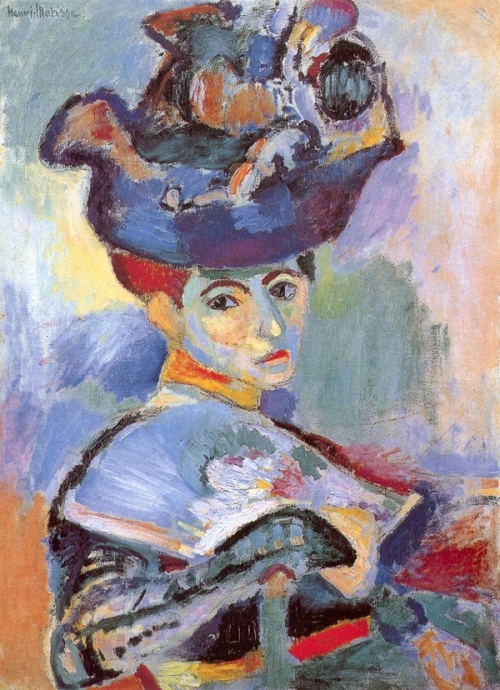
It’s fascinating to read about the outrage that greeted paintings which now seem, if not tame exactly, at least uncontroversial. Indeed the first time he shocked the Parisian public, it was with a painting (The Dinner Table) that now looks positively conventional.* Over the past hundred years, outraging the public has become an explicit part of the job description for artists; but how much more satisfying to shock people not by placing a sculpture of Christ in a glass of urine, or exhibiting a work consisting of a room with the lights going on and off, but with a painting of a woman in a hat.

Not that Matisse seems to have been temperamentally inclined to shock people for its own sake. Some of the other modern artists obviously rather enjoyed the opportunity to wind up the public: André Derain came back from a visit to London with a classically tailored English suit made fauvist by the choice of a green fabric, with a red waistcoat and yellow shoes. Matisse, though, was more inclined to respectability: partially because unlike most of his contemporaries he had a young family, which meant he needed at least enough saleable work to keep them in food. But also because (through no fault of his own) he was caught up in the most magnificently baroque financial and political scandal I’ve ever heard of — really, it would merit a book by itself — which gave him enough experience of public notoriety to last a lifetime.

It’s a fine book, readable, evocative, well-researched.  Or at least it gives the impression of being well-researched, which is as much as I have the expertise to judge.

* Although actually, in one of their periodic fits of cynical outrage about the Turner Prize, the Daily Mail held a ‘Not the Turner Prize’ competition, open to the public, and the work in that suggested that there are still plenty of people in Britain who feel that the highest aspiration of the painter should be photographic accuracy. Preferably of tigers. Or steam trains.

Categories
Culture

Pulp Beowulf

A link from C. Dale Young sent me to this article which is rather unflattering about a scheme to promote poetry in Seattle. What got me going, though, was this, from someone defending the scheme in the comments:

On comprehending poetry: you say “Poetry, by its very definition, is a difficult thing to write and to comprehend.” Certainly you can’t mean this, or perhaps you are simply uninformed. Since Mallarmé and especially since TS Eliot, perhaps, poetry’s hallmark is to be difficult, but again this is recent history given the history of bards: the Odyssey was the equivalent of a pulp fiction bestseller or action-adventure flick, ditto Beowulf and the Eddas. The Canterbury Tales, the Divine Comedy and Paradise Lost were intended to be blockbusters, not PhD theses. Shakespeare was not looking to mystify the objects of his love sonnets, nor is the work of Walt Whitman, Emily Dickinson, William Carlos Williams, Langston Hughes, Adrienne Rich, Carlos Drummond de Andrade, Ntozake Shange, Sharon Olds, Saul Williams, Li-Young Lee or in fact most poets worth their salt supposed to be incomprehensible or even that difficult.

Now I agree with the basic point that difficulty is not an essential quality of poetry. But as someone with an interest in Anglo-Saxon poetry, I notice references in the media, so I have encountered this idea before, that Beowulf ‘was the equivalent of a pulp fiction bestseller or action-adventure flick’.

It is a fucking ridiculous comparison.

One version of it is based, as far as I can tell, simply on the kind of story it is: Beowulf is about a buff warrior-hero type who goes out and fights monsters, so it must be the Dark Ages version of Die Hard or Independence Day.  Now I happen to believe this is a profound misreading of the poem, at least until someone makes a version of Die Hard which concerns itself deeply with the fragility, briefness and futility of human existence, or a version of Independence Day where the aliens win at the end.

But to properly try to refute that argument would be a difficult exercise, hedged around with qualifiers and uncertainty, because anyone who claims to know why Beowulf was written, who it was written for, how it was received or what kind of place it had in the culture is talking out of their arse.
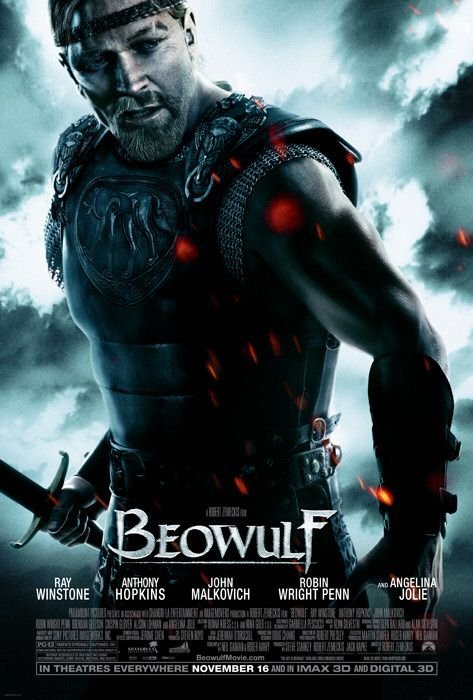
Do you know how many surviving copies there are of long narrative Anglo-Saxon poems on non-Christian mythological themes? One. Beowulf. We assume that it is the only survivor from a rich oral culture of similar poems that were either never written down or have been lost — but we don’t know. And we certainly don’t know if Beowulf is a typical example, or how much it was changed when it was written down… or anything much at all, really.

And as for the statement that ‘the Canterbury Tales, the Divine Comedy and Paradise Lost were intended to be blockbusters, not PhD theses’: Jesus wept.

I mean Chaucer, maybe sorta kinda; Dante I don’t know much about, although even in C14th Florence there must have been more populist options available than the theological epic; but Milton? Seriously? He’s your example of poetry not having to be difficult? There aren’t many poems in English more self-consciously literary, less populist and more stubbornly unwilling to make life easy for the reader than Paradise Lost.

I think what annoys me so much isn’t the inaccuracy of these comparisons: it’s the fact that anyone wants to make them at all. I understand the wish to resist the ghettoisation of poetry as an recondite and überliterary artform. And it’s true that there is a long and valuable tradition of popular, accessible poetry, much of it ephemeral but some of real merit. But to compare Homer and Beowulf to action movies, or call the Divine Comedy a blockbuster, and think you’re doing them a favour… I just don’t get it.

Categories
Culture

Ageispolis