Categories
Culture

The Day Lasts More than a Hundred Years by Chingiz Aitmatov

This novel tells the story of Yedigei, a worker at a remote railway junction in the middle of the Kazakh steppes. There’s a refrain which is repeated at intervals throughout the book:

Trains in these parts went from East to West, and from West to East . . .
On either side of the railway lines lay the great wide spaces of the desert — Sary-Ozeki, the Middle lands of the yellow steppes. 
In these parts any distance was measured in relation to the railway, as if from the Greenwich meridian . . .
And the trains went from East to West, and from West to East . . . 

Yedigei is taking the body of a friend to be buried at a traditional cemetery out in the steppes, and his life story is told in flashback. The railway junction is near a rocket launch site, and running in parallel to Yedigei’s story is a strange subplot about cosmonauts making contact with an extraterrestrial civilisation.

Aitmatov was from Kyrgyzstan, and The Day Lasts More than a Hundred Years is my book from Kyrgyzstan for the Read The World challenge. In some ways, though, it’s very much a book of the Soviet Union. It was written in Russian and is set in Kazakhstan, and one of the themes in the book is the tension between the traditional Kazakh culture and the Soviet bureaucracy.

Which isn’t to say it’s some kind of radically dissident novel; according to the introduction, Aitmatov (who died earlier this year) was a firmly establishment figure, a correspondent for Pravda, winner of a Lenin Prize and a State Prize for literature, and a winner of the Hero of Socialist Labour medal. The material which is most critical of the government is about things which happened under Stalin; presumably by 1980, when this novel was published, that was fair game.

Incidentally, this English edition was published in 1983 and it’s really strange to be reading all this stuff in the present tense. ‘He is a member of the Supreme Soviet, was a delegate to the last four Party Congresses…’ I wouldn’t say it makes me nostalgic exactly, but it is a bit of a throwback to my childhood.

In 1952 the summer was even hotter than usual. The ground dried out and became so hot that the Sarozek lizards did not know what to do; they lost their fear of people and were to be found sitting on the doorstep, their throats quivering, with mouths wide open, trying somehow to find shelter from the sun. Meanwhile, the kites were trying to get cool by soaring to such heights that you could no longer see them with the naked eye. Just now and again they gave themselves away with a single cry and then once more they became silent in the hot, quivering, mirage-laden air.
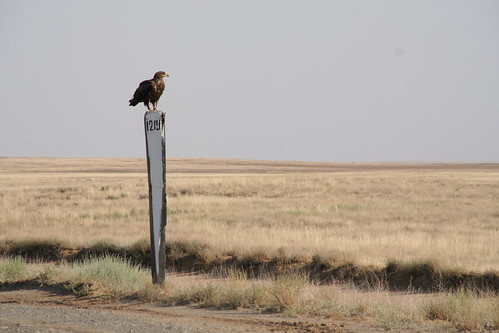
I really enjoyed this book. The setting is striking and atmospheric; the steppes of central Asia, punishingly hot in summer and snow-covered in winter, inhabited by foxes and eagles and camels, with just this one railway line running through it. And the fairly conventional human drama which anchors the book is intertwined with the science fiction subplot on one hand and bits of Kazakh folk myth on the other.

Here Yedigei is dealing with his magnificent but difficult camel, Burannyi Karanar:

That snowfall heralded the start of winter in the Sarozek, early and chill from the very first. With the start of the cold weather Burannyi Karanar became restless, angry and irritable, as once again his male instincts rebelled within him. No one and no thing could be permitted to encroach on his freedom. During this time even his master had to retreat on occasions and bow to the inevitable.

On the third day after the snowfall there was a frosty wind blowing over the Sarozek, and suddenly there arose a thick, chilly haze just like steam over the steppe. You could hear footsteps crunching in the snow far away, and any sound, even the faintest rustling, was carried through the air with exceptional clarity. The trains could be heard coming along the lines when they were many kilometres away. And when at dawn Yedigei heard the waking roar of Burannyi Karanar in the fold and heard him trampling and noisily shaking the fence behind the house, he knew only too well that he was in for trouble. He dressed quickly and stepping out into the darkness, walked over to the fold. There he shouted, his voice hoarse from the astringent air, ‘What’s this all about? Is it the end of the world again? You want to drink my blood? You lecherous beast!’ 

But he was wasting his breath. The camel, excited by his awakening passions, took not the slightest notice of his master. He was going to have his was, come what may. He roared, snorted and ground his teeth threateningly and broke down part of the fence.

Really it’s exactly the kind of book I hoped to find during this exercise: one I’d never heard of and would probably never have read otherwise, which introduces me to a part of the world and a culture I knew little about, but which is above all a really world-class novel. I’d recommend you buy a copy without extensive scribbles in biro all over it, though.

And one last thing, since I think it’s important to give credit to translators: translated by John French.

» the photo of a camel in front of Baikonur cosmodrome in Kazakhstan is © alexpgp and used under a CC by-nc-sa licence. Steppe eagle, Kazakhstan, posted to Flickr by and © rtw2007.
Categories
Culture

Flemish paintings at the Queen’s Gallery

I went yesterday to see Bruegel to Rubens — Masters of Flemish Painting at the Queen’s Gallery, Buckingham Palace. I wasn’t really sure what to expect; you have to love Bruegel, but I’ve always found Rubens easier to admire than to enjoy.

It turned out to be just the one Bruegel on show, with seven or eight paintings by Rubens and a variety of other artists: Teniers, van Dyck, Memling and so on. Or to be strictly accurate, only one painting by Pieter Bruegel the Elder; there are a couple by Jan Brueghel the Elder as well. You can see all the paintings on the exhibition website I linked to above.

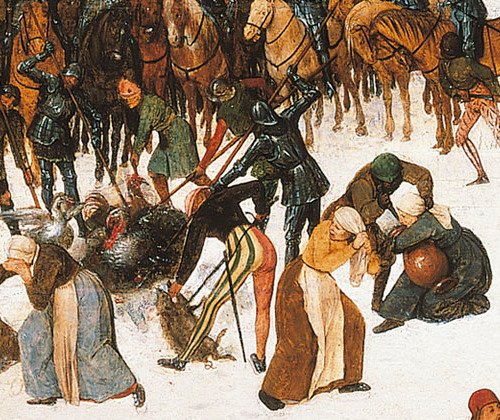
The Bruegel, Massacre of the Innocents, is a hell of a painting. The biblical story of the massacre ordered by Herod has been painted as set in a Flemish village, with the troops in Spanish costume, making it highly topical, apparently, because the Holy Roman Empire had been cracking down on the Netherlands in brutal fashion. The painting was then acquired by Emperor Rudolph II, who presumably for political reasons had the painting edited: all the massacred babies have been painted over to make the scene one of generic plunder.

So wherever you see a soldier slaughtering an animal, or a woman trying to hold on to a storage jar or a bundle of rags, you know that there was originally an infant. In some places, as in the detail above, you can almost make out what it originally looked like.

It really is one of those occasions when reality seems to be demanding to be used as a metaphor for something, but I shall resist.

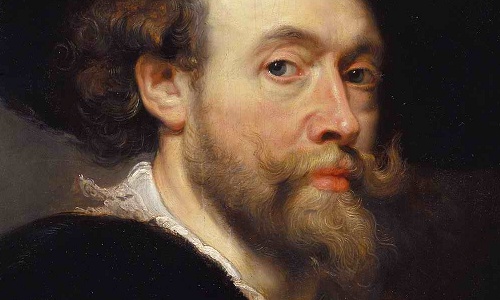
The exhibition didn’t persuade me to love Rubens, or at least, not his mythological works or landscapes (though the painting Winter: The interior of a barn pleased me more than most). There were, though, two Rubens portraits which were really fabulous, particularly his self-portrait. Apparently an English nobleman bought a painting from Rubens, and Rubens, not knowing that it was actually intended for the king, fobbed him off with a mediocre work that was mainly painted by his workshop. The self-portrait was the piece he sent to the king as an apology.

It really is a gorgeous piece of work. It doesn’t make me like all those big pink women any more, but this painting at least is very very covetable.

» I got the pictures from this article about the exhibition. The Royal Collection’s website for the show is very good: all the paintings, I think, with commentary, so do check it out.

Categories
Culture

scribble scribble

Because I need to find rather obscure books for the Read The World challenge, I’ve been buying second-hand copies online. And that has meant an irritation I’ve barely had to deal with since university: people who write all over books.

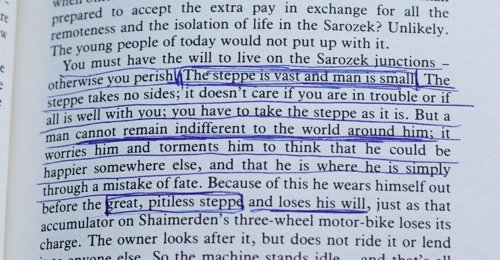
To be fair, whoever wrote in this book was presumably its owner, so they can be spared the special level of hell that I can only hope is reserved for people who write in library books. But eight lines of underlining in blue biro cannot possibly be the best way of annotating a book, even for your own use. It’s far too distracting when you come back to have a look at what you marked earlier.

Use pencil, dammit. And confine the markings to the margin, as God intended. And while I’m on the subject: one sheet of A4 can easily be torn into about 200 scraps of paper that make perfectly serviceable bookmarks; so there’s no need to turn down the page corners.

Harumph.

Categories
Culture

The Kite Runner by Khaled Hosseini

The Kite Runner was really the obvious choice from Afghanistan for the Read The World challenge, since my mother had a copy already. I have to admit I was sceptical about it; the very fact it became so popular at a time when Afghanistan was in the news made me wonder whether its success was based more on topicality than merit. Also the UK edition has a very wishy-washy cover with a sepia-tinged photograph of a small boy on it, and while covers are often misleading, they do at least tell you something about what the publishers think is the market for the book.

And so I rather expected The Kite Runner to be a bit like the book I read for Iran, also written by a refugee who has lived for many years away their home country: nostalgic and rather insubstantial. In fact, it is much darker than I was expecting.

It tells the story of the narrator Amir’s childhood in Kabul, particularly focussing on his relationship with his father and his friendship with the servant boy Hassan; then his life with his father as a refugee in California in the 80s after the Soviet invasion, and a trip back to Taliban-controlled Afghanistan to do a favour for someone. Some of the darkness comes from the brutality of the past 30 years of Afghan history, but Amir’s personal story is one of betrayal and guilt even in his childhood in the relatively peaceful pre-Soviet days.

Generally I thought it was successful: the childhood stuff is gripping and moving; the portrayal of the refugee experience, and the contrast with their life in Afghanistan, is very effective; and the vision of an absolutely shattered Afghanistan under the Taliban is also pretty good. I found the book to be a genuine page-turner; I was reading until 2am a couple of times. Just to be clear, I don’t think it’s a literary masterpiece. But it is a well-written novel that tells a good story.

Hosseini isn’t afraid to pile on the emotive material, and most of the time he manages that without tipping over into corny or melodramatic, but towards the end of the book he did trigger my own personal cynic a couple of times. There’s a confrontation with a member of the Taliban in Afghanistan where the coincidences got a bit too Hollywood for me, and I never quite got pulled back into the book again in the same way after that. I also think he fluffed the last few pages.

So having been thoroughly gripped by the book initially, I was a bit disappointed at the end; even so I would recommend it.

» the photo of boys flying a kite in Kabul is AFG_20071109_169.jpg, posted to Flickr by AndyHiggins.

Categories
Culture

Told by Starlight in Chad by Joseph Brahim Seid

Told by Starlight in Chad is a collection of stories by Chadian writer Joseph Brahim Seid, translated from French by Karen Haire Hoenig. I’ve tagged this post with ‘short stories’ but they aren’t really short stories in the literary tradition: they are fables or folk tales in the oral tradition. I’m not sure whether they are all traditional stories or new ones, or how true they are to the way the stories might be ‘told by starlight’.

In some ways the material seems very familiar — wicked stepmothers, magic purses, and beautiful princesses — although the stories feature hyenas and gazelles rather than foxes and rabbits. Sometimes the stories end with a moral or an explanation of the ‘and that’s why we do so-and-so’ type, and sometimes they are, as far as I can tell, just stories.

Just to give you an idea of the style, here’s the opening to a story called Bidi-Camoun, Tchourouma’s Horse.

A very long time ago, in the days when miracles and wonders were still common among us, a little prince was born in the kingdom of Lake Fitri. Tchourouma was his name; noone knew the reason why. His father loved him dearly and his mother adored him. At a very young age, they had given him as a gift Bidi-Camoun, a splendid chestnut horse. When Tchourouma had barely reached his fifteenth year, his gentle mother died, snatched away by a cruel disease in her chest, which neither the skill of the fakihs, the fetish doctors nor the Bulala witchdoctors could cure. In memory of his beloved wife, the Sultan retained a great deal of affection for the child. He took him lion hunting and on walks around the lake which is the sanctuary of the ancestral spirits and the safeguard of the kingdom. Devoured with envy by the King’s great fondness for his son, the women of the harem devised plots to kill the child….

All quite interesting and quite enjoyable, though I can’t say I was completely grabbed by it. Told by Starlight in Chad is my book from Chad for the Read The World challenge.

» The picture of rock art in Chad, “Round head” paintings, is © Franck Zecchin and used under a by-nc-sa licence.

Categories
Culture

Main Street by Sinclair Lewis

I made a vaguely dismissive comment about Sinclair Lewis in the comments to the Halldór Laxness post, questioning whether he deserved a Nobel Prize. But not long afterwards, in reference to the Wall Street vs. Main Street theme that has been running in US elections, a journalist mentioned the novel Main Street by Sinclair Lewis. Hang on a minute, I thought, that doesn’t sound right… and about 30 seconds of research revealed that I hadn’t been thinking of Sinclair Lewis at all. I was thinking of Wyndham Lewis. A really quite different writer.

So I read Main Street. And actually, it was surprising how often it seemed relevant to the kind of culture war rhetoric that has been coming up on the campaign trail. Especially for a book published in 1920. There was even an argument about whether or not it’s patriotic to pay taxes.

The book is about Carol, a liberal, bookish girl who is non-specifically ‘artistic’; she marries a country doctor and moves with him to his home town of Gopher Prairie, Minnesota, which is part of what Sarah Palin would call ‘the real America’. She goes there with vague but idealistic hopes of improving the town, with beauty or culture or architecture, which founder in the face of the gossipy, judgemental, conservative, hypocritical, prejudiced, narrow-minded, coarse, prudish and generally unsympathetic locals.

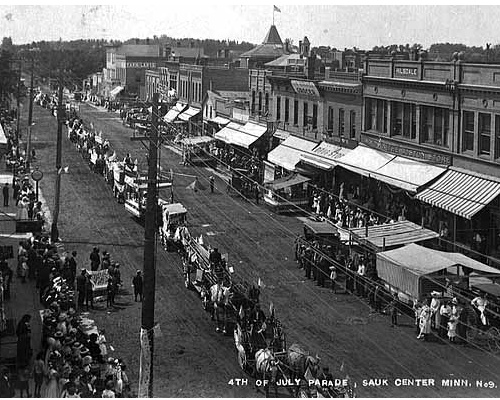
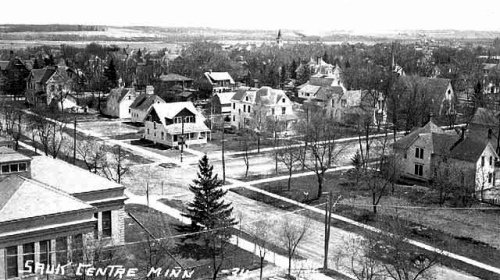
It is a fiercely satirical portrayal of small-town America which confirms all the worst fears of an arugula-eating, latte-drinking liberal like myself*. Lewis came from a small town himself (Sauk Centre, Minnesota), so he was writing from experience, although it does seem possible that he had a few biases of his own.

This is Carol’s first Gopher Prairie party:

Sam Clark had been talking to Carol about motor cars, but he felt his duties as host. While he droned, his brows popped up and down. He interrupted himself, “Must stir ’em up.” He worried at his wife, “Don’t you think I better stir ’em up?” He shouldered into the center of the room, and cried:

“Let’s have some stunts, folks.”

“Yes, let’s!” shrieked Juanita Haydock.

“Say, Dave, give us that stunt about the Norwegian catching a hen.”

“You bet; that’s a slick stunt; do that, Dave!” cheered Chet Dashaway.

Mr. Dave Dyer obliged.

All the guests moved their lips in anticipation of being called on for their own stunts.

“Ella, come on and recite ‘Old Sweetheart of Mine,’ for us,” demanded Sam.

Miss Ella Stowbody, the spinster daughter of the Ionic bank, scratched her dry palms and blushed.

“Oh, you don’t want to hear that old thing again.”

“Sure we do! You bet!” asserted Sam.

“My voice is in terrible shape tonight.”

“Tut! Come on!”

Sam loudly explained to Carol, “Ella is our shark at elocuting. She’s had professional training. She studied singing and oratory and dramatic art and shorthand for a year, in Milwaukee.”

Miss Stowbody was reciting. As encore to “An Old Sweetheart of Mine,” she gave a peculiarly optimistic poem regarding the value of smiles.

There were four other stunts: one Jewish, one Irish, one juvenile, and Nat Hicks’s parody of Mark Antony’s funeral oration.

During the winter Carol was to hear Dave Dyer’s hen-catching impersonation seven times, “An Old Sweetheart of Mine” nine times, the Jewish story and the funeral oration twice; but now she was ardent and, because she did so want to be happy and simple-hearted, she was as disappointed as the others when the stunts were finished, and the party instantly sank back into coma.

The scathing portrayal of Gopher Prairie is pretty relentless, but the book is more than just 400 pages of mocking the rubes. Carol is hardly perfect herself: she’s just a touch too highly-strung and prickly. And her husband may be more interested in motor cars and land deals than Yeats, but he is shown to be a hard-working, resourceful and skilful doctor. 

Mainly, though, I thought it was an enjoyable read: I really got caught up in it as a story, which isn’t true of everything I read these days. The details, both social and physical, are well observed; it’s funny; it has just enough of the soap opera about it to keep me turning the pages. Good stuff.

*Actually, that’s not true, I can’t see the point of latte. But I don’t suppose my organic, single estate coffee grown on a Guatemalan co-operative wins me any Real America points either. And not being American can’t help, of course.

» The pictures of Sauk Centre are from the enormous collection you can find at the Minnesota Historical Society website.

The reason I quoted such a long passage is that it’s out of copyright, so I could just copy and paste it from the Electronic Text Center at the University of Virginia LIbrary.