Categories
Culture

Georg Baselitz at the Royal Academy

Baselitz is a German painter and sculptor. I thought that I knew nothing about him at all, but when I got to the exhibition several of the paintings turned out to be familiar.

Baselitz was born in East Germany, his father had been a member of the Nazi party, and he was studying at an art college in West Berlin when the Berlin Wall went up and separated him from his family and home town. So it’s not surprising that a lot of history and politics gets into his paintings or that they tend to be a bit angry. In fact, his earlier paintings, which are figurative but distorted and blocky, are reminiscent of some of those similarly angry-looking Picassos.

The Woodmen

Later he developed a different quirk: upside-down paintings. They are, apparently, actually painted upside-down, but they look like they’ve just been hung that way. It’s a surprisingly effective way of transforming even quite mundane paintings into something more interesting, and the early examples are fairly mundane, as though the point of them is the upside-down-ness and so the paintings themselves are much more straightforward representational works than those he had been doing before. Interestingly, as the paintings then get more abstracted, they stay upside-down, but because the subject is less clear the upside-down-ness is also less obvious.

The Gleaner

More recently Baselitz has started producing ‘remix’ paintings: new versions of his early works. So, for example, there’s a painting, I think from the 60s, called ‘The Great Friends’ that depicts two people among ruins and in front of a fallen flag. The new version is the same design, but painted in different colours and with different technique; he’s taken to painting them on the floor, making much use of dripped paint. No doubt this is partially the normal looking back of an old man. It was noticeable in the Louise Bourgeois show at Tate Modern that she has also returned to motifs from her childhood as she gets older. But also it is surely related to the fall of the Berlin Wall and the re-unification of Germany stirring up the whole messy subject of C20th German history.

I got the audioguide for the exhibition, which was interesting if not exactly sparkling, and it included contributions from Baselitz. Rather admirably, he never made any attempt to tell you what the paintings were about, or explain their symbolism or even their personal significance for him. Everything he said was to do with how he painted them and what visual effect he wanted to create. For example, he said about one painting that he wanted as much of the canvas as possible left unpainted and he was pleased because he largely managed to get it right first time and didn’t need to do much overpainting. He didn’t provide any reason why he wanted the canvas left bare; presumably he thinks he paintings should speak for themselves.

» The exhibition website is short of useful pictures, so the two I’ve included are from other sources. They’re not really the examples I would have picked given a free choice, but I wanted some kind of pictures, so they’ll do. The top one, ‘Meissen Woodmen’, is from the National Gallery of Australia; the other is ‘The Gleaner’ from the Guggenheim in New York.

Categories
Culture Nature Other

Big trees at Kew

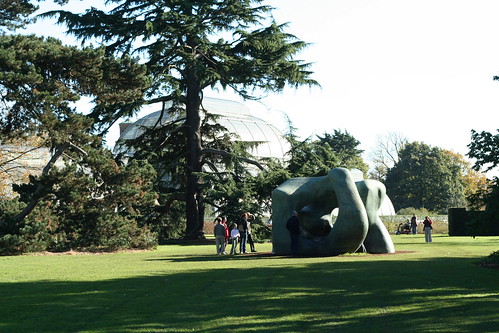
I went to Kew Gardens to see the Henry Moore sculptures. Which were OK, I guess. It’s not easy to display such a lot of very large sculptures—28 in all—but Kew is big enough that there’s plenty of room for them, so it’s quite a good match. I wandered around desultorily looking at them but they didn’t really grab me; not that I tried that hard to engage with them. I’d be curious to know whether I would have got more out of them if they were in a field; i.e. if there was less other interesting stuff around to distract me.

Moore sculpture

The particular thing that side-tracked me most was Big Trees; and specifically, some of the oaks and chestnuts. Now there has been a botanical collection at Kew for over 200 years, so there are some decent sized exotic trees. The conifer in the picture above is a pretty imposing example. But the trees I was looking at must surely be older still. There was one particular chestnut which must have been about eight foot in diameter. I didn’t get a picture that did that one justice, but here’s a smaller one:

sweet chestnut tree

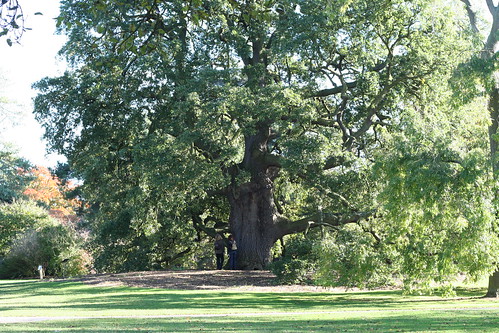
I love the deeply grooved bark of mature chestnut trees. The sweet chestnut isn’t actually native to Britain; it was introduced in the Middle Ages. The oak, Quercus robur, is a native species. Of course it’s native to the whole of Europe, so the fact that in this country it’s often referred to as the English Oak is a wee bit parochial. Still, it’s a key feature of the English landscape. And this is an impressive example. Not a great picture, but hopefully the people standing in front of it give some sense of scale.

oak

I love these big trees; there’s something so satisfying about the sheer bulk of them. It makes you wonder what England looked like when it was a genuinely wild landscape; for many hundreds of years, the normal fate of a mature oak was to be cut down and used to make a timber-framed building or a ship. But once upon a time there must have been thousands of ancient trees all over the place. That landscape, of untouched primary forest, isn’t even a folk memory now; it was long gone by the time of Stonehenge. British woodland is artificial, a managed resource. Or now that wood is less in demand, an unmanaged resource; but I don’t think much of it is likely to be left alone for the few hundred years necessary to revert to wildwood.

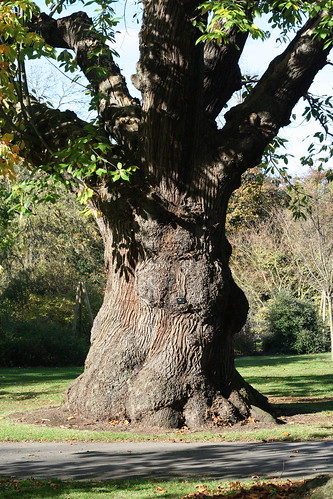
Here’s another chestnut. I think the shape of it, with a fat trunk splitting into lots of branches a short way up, may be a sign that it was once pollarded. But I’m not sure.

sweet chestnut

Just think, that was probably already a mature tree when George III was confined to Kew Palace, strapped to his bed by the doctors and being bled, cupped, blistered and given emetics in a desperate and ignorant attempt to cure his madness.

» All pictures are hosted on my Flickr account, and you can see bigger versions there, if you want.

Categories
Culture Other

Erasmus Darwin by Desmond King-Hele

This is a biography of Charles Darwin’s grandfather. He was a doctor by trade, and one of the most highly rated in the country, but was one of those classic Enlightenment figures whose interests included botany, meteorology, physics, chemistry, engineering, philosophy and just about anything else that came his way. And for a few years he was the most successful and critically acclaimed poet in England.

He seems to have been effortlessly brilliant at everything; the list of inventions and discoveries which can be attributed to him is startling. The inventions include: an improved steering system for carriages, a machine for writing in duplicate, a temperature-regulated system for opening and closing the windows of a greenhouse, a machine that reproduced human speech, an artificial bird, an improved seed-drill, the gas turbine, the rocket motor, cataract surgery and the canal lift. Scientific principles include: the ideal gas law, the chemical composition of water, the structure of the atmosphere, the formation of clouds, the artesian well, and of course evolution.
rocket

Even so, there’s a touch of defiance in the book’s full title: Erasmus Darwin: A Life of Unequalled Achievement. That’s because almost everything on that list comes with a caveat of one kind or another. For example, many of them are based on a few lines or a quick sketch appearing in his Commonplace Book or in one of his letters; and while it’s undoubtedly takes a remarkably inventive mind to come up with the principle for the gas turbine a hundred years ahead of its time, if it never gets beyond a quick scribble it’s a very limited achievement. Another example is his improved steering system, which worked by just angling the wheels left and right instead of turning the whole axle. This creates a much more stable carriage and is the principle used by all modern cars. Darwin built a carriage on this model, and used it successfully for decades going over thousands of miles of bumpy roads to visit his patients; but he never made a real effort to market the idea and it died with him.

Which isn’t to say he had nothing to show for his scientific brilliance. He submitted quite a few papers to the Royal Society on subjects like meteorology and geology; he did the first English translation of Linnaeus, and wrote a major book on medicine. But there is no one major achievement you can attach his name to. Partly that’s because he was a very hard-working doctor. Not only did it take up a lot of time; he was also very worried about his professional reputation. Much of his work was published anonymously because he didn’t want to detract from that reputation, and the biggest single factor that prevented him from achieving more as a scientist was probably that he always put his career first.

And when he did commit to major works he didn’t always make the best choices. His translation of Linnaeus’s botanical taxonomy was drudgery really, the scientific equivalent of translating a phonebook, even if it did add a few words to the English language, like bract, floret and leaflet. And his major work on medicine doesn’t hold up at all because, frankly, no-one at the time knew enough about the workings of the human body. No-one knew about germs, microscopes had been invented but weren’t really used, and they had very few treatments that did any good, so they just gave everyone lots of opium.

opium poppy

Comparisons between Erasmus and Charles are inevitable, and it’s tempting to put the difference between them down to personality: to suggest that Charles was less brilliant but made up for it with dogged single-mindedness. Personally I think the financial aspect is just as important. Erasmus and his son Robert were both highly successful doctors and Robert also had a very good eye for investments, with the result that Charles was a wealthy man. If Erasmus hadn’t had to work, who knows what he would have achieved. His medical practice certainly proves he was capable of hard work; his calculations suggest he travelled about 10,000 miles a year, which on C18th roads is a hell of a long way.

I find the poetry the most interesting thing, though. Science is not a subject that has often been successfully treated in poetry, so someone like Erasmus Darwin writing poems about science is really intriguing. If you have an interest in science and poetry, it’s always fun when the two overlap, as with the reference to Galileo in Paradise Lost. But it’s rare to have poetry written by someone right at the heart of the scientific culture. Darwin’s friends and correspondents include people like Joseph Priestley, Joseph Banks, Benjamin Franklin, James Watt, Josiah Wedgwood, Matthew Boulton and Richard Arkwright. He writes about science and technology as a complete insider. And for a few years he was very successful and critically acclaimed, before being left behind by a shift in fashion—he represents everything Coleridge and Wordsworth were reacting against—and in politics. As the French Revolution turned bad, his radical views became a public liability.
detail of Gillray cartoon, tree of liberty

So I find the idea of Darwin’s poetry fascinating. I’m undecided about the poetry itself. All the mythological trappings seem so unnecessary, and the ornate style can border on self-parody; one of his particular quirks is phrases like this:

Swords clash with swords, on horses horses rush,
Man tramples man, and nations nations crush

Still, I love the very fact that he’s applying this high style to such non-literary subject matter. In another poem, someone might only apply this kind of language to a subject like a tadpole to make a joke out of the incongruity. Darwin did have a sense of humour, and if not actually tongue-in-cheek, I think the poems are intended to have a fairly light touch; but he seems to be trying to communicate a real fascination and beauty he finds in nature, as in this passage where he is invoking tadpoles and mosquitos as a comparison with life emerging from the sea:

So still the Tadpole cleaves the watery vale
With balanc’d fins, and undulating tail;
New lungs and limbs proclaim his second birth,
Breathe the dry air, and bound upon the earth.
So from deep lakes the dread Musquito springs,
Drinks the soft breeze, and dries his tender wings,
In twinkling squadrons cuts his airy way,
Dips his red trunk in blood, and man his prey.

Is that good poetry? Maybe not. Maybe the style is just a distraction. On the other hand I think you can pick out passages which are more successful, like this:

“Yes! smiling Flora drives her armed car
Through the thick ranks of vegetable war;
Herb, shrub, and tree, with strong emotions rise
For light and air, and battle in the skies;
Whose roots diverging with opposing toil
Contend below for moisture and for soil;
Round the tall Elm the flattering Ivies bend,
And strangle, as they clasp, their struggling friend;
Envenom’d dews from Mancinella flow,
And scald with caustic touch the tribes below;
Dense shadowy leaves on stems aspiring borne
With blight and mildew thin the realms of corn;
And insect hordes with restless tooth devour
The unfolded bud, and pierce the ravell’d flower.

“In ocean’s pearly haunts, the waves beneath
Sits the grim monarch of insatiate Death;
The shark rapacious with descending blow
Darts on the scaly brood, that swims below;
The crawling crocodiles, beneath that move,
Arrest with rising jaw the tribes above;
With monstrous gape sepulchral whales devour
Shoals at a gulp, a million in an hour.
— Air, earth, and ocean, to astonish’d day
One scene of blood, one mighty tomb display!
From Hunger’s arm the shafts of Death are hurl’d,
And one great Slaughter-house the warring world!

I find that to be a strong piece of writing and a striking vision of violent nature. It’s from Canto IV of The Temple of Nature, where Darwin comes within a whisker of stating the principle of natural selection. Here’s another bit from later in the same canto:

“HENCE when a Monarch or a mushroom dies,
Awhile extinct the organic matter lies;
But, as a few short hours or years revolve,
Alchemic powers the changing mass dissolve;
Born to new life unnumber’d insects pant,
New buds surround the microscopic plant;
Whose embryon senses, and unwearied frames,
Feel finer goads, and blush with purer flames;
Renascent joys from irritation spring,
Stretch the long root, or wave the aurelian wing.

“When thus a squadron or an army yields,
And festering carnage loads the waves or fields;
When few from famines or from plagues survive,
Or earthquakes swallow half a realm alive; —
While Nature sinks in Time’s destructive storms,
The wrecks of Death are but a change of forms;
Emerging matter from the grave returns,
Feels new desires, with new sensations burns;
With youth’s first bloom a finer sense acquires,
And Loves and Pleasures fan the rising fires. —
Thus sainted PAUL, “O Death!” exulting cries,
‘Where is thy sting? O Grave! thy victories?’

I love the cheeky jabs at both royalty and religion; firstly in lumping together a monarch and a mushroom as comparable lumps of organic matter, and then the way he implies that acting as compost for plants and food for insects is what St Paul had in mind with ‘Oh Death! Where is thy sting?’ But there is also a kind of slightly nutty grandeur to the poetry.

Some bits of his poems hold up better than others, both scientifically and aesthetically. But I think the best of it is good enough to be worth reading, particularly because the subject matter makes it so unique.

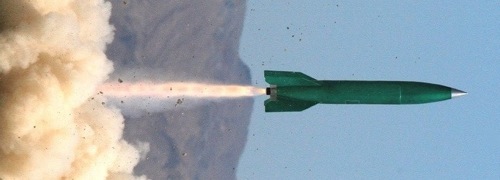
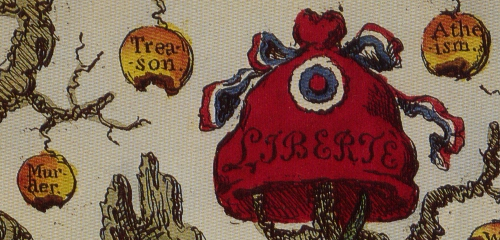
» passages from The Temple of Nature are taken from this site where you can read it in full. The picture of a rocket is by jurvetson on Flickr and is used under an attribution CC licence. The opium poppy is from a C19th German herbal and is used courtesy of Missouri Botanical Garden at botanicus.org under a by-nc Creative Commons licence. The hat is a detail of a Gillray cartoon, the Tree of Liberty, from a page of cartoons from the period at the University of Lancaster.

Categories
Culture

Visiting the crack

Last week I went to see the crack at Tate Modern, which is the latest big artwork in the Turbine Hall. You can read what the Tate thinks it’s about here. I found it less impressive in reality than I expected. I’d heard about it before I went, and it looked exactly as I expected except I vaguely thought it might be bigger and scarier at the fat end.


Shibboleth by Doris Salcedo – the crack at Tate Modern, London, originally uploaded by chrisjohnbeckett.

I personally didn’t notice it exposing a fracture in modernity itself or encouraging me to confront uncomfortable truths about our history and about ourselves with absolute candidness, but then I didn’t read the blurb until after I saw it.

I also went to the Louise Bourgeois exhibition. Which I quite enjoyed although I wasn’t really in the right mood to give it the attention a major retrospective hopefully deserves. Bourgeois was born in Paris in 1911 but has lived in New York since 1938. One interest was just to see work produced over such a long period; the earliest works were from the 1940s and the most recent from this year. I thought the objects were quite likeable—they had a very human sort of quality. A lot of contemporary art seems to be either highly finished and glossy or so roughly put together that it looks scruffy and half-arsed. This work avoids either quality. Apart from the traditional sculpture, I thought one example of that was the recent works which are ‘rooms’ assembled together out of found objects: furniture and tapestries and stuff. The objects themselves are battered and tatty, and it’s the kind of work which can often be a bit nothingy, but here I felt they were thoughtfully put together and really felt like coherent artworks. Those works also seemed very French; after 60 years in New York producing work that doesn’t seem so specific to a particular place, it’s interesting to see her returning to the details of her childhood in France.

Anyway. I can’t really claimed to have engaged with it in a very meaningful way, but it was interesting enough. I’ve got a cold and I’m feeling a bit shit, so rather than rambling on any more I think I’ll go and make some hot lemon and honey or something. Can anyone suggest any other favourite homemade cold remedies?

Categories
Culture Me

How now, nuncle!

Hot news of the day: I’m an uncle. My sister-in-law had a baby girl yesterday. So send positive mind rays in the general direction of Cheltenham, please.

The word ‘nuncle’ is, as I expect you know, a variation of ‘uncle’ formed by mishearing ‘mine uncle’ as ‘my nuncle’. The same with ‘Ned’ as a variation on ‘Edward’. ‘Adder’ and ‘apron’ went in the other direction: it was originally ‘a nadder’ and ‘a napron’. Similarly, while I’m on the subject, ‘pea’ is formed by misinterpreting ‘pease’ as a plural, and the same with ‘cherry’, which also originally ended in an s, as it does in the French cerise.

I vaguely thought that ‘nuncle’ was widespread in Shakespeare, but I did a search online and it turns out that only one character uses it: the Fool in King Lear, who uses it fourteen times. So I don’t know whether it was a genuine misunderstanding or just a whimsical usage. Almost baby-talk. Or informal/affectionate: in which case the fact that the Fool uses that kind of language in addressing the King is an indication of his special freedom. I suppose I could consult the OED and see if it tells me.

Looking for nuncles in Lear reminded me of what an incredible piece of writing that storm scene is, with the interplay between the mad Lear, Edgar pretending to be mad, and the Fool whose job is to act mad. Language is stretched almost to meaninglessness, and there’s an edge to it, a nastiness, that helps counterbalance the ladlesful of pathos. I find the overt artificiality fascinating as well; having the three ‘mad’ characters on stage together, and of course the blinded Gloucester who doesn’t know that one of them is his son. Obviously throughout his career Shakespeare made liberal use of coincidences and unlikely plots, but some of the late plays, like Lear, seem to move away from realism in a much more profound way. As a comparison, in Twelfth Night, when people keep getting confused between Viola and Sebastian, the unlikeliness of the situation is part of the joke. I’m not sure it even makes sense to look at Lear in those terms. it’s clearly true that the plot of King Lear is unlikely, but it seems ridiculous to say so. It’s somehow not the point.

KING LEAR:
Why, thou wert better in thy grave than to answer with thy uncovered body this extremity of the skies. Is man no more than this? Consider him well. Thou owest the worm no silk, the beast no hide, the sheep no wool, the cat no perfume. Ha! Here’s three on’s are sophisticated! Thou art the thing itself: unaccommodated man is no more but such a poor bare, forked animal as thou art. Off, off, you lendings! Come unbutton here.
[Tearing off his clothes.]

Fool:
Prithee, nuncle, be contented; ’tis a naughty night to swim in. Now a little fire in a wild field were like an old lecher’s heart; a small spark, all the rest on’s body cold. Look, here comes a walking fire.
{Enter GLOUCESTER, with a torch.}

EDGAR:
This is the foul fiend Flibbertigibbet: he begins at curfew, and walks till the first cock; he gives the web and the pin, squints the eye, and makes the hare-lip; mildews the white wheat, and hurts the poor creature of earth.
S. Withold footed thrice the old;
He met the night-mare, and her nine-fold;
Bid her alight,
And her troth plight,
And, aroint thee, witch, aroint thee!

It wasn’t a time with a very sensitive approach to mental health issues; people used to go to visit Bedlam for the entertainment value of seeing the madmen. And indeed there’s a scene in Webster’s The Duchess of Malfi where a bunch of actors basically come on stage to act mad for the amusement of the audience in the same freak show manner; the contrast with the portrayal of madness in Lear is striking.

Shakespeare really was a very good writer. I’m always tempted to be sceptical about his status, towering untouchably over English literature; my bloody-minded reaction to the cult of Shakespeare which treats him as though he never wrote a bad line, let alone a bad play. We’re less reverential about art these days—less reverential about everything—but still, the big names have a halo around them, as though entry into the canon equated to canonisation. I’m torn between feeling that serious, unironic celebration of the power of art is a Good Thing and a sense that once something gets tainted with sacredness it is defanged.

Anyway, I seem to have rambled from my new niece, via cherries, to ART. I shall stop before I wander any further off-topic. Hopefully responding to the birth of a daughter by quoting King Lear isn’t too much of a bad omen :)

» The photo Cherry was posted to Flickr by moogs and is used under a Creative Commons by-nc licence.

Categories
Culture

Journey by Moonlight by Antal Szerb

This is a Hungarian novel from 1937. I don’t really know much about it; I found it while I was sorting books into some new bookshelves. It’s the kind of thing I can imagine myself buying, but I don’t actually remember doing so. But it had lots of glowing blurbs on the back, including one from litblogging’s favourite Anglo-Hungarian (Hungaro-Briton?) so I thought I’d give it a go.

And I enjoyed it. It feels very much of its time. Not in a bad way; in fact there was a pleasant sense of recognition that ah, this is one of those European inter-war novels. Kazantzakis, Lawrence and Hesse spring to mind. The characters don’t actually spend that much of the book having earnest conversations about death and sex and love, but you feel they might start at any minute. It’s fundamentally serious and rather highly-strung: which is probably a fair reflection of Europe between the wars politically as well as artistically.

Which makes it sound like it might be rather hard work, but it’s not; it’s quite short, it moves along at a fair clip, and it’s full of striking imagery. While I wouldn’t necessarily want to be stuck on a desert island with any of the characters, they’re an engaging bunch. And while I say it’s fundamentally serious, it’s also quite funny.

Anyway, I’m not going to attempt to offer any kind of thoughtful analysis of it, but if you’re looking for something to read, you could do a lot worse.

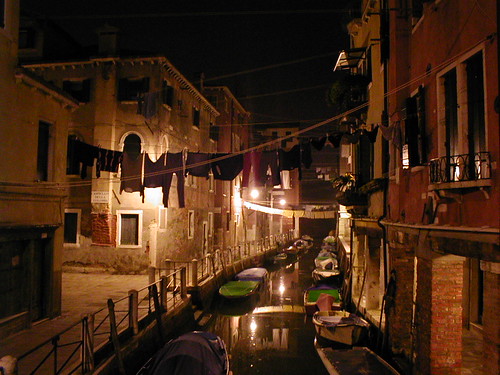
» That photo, Night in a venetian alley, was posted on Flickr by Damiel and is used under a Creative Commons by-nc-sa licence. It is loosely relevant to the novel but I mainly posted it because the blog seems a bit short of pictures at the moment.