Categories
Culture

Mask of the Week

A few weeks ago I posted the mummy mask of Satdjehuty, a very glamorous and stylised Egyptian mask from about 1400 BC. To give some indication of the incredible continuity of Ancient Egyptian culture, here’s the mummy mask of Pachons, from 1600 years later in Roman Egypt:

That’s also from the British Museum. here’s what they have to say about it:

Excavations in the later layers of debris over the Temple of Hatshepsut at Deir el-Bahari have revealed that part of the area was used as a cemetery in the middle Roman period. A small number of the mummies found were adorned with masks. On the basis of the style of their hair and dress, they have been dated to the third century AD. They presumably belonged to people of high status, as the area of Deir el-Bahari was, and still is, a holy one.

The owner of this mask, Pachons, son of Psesarmese, is portrayed wearing a long-sleeved cream-coloured tunic. Around his head is decoration in yellow, in imitation of gold. In his hands he carries a pot and a small garland of orange flowers. The panel at the bottom shows a representation of Sokar, the god of the Memphite necropolis (cemetery).

There are remains of pieces of plaited linen which either attached the mask to the mummy or attached a wooden label, which bore the name of the deceased.
Categories
Culture

Baile Funk

It’s not subtle.

Categories
Culture Nature Other

Birds, history and stuff

When I started planning a trip to Andalucía, I posted a message to BirdForum asking whether my plans were practical. One of the people who replied was John Butler, who, I’ve since discovered, not only runs bird tours there but actually wrote the book on birding in the area. One of the things he said was:

Do not miss Sevilla. It is a beautiful city and well worth visiting for the sights of the city, but there are also lots of birds to be seen. Lesser Kestrels live in large numbers around the cathedral and these will be joined by Pallid Swifts from late March onwards. Lots of good birding can also be done in the Maria Louisa gardens, less than a km from the historic centre of the city.

I can’t tell you how much it made me smile to read that “Lesser Kestrels live in large numbers around the cathedral”. There’s something special about going to a place for the history and architecture, and seeing good birds there. Partially it’s just because it’s double the pleasure, but also the bird makes the place more memorable and the place makes the bird more memorable. And because birds play a large part in my sense of place, they can bring somewhere to life beyond its historical context.

Some examples – White Storks nesting on the top of marble columns in the ruins of Ephesus; a pair of Scops Owls in a tree outside the museum at Corinth; Cirl Bunting at Mycenae, Long-legged Buzzard at Troy. Perhaps the best of the lot – swirling flocks of thousands of Alpine Swifts coming in to roost in the walls of Fez in Morocco.

Categories
Culture

Mask of the Week

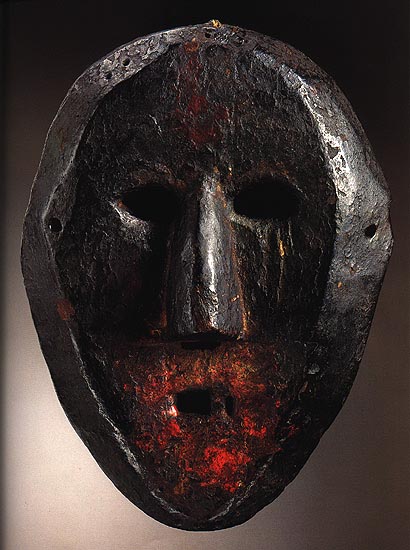
A shamanic mask from Nepal:

from this article at asianart.com

Categories
Culture

Gaming and art

With Shigeru getting his French knighthood and the British Academy of Film and Television Art giving awards for computer games, I was mulling over the old computer-games-as-art question. The comparison is inviting, not least because games are full of things which were historically the domain of other art forms – visuals, music, dialogue, narrative and so on. And I have no doubt that, as the industry develops, there will be games that demand to be regarded as important artworks. I just wonder what they’ll look like.

The normal game dynamic is that the player is continually attempting to complete tasks in order to progress to the next part of the game. The task could be almost anything – to kill enough zombies, get around a track quickly enough, solve a puzzle, make enough money – but the usual experience is of being stuck much of the time, of repeatedly attempting the same thing, or of wandering around aimlessly trying to work out what you should be doing. Much of good game design is trying to keep the player just the right amount frustrated.

And however much your character interacts with other characters, the central experience is of playing against the game. The storyline and characterisation are fundamentally a sideshow. They add flavour and help keep you engaged when you might get too frustrated and stop playing, but despite endless claims over the years of more intelligent interactivity, the narrative isn’t what drives the game forward, it’s just the backdrop to the action.

It’s hard to see that task-completion dynamic as a basis for a work of great art – something rich, nuanced, emotionally and intellectually engaging – and one possibility would be to make things that don’t even pretend to be ‘games’. One trope that’s been doing the rounds for years now is the idea that, as games get more sophisticated, they’ll become more like interactive movies. Well, an interactive art movie would presumably not play like a game, in that there would be no pre-defined objectives; it would be more like a fluidly evolving scenario you could take part in. The technical difficulties in trying to create genuinely open-ended situations with complex, believable characters would be staggering, of course, but if it could be done it would be interesting.

Even more interesting, perhaps, would be a game which harnessed the task-completion dynamic in some way, and used it in the service of something more sophisticated. I can’t see what that would be; but that’s probably just a failure of imagination on my part.

Categories
Culture Other

MAKE, folk art, and postpoems.com

I love MAKE: Blog. Not because I actually want to make my own automated cocktail dispenser or LED tank-top that plays Conway’s Game of Life, or even an iPod Nano arcade cabinet. But I love the fact that there are people who do these things. A while ago, I went to the Folk Archive exhibition at the Barbican, and said:

It was an exhibition of contemporary British folk art, but that term was interpreted extremely broadly; the exhibition includes (some of these are photos rather than the actual object): trade union banners, graffiti, prison art, modified cars, costumes from traditional festivals, prostitute calling cards, sectarian murals, shop signs, painted false nails, football fanzines, protest placards, crop circles, sand castles, flower arrangements…

The sheer range of objects makes it hard to know what to say. Many of them were complete tat – unremarkable examples of mundane objects – but seeing them all together one did get a sense of a huge wealth of amateur, unofficial creativity. I enjoyed it and found it curiously cheering.

Whatever you think of ‘folk art’ as a category, and whether or not you think an iPod Nano MAME cabinet fits that category, what does apply to the stuff at MAKE is “a huge wealth of amateur, unofficial creativity”. People making stuff, in their spare time, because they want to. Love it.

I admit I find it harder to be so cheerfully enthusiastic about the reams and reams of bad poetry on the internet; but even if I don’t want to read the stuff, I’m glad it exists.