Categories
Other

Everything I Know About Cooking, I Learnt From Making Stew (addendum)

Just another thought that occurred to me while I was cooking this the other day:
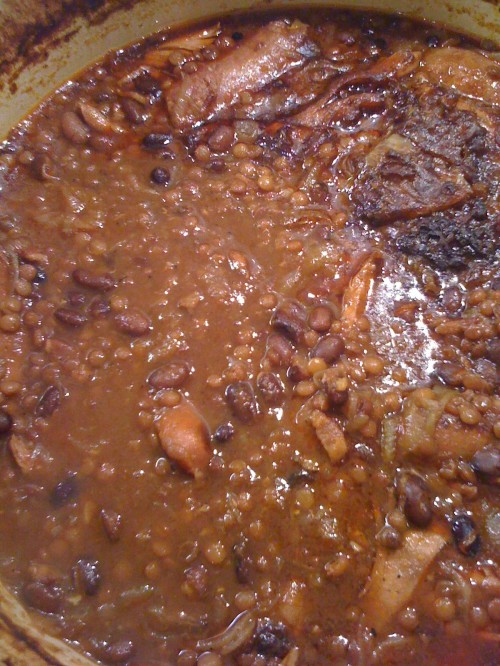
Food isn’t fashion.

I’m always annoyed by the way they present food products in the style section of the Sunday paper: a stylish-looking package of olive oil/chocolate/wine floating in white space to tempt shoppers as though it was a new pair of shoes or some face cream. Or those terribly precious delicatessens with largely empty shelves which just have a few products artfully arranged as though they were Fabergé eggs rather than, for example, eggs.

It’s not the cost — I’m not averse to spending money on food — it’s the suggestion that good food is just a style issue. Which is kind of ridiculous. For example, Spanish food has been a bit trendy over the past couple of years in London, and so people who care about such things are perhaps more likely to buy Spanish Iberico ham where before they would have bought Italian prosciutto. And why not, it’s a great product. But there’s nothing new about it. It is made in the same way as ham has been made over half of Europe for hundreds of years. It may be new to us, but it is the most traditionally produced product imaginable, the antithesis of fashion.

So what’s the significance of the [delicious if not very photogenic] gloop? Well, it’s a sausage casserole. And sausage casserole is, for me, a dish very much associated with bad student cooking: cheap sausages, too much tinned tomato, big lumps of random vegetables. My sausage casserole was made with Toulouse sausages and chorizo, a mixture of brown lentils and black beans, a jar of Spanish tomato and red pepper sauce, all backed up with lots of onion, celery, garlic, bacon, fresh herbs, and stock made with the carcass of a roast organic chicken and a pig’s trotter for extra oomph. It’s somewhere between a cassoulet and a feijoada. But it is still, really, a sausage casserole. The difference is that I am a better cook than I was back then, using better ingredients and making better use of them.

My personal tiny epiphany about this came when I was looking through an Italian cookbook and found a recipe for polpettone. You take minced beef, mix in some onion, herbs, garlic, chopped salami, milk-soaked breadcrumbs and grated parmesan, press it into a bread tin and cook it in the oven. In other words, it’s meatloaf. But up until that point I had entirely associated meatloaf with blue-collar American cooking of a, umm, not very aspirational kind. In the sitcom Roseanne, she was always cooking meatloaf, and I’m sure I’ve seen it used elsewhere in US popular culture as a signifier of social class. But seeing it in an Italian cookbook with an Italian name made me look at the recipe and think, you know, that actually sounds rather delicious. And it was. My preconceptions about meatloaf were simple snobbery.

Maybe there are some dishes which are genuinely just a bad idea, but which were inexplicably popular at some time or other. But generally, no matter how old-fashioned or déclassé or boring you think a dish is, if you make it carefully and thoughtfully with good ingredients it will be delicious.

[The first two parts of Everything I Know About Cooking, I Learnt From Making Stew are here and here.]

Categories
Other

Everything I Know About Cooking, I Learnt From Making Stew (part two)

The first part was very broad-brush stuff: here I get (slightly) more specific.

Learning to cook is a lifelong project.

Learning to cook is a cumulative process. Some bits of it are widely applicable, but there are also many small pieces of specific knowledge. They aren’t generally complicated or difficult, but there are a lot of them, because there are so many different ingredients and cooking techniques. You build up a stock of knowledge as you learn new recipes. You can’t really rush that process, short of going to catering college or working in a restaurant so that you’re cooking all day every day. But learning is part of the fun.

Categories
Other

A passing thought on the iPad: handheld ≠ mobile

I think one reason people have a hard time visualising how the iPad will fit into their lives is that they assume it will mainly be a mobile device; i.e. something they will actually carry around with them all the time.

I don’t think that needs to be true for it to be successful. I think it’s significant that Apple had a sofa on stage for the product launch.

Despite the fact that there is more than one real computer in the house, I often use the iPhone at home to look things up on the internet or check my email. Because if you just want to do something quickly, the device which is in the same room beats the one which is somewhere else; but also because sometimes it’s nice to do all that stuff from the comfort of a sofa.

Nintendo recently brought out a larger version of the DS, which might not make sense if you believe that a handheld device is all about portability. But it makes sense to me, because I don’t actually use my DS on the train or waiting for a bus; I sometimes take it on holiday but otherwise it doesn’t leave the house. It’s still nice to be able to just pick it up and play it anywhere. And somehow it feels like less of an effort — you can pick it up, play for a few minutes, put it down — it’s a more casual, comfortable experience than using a ‘real’ games console.

I think the iPad could be a successful product just to have around the house, something to pick up and use for a minute or two as an internet device or for casual gaming; something you can curl up on a sofa with. Something that never leaves the house, except perhaps to take on holiday.

Some people will carry them around, of course, and no doubt people will find lots of ingenious uses for the thing — it is a blank slate — but that may not be the norm.

Categories
Other

I know what the Apple Tablet is for

Among all the speculation about the forthcoming Apple Tablet/iSlate/iPad has been a thread of uncertainty: no one is really sure what it’s for; what niche it fills.

Everyone has been missing the obvious: it’s an e-reader for birdwatchers.

I have two field guides on my iPhone: butterflies and birds. I haven’t had a chance to use the bird guide in earnest yet, but the butterfly guide has been useful several times. You never know when you might see a butterfly, and when you do, you need the information on hand immediately if you’re going to have a chance to identify it. I would happily fill my phone with other field guides — trees, flowers, fungi, dragonflies — just so I could always have that information to hand.

So that’s good. But but but: the screen is not big enough. A real, paper field guide would have several species, each with several illustrations, and distribution maps, and text, all on the same double-page spread. The phone has space for one or maybe two illustrations per screen; that means an awful lot of scrolling backwards and forwards to compare species.

Until screens get much much higher resolution, you’re never going to fit as much information onto a screen as you can on a printed page; but for these purposes, any increase in screen size is a bonus. And no, even with 16 levels of grey, an electronic paper display is not going to cut it.

And it’s not just field guides: there’s a new app for the iPhone that, for £25, has 1:50,000 scale Ordnance Survey maps of, for example, the South-East of England. Always having an OS map with you whenever you go for a country walk: how cool is that? Well, it’s a damn sight cooler with a 10″ screen than it is with a 3½″ one.

So, since the Tablet is going to be aimed at birdwatchers and ramblers, I confidently predict it will be a rugged, waterproof device designed for outdoor use.

No, just kidding.

OK, so the examples that spring to mind for me are rather specific, and Steve Jobs isn’t about to launch an incredible new product aimed specifically at birdwatchers and hikers. Sadly. But really, I think people might be overthinking this. After all, when is a bigger screen not a useful thing to have?

» iTunes links: butterflies, birds, OS maps.

Categories
Other

Links of the year 2009

A (not very methodical) selection of the best links I posted over the past year. The ones picked out in green were those which struck me as especially memorable when I looked back.

Andy Goldsworthy // Better planning for healthcare — British foods — British wrestling posters // Cardiff at night — Colour-coded children — Composite photos of New York // Dolphins and bubbles // Endurance cycling — Europa — Evolving blackcaps // Football fans without a team // Ghanaian film poster paintings — Glass microbiology // Ham radio cards — Hubble Ultra Deep Field in 3-D // LEGO Pop-up Kinkaku-ji — Living root bridges // Martian Dust Devil Trails — Masal Bugduv // Night skatersNon-porn porn — Notgeld // Peculiar book covers — Peculiar book covers, again — Photosketch — Playground rhymes // Rigging an internet poll // Sand animation — Solitary confinement — Stickney Crater // Teddy bear typologies — Toilet-roll face sculptures // Weaving spider silk // X-ray speech

Categories
Other

A passing thought on the Nutt business

Politicians are always quick enough to invoke ‘scientific advice’ when they want to deflect responsibility for an unpopular policy decision, like the availability of different treatments on the NHS, or the mass slaughter of animals during a foot and mouth outbreak. And as long as they actually are acting on good scientific advice, fair enough.

But if you’re going to hide behind scientists when it’s convenient… well, the flip side of that is that if you later choose to ignore the advice of your carefully chosen independent scientific advisors, you should have the guts to stand up and explain why.

» If you don’t know what I’m talking about: a government minister sacked an (unpaid) senior drugs advisor, a professor of psychopharmacology called David Nutt, for giving a lecture saying that the government’s drug policy ignored the scientific evidence. You can download the lecture as a PDF here; it is worth reading.