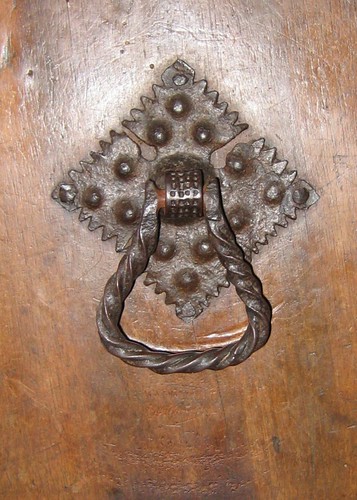
This week’s Flickr set of the week is knocker by mfdudu.

A local free magazine that came through the door includes a few hundred words of Buddhist-inspired wisdom. The column starts:
As a child, were you encouraged to aim for perfection*?
The footnote at the bottom of the page explains:
The word * ‘perfection’ comes originally from the Greek ‘telios’ meaning ‘completeness’, ‘purpose’
The first thing that bothered me about that was — how much of a tin ear for language do you need to believe that ‘perfect’ could possibly derive from ‘telios’?
Even if ‘perfect’ did come from a Greek word meaning ‘completeness’, ‘purpose’ — how would it prove anything? What difference would the Greek root mean to a discussion in English? Words change their meaning. Over two thousand years and a shift from one language to another, the meanings can change really quite a lot.
In fact it derives (via Old French) from the Latin perfectus ‘completed,’ from the verb perficere, from per– ‘through, completely’ + facere ‘do.’ The outlines of which I guessed, although the details came from a dictionary.
A bit of googling reveals that there is a connection between ‘perfect’ and ‘telios’, though. Teleios (τελειος) is indeed a Greek word for perfect, and it’s regularly translated as perfectus in the Vulgate and ‘perfect’ in the KJV (I did check, but you’ll have to take my word for it).
However, although teleios does mean ‘perfect’ and ‘complete’, it doesn’t apparently mean ‘purpose’. But it’s derived from telos (τέλος), which means ‘purpose’ or ‘aim’ (hence ‘teleology’); presumably because something which is complete is something which has achieved its aim.
So we can reconstruct the idea as it was presumably originally told to her:
“In Greek, the word for ‘perfect’ meant something which had fulfilled its purpose.”
As I said, arguments from etymology are daft anyway; but at least this version has a certain fortune-cookie aphoristic quality to it. It approaches the idea of ‘perfection’ from a slightly different angle. The version in the column
The word * ‘perfection’ comes originally from the Greek ‘telios’ meaning ‘completeness’, ‘purpose’
is not only obviously false, it also garbles the point of the original observation. How could you write that down and not think “hang on a minute, I don’t think I’ve got that quite right”?


I’d try to create this kind of googlebait on purpose if I thought that any of those hits were likely to become return visitors. As it is, it’s mainly going to eat my bandwidth (not that I’m in any danger of running out).
What did Materazzi say to Zidane to provoke such a violent reation?
EDIT: I’ve had a bit of a spike in traffic because this blog is the top-ranked result on Google for “what did materazzi say to zidane.” Welcome to my blog, but I’m afraid I don’t know the answer. I’ve seen people confidently claim it was “dirty Muslim terrorist” and “son of a terrorist whore” as well as other things, and it’s always claimed as coming from ‘a high ranking FIFA official’ or ‘a friend of Zidane’ or similar. It all sounds like speculation to me. I think I read that Zidane is planning to make a statement over the next couple of days, so perhaps we’ll learn then.
The Flickr set of the week is Jumping pictures, from Two loose trees.


pictures are ©Two loose trees.
I know why the phrase ‘like shining from shook foil’ is in my head — because I was putting some foil over a dish of coronation chicken. More peculiar is the other thing that’s been going around my head this morning:
“Bush and Saddam sitting in a tree, K-I-S-S-I-N-G”.
I think it’s unlikely that either of the Presidents Bush have ever snogged Saddam Hussein, and even if they have, a tree would be an unorthodox venue. But I suppose you never know.