-
What if the whole world could vote? Admittedly, Economist reader may not be the most representative sample, but still…
Categories
My blog turns four today! That first post four years ago (when the blog was called stormy petrel) wasn’t actually very interesting, but hey-ho.

Mmmm, Smarties.
» The picture, from Flickr, is © Luke and/or Kate Bosman and used under a by-nc-nd licence.
I haven’t commented much, because I don’t think my political instincts are that brilliant even for the UK, let alone a country I haven’t visited for over a decade. But I’ve been enjoying the US elections ever since the primaries: the Americans always do democracy on a bigger scale than the rest of us, but this time round it has been more dramatic than ever. Not so much political theatre as political epic. The Cinton vs. Obama storyline alone was more exciting than anything that’s likely to happen in our own next general election; and it kept on getting more remarkable. I mean really: Sarah Palin! You couldn’t make it up. It adds to the fun, of course, that it definitely means the end of Bush and probably a Democrat in the White House.
But since the world’s financial sector apparently started circling the plughole, I’ve been unable to take the same kind of simple pleasure in the whole thing.
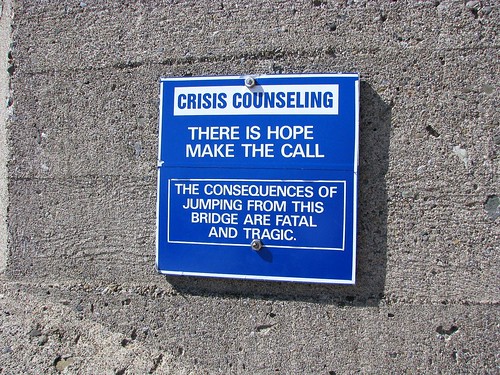
This is genuinely scary. When apparently well-informed people start making comparisons with the Great Depression: eep. Even if they’re saying things like ‘with the right government intervention we should be able to prevent this turning into anything like the Great Depression’: still eep. What Sir Alex Ferguson once called ‘squeaky bum time’.
Neither candidate has exactly covered themselves in glory over this issue. McCain’s stunt of ‘suspending’ his campaign and rushing back to Washington was the undoubted low point, but neither of them has said anything that convinces me that they have exceptionally clear insights or solutions to offer. Neither of them has made a strong and unambiguous case either for or against government intervention. I understand that since they are not in office and are in the middle of an election campaign, they are in the worst possible position to be unbiassed and pragmatic; perhaps it’s too much to expect to ask them to rise above the politics of the moment. But they haven’t. Neither of them has managed to step in and fill the leadership void left by the complete disintegration of Bush’s credibility.
When asked in the debate how the crisis would affect their spending plans, both of them fluffed the issue: Obama just restated all the things he wants to spend money on, and McCain came out with some ludicrous crap about cutting earmarks. I’m not expecting them to come up with new plans on the fly, several months in advance and without knowing how the situation will change, but it would have been nice to see them engaging seriously with the question.
And that leads me onto the last point: this is a horrible time to become President. I will be thrilled to see Obama elected, insha’Allah, but I think the job may be a poison chalice. Just to take healthcare: there’s no doubt at all that America can afford a proper healthcare system, since Americans already pay more than everyone else for healthcare as it is. But it is money that will have to come from somewhere, and the state of the economy will not make the politics of it any easier.
Frankly, even if it wasn’t for the economy, the next President would have enough on their plate dealing with Iraq. It may be that there there is no good exit strategy from Iraq, but we who invaded the country have some responsibility for what happens to it. As the shop sign says: you break it, you’ve bought it. I would vote for Obama, if I had a vote, at least partially from a belief that he wouldn’t have invaded Iraq in the first place, and therefore that he is hopefully less likely to get into some new foreign adventure of his own. But I don’t have any faith that he knows how to sort out the mess in Iraq now. Would McCain do any better? I don’t know. I suspect that to do the job properly would take decades, and I don’t think there’s the political will in America to commit to that kind of timescale anyway. The Iraqis might not be thrilled either.
All of which adds up to: It’s a lot harder than it was a few months ago to look forward to the election with a sense of optimism.
» the picture, Last Chance, is © huangjiahui and used under a by-sa licence.
I was originally considering Yemen: Travels in Dictionary Land* as my book from Yemen for the Read The World challenge, but I’ve tracked down a novel by an actual Yemeni writer which is available in English⁑, so I’ll read that at some stage. I still wanted to read Travels in Dictionary Land, though, because I very much enjoyed Mackintosh-Smith’s two books† following in the footsteps of the medieval Arab traveller Ibn Battutah.
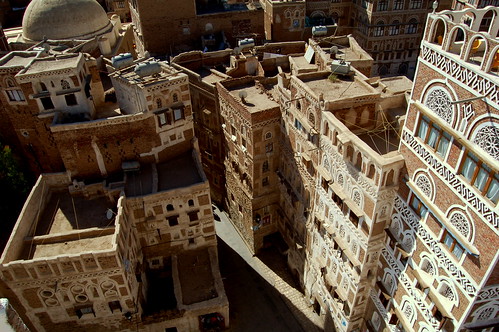
I’m not quite sure how long Mackintosh-Smith had lived in Yemen when this book was published 10 years ago, but he still lives there; he is clearly deeply engaged with Arab culture, history and language generally and Yemen in particular — in fact, living in San’a and chewing qat, I think in the terminology of the Empire they would have said he has gone native — and the book mixes what you might call straight travel writing with historical context and snippets of literature and mythology.
I think it’s easiest to just quote a couple of passages.
Very occasionally they [scorpions] are found in bunches of qat. Once, a baby one walked out of my bundle and across my lap, and disappeared among the leavings in the the middle of the room. I have never seen qat-chewers move faster. Another creature that sometimes pops up in qat is the fukhakh, the hisser — the Yemeni name for the chameleon. Its blood taken externally is a cure for baldness, but its breath makes your teeth fall out.. The gecko too is often killed, as it eats the remains of food from around your mouth as you sleep, pisses and gives you spots. Despite this I have been attached to several that have grown up in my house as they are clever flycatchers and converse, like the Hottentots, in clicks.
Or, in a bar in Aden:
Then the band broke into a sort of Egyptian glam-rock number and, unexpectedly, the floor filled with young men dressed in Paisley pattern shirts and pleated trousers. The number of pleats seemed to reflect their prowess at dancing. One particularly energetic youth — a twenty-pleater — shone out: his pelvis was articulated in extraordinary places, and spurts of sweat shot from his forehead. These were the mutamaykalin, the Michaelesques — the fans of Michael Jackson.
So, generally speaking, enjoyable stuff. Some of the political/history passages are less gripping than the travel anecdotes, but at least I now know a lot more about Yemen.
* sold under the title Yemen: The Unknown Arabia in the US.
⁑ The Hostage, by Zayd Mutee‘ Dammaj.
† Travels with a Tangerine and The Hall of a Thousand Columns.
» The photo of Sana’a old town in Yemen is © eesti and used under a CC by-nc-nd licence.
Mother’s Beloved is a collection of short stories from Laos; even with an introductory essay and with the Lao printed opposite the English, it’s only 160 pages. BTW, I don’t know a lot about Lao names, but I think that ‘Outhine’ is the surname.
I knew absolutely nothing about Laos except its approximate location (between Thailand and Vietnam). Fortunately this book has an essay about contemporary Lao literature that acted as a quick primer on the country’s modern history, which has been fairly grim: it went from being a Thai colony to a French one, got caught up in the Indochina War and the Vietnam War, when the Americans bombed it extremely heavily, then had about 15 years of communist government. Apparently it has liberalised somewhat since the fall of Russian communism, but there’s still only one legal political party: the Lao People’s Revolutionary Party.
The stories themselves are short and simple, both stylistically (as far as I can tell from these translations) and in terms of action. And indeed morality: by which I mean that you could often end each story with ‘and the moral of this story is … [something].’ I don’t think it’s a coincidence that most of them were published when Laos was a communist state; I think some of that simplicity that comes from writing in a country where too much ambiguity might be regarded as politically suspicious. And often the ‘morals’ are as much political as moral: ‘every one of us, no matter how humble, can make our own sacrifice in aid of the war effort’, for example.
Still, the very simplicity of the stories has its own appeal, and one or two of them managed to combine that simplicity with just the right emotional note in a way I found effective. I’ve decided that one way I could make these little reviews more useful would be quote some of the books, so here’s the opening of a story called The Eternal Pair of Birds. It’s actually an unusually elaborate passage, but you can see it has a kind of plainness to the language.
It was late February. At the edge of the rice fields grew a flame tree full of red blooms whose colour, when reflecting the setting sun, was so bright it hurt the eyes. Next to it stood a lone palmyra. It stretched so high as if to challenge the rainstorm, the hurricane, and the sunshine. It had stood there, strong and graceful, for ages. To the people in this rural hamlet, it was like a timepiece. When the sun was high above its crown, it was noon. When the sun’s rays struck parallel across the top of its fronds, it was time to herd the cattle back to the stable and for the housewives to prepare dinner.
Mother’s Beloved is my book from Laos for the Read The World challenge. I quite enjoyed it, on balance, and if nothing else, it encouraged me to learn a bit more about the country.
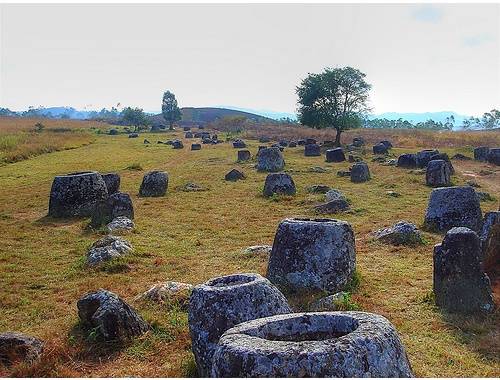
» The picture is from the Plain of Jars, an archeological site in Laos which I hadn’t heard of before but is mentioned in one of the stories. The stone ‘jars’, about 1500-2000 years old, are of unknown purpose but may be funerary urns or for food storage. Apparently it’s now one of the most dangerous archeological sites on earth because of all the left-over American cluster bombs. The photo, from Flickr, is © Kumar Nav and used under a CC by-nc-nd licence.