Categories
Culture

‘The Wyeth Family’ at DPG

The Wyeth Family: Three Generations of American Art is an interesting little exhibition at Dulwich Picture Gallery.

There are three main Wyeths featured: N.C. Wyeth, an illustrator notable for cheerily technicolor illustrations for books of adventure stories; his son Andrew Wyeth, the most famous of the three, who painted highly realistic, formally composed, rather chilly new England landscapes, often with figures in them; and his son Jamie Wyeth, who paints rather freer, rather more colourful paintings, also largely of New England subjects. Andrew is clearly the pick of the bunch, though I certainly would have loved reading books with N.C.’s illustrations when I was a child… you’ve got to love pictures with titles like Sir Nigel Sustains England’s Honor in the Lists, Up and down went the long, shining blades with flash of sparks at every parry. Jamie is the least interesting of the three.

Although there can’t have been many exhibitions which cover the whole C20th, from 1916 to the present, and show less influence of Modernism. This really is Ron Silliman’s School of Quietude in paint. But since the SoQ appellation always annoyed me when applied to poetry, I’m not going to complain on that basis. Avant-Gardeism for its own sake doesn’t strike me as particularly worthy, and I’ve seen far too much boring contemporary art already, thank you. On the other hand, if you are going to be this technically conservative, you’d better be good, because unambitious mediocrity is really deadening. Andrew Wyeth I think clearly is good enough and distinctive enough to stand out from the crowd a bit… I’m not sure Jamie Wyeth is, though.
Categories
Culture

Skeletons

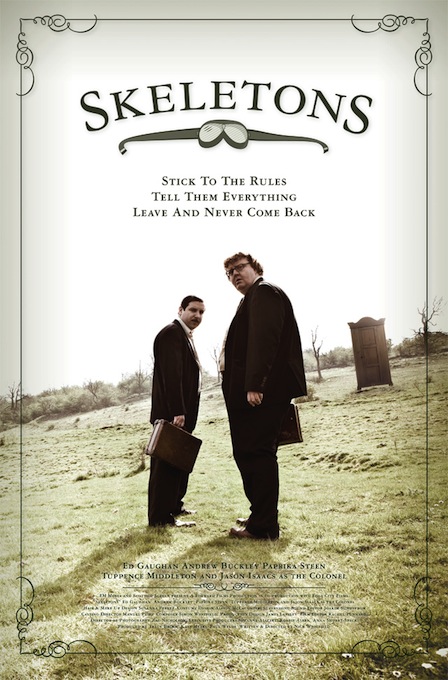
I went to see Skeletons, directed by Nick Whitfield. The IMDB blurb says ‘two exorcists literally remove the skeletons from the cupboards from people’s homes’, which is a particularly daft thing to say since there are no literal skeletons involved — though there are some literal closets. And ‘exorcists’ isn’t quite accurate either, but it gives you the general idea: there is something spooky going on.

It’s darkly comic, moving, understated. It’s hard to know what to compare it to: some people have suggested Withnail and I; I found myself being reminded a bit of Delicatessen. I’m not sure it’s an instant classic, but it’s definitely worth seeing. Any film which is thoughtful and shows real originality has to be worth a plug, especially perhaps a small British film.

Because it is a low-budget film, it’s currently on a limited release in the UK, so catch it while you can. Or if you’re in some other country where it may not get a release, watch out for the DVD.

Categories
Culture

Redemption Road by Elma Shaw

Redemption Road is a novel about people dealing with the aftermath of civil war in Liberia.

I’ll keep this fairly short because I don’t really enjoy being nasty about books, and this is unfortunately a quite badly written novel. It is full heavy-handed exposition — it has a particularly irritating way of carefully spelling everything out as though readers are a fundamentally unreliable bunch who cannot be trusted to work out anything for themselves. And it’s full of clichés; often the clichés of the romance novel or the crime thriller, which seem particularly clumsy in a book which is painstakingly working through a list of Important Social Issues.

It is so obviously well-meaning that I feel a bit guilty giving it a kicking, but this seems like a novel written as a social project rather than a work of literature.

Redemption Road is my book from Liberia for the Read The World challenge.

» The photo GOL, was uploaded to Flickr by and is © acqui_photography. He gives it this caption: ‘June 23, 2003, Monrovia, Liberia. The Government of Liberia prepares for War War II.’

Categories
Nature

Hot wasp

I saw one of these parasitic wasps in the garden…

… which turns out to be Gasteruption jaculator. Nice, innit?

Because it was long and thin with a light tip to the ovipositor, it looked sort of like a small, delicate blue-tailed damselfly when it was flying around the flowerbeds.

» the photo is © nutmeg66 and used under a CC nc-nd-sa licence.

Categories
Culture

Poceza m’Madzulo by Julius Chongo and Ernst Wendland

Or to give the full title: Poceza m’Madzulo: Some Chinyanja Radio Plays of Julius Chongo with English Translations by Ernst R. Wendland. Poceza m’Madzulo means ‘evening story time’, apparently, and was the name of a show broadcast in Zambia from 1967-77. They aren’t really what I would call plays: they are solo storytelling performances. Apparently he did write scripts for them but the broadcast version always differed somewhat from the prepared text; this book is based on transcriptions of the actual broadcast.

Some are the kind of thing I would think of (rightly or wrongly) as traditional African stories: Hare has been stealing chickens but he tricks Hyena into taking the blame for it. Others are more contemporary in their subject matter: stories about young men who leave the village to go and find work in the big town so they can afford to buy bicycles and record players. The division between the traditional and modern isn’t clear-cut; there’s a story about two men returning from working at the mines who are tricked out of all the wealth they are bringing back with them by a witch who turns them into wild pigs. You can imagine basically the same story being told a hundred years earlier with a different social context.

The stories are enjoyable, and these kind of things always work better if they are reproduced with all the quirks of verbal performance; tidying them up and turning them into a plain prose narrative tends to suck some of the life out of them. So that’s all good. My major problem with the book is actually with the presentation, not the content. Each story is given first in Chinyanja and then English, but to make it easier to cross reference the translation with the original, every sentence is numbered.

(251) But Hare merely said “Listen folks! (252) I told you that I’d bring a dance on Saturday. (253) Now what have you done about it, isn’t this the very dance I was talking about?! (254) What kind of dance do you want?! (255) ((That was Hare, stoking up the fire, ahi-hi, hgha!))

As you can imagine, this is incredibly irritating. You might think you would get used to it, but I didn’t — it just made reading the book a lot more like hard work. Why they couldn’t just number each paragraph, preferably in the margin… but there you go.

Still, that’s a pretty inevitable part of the Read The World challenge; I’ve been reading a lot of books published by niche publishers and university presses, and they tend to focus their limited resources on the content, rather than design. If only their were more people in the world like Robert Bringhurst, who published both a very good book about typography and his own (beautifully typeset) translations of the oral poetry of the Haida people of British Columbia.

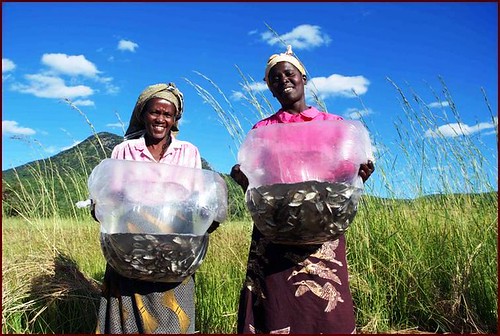
» The photo — Zambian Women Hold Bags of Tilapia Fingerlings — has no connection to the book at all apart from the fact it was taken in Zambia. But I thought it was a nice image and a brilliant title. There are actually some great photos of Africa from the 60s and 70s on flickr, like this one, but they are all of white people.

Categories
Culture

‘Rude Britannia’ at Tate Britain

I went along to Rude Britannia, the Tate’s exhibition of ‘British Comic Art’. Which was likeable enough, although much of the ground covered is pretty obvious: Hogarth, James Gillray, Thomas Rowlandson, Gerald Scarfe, Steve Bell, Spitting Image, Donald McGill, Viz. Bits of Punch, Aubrey Beardsley, Beryl Cook. There are also some pieces from the contemporary fine art world: the Chapman brothers, Sarah Lucas, Grayson Perry.

All of which is somewhat interesting and even sporadically amusing — although both 200-year-old social satire and wryly humorous conceptual art tend to be quiet-smile-funny rather than uncontrollable-belly-laughter-funny.

I suppose the suggestions is that there is some kind of overarching narrative about the British sense of humour or the British approach to art, but I’m not completely convinced. I guess if you were not British and were encountering all this material together for the first time, you would come away with a somewhat coherent overall impression: a kind of anarchic vulgarity which attempts to undermine anyone’s attempts at self-importance. Scatological humour and knob gags not just for their own sake but also because they are the enemy of dignity.

» Donald McGill, A Stick of Rock, Cock?
British Cartoon Archive, University of Kent
© Donald McGill Archive