-
'Using redshift data, a 3-D animated view of the Hubble Ultra Deep Field was created.' This video has been all over the place, but if you *haven't* already watched it, you should.
-
'Here's the fourth of Frank L. Baum's Wizard of Oz books, the one that features fighter jets and the planet Mars' (and other amusingly inappropriate book covers)
-
All that great Goldsworthiness collected in one place. via Accidental Mysteries.
Tag: books
The Earth: An Intimate History is big, fat (480 page) book about geology. Richard Fortey writes extremely well and it’s an impressive attempt to make a fairly dense subject exciting.

I have to admit though I nearly didn’t finish it; by about halfway though I’d had about as much as I could take of schist, gneiss, nappes and the endless litany of different places, geological periods and minerals that every new page seemed to require. So I put it down for a few weeks.
But eventually I built up the willpower to finish it off, and I’m glad I did; there’s plenty of interesting stuff in there, like the fact that the rocks of England and Scotland were formed on different sides of the Atlantic — or at least a previous ocean that lay between previous versions of Europe and America. Or the fact that in university laboratories, geologists have built vast machines that can squeeze minute samples of rock to the point where they mimic the temperatures and pressures found hundreds of kilometres below the earth’s surface.
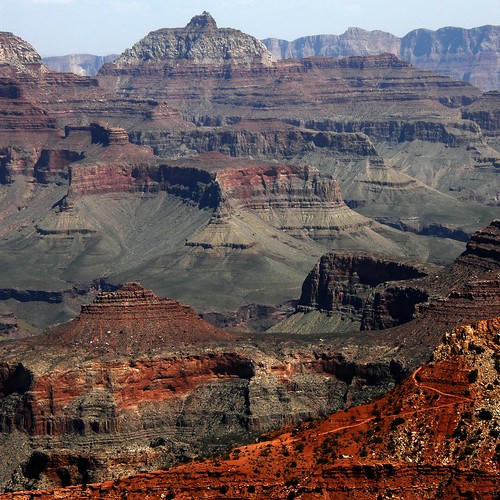
» The Grand Canyon is possibly a rather unoriginal choice of photo to illustrate geology, but wotthehell, it’s relevant and looks spectacular. Couleurs de la Terre / Colours of the Earth is © Olibac and used under a CC by-nc-nd license.
Masters of the Dew by Jacques Roumain
When I opened the package and saw the cover, I thought for a moment that the bookseller had cocked up and sent me a romance novel by mistake. But they hadn’t; Masters of the Dew is that slightly curious thing, a peasant novel. Curious because, generally speaking, peasants don’t write novels — the hero of this story is illiterate, in fact — so these books are written by outsiders, for whatever reasons of their own.
Jacques Roumain was from a wealthy Haitian family, educated in Europe, a politician, ethnologist and at the time of writing this book in 1944, a diplomat. He was part of the nationalist resistance against American occupation, founded the Haitian communist party, and later founded the Bureau d’Ethnologie. I imagine that the ethnology itself was originally political, as is so often the case: a wish to celebrate an authentic local identity creates an interest in traditional peasant culture. But certainly you can see how the nationalism, the communism and the ethnology would all feed into a peasant novel.

And given that background, it’s not a complete surprise that this is a novel about a strong, handsome peasant, uneducated but thoughtful and eloquent, sincere and full of integrity, who returns from working in Cuba, where he has been politically awakened by the experience of sugar-cane workers striking for better pay, and teaches the other villagers that only by working together, and putting aside their feuding, can they save their village — in this case by creating a new irrigation system.
However, the fact that the political messaging is a bit unsubtle — there’s also a corrupt local police chief and when one of the characters dies, they can’t have a church funeral because they can’t afford the fees — doesn’t make this a bad book. The descriptive passages are particularly strong and the dialogue is effective too, although apparently we are missing a certain amount in translation. In the original, Roumain apparently struck a compromise between using Haitian creole — which would have been authentic but difficult for his French-speaking readers — and putting pure French into the mouths of his peasant characters; songs and proverbs are quoted in creole and the dialogue is sprinkled with creole words. The translators, Langston Hughes and Mercer Cook, rather than trying to find suitable English equivalents or having the characters speak some kind of rural American dialect as a substitute, has them speaking standard English. I think that’s probably a solid decision, but there’s a whole layer of local flavour which is lost.
She sat next to him, leaning against the trunk of a macaw tree, her dress spread around her, and she clasped her hands around her knees.
The plain unfolded before them, surrounded by the hills. from here they could see the mingling of acacia trees, huts dispersed in the clearings, fields abandoned to the ravages of drought, and in the glare of the savanna, scattered cattle moving. Above this desolation crows on the wing hovered. Over and over they made the same circuit, perched on the cactus, and, frightened for some reason, flayed the silence with their harsh cawing.
Masters of the Dew is my book from Haiti for the Read The World challenge, and also my fourth book for the Caribbean Reading Challenge.
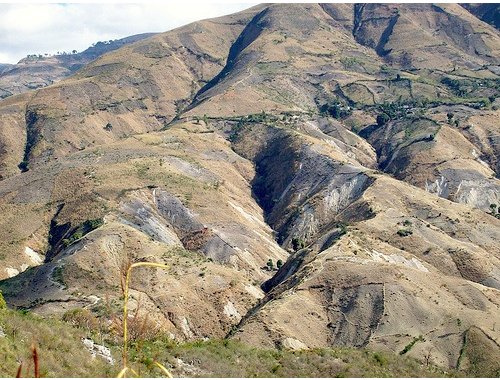
» The photo is ‘Degraded mountains‘, © Trees for the Future and used under a CC attribution licence. The damaging effect of deforestation comes up in the novel.
The description for that photo on Flickr says ‘The degraded mountain of Tibois (Top of Arcahaie)’; according to Wikipedia’s Arcahaie entry ‘the weather in this little quiet place is extremely pleasant and the feelings is unbelievable.’ Although I expect sooner or later some killjoy will edit it.
All About H. Hatterr by G.V. Desani
All About H. Hatterr is a novel I bought after seeing it recommended somewhere — the complete review, I think. It is a modernist novel written in 1948 in a colloquial Indian English laced with bits of slang, Shakespeare, legal jargon and so on. I’m not in a position to judge the relationship between the language of the book and the English of India, but Salman Rushdie is quoted on the back cover:
Hatterr’s dazzling, puzzling, leaping prose is the first genuine effort to go beyond the Englishness of the English language…. This is the ‘babu English,’ the semi-literate, half-learned English of the bazaars, transmuted by erudition, highbrow monkeying around, and the impish magic of Desani’s unique phrasing and rhythm into an entirely new kind of literary voice.
It would be interesting to read the whole article which that comes from, but it’s hidden behind the New Yorker’s pay wall.
The book is narrated by the H. Hatterr of the title, the son of a European merchant seaman and a woman from Burma, raised and educated in missionary schools in Calcutta. It’s anecdotal and episodic in structure; there isn’t, at least for me at first reading, any kind of overarching plot. Picaresque might be a good word for it.

It is somewhat ‘difficult’ — it’s not for people who like their prose plain. But googling around while writing this post I’ve seen it compared to Ulysses and Finnegans Wake, and it’s certainly not that difficult. The prose is sometimes elaborate and colourful but otherwise fairly conventional: it’s not all stream-of-consciousnessy or anything. And there’s not a great deal of vocabulary from Indian languages. There’s more English public-school slang than there is Hindi.
PRESUMPTION: ‘Kismet’, i.e., fate — if at all anything, and as potent as suspected for centuries — is a dam’ baffling thing!
It defies a feller’s rational: his entire conception as to his soma, pneuma, and psyche!
Why did a feller like me commit matrimony with a femme fatale like Mrs H. Hatterr (née Rialto), the waxed Kiss-curl?
A personal query, but I don’t mind answering…
If only I could!
All I know is that I wanted to raise a family: add to the world’s vital statistics and legitimate: have a niche in the community, for my own kid, to hand out the wager till the end. And since you can’t achieve this without a wife — the neighbours wouldn’t let you! the police wouldn’t let you! — I equipped myself with the blarney-phrases, convinced this female that she was real jam, had me led to the middle aisle and gave the ready ‘I do’ to the amenwallah her brother had hired for the occasion.
This I did, knowing, hell, that between us was all the temperamental difference in the world!
Till death us do part! this museum-piece and I! And that promise — what a stingo! — after a conflict dating back to the donkey’s Sundays!
The female — contrast? — was poles apart: though, between the cur Jenkins, me and the Duke Humphrey, it did seem once that she was going to win my regards for good, by delivering me an heir-presumptive — my own piccolo le fils — to survive me (and be added to the looney-bin). But despite days and days of biological observation and anticipation — the wasted reference to the obstetric table and pre-occupation with the signs of labour — it didn’t come off. (Backed the wrong filly, or, maybe, something the matter with me as create-or!)
You probably have a pretty good idea whether that’s the kind of thing you like. Personally I enjoyed it, stylistically; occasionally there would be a particularly dense paragraph or two and I would glaze over a bit, but more often it was lively and funny.
My only reservation really is the one I have about a lot of these less traditional novels: I think perhaps the whole is less than the sum of its parts. I think people often overstate the importance of plots, but they are at least one way of holding a book together. Still, I’m glad I read it.
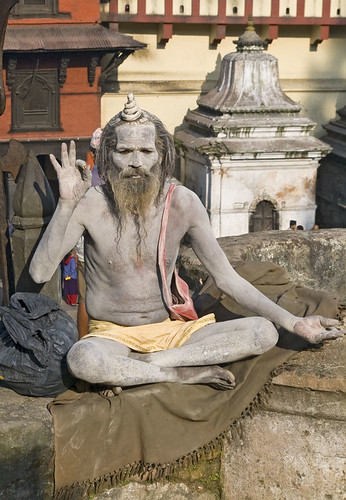
» The picture, ‘a Sadhu‘, is © Chris de Rham and used under a CC by-nc-nd licence. Sadhus feature quite heavily in the book.
The Golden Boat by Srečko Kosovel
According to the dust jacket, Srečko Kosovel is ‘often called the Slovene Rimbaud’.* Mainly, as far as I can gather, because he wrote all his poetry very young; not, like Rimbaud, because he decided to run off and do something else, but because he died at 22.
I found The Golden Boat: Selected Poems of Srečko Kosovel while I was browsing through the Salt website, looking for something I could buy to support their ‘Just One Book’ campaign. I decided to kill two birds with one stone and buy it as my book from Slovenia for the Read The World challenge. As a point of geographical and historical pedantry, Kosovel wasn’t actually born in Slovenia. As far as I can gather from the Wikipedia article, Slovenia never existed as an independent nation before June 1991, so anyone born in Slovenia is still under 18 today. Kosovel was born in 1904 in Austria-Hungary and died in 1926 in the Kingdom of the Serbs, Croats and Slovenes (which became Yugoslavia three years later).
EDIT — Just to add to the historico-geographical confusion: Tom points out in the comments that Kosovel’s home town was in the part of modern Slovenia that was annexed by Italy after WWI. So he actually died in Italy.

Kosovel wrote in free verse from the start, and if I’ve understood the introduction correctly, he was the first person to do so in Slovenian. But in subject matter and language, as far as one can tell in translation, the early poems are fairly conventional: low-key, atmospheric lyrics which are rooted in the Slovenian landscape, and particularly the Karst,† a rugged limestone plateau where a wind called the burja blows down from the Alps. I rather liked this early work, but I can see that if he had died even younger and these were the only poems that survived, he might not seem to be a particularly significant poet.
On a Grey Morning
On a grey morning
I walk the streets downtown,
the fog cuts into my burning eyes,
it cuts into my throat,
and is cold around my heart.Then, from the bakeries,
the smell of fresh rye bread,
but the bakeries are still dark,
the street silent, nobody yet around
and I feel tight in my soul.It is the memory of the Karst:
a village strewn among the rocks
that this black bread reminds me of,
this healthy scent from the bakeries
that smells so much like a caress.
Later his poetry became more avant-garde. He called himself a Constructivist, although apparently the connection with Russian Constructivism is not especially close.‡ Whatever the terminology, he is certainly part of the broader movement of European modernism, of Dada and Surrealism and Futurism and God knows what else. The poems become more fragmented, more opaque, more aggressive, there are sprinklings of mathematical symbols and typographical experimentation with different sized text and vertical text. There is some continuity of theme; the night and moonlight which are such a feature of the Karst poems are still constantly present, the Karst landscape and the burja still appear from time to time. But the poems become wider-ranging, more political. The death of Europe becomes a recurring theme, no doubt a response to having lived through the First World War: Kosovel was too young to fight, but he didn’t have to go war because the war came to him, or the town where he lived as a teenager.
Delirium
A martyrdom of thoughts.
Blue sea.
Grey prison.
A soldier is impaling
hopeless thoughts
on his bayonet
in front of the windowPardon me. ‘O, nothing.’
Sigaretta.
Eine Edison.
I hear the blue sea
butting monotonously
into my skull
And another example:
The Red Rocket
—–I am a red rocket, I ignite
myself and burn and fade out.
—–Yes, I in the red vestments!
—–I with the red heart!
—–I with the red blood!
—–I am escaping tirelessly, as if
I alone must reach fulfilment.
—–And the more I escape, the more I burn.
—–And the more I burn, the more I suffer.
—–And the more I suffer, the faster I fade out.
—–O, I, who want to live forever. And
I go, a red man, over a green field;
above me, over the azure lake of silence,
clouds of iron, o, but I go,
I go, a red man!
—–Everywhere is silence: in the fields, in the sky,
in the clouds, I’m the only one escaping, burning
with my scalding fire and
I can’t reach the silence.
I enjoyed the poems enough, and found them interesting enough, to be glad I bought the book, though I don’t know that many of them will really stay with me. As ever with poetry in translation, you never quite know what you’re missing, although at least with free verse you don’t have the added complication of the translator having to produce some kind of rhyme and metre in the English. Not that I have any reason to doubt the merits of this translation, by Bert Pribac and David Brooks ‘with the assistance of Teja Brooks Pribac’; I just have doubts about the whole exercise of translating poetry. But perhaps that’s a subject for another day.
*Not, as I keep hearing inside my head, the Slitheen Rambo. Though poetry written by the Slitheen Rambo might be quite interesting, as a piece of xenoanthropology if nothing else.
† Or indeed Kras. Rather like the book about Cyprus I was reading the other day, this is one of those regions where everywhere has several different names in different languages. The translators use Karst, the Germanised form of the name, perhaps for its associations with the kind of geological landscape that is named after it.
‡ I’m just repeating what it says in the introduction at this point. I don’t know enough about Constructivism or its relationship with the many other isms of the time to make that judgement.
» The photo is Škocjan, © inyucho and used under a CC attribution licence. inyucho says: ‘A large collapsed doline, typical for the Kras region from which the term “karst” is derived.’
Anil’s Ghost by Michael Ondaatje
The Anil of Anil’s Ghost is a forensic anthropologist; she was born in Sri Lanka but having left to study and work, she is now returning after 15 years away to investigate allegations of political murders. Ondaatje was eleven when he left Sri Lanka, so Anil’s insider/outsider status is presumably a reflection of his own experience. His decision to write this book is perhaps his equivalent of Anil’s need to return to Sri Lanka.

Ondaatje is really a very good writer. His books seem to have a dream-like quality, not so much because of what happens but the way that it is presented to us. Part of it is the way that the focus shifts around, not just between the main characters but an assortment of others who are only loosely connected to the central plot; and shifting backwards and forwards in time as well.
Also, if you were someone who just read books for the plot you might feel that it had its priorities oddly skewed: an ‘important’ event will go past rather rapidly, and then the book will dwell lovingly on a scene which has no particular narrative importance, but is atmospheric or striking or thematically apt.* It’s a kind of structuring which would seem very natural in a long poem but is a bit less common in novels.
As much as I liked the book, it was somewhat depressing. Perhaps a novel about ethnic conflict and political atrocities should be depressing, but still. Obviously I knew there was a long-running conflict in Sri Lanka, and of course it has been in the news recently as the war (or that phase of the war) drew to a bloody end; but I was blissfully ignorant of any of the details, and for me, Sri Lanka was largely associated with cricket. And it’s much more pleasant to associate a country with flamboyant opening batsmen than with heads on spikes. The book doesn’t actually wallow in the atrocities as much as it could do — they are evoked sparingly rather than described at length — but they are quite disturbing enough without that kind of pornographic attention to detail.
I had already counted a different book by Ondaatje — In the Skin of a Lion — as my book from Sri Lanka for the Read The World challenge, but that book is all set in Canada, so it seemed appropriate to read a book with a bit more Sri Lanka in it.
* I would hate to have to justify that sentence with close reference to the text, but thankfully I’m a blogger not a scholar.
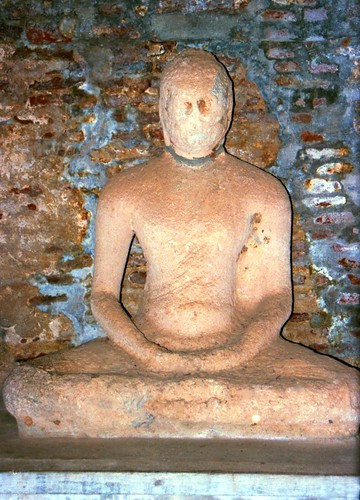
» The picture, ‘Old Buddha, Sri Lanka‘ is © Rahul Barraez D’Lucca and used under a CC attribution licence.