Categories
Culture

The President by Miguel Angel Asturias

The President is my book from Guatemala for the Read The World challenge. I’m probably going to count it it towards Scavella’s Caribbean Reading Challenge as well, although I haven’t really worked out my list for that yet. It comes with one high recommendation: Asturias was, as it says on the cover, ‘Winner! Nobel Prize for Literature’.

It is a book about life under a dictatorship; at the beginning a Colonel is murdered under slightly freakish circumstances, and the repercussions spread out from there, starting with the President using the murder as a pretext to target other politicians. The President isn’t particularly about the president himself, but the psychological and social impact on other people of the arbitrary and ruthless exercise of power.
I have to say I was left slightly cold by it. I don’t know if I would have read it any differently if I’d checked to see when it was written before reading it (d’oh!). It turns out it was actually written between 1922 and 1933 (though not published until 1946), which makes some of the stylistic quirks seem rather more radical and others more forgivable.

The things I might need to forgive – i.e. what I found irritating – is a certain overwrought quality to the prose, typified by the plentiful use of ellipses… and exclamation marks! Knowing that the book was written at least four decades earlier than I thought provides a degree of context for that, I think; quite a lot of books from the interwar period have a hint of intellectual melodrama to them. When I was reading it, though, I just thought it might be a very dodgy translation.

And on the other hand, the surreal aspect to the writing – the narrative slips into almost dream-sequence passages, and the action and characterization is sometimes slightly grotesque – is clearly not, as I vaguely thought, a pale imitation of Marquez. Rather, Asturias is probably an important influence on a writer like GGM.

Still, this is all post facto stuff, and when I was reading it I was rather less charitable. It was sporadically brilliant – after reading the first chapter I really thought I was in for a treat – but it never quite gripped me. It follows various intertwined characters, which meant no strong central narrative to pull me back in once my attention started wandering.

Anyway, here’s an extract:

Nothing was visible ahead. Behind them crept the track like a long silent snake unrolling its fluid, smooth, frozen coils. The ribs of the earth could be counted in the meagre dried-up marshlands, untouched by winter. The trees raised themselves to the full height of their thick, sappy branches in order to breathe. The bonfires dazzled the eyes of the tired horses. A man turned his back to urinate. His legs were invisible. The time had come for his companions to take stock of their situation, but they were too busy cleaning their rifles with grease and bits of cotton that still smelt of woman. Death had been carrying them off one by one, withering them as they lay in their beds, with no advantage to their children  or anyone else. It was better to risk their lives and see what would come of that. Bullets feel nothing when they pierce a man’s body; to them flesh is like sweet warm air—air with a certain substance. And they whistle like birds. the time had come to take stock, but they were too busy sharpening the machetes the leaders of the revolution had brought from an ironmonger whose shop had been burned down. The sharpened edge was like the smile on a negro’s face.

 I think this is a good book which, for whatever reasons, didn’t grab me. Shrug.

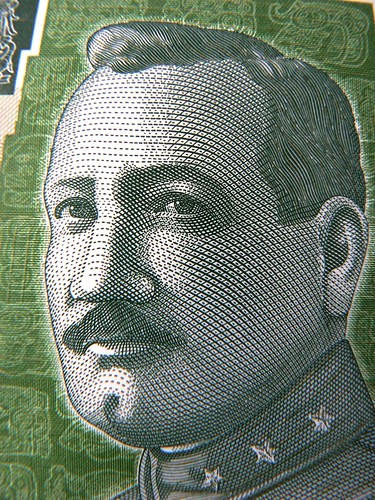
» The picture is of José María Orellana, president of Guatemala when Asturias started writing the novel, as he appears on the one quetzal banknote. It is © Oscar Mota and used under a CC attribution licence.

Categories
Culture

Books of the Year 2008

As ever, these are books I read in 2008, not necessarily or usually books published in 2008. The selection process wasn’t terribly rigorous; I just quickly picked out titles I particularly remember enjoying. I blogged about most of the books I read this year, so rather than go over them again, I’ve provided links to those posts. In the order I read them, these are my picks for the year:

Looking at that list, I’ve had a particularly good year for fiction this year, partially because of the Read The World challenge; the Aitmatov stands out as an example of a book I thought was really good and which it’s very unlikely I would have read if I hadn’t been looking for a title from Kyrgyzstan.

The Mitford letters might be the pick of the non-fiction; I knew they’d probably be worth reading, because they were an extraordinary bunch and several of them wrote well, but I wasn’t expecting to enjoy them as much as I did. Like a sparkling, witty and very posh version of Heat magazine, only with Hitler and Evelyn Waugh instead of Amy Winehouse.

Categories
Culture

The Butterfly’s Burden by Mahmoud Darwish

The Butterfly’s Burden is a translation of three books by the Palestinian poet Mahmoud Darwish who died earlier this year: The Stranger’s Bed (1998), A State of Siege (2002) and Don’t Apologise for What You’ve Done (2003). It’s a parallel text edition, which always makes me feel terribly learned, but in practice is just a waste of trees since I can’t even read Arabic script.

I am writing this post without having read the whole thing, which may be an admission of defeat. I’ve been having some difficulty connecting to it. I’m not inclined to blame Darwish for that: I imagine it’s partially the basic awkwardness of reading poetry in translation which is, as they say, like eating a Mars bar with the wrapper on; partially a lack of contextual knowledge on my part; and perhaps partially down to the translation by Fady Joudah, although I’m not in a position to judge it as a translation. And of course, very likely because of my own biases as a reader.

I initially picked it up and dipped in at random, which wasn’t a success, so I sat down and read A State of Siege straight through from beginning to end, and actually I did quite get into it and enjoy it. So, heartened by that, I tried the same thing with The Stranger’s Bed, but despite a few moments where I thought I was getting somewhere, I found it a bit of a chore. There were images or passages or moments that I thought were striking or effective, but I felt that on some basic level I just wasn’t getting it; the whole wasn’t cohering into more than the sum of the parts, and I found it all a bit frustrating.

I will make an attempt on Don’t Apologise for What You’ve Done as well, but whether or not I finish it I’m still going to claim Darwish as my writer from Palestine for the Read The World challenge, because I read two of the three books, and I think that’s good enough.

For an extract I’m going to pick something from A State of Siege, since that was the book I enjoyed most; in a sense, though, it’s a more difficult piece to pick extracts from because it isn’t divided into separate poems. Instead, it’s a thirty-page poem built up of short lyrical fragments, separated on the page by a little typographical squiggle. They work together cumulatively, and the poem has a kind of reflective tone; they could be the journal entries of a slightly gnomic diarist, or the contents of a notebook. The poem was written during the Second Intifada, and the conflict is the central subject, but the poem circles around it, sometimes explicitly talking about politics and violence, sometimes about poetry or love.

The mother said:
I did not see him walking in his blood
I did not see the purple flower on his foot
he was leaning against the wall
and in his hand
a cup of hot chamomile
he was thinking of his tomorrow …

The mother said: In the beginning of the matter I didn’t
comprehend the matter. they said: He just got married
a little while ago. So I let out my zaghareed, then danced and sang
until the last fraction of the night, when
the sleepless were gone and only baskets of purple flowers
remained around me. Then I asked: Where are the newlyweds?
Someone said: There, above the sky, two angels
are consummating their marriage … So I let out my zaghareed,
then danced and sang until I was struck
with a stroke.
When then, my beloved, will this honeymoon end?

This siege will extend until
the besieger feels, like the besieged,
that boredom
is a human trait

O you sleepless! have you not tired
from watching the light in our salt?
And from the incandescence of roses in our wounds
have you not tired, O sleepless?

We stand here. Sit here. Remain here. Immortal here.
And we have only one goal:
to be. Then we’ll disagree over everything:
over the design of the national flag
(you would do well my living people
if you choose the symbol of the simpleton donkey)
and we’ll disagree over the new anthem
(you would do well if you choose a song about the marriage of doves)
and we’ll disagree over women’s duties
(you would do well if you choose a woman to preside over security)
we’ll disagree over the percentage, the private and the public,
we’ll disagree over everything. And we’ll have one goal:
to be …
After that one finds room to choose other goals

» The photograph is of Mahmoud Darwish’s funeral in Ramallah and is © activestills.org.

Categories
Culture

The Unknown Matisse by Hilary Spurling

The Unknown Matisse is the first of two volumes, taking our hero from 1869-1908. I actually bought it some time ago on Jee Leong‘s recommendation, but it has taken me some time to finish, mainly I think because the simple physical size of it makes it slightly awkward to read in bed. It’s not that huge, but it’s quite a fat volume and printed on large format paper to make space for some colour reproductions of the work. Which are, of course, lovely and very welcome.

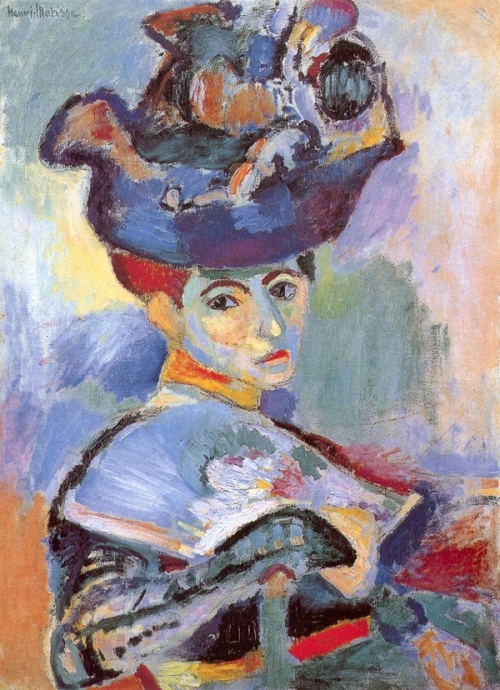
It’s fascinating to read about the outrage that greeted paintings which now seem, if not tame exactly, at least uncontroversial. Indeed the first time he shocked the Parisian public, it was with a painting (The Dinner Table) that now looks positively conventional.* Over the past hundred years, outraging the public has become an explicit part of the job description for artists; but how much more satisfying to shock people not by placing a sculpture of Christ in a glass of urine, or exhibiting a work consisting of a room with the lights going on and off, but with a painting of a woman in a hat.

Not that Matisse seems to have been temperamentally inclined to shock people for its own sake. Some of the other modern artists obviously rather enjoyed the opportunity to wind up the public: André Derain came back from a visit to London with a classically tailored English suit made fauvist by the choice of a green fabric, with a red waistcoat and yellow shoes. Matisse, though, was more inclined to respectability: partially because unlike most of his contemporaries he had a young family, which meant he needed at least enough saleable work to keep them in food. But also because (through no fault of his own) he was caught up in the most magnificently baroque financial and political scandal I’ve ever heard of — really, it would merit a book by itself — which gave him enough experience of public notoriety to last a lifetime.

It’s a fine book, readable, evocative, well-researched.  Or at least it gives the impression of being well-researched, which is as much as I have the expertise to judge.

* Although actually, in one of their periodic fits of cynical outrage about the Turner Prize, the Daily Mail held a ‘Not the Turner Prize’ competition, open to the public, and the work in that suggested that there are still plenty of people in Britain who feel that the highest aspiration of the painter should be photographic accuracy. Preferably of tigers. Or steam trains.

Categories
Culture

The Wooden Village by Peter Pišťanek

Or as the cover has it: The Wooden Village (Rivers of Babylon 2). That’s because it’s the sequel to Rivers of Babylon, which I read recently, and book two of a trilogy.

Rivers of Babylon, you may remember, follows a character called Rácz as he fights his way up from stoking the boilers of a big hotel in Bratislava to become a powerful businessman/crime lord. The Wooden Village focuses on one of the minor characters from that novel: Freddy Piggybank, who works in the hotel car park.

I didn’t think it was quite so successful; it suffers not so much from the absence of Rácz as a character but the lack of an equally compelling narrative framework. Rivers of Babylon had a whole cast of minor characters and subplots, but it was held together by the remorseless rise of Rácz; I don’t think the second book has such a strong core. The tone has shifted a bit, too; it’s still scathing and vulgar and energetic, but it seems to have lost the ferocious anger that powered the first book. It feels like a shift away from satire towards farce.

Anyway, here’s an extract. Freddy has just been told that the council is closing the car park and that he will therefore be losing his job:

Freddy sits there lifelessly. Only now does he feel the whole impact of his cruel fate. This is the end of Freddy. Life will not be worth living now. Where will he go? What will happen to him? Back to the brickyard? They’re laying off workers there. And his parents? What will his parents say? The vein in his head begins to pound dangerously. Freddy should be taking his medication, but he just sits there. I might as well croak, he thinks, full of self-pity. He imagines big headlines in the daily papers: BANKRUPT CAR PARK ATTENDANT DIES ON HIS LOT!.. HE ONLY WANTED TO LOOK AFTER CARS!.. ANOTHER VELVET REVOLUTION VICTIM? Yes, he’ll probably die here. The bitch from town council will read the paper and her conscience will bother her until she dies. Freddy wallows in his misery and rather pleasant self-pity. His chest heaves mightily a few times and he sighs with sadness. No, Piggybank realises, his death will not be headline news. Maybe some paper will have a little piece about it in the miscellaneous section: MENTALLY DISTURBED MISER DIES OF STROKE IN CAR PARK. Or something like that.

Freddy makes a decision. He will survive. He won’t allow his tragic death, a number one event for him, to become a source of entertainment fro some fool having his morning coffee. No! Freddy will fight. He will have revenge on this fucking government for this humiliation. He will live off crime. He will sink deep into the muck. He will steal and so on, until they catch up with him and lock him up in jail. And he’ll die in jail. As a sort of silent protest. As an example of what this government did to an honest businessman, Alfred Mešťánek, who only wanted to guard cars until his death and make an honest living. From now on, no wickedness will be wicked enough for Freddy!

I’d certainly recommend you read Rivers of Babylon, and if you enjoy that, you’ll probably enjoy this one too; it’s just not as good, I think.

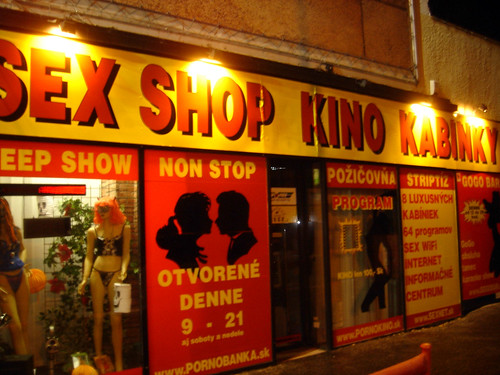
» The photo of a sex shop in Bratislava is © Mark Pozzobon and used under a CC by-nc-sa licence. I don’t seem to have mentioned it in this post, but The Wooden Village has a lot of stuff about the sex trade, which is why the photo seemed relevant.

Categories
Culture

How the Soldier Repairs the Gramophone by Saša Stanišić

How the Soldier Repairs the Gramophone by Saša Stanišić is my book from Bosnia and Herzegovina for the Read The World challenge. I actually had a different writer in mind — Ivo Andrić, who won the Nobel Prize for Literature in 1961 — but when I saw this in the bookshop I switched. Mainly because most of the books I’ve been reading are a few decades old, and it’s nice to find one which is fresh out of the oven (published in German in 2006; the English translation by Anthea Bell in 2008).

How the Soldier Repairs the Gramophone tells the story of Aleksandar Krsmanović, a boy who is growing up in the Bosnian town of Višegrad but flees with his family to Germany in 1992 to escape the war. Since Stanišić grew up in Višegrad and moved to Germany in 1992 as a fourteen-year-old, I assume it is somewhat autobiographical.

The blurb on the back cover compares Stanišić with Jonathan Safran Foer and David Foster Wallace, which gives you some idea of the kind of writer he is: a clever young man who isn’t afraid to leave evidence of his cleverness on the page. There are sections written in different voices, stylistic quirks, elements you might call magical realist, a bit of a book-within-a-book and so on. In fiction there can be a fine line between overtly clever and overly clever, and for the first few chapters I was a bit unsure which side of the line this book falls, but it won me over.

Here’s a fairly randomly picked passage:

My Nena went deaf the day Grandpa Rafik married the river Drina, face down. The marriage was legal because Nena and Grandpa Rafik had been divorced for years, something unusual in our town. After Grandpa Rafik was buried, they say she said at his graveside: I haven’t cooked anything, I haven’t brought anything, I haven’t put on black clothes, but I have a whole book full of things to forgive. They say she took out a stack of notes and began reading aloud from them. They say she stood there for a day and a night, and word by word, sentence by sentence, page by page she forgave him. And after that she said no more, and she never reacted to any kind of question again.

Nena Fatima has eyes as keen as a hawk’s, kyu, ket-ket, she recognises me before I turn into her street, and she wears headscarves. Nena’s hair is a secret — long and red and beautiful, she gave the secret away to me as we sat outside her house eating börek in summer and feeding the Drina with minced meat. Cold yoghurt, salted onions, the warmth of Nena rocking silently as she sits cross-legged. The dough is shiny with good fat. Nena rocks back and forth and lights a cigarette when I’ve had enough. I am the quietest grandson in the world, so as not to disturb her stillness and our sunset. Sultry heat gathers over the river and looks attentively at Nena Fatima, who is humming as she plaits her secret into a long braid. I don’t laugh with anyone as softly as with my Nena, I laugh with her until I’m exhausted, I don’t comb anyone else’s hair.

As I do the Read The World challenge, various themes are recurring; this is the third book I’ve read (along with My Father’s Notebook and The Kite Runner) which is written by a refugee, starts with nostalgic memories of the home country, and then describes the country collapsing and the refugee experience. It is much the best of the three, I think; I did genuinely enjoy The Kite Runner, but it is deeply emotionally manipulative, like watching a Hollywood film about a difficult subject by a skillful but solidly mainstream director. The kind of glossy film on a ‘brave’ subject which is daring enough to win a few Oscars but which you look back on a few years later and think… meh. How the Soldier Repairs the Gramophone is a more interesting book all round; messier, more personal (I think), funnier, sadder. And while I don’t want to overstate the originality of it — it’s been nearly a hundred years since some bright spark invented modernism, FFS — it is at least less of a straight down the line conventional narrative.

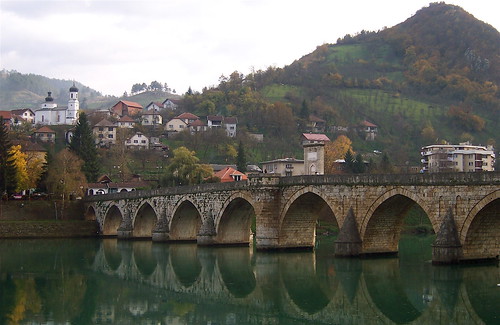
» the photo is of the bridge over the Drina in Višegrad that is mentioned in How the Soldier Repairs the Gramophone and is also incidentally the eponymous bridge in Ivo Andrić’s novel The Bridge on the Drina. The photo is © blandm and used under a CC by-nc-sa licence.