Categories
Culture

Miró at Tate Modern

Without knowing a lot about Joan Miró, I’ve always liked his work when I’ve seen it. It’s interesting the way that the work of one artist will speak to you and another won’t… so I’ve aways liked Miró, never liked Chagall.
Or at least I say the work ‘speaks to you’ but that’s not the right metaphor; I don’t think it’s because the paintings are making some sort of intellectual or emotional connection. Or at least I don’t think that’s primarily what it is; it’s more to do with a basic visual aesthetic. I tend to like controlled, precise, carefully composed paintings with strong clear colours: so I like Vermeer, but find it hard to like Rubens. It’s suppose it’s a graphic design sensibility, really.

Articulating it like that does make me feel a bit shallow; taking great painters and sorting them into sheep and goats according to the most superficial and basic elements of their visual style, well, it doesn’t exactly make me a sophisticated judge. But there you go. It’s not the only factor which decides which work I like, but it certainly makes a difference.

So I was predisposed to like this exhibition. Which I did. I thought it was fabulous. Mainly because I liked all paintings, of course; but also because I didn’t know much about Miró, so it was interesting to see the chronological development of work. There was also quite a lot of biographical context, much of it related to Spanish politics — Miró’s Catalan identity, the Spanish civil war, WWII and so on. So that was all quite interesting.

But mainly I just love the paintings. I want to own all of them and have them on my walls.

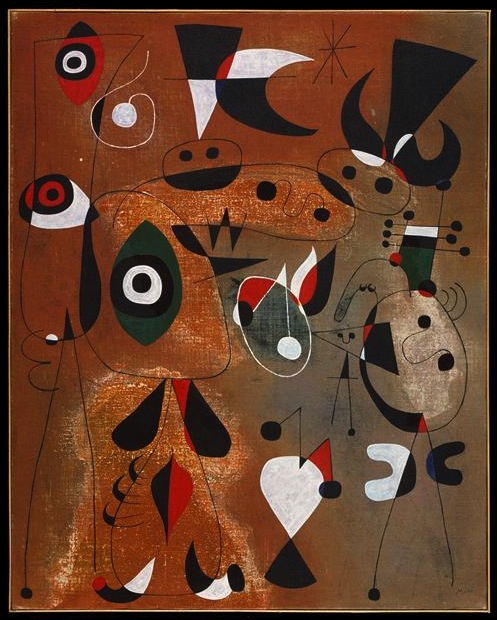
» Women, Birds, and a Star, 1949. Which is in the Met, although I got the image from RMN.
Categories
Culture

Ragamuffin by Tobias S. Buckell

Ragamuffin is my book from Grenada for the Read The World challenge. It’s a science fiction novel about a universe where humans share space with various other species and can travel from world to world via wormholes. Some of them come from a world which was settled by people from the Caribbean, hence the title and a certain amount of West Indian-inflected dialogue.

It was quite entertaining, I guess; I’m not really much of an SF fan. I read a lot at one stage because my brother used to read them, but since we don’t live in the same house anymore, I’ve largely stopped. I think the most interesting thing about SF is when it’s used to explore ideas: so for example, Iain M Banks’s Culture novels are in a sense a contribution to the Utopian tradition, and among other things, they raise the question of what human society would be like in a situation with limitless material wealth.

Ragamuffin is not really a novel of ideas in that way; it’s inventive enough, but it’s inventive within the standard tropes of science fiction. In a way this kind of space opera is really futuristic fantasy; swords and sorcery, with bionic implants taking the place of magical powers. I always thought it was interesting, incidentally, that two of the most popular works of C20th narrative, Lord of the Rings and Star Wars, have such a medieval shape to them. But maybe that’s too much of a detour for this post.

Anyway, sub-genres of SF aside, what really makes the difference between good novels and bad ones is not the genre, it’s always the quality of the writing. Which in this book was perfectly reasonable but nothing remarkable. Even though it’s not the kind of book I usually read, I picked it up thinking it might be a bit of treat to read some escapist fiction. But it never really grabbed me.

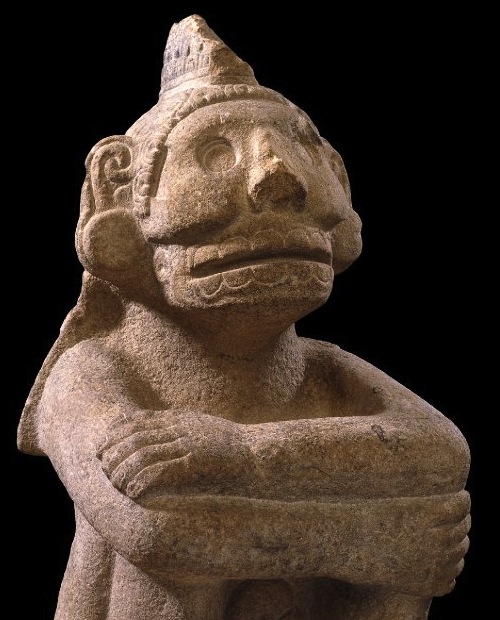
» The Aztec figurine of Mictlantecuhtli is from the British Museum. As well as the Caribbean theme in the novel, there’s an Aztec-inspired culture, weirdly enough.

Categories
Other

A thought on AV

I’m sure the whole world is on the edge of its seat on the eve of the UK’s referendum to change its voting system. I don’t particularly want to go over the arguments about voting reform again [previous posts for the truly interested], but I’m interested by the psychology of the supporters of first past the post. It is, after all, a truly terrible voting system for any election with more than two candidates.

There are two obvious reasons why people might support the status quo, one more cynical than the other. The cynical one is simple self-interest: FPTP tends to entrench a two-party system and creates a structural advantage for the two major parties. The other obvious reason is small-c conservatism. We’ve always done it this way, if it ain’t broke don’t fix it, if it was good enough for Winston Churchill it’s good enough for me, blah blah blah.

But some politicians seem to have a visceral dislike of it, and I wonder if part of that is the psychology of party politics. You don’t generally end up as an MP, and certainly not a government minister, without a deep tribal attachment to a particular party. The kind of people who go into student politics, who get jobs as researchers for MPs, who go door to door with leaflets: these are people who always know who they’re going to vote for, who always have a dog in the race. If their man doesn’t win, that counts as a loss. People who are active in party politics are like sports fans — Chelsea till I die! — and their experience of elections is completely different to that of the mass of the public.

Perhaps that’s why they seem to regard the use of second preferences as somehow cheating. They can’t relate to people who are ambivalent about all the parties, who often feel they are voting for the least bad choice, or who feel unrepresented by the system.

I think AV is a better system than FPTP because it eliminates spoiler candidates and tactical voting. But I think it also appeals to me personally because it is a better reflection of the way I feel about the parties. I don’t go into the voting booth with one clear automatic first choice; I go in weighing up a mix of different priorities. I don’t agree with any of the parties wholeheartedly, and I don’t like them very much, but some are preferable to others.

I might go in to vote feeling that Labour, the Lib Dems and the Greens would all be acceptable, with Conservative a distant fourth but still clearly preferable to the BNP, UKIP, the Christian Party, the Workers’ Revolutionary Party, or Respect; well, AV allows me to express that.

Depressingly it looks very much like the referendum is going to fail, so we are going to continue with a voting system that is designed for people with the absolute political certainty and strong partisan instincts, rather than wishy-washy people like me. Ho hum.

Categories
Culture

Shadows of your Black Memory by Donato Ndongo

As part of my ongoing quest to read a book from every country, I picked up Shadows of your Black Memory as a book from Equatorial Guinea. It is a childhood/coming of age novel that sets up the conflict between traditional and western cultures: particularly in this case between traditional religion and Catholicism.

Which, at this point in the exercise, is not a description that fills me with excitement; because nearly all the literature of the post-colonial world seems to be about the conflict between tradition and western culture and/or modernity. Certainly the stuff which makes it into English translation. And it’s also pretty common to tell it as the story of a young person growing up caught between two worlds.

So I didn’t pick it up with much enthusiasm, but actually it’s a really good novel. It is simply very well written: vivid, fresh and engaging.

Here’s one of the Catholic bits:

When I was eight, I knew Father Claret’s catechism by heart, and my favourite book was his Straight and Sure Path to Heaven. The horror of eternal condemnation didn’t allow me to be a child. I didn’t go to the Wele River with Ba any more, I couldn’t learn how to make those bamboo toy cars that I loved so much even though cousin Asumu offered to teach me many times. I didn’t carve arrows to shoot at birds anymore, I didn’t go swimming in the Nganga River with my friend Otunga or my cousins Anton and Mbo. Even today I don’t know how to swim. I didn’t have a hunting dog, and I didn’t know how to make a cage for trapping fish. All this was for other children now, for the ones who weren’t fortunate enough to be touched by the grace of God. What’s the use of all that fun and idleness if in the end your soul is damned forever? Father Claret, the saintly one, asked me this as I read his book, and I had no choice; I had to acknowledge that the most important part of my life was my soul, and to be saved I had to avoid useless amusements, the silly games of my friends, my cousins, the brothers in my tribe. It was shortly before I was nine when I got into the habit of saying Mass from a little altar I made for myself in my room in front of the crucifix Father Ortiz had given me and under the religious things I had on the wall: the Eye-of-God triangle and some prints that were brought to me by my father’s white friends; the Little Prayer Book served as missal. Alone in my room, when no one was looking, when my little brothers succumbed to the midday sun, I got all dressed up in a bed sheet and pretended it was a priest’s chasuble and started to say Mass, in nomine Patris et Filii et Spritus Sancti, and I made the sign of the cross: I, a sinner, confess to Almighty God and the Blessed Mary Ever Virgin, Saint Michael the Archangel, John the Baptist, and to Apostles Peter and Paul and all the saints, and I beat my little breast in contrition, mea culpa, mea culpa, mea maxima culpa, and I almost forgot the kyrie eleison kyrie eleison Christe eleison Christe eleison, then the intraito, oremus, and I turned my head ceremoniously; then in silent fervor I genuflected, gloria in excelsis Deo, and I recited it all without knowing what I said in a Latin I learned from listening to Father Ortiz so much.

So, yup, I really enjoyed this one. Well worth picking up. I’d be quite interested in reading the sequel if it was available in English. And I often forget to mention translators, but credit is certainly due in this case, so: the translation is by Michael Ugarte.

» The photo is of a Reliquary Guardian Figure (Eyema-o-Byeri) in the Brooklyn Museum. It is actually from Gabon rather than Equatorial Guinea, but it’s the right ethnic group (Fang).

Categories
Other

Royal wedding weirdness

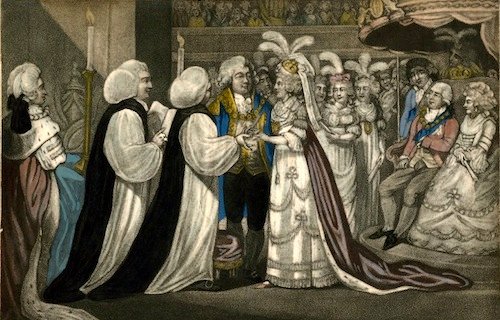
Interesting to see that the crown Prince of Bahrain has said he won’t be coming to the Will&Kate wedstravaganza because he doesn’t want the political situation in Bahrain to be a ‘distraction’ from the wedding. Because news stories about the arrest, beating and torture of political dissidents might be an unnecessary turd of realism in the candy-floss.

Perhaps he came to this decision spontaneously; it seems likely that there was some diplomatic pressure being exerted behind the scenes by the British government. Still, the Saudis are coming, so the government clearly doesn’t feel there’s a fundamental conflict between fairytale weddings and brutal human rights abuses; it’s not a question of morality so much as timing.

The guest list actually makes rather interesting reading. A lot of it is very predictable — friends and family, some British political bigwigs, various religious representatives. Where I think it gets interesting is the foreign guests, who basically fall into two categories: royals and the Commonwealth.

Prince William will one day be head of the Commonwealth, so it makes a quirky kind of sense that St Lucia gets an invitation ahead of, for example, the US or France.

But the royals category does make me just slightly queasy. All royals, from whatever country, seem to automatically get an invitation because, what, royals should stick together? Is that really what we think? Do we really think that it’s more important to extend this courtesy to the Crown Prince of Yugoslavia, a man whose family have not been heads of state since 1945, and whose country doesn’t even exist anymore, than to, say, the President of France? or Ireland? or Germany?

As I’ve said before, I’m a sort of pragmatic royalist by inclination. That is, I know that the monarchy is anti-democratic, anti-meritocratic and anachronistic, but I think it’s mostly harmless; and given the political melodrama that would involved in getting rid of it, on balance I’m inclined to let well enough alone. But there’s nothing like a royal wedding to bring out the republicanism simmering under the surface. It’s the symbolism of it, the idea that a title inherited through blood is somehow more special than one which is given via the democratic will of the people.

Categories
Nature

Dazzled and Deceived by Peter Forbes

This is a book about mimicry and camouflage; principally in nature but also in human use — i.e. the military. I heard about it because it won the Warwick Prize for Writing 2011, and the subject sounded interesting, so I thought I’d give it a go.

It’s certainly pretty good, but I wasn’t blown away by it. It didn’t help that I was familiar with many of the examples already.

My other slight gripe is that it spends a lot of time using examples of mimicry and camouflage as a way to shed light on deeper ideas about evolution. Which is, obviously, a valuable exercise, and not in itself a Bad Thing. But I’ve read loads of stuff about evolution already, thank you, and so reading yet another explanation of evo-devo is not enormously exciting. I would much rather have been reading about extra examples of strange and curious animal mimicry.

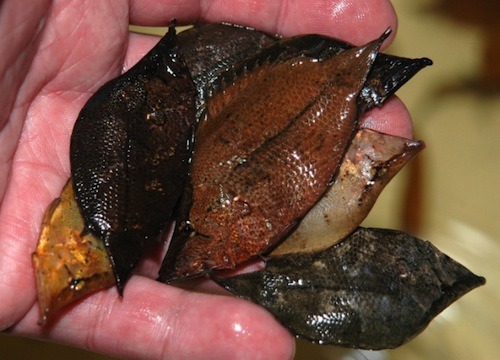
So, you know, a good book; but I am not its perfect audience. Still, if nothing else it introduced me to the jaw-dropping amazon leaf fish pictured above.