Categories
Culture

Exhibition roundup: Nash, quilts, Moore

Dulwich Picture Gallery currently has an exhibition of the English painter Paul Nash, best known I guess for his work as a war artist in both world wars. I know I first encountered him at school, when we were doing Wilfred Owen or Robert Graves or someone.

This exhibition did include some of that work, but also provided a bit of context for me. It was certainly interesting to see the kind of surrealist/symbolist paintings he did, often of the English landscape, when it wasn’t wartime. But it wasn’t really to my taste; it didn’t trigger that acquisitive urge. All else being equal, I am drawn to paintings which use strong, clear colours and sharply defined forms: Vermeer, El Greco, Matisse. Provençal Van Gogh rather than Flanders Van Gogh. Paul Nash is kind of the opposite: grey-brown tones and splodgy brushwork.
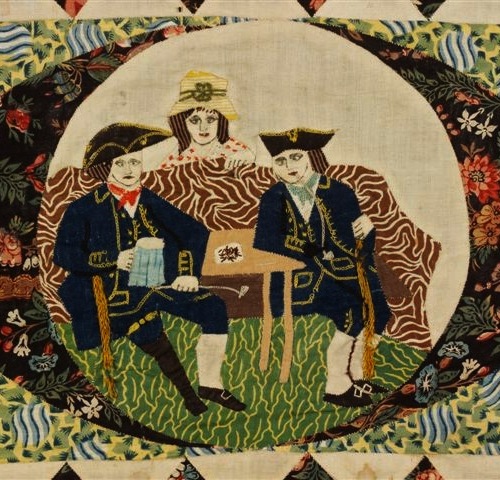
Meanwhile, the V&A has its first exhibition of British quilts, Quilts 1700-2010. I went to see it at an evening event in aid of Fine Cell Work, a charity that teaches prison inmates to do needlework as a rehabilitation exercise. There’s a quilt in the exhibition made by inmates with FCW; it is given context by a quilt made in a Japanese POW camp and one made by inmates on a prison ship who were being transported to Australia in 1841. Not surprisingly, the exhibition is keen to tease out this kind of social history from the quilts, but the other pleasure of it is just the extremely high quality of work on show. I’m fairly familiar with this stuff — my mother is a keen quilter — but they really have put together some great pieces.

The curator of the exhibition has managed to seriously annoy my mother by coming out with stuff like this in the Guardian:

Curator Sue Prichard thinks this enthusiasm is partly due to the global downturn. “I started on this project in 2004. Now there is a huge revival of interest in traditional crafts. There are a lot of women out there who are really keen to learn new skills and step away from their computer and their Blackberry.”

or in the Times:

Ms Pritchard said she hoped that the museum would inspire a revival of the craft through workshops that would teach people traditional techniques.

Because if there’s one traditional craft which didn’t need a revival, it’s quilting. That’s what appeals to me about quilting; it’s a genuinely living tradition, a vernacular art form which is thriving. It doesn’t need to be supported by government grants, it’s not the preserve of a handful of obsessive enthusiasts. Quilt shows are big business; indeed, the V&A’s exhibition is their most successful ever in terms of advance ticket sales. If there’s one criticism I have of the exhibition, it’s that it doesn’t give much sense of the liveliness of that current tradition. That gripe aside, it’s well worth visiting.

And finally Henry Moore at Tate Britain. Henry Moore was perhaps the biggest name in British art in the mid-C20th century, but he’s probably been rather out of fashion for a couple of decades, so it’s quite interesting to see this big show at the Tate.

Rather like the Paul Nash, I can’t say this particularly excited me, though it had its moments. Moore’s sculptures are often quite appealing as objects, with their curves, and the textural qualities of the materials; but it often feels like they are attractive in the same way as a weathered tree stump. Don’t get me wrong, I like a weathered tree stump as much as the next person, but I kind of feel that art could aim a bit higher than that.

The most interesting bits were probably the famous drawings of people sheltering in the Underground during the Blitz. Even though he makes the people look so much like his own sculptures, they have more impact than the sculptures themselves. They seem to hit a sweet spot between sculptural dignity and living humanity. There were some fine pictures of coal miners at work that managed the same trick.

Some of his post-War sculpture had some of the same human vulnerability and oddness, a bit of edge to it; but generally he seems to have reverted to weathered tree stump territory. Perhaps his greatest strength was a knack for producing sculptures that really worked as public art: large scale, impressive, and just about modern enough while unlikely to offend anyone.

Categories
Culture

The Whistler by Ondjaki

I have read several books recently that felt like a bit of a chore, so the first point to make about The Whistler is that it is gloriously short. With the help of generous amounts of white space the publishers have padded it out to 100 pages, but it’s probably more like 60 pages of actual text. I’m not a fan of short stories and I’m usually suspicious of very short novels, but this time I was in the mood for it: how nice to get a book finished in a couple of short sittings.

It’s about a man with an extraordinary whistle; except actually the whistler himself hardly appears. It’s really the story of a village reacting to the whistler’s arrival; and his whistling has a remarkable effect on people. We’re in magical realism territory here.

The story is light on plot but strong on atmosphere; it’s dreamy and wistful and gently funny. I guess in the end it might be a tiny bit insubstantial, but I found it very likeable. And it’s nice to read African fiction which isn’t about civil war or dictatorship or colonialism, important though those subjects are, but instead about people’s normal desires and concerns on a human scale.

He arrived in October, at the same time as the enduring and silent rains of that village. His hair fell along the thin sides of his face, his clothes were completely soaked and heavy, his eyes barely open from such amazement: it was a rain as soaking as any other, but without the natural gift of making a noise as it fell. He believed he was in the midst of an intense snow storm, and opened his mouth. He had never experienced a rain like this.

He put his bag on the steps. He looked, still with that soaked gaze, at the pigeons that surrounded the church. They flapped around him, alighted n the windows and took to the air again. It was only them that made a noise; only their noise could be heard. Further in the distance was a donkeys’ retreat. It is true, gathered donkeys: grey, fat, content and ambling.

He went into the church with a small step, without making a noise. The day was still young and the first mass had already taken place. He breathed the air around him, felt a delicate religiousness penetrate his lungs and his heart. The beauty of the architecture, the light filtering through the stained-glass windows, the morning and the moment, the absence of the Padre, led him to begin whistling. He discovered, with the end of the first notes, that this was one of the best places in the world for the whistling of melodies.

The Whistler by Ondjaki (trans. Richard Bartlett) is my book from Angola for the Read The World challenge.

» The photo is © Jose and used under a CC by-nc-sa licence. It has no particular relevance except that it was taken in Angola and I like it.

Categories
Culture

‘The Kingdom of Ife’ at the British Museum

I went to the BM to see the exhibition of art from the medieval west African kingdom of Ife (now in Nigeria). Ife is most famous for some extraordinarily high quality naturalistic heads cast in brass or copper, although the exhibitions also has various other pieces, including terracotta heads in the same style, jewellery, animal pieces and so on.

These heads are of such high quality that one of the first Europeans to see them felt they couldn’t possibly have been made by Africans: instead he hypothesised that they were evidence for the lost civilisation of Atlantis. Which is, umm, a bit cringeworthy. You know you’ve got a bit of a blind spot when you think that Atlantis is a more likely explanation than a previously unknown African kingdom with a strong metalworking tradition. Its especially embarrassing because while it sounds like something some Elizabethan explorer might have come up with, it was in fact… in 1900. Yikes.

He was at least right that these are genuinely remarkable objects, superbly crafted and of great beauty. In fact if you judge art by how much it looks like the thing it portrays — the Daily Mail school of art criticism — there is something extraordinary about this little flowering of naturalistic sculpture in a continent dominated by various kinds of highly stylised art. Certainly that was the Western press reaction when the bulk of the work was found; references to an African Donatello, to African sculpture standing comparison with the great works of Greece and Italy, and to these sculptures being a great mystery of African art. Because, of course, there is no higher ambition than to produce work which fits tidily into the European tradition, and it is inherently mysterious that Africans should be able to do it.

I’m being a bit glib, but actually the exhibition had me examining my own preconceptions about art (I haven’t reached any conclusions yet). Although these days we are all much quicker to see beauty in ‘primitive’ art, not least because its profound influence on Modernism helped change our expectations of what ‘fine art’ looks like, I think most of us have at least an implicit sense of a hierarchy which sees exquisite representational art as, if not better, then more developed or more sophisticated than the highly stylised carvings which we normally associate with Africa. And so these Ife heads seem to carry a significance beyond their beauty.

But the emergence of naturalism really require any special explanation? I guess it might need a society wealthy enough for some people to work as nearly full-time artists, but beyond that maybe all it needs is a shift in fashion. In fact, perhaps representational art is the kind that needs least explanation, since the logic of ‘making things that look like other things’ is so straightforward.

All such questions aside: it’s a marvellous exhibition and if you’re passing through London in the next three months you you should go and see it.

Categories
Culture

Internet shopping WIN

I ordered some books online at 8:15am and they arrived at 1pm. Free delivery and everything! I realise they can’t reproduce this level of service for everyone — it turns out I live very close to the publisher — but it was still kind of cool.

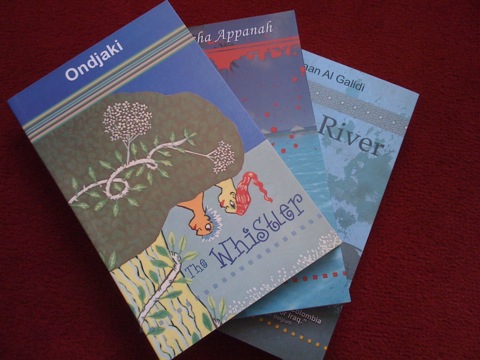
The publisher in question is Aflame Books, incidentally, a small press specialising in translated fiction from Africa, Latin America and the Middle East who I learned via the complete review are having financial difficulties. And since I need books for the Read The World challenge it made sense to order a few books from countries I haven’t ticked off yet.

Meanwhile, a minor internet shopping FAIL from Amazon via their package tracking service. Last Thursday they put some books into a van for me, drove them around south London, decided they had an incorrect address and sent them back to the depot. Harumph. They are now once again in transit; let’s see if they can find the house this time.

Categories
Culture

Céleste Boursier-Mougenot and Ron Arad at the Barbican

I went along yesterday to see the new commission by Céleste Boursier-Mougenot in the Curve gallery at the Barbican. You may have seen it on YouTube, where it has been a bit of a hit:

The set-up in the video isn’t exactly the same as the one in the gallery, but it gives you the idea: a flock of zebra finches in a room with electric guitars and up-turned cymbals, who ‘play’ the instruments by hopping around and perching on them. They are free-flying in the gallery, and you can walk on paths between the instruments.

It’s an immediately appealing idea and quite memorable, so it will probably be something of a hit, at least by the standards of contemporary art installations. To be honest, though, I thought it was less striking in reality than it was in neatly-edited little close-ups on YouTube. It was more like being in a slightly odd aviary than in some kind of extraordinary art-place. People did seem to be enjoying it, though. I slightly wonder how much of that was just the pleasure of being in among all these very tame little birds, but perhaps I’m just projecting my own reactions. I did inevitably go into birdy-man mode, noticing that they were piking up nesting material and looking in vain for somewhere to put it, wondering why they were pecking a concrete wall, looking for mating behaviour.

And while zebra finches aren’t exactly imbued with an enormous amount of dignity at the best of times, there was something slightly off-putting about seeing these little birds with their own aims and desires in life being cajoled into being art. I’m not suggesting it was inhumane: they had grass and food and water, and lots of room, so by cagebird standards it seemed like pretty good accommodation.

Categories
Culture

The Railway by Hamid Ismailov

Having set myself the modest enough goal for 2010 of reading a few more books for the Read The World challenge than I did in 2009… I’m already behind schedule. We’re into March and I’ve only just finished my first. Ho-hum.

The Railway (translated by Robert Chandler) is my book from Uzbekistan. I was slightly peeved when I received the book to read in the author bio that Hamid Ismailov was actually born in Kirghizstan, but his Uzbek credentials appear to be otherwise impeccable. His parents were just working in Kirghizstan when he was born, at a time of course when both countries were part of the USSR anyway. In some ways it’s quite fitting for this novel, because it is a book full of a patchwork of different nationalities and ethnicities, and full of people moving from place to place, for traditional reasons like pilgrimage and trade; or as part of the army or civil service; or sent to labour camps; or forcibly relocated en masse by the government, like the ethnic Koreans from the far east of the USSR who were moved to Central Asia for some paranoid reason that presumably made sense to Stalin.

One of the reviews quoted on the cover says ‘imagine Marquez’s One Hundred Years of Solitude on the empty plains of Central Asia’, and although it’s perhaps not quite so overtly magical as 100YoS, it is certainly of that ilk, full of strange happenings and grotesquerie. It also has many many characters, all with long Uzbek names — there’s an eight-page list at the back to help you keep track of them, although I can’t say it helped me much — and it shifts around in time and place in a way which, to be honest, just meant I was usually a bit confused. It almost would have been better if I’d read it as a book of short stories, I think, because it would have saved me that sense of being permanently unsure what was going on. I have a relatively high tolerance for non-linear narratives and that sort of thing, but I found it hard going. I didn’t help myself by the way I read it; rather too many long gaps between picking it up.

On the positive side, the world it conjures up is an interesting one: a traditional Central Asian culture rubbing up against Russia and the Soviet bureaucracy, an Islamic culture in a sometimes aggressively secular state, petty local politics in the middle of it. It was one of those books where I kind of thought that maybe, if I had read it in a different place or a different mood I might have really enjoyed it, because it certainly had interesting stuff going on and I can’t put my finger on why I didn’t enjoy it… but there you go.

» Le pain rond ouzbek is © Mon Œil and used under a CC by-nc-sa licence.