Categories
Culture

Millais at the Tate

I went to see the Millais at the Tate today. After my scathing comments about the Pre-Raphs last year, it may not surprise you that I was a bit half-hearted about visiting this. But I’ve got a Tate membership, so I didn’t have to pay, and the exhibition is about to close; so I thought I’d check it out.

Because it’s the last weekend the exhibition was absolutely heaving with people, which didn’t help, but I tried to give Millais a fair go and see if I could find things to like about his work. And… well, there were some nice paintings there, but he’s not suddenly my favourite painter. He left the Pre-Raphaelitism behind fairly quickly; his painting style loosened up a bit and his subject matter changed first to more contemporary subjects and then to less literal-minded story-telling—both shifts in the right direction—but he never seemed to quite lose the narrative instinct. He couldn’t just paint a picture of a woman in chair, it had to have some story implied: she’s holding a black-bordered envelope and she’s wearing mourning, or whatever.

portrait of Louise Jopling by Millais

So I rather liked the room of portraits, like this one of Louise Jopling, because if you just stopped him from trying to tell a story for five minutes he was a pretty good painter. I’m not quite sure whether there was actually anything wrong with his narrative paintings or if I’m just prejudiced against the whole genre, but I found them stiff and heavy-handed.

As ever, the Tate have put together a really comprehensive website for the exhibition with loads of pictures online, so judge for yourself.

Categories
Culture Nature

Moby Dick

I thought I ought to reread some of those Great Novels which are sitting on my shelves and I haven’t read for years. I’m not sure why I picked up Moby Dick in particular, but after a few pages I was thinking oh, man, I’d forgotten how funny this book is, and so brilliantly written. But after a couple of hundred pages I remembered why it has a reputation for being unreadable, or at least unfinishable.

whaling scene

The opening scenes, where he meets Queequeg, and goes to the whaling chapel, and joins the Pequod, and the crew are all introduced, are truly superb: grotesque and funny. But then after they get to sea, the book loses forward momentum. Partially because there’s not much plot going on, and it’s very episodic, but especially because of Melville’s (or, I suppose, Ishmael’s) long discourses on whales and whaling. Even those are interesting, and frequently well-written and entertaining. But there’s an awful lot of it, and it’s just rather pale and conventional compared to the weirdness of the narrative stuff. It’s as though Bram Stoker had decided that Dracula would be greatly improved by a few chapters about folk customs in Romania and the best techniques for garlic cultivation.

So the book is rather becalmed. But towards the end it picks up again and builds to a suitably grotesque crescendo when they finally track down Moby Dick.

In all seriousness, although I do think this is a great novel, I also think you could greatly improve it by judicious editing. You could cut it down to about the half and length and change it from a sprawling, discursive tome into something short, dark, strange and intense. Like Heart of Darkness with whales.

Since it’s out of copyright, I suppose I could do it myself. As a public service.

Categories
Culture

Books of the year, 2007

Since I’ve recorded [nearly all] the books I’ve read since March this year on a special book page, and it’s possible to view them ordered according to my rating, I hardly need to to do a books of the year post. Here are some links to some of the longer posts I did about books:

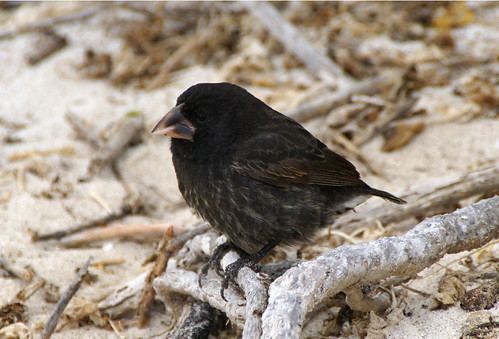
The Beak of the Finch by Jonathan Weiner is a fabulous book about a long-term study of Galapagos finches and what it revealed about natural selection.

Large Cactus Ground finch

Imperial Life in the Emerald City by Rajiv Chandrasekaran is about life in the Green Zone in Baghdad; what was then the base of the US administration of Iraq and is now the embassy complex.

The Elements of Typographic Style by Robert Bringhurst is a very good book about typography.

George III and the Mad-Business by Ida Macalpine and Richard Hunter is about George III’s illness and its broader cultural context.

The Utility of Force, by the eminent British general Rupert Smith, is about modern warfare and how it’s different.

» The Galapagos finch photo is one taken by putneymark which I found on Flickr and am using under a Creative Commons by-sa licence.

Categories
Culture Nature

Redwings

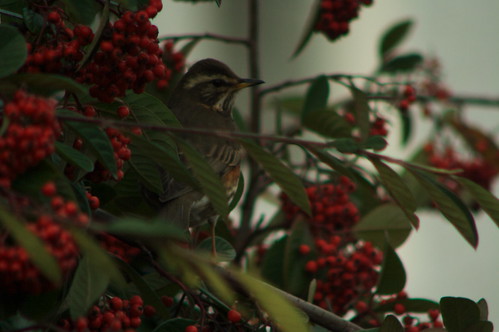
There’s a berry-covered tree over the road from the house—some kind of cotoneaster?—and at the moment there’s an almost constant stream of redwings going back and forth from it.

redwing with berry

The redwing is a smallish thrush with a marked white eyebrow stripe and a brick-red underwing. I’m always pleased to see them, not least because they’re one of the few true winter visitors we get here. I mainly see the same species in this bit of South London all year round. The only two species that regularly turn up in winter are redwings and siskins, and even the siskins are breeders in other parts of southern England. The redwings, though, have come from Iceland or Finland or somewhere.

redwing with berry

In fact, quite a lot of the birds in the garden in winter have probably come from the Arctic, it’s just that they’re the same species that breed here, so it’s not obvious. Millions of blackbird, blue tits, starlings and other common species come here for the winter while our summer visitors are soaking up the sun in Africa. It feels pretty cold here to me at the moment, but I guess it’s all relative.

» the photos can be found in my Flickr stream where you can see them bigger if you want. I’m not sure I recommend it, though: my digiscoping set-up was struggling with the miserable winter light and they don’t bear close inspection.

Categories
Culture

Fela Kuti

Fela performing in 1971.

Categories
Culture Other

New iTunes icon for Leopard: Aphex Twin

Some time ago I made a whole set of icons for iTunes based on old 45s because I think that the Apple one just looks a bit cheap and tacky. I’m now using Leopard, the latest version of Apple’s OS, and Leopard uses super-large icons so that they look good in coverflow mode. So I felt the need to make a new version for myself.

Aphex Twin iTunes icon

This time, instead of old soul and reggae labels, I thought I’d make an homage to one of my favourite albums of all time: Aphex Twin’s Selected Ambient Works 85-92. I don’t listen to this kind of bleepy music as much as I used to, but this album is about as good as it gets. It was released as a double LP, and I’ve used side C for the icon because that’s the side with a track called Ageispolis on it. You can get it as an .icns file here.