Categories
Culture Other

Anthony Gormley at the Hayward

Last week I went to Blind Light, the Gormley show at the Hayward. Gormley must be the third most famous artist in Britain, I should think*, particularly on the back of two spectacular public works: Angel of the North and Another Place.

For those of you who don’t know his work—foreigners and the like—he has produced an endless series of variations of the human form; his visual signature is a blank-faced statue, standing rigid with its hands by the sides. I believe most of them are cast from his own body, but any distinctive characteristics are removed to leave a generic male form. The two works I’ve linked to above give you an idea of how he varies the basic template. To accompany the current exhibition, he has created another such installation: a number of life-size male figures, cast in bronze, positioned on rooftops and other prominent places over a 1.5 km radius, all facing towards the gallery.
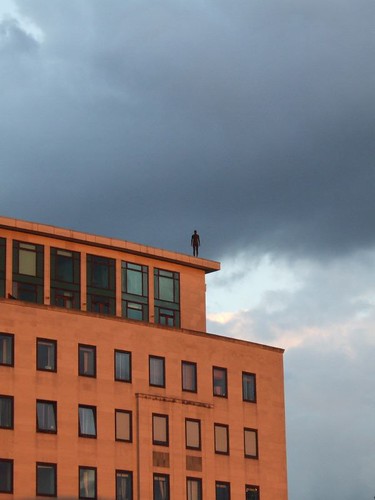
0706290002, originally uploaded by domeheid.

This installation, titled Event Horizon, is a joy in itself; you start seeing the figures as you walk to the gallery, and then from the various exterior spaces of the gallery you can scan the rooftops of London to look for more of them. All these mute figures watching from the rooftops are almost rather creepy—it’s very Doctor Who—but mainly it adds a touch of magic to some very mundane buildings and creates a striking relationship between the exhibition and its surroundings.

Part of what makes it so good is the sheer scale. It must have been a major undertaking just identifying places to put them, negotiating with the owners of the buildings, and getting them into position. You could imagine an artist doing the same thing but being content to just place half a dozen figures on nearby buildings. Gormley has placed 31 figures (according to Wikipedia); some are so far from the gallery that you can’t even be certain that you’ve identified them correctly.

That commitment, I think, is typical of the artist. With someone whose work has quite such a consistent theme running through it, there’s a risk of them being a one-trick pony, but Gormley doesn’t just have lots of ideas for how to develop his basic theme; he develops and executes those ideas thoroughly. My most frequent irritation with contemporary art is when I feel that it’s under-developed. Half baked. I don’t get that with Gormley.

It helps of course that, being human ourselves, we tend to find the human form endlessly fascinating.

The most striking work inside the gallery is called Blind Light; it’s a glass-walled box, about 10m square, which, with the help of ultrasonic humidifiers and flourescent lights, is filled with bright white fog. Once you enter, visibility is down to a couple of feet, sound is muffled, the floor is wet underfoot; I only walked across the box and then turned round to walk back to the entrance, but still got lost enough that I had to feel my way along the wall to find the door again. Meanwhile, from the outside, you see people’s figures appear as ghostly shadows in the mist.
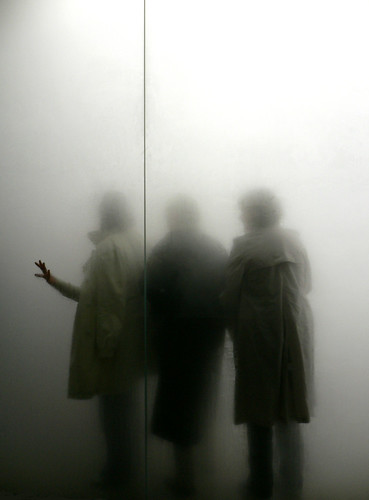
people in the mist

blind light by _imax, used under a by-nc-nd Creative Commons licence.

What I found most striking was the disjuncture between the immersive, disorientating strangeness of being inside the box and the relative mundanity of what it looks like from the outside. Intellectually you know what it will be like, and you can see other people stumbling around in the mist, but it doesn’t quite prepare you for actually being in there. In a sense this feels like a trick; yes, it’s an intense experience being unable to see where you’re going. Does that mean it has artistic worth or is it just a fairground ride with an arty blurb attached to it?

One point to make is the way it relates to the other work in the exhibition; the box obscures people’s individuality and turns them into shadowy versions of Gormley’s blank-faced statues. And when you’re in there, you become very aware of your own body and your relationship with your surroundings. In the same room there’s a work from 1991 called Sense, a block of concrete with a couple of holes that turn out to be just the ends of a body-shaped void in the block. A model of Gormley’s body was cast in wax, the concrete was poured around it, and then the wax melted to leave the empty space. Blind Light is like a live-action version of the same thing; everyone who walks into it carves out a body-shaped hole in the mist.

There were lots of other works as well which I haven’t touched on; this slideshow from the Telegraph gives you some idea.

*Hirst and Emin.
Categories
Culture Nature

Too wit to woo

I heard an owl last night, for the first time in years. I think there are quite a few tawny owls in London—they’re a basically woodland species and fairly well suited to a suburban mix of woodland, park and gardens. A few years ago I used to hear them quite regularly here, but as I say this is the first for a long time. I guess it’s probably a young bird dispersing from its parents’ territory.

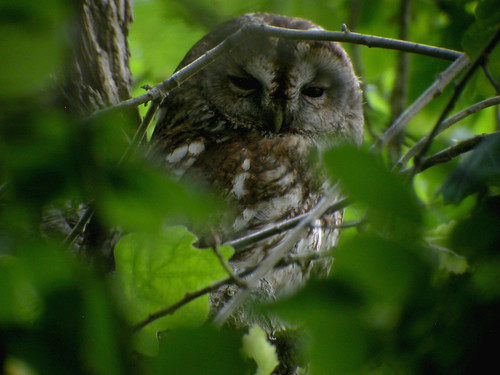
Tawny Owl, Sparham Pools (Norfolk), 24-May-07, originally uploaded by Dave Appleton.

There’s something incredibly atmospheric about hearing animal calls at night. It’s hard not to hear the quavering calls as somehow mournful, although presumably the owls aren’t actually permanently depressed. It makes a change from foxes; we’ve got a lot of young foxes around at the moment (one wandered into the house the other day) and they make a complete racket.

From Love’s Labour’s Lost:

WHEN icicles hang by the wall
And Dick the shepherd blows his nail,
And Tom bears logs into the hall,
And milk comes frozen home in pail;
When blood is nipt, and ways be foul,
Then nightly sings the staring owl
Tu-whoo!
Tu-whit! tu-whoo! A merry note!
While greasy Joan doth keel the pot.

When all around the wind doth blow,
And coughing drowns the parson’s saw,
And birds sit brooding in the snow,
And Marian’s nose looks red and raw;
When roasted crabs hiss in the bowl—
Then nightly sings the staring owl
Tu-whoo!
Tu-whit! tu-whoo! A merry note!
While greasy Joan doth keel the pot.

Most of Shakespeare’s owls are referred to as screeching or shrieking; indeed he sometimes calls them ‘screech-owl’. Those are probably barn owls. But ‘tu-whit tu-whoo’ is the call of the tawny owl. In fact it’s the call of a pair of tawny owls; the female does the ‘tu-whit’ followed immediately by the male saying ‘tu-whoo’. That wasn’t what I heard last night, though; mine was saying ‘hoo… hu-hu-hu-hoo’. So it was just a male owl on its own.

And on an unexpectedly sinister note; according to Wikipedia “This species probably injures more people than any other European bird. It is fearless in defence of its nest and young, and strikes for the intruder’s face with its sharp talons. Since its flight is silent, at night in particular it may not be detected until too late.”

Categories
Culture Other

Notes from the war

Not the current debacle in Iraq, the ’39-’45 war. I’m reading the second volume of the Mass-Observation diaries (see my post about the first one here), and I thought I’d just pick out a couple of quotes. After the battle of Alamein:

The newspapers are in ecstasies. There are more maps than ever, showing arrows pointing in all directions, arrows inside arrows, arrows straight and arrows coiled and curving like snakes, and various other wonderful symbols. It is a military map-makers paradise. As Mr H said, ‘You’d think the war was over from the Daily Express headline.’

From a different diarist, this made me laugh:

A neighbour called and left us a Homeopathic tract, and a report on the analysis of some other neighbour’s urine. The latter was probably an oversight.

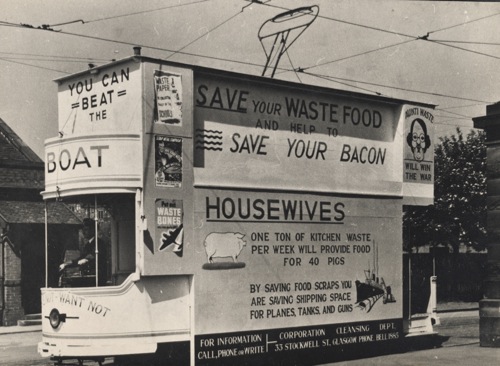
wartime tram in Glasgow

A wartime tram; picture from The Glasgow Story. You can see a bigger version on their site.

And here’s a woman who has just started work for the United States War Shipping Administration in Glasgow:

I don’t get told much in my new job. At first I thought my new boss Captain Macgowan did not intend to give away secrets till he knew me, but there are many indications that he trusts me – I have a key to the safe where all the private papers are put away. A reserved disposition is a big element, coupled, I think, with a belief that I should be upset if I knew ‘all about’ submarine attacks and the like.

The captains of American vessels have instructions to look us up on arriving and most of them like being in an American atmosphere so much that they come back again and again. They talk freely enough and I am getting to know heaps about life and sea and what seamen are like on shore.

It is a novel environment for me. A woman’s woman, an ardent feminist, a patron of cultural clubs with cups of tea and little cakes (not too plentiful nowadays) me, to be suddenly plunged into a super-masculine world. I must say that viewing them at close quarters, men are getting much better than I thought them before – by men meaning American captains.

I’ve got to the point where the worst of the war, from a British POV, is past, although the diarists don’t know that. The Russians and Americans are both now in the war on the Allied side, the threat of invasion has receded, the Germans have lost the battles of Alamein and Stalingrad. There’s a long way to go, but the Third Reich has peaked.

After the 7/7 bombings, the idea of the Blitz spirit was thrown around a lot, especially by Americans: the time when the British stood alone against the world and kept a stiff upper lip. i couldn’t help feeling, though, reading the diaries of the period, that if you were going to be anywhere in Europe during WWII, Britain was really quite a good choice. Admittedly, and it’s an important point, none of of the diarists are living in the East End of London—or Coventry, or Plymouth, or any of the hardest-hit areas—but still, there were no battles fought street-by-street across Birmingham or Ipswich, no occupation, no starvation, no concentration camps.

You still sometimes see a few left-over anti-tank fortifications if you go for country walks in Kent; if they’d ever been needed, if the Panzers had ever been rolling across Romney Marsh, the pluckiness of the British would have had a real test. The fact that some of those who name-checked the Blitz a couple of years ago were probably the same people who made cheese-eating surrender monkey jokes about the French in the build up to the Iraq war is particularly nauseating.

I guess everyone tends to see world history with themselves at the centre, though. I remember someone posting a poem at an online workshop once which referred to Ireland as having a ‘blood-soaked’ landscape. Well, I know that Ireland’s history has been pretty brutal at times, but blood-soaked compared to Russia? or France? China? Poland? Cambodia? My point being… I don’t know, really. Be wary of self-mythologising, I guess.

Categories
Culture

Pop Princess

I caught a bit of the build-up for the Concert for Diana earlier and it was a weird experience, seeing them try to present Diana’s taste for anodyne mainstream 80s pop music (Elton John, Queen, Duran Duran, Wham, ABBA, Chris de Burgh) as though it was a revealing personality trait.

Diana

I’m not knocking her taste (except for Chris de Burgh, obviously); as a child of the 80s I have a soft spot for Duran Duran and Wham myself. But it’s not actually very interesting, is it? I suppose a senior member of the Royal Family listening to Wham on her Walkman around the palace was symbolic of a culture clash of a kind, but that says more about the Royal Family than about Diana. And the fact that she enjoyed meeting pop stars doesn’t exactly represent a deep engagement with music.

I don’t know. It just seems odd to project such significance on to one of the least interesting things you could say about anyone: she listened to Radio 1, you know. I suppose having a charity concert in her memory with music she liked is reasonable enough; it’s the soft-focus halo of what, sanctity? reverence? earnestness? forelock-tugging? that weirds it. But then the whole idea of a ‘people’s princess’ was always kind of creepy and parasitic.

Categories
Culture

Malachi Stilt-Jack am I

There’s serious flooding in Yorkshire at the moment. I found this brilliant photo on Flickr:

Surfer on Chants Ave!, originally uploaded by Dave Foy.

The Daily Mail asks an unusually reasonable question on their front page today—why do we keep building new houses on flood plains? The trouble is that Britain is a small, rainy island; there are a limited number of sites available that aren’t flood risks. And we need new houses because property prices in England are insane.

It seems to me that there’s a simple answer: start building houses on stilts.

palafitos, originally uploaded by wciu.

I’m serious about this; or at least as serious as I can be without the architectural or engineering background to judge the practicalities or it. To build houses where you know they’re likely to get flooded may be reckless; to build them the same way as you would on high ground is just stupid.

Stilt houses on Pulau Mabul, originally uploaded by Vueltaa.

It’s not just stilts; how about watertight windows and doors? If you can’t keep the water away from the house, at least you can keep it from getting inside.

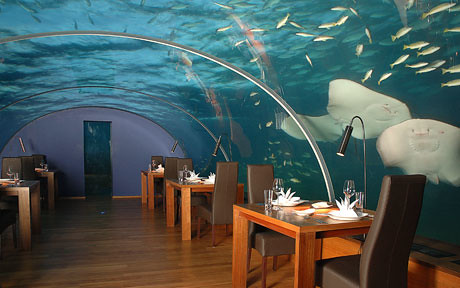
underwater restaurant

» underwater restaurant by udannlin, used under a Creative Commons by-nc-nd licence.

Categories
Culture Other

Imperial Life in the Emerald City by Rajiv Chandrasekaran

Imperial Life in the Emerald City by Rajiv Chandrasekaran has the subtitle ‘Inside Baghdad’s Green Zone’; the Green Zone being the seven square mile compound in Baghdad centered around the Republican Palace, where the Coalition Provisional Authority (CPA) under L. Paul Bremer III attempted to rule Iraq for about 12 months after the fall of Saddam Hussein.

Chandrasekaran paints a picture of a little American bubble where the water and electricity are always working and the air conditioning is on high, the buffet is piled with pork, there are bars and bible study classes, no-one speaks Arabic, and the huge blast-proof walls keep out the noise of gunshots and the call to prayer. Even the food, down to the water the hot-dogs were boiled in, was all shipped in from approved suppliers outside Iraq.

Swimming pool at the Republican Palace, 2003

Swimming pool at the Republican Palace, 2003. Image taken from Wikipedia, and used via a GFDL licence.

Here’s a story which captures some of that disconnection between the people inside the compound and the world around them. It takes place at a farewell party about six weeks before the handover of sovereignty:

It had been a quiet night. No mortar thunderclaps. No messages from the Giant Voice warning people to take cover.

Then came the gunshots. A pop-pop-pop in the distance. Alex Dehgan, a State Department employee at the pool party, dismissed it as a firefight between soldiers and insurgents. So did his colleagues.

But the popping grew louder, more intense. It seemed to be coming from every direction. Orange tracer rounds arced into the night sky. Bursts of AK-47 fire echoed across the Tigris.

Dehgan began to panic. This is it, he thought. The full-on assault. They’re going to crawl over the walls.

He and everyone else by the pool scurried indoors. Some ran into the basement shelter. Others retreated to their offices but stayed away from the windows. They began to wonder if they’d have to leave by helicopter, like the last staffers at the American embassy in Saigon.

Hours later they heard the news: Iraq had defeated Saudi Arabia 3 to 1 in a soccer match, earning a berth at that summer’s Olympics in Athens.

Baghdad was celebrating.

As I hope that story shows, the book is a great read and full of good anecdotes. It would be funny if it wasn’t so incredibly depressing.

Ham station, originally uploaded by Kjirstin. Used under a CC by-nc-sa licence. This picture was taken in the Green Zone, but it’s from after the CPA period; the Green Zone is now the US embassy compound.

If these people had some other, less important job, this might not matter very much. But they were supposed to be running the country. Here’s another quote that seems typical:

Agresto [senior adviser to the Ministry of Higher Education] knew next to nothing about Iraq’s educational system. Even after he was selected, the former professor didn’t read a single book about Iraq. “I wanted to come here with as open a mind as I could have,” he said, “I’d much rather learn firsthand than have it filtered to me by an author.”

In fact Agresto turns out to be, relatively speaking, one of the good guys. When he got to Iraq and encountered the reality of the situation there, he was adaptable enough to set aside his grandiose plans for Iraq’s university system and focus on the pragmatic business of trying to help the universities recover from the damage done by sanctions, war and looting. He didn’t actually manage to achieve much, because he didn’t have the staff or money to do it, but at least he responded to the situation by changing his plans. Most of his colleagues seem to have ploughed on regardless. Still, that mindset, that a career in American academia and an open mind were all the preparation he would need, seems typical of the overconfidence and naivety of the CPA.

Also typical was the choice of a Republican loyalist rather than someone with specific experience of the Middle East or reconstruction in a war zone. Not, I think, out of simple corruption or nepotism, but because it was an operation being run by ideologues from the White House downwards; people who seem to have believed that democracy, privatisation and a free market were some kind of magic wand, and if they could just pass the right laws, the recovery of Iraq would take care of itself. The problem wasn’t so much the fact that they were trying to impose their own political beliefs on the Iraqis, but that they were focusing on theory while Iraq was lawless, unstable, and suffering 40% unemployment and shortages of electricity and fuel.

And that’s just the start of it. There were failures of communication—or overt hostility—between the Pentagon and the State Department, between the CPA and the Iraqis, and between the CPA and the army. They were more worried about how news would play in the US than in Iraq. They didn’t trust the Iraqis to do things for themselves. They didn’t have nearly enough money or enough staff. They allowed the timetable to be driven by the American elections. Over and over again, it all seems to come back to the looting which was left to go unchecked in the week or so after the fall of Saddam, both because it established a pattern of lawlessness and because it crippled half the institutions in Iraq. Hospitals, universities, ministries, schools and businesses lost the equipment they needed to function.

My impression is that the White House and the Pentagon simply didn’t take what they were doing seriously enough. I don’t care how confident they were that, with Saddam out of the way, the Iraqis would gratefully embrace freedom and democracy: they still needed to make plans. Even with the best possible outcome, they would still have been running a whole country, and they seem to have thought they could just wing it.

Anyway. From a British point of view, I would have liked some kind of indication of how my own government fit into the whole situation, but this is a very good book: vivid, thorough, funny, and deeply sad.