Categories
Other

England vs Algeria: my diagnosis

England are suffering from the world’s biggest collective case of the yips.* It seems like the only explanation for how much worse these players become when they pull on an England shirt.

Sigh.

* Well, not quite the biggest: that must be the one that afflicts the All Blacks every four years at the Rugby World Cup.

Categories
Culture

Happy Bloomsday.

His heart astir he pushed in the door of the Burton restaurant. Stink gripped his trembling breath: pungent meatjuice, slop of greens. See the animals feed.

Men, men, men.

Perched on high stools by the bar, hats shoved back, at the tables calling for more bread no charge, swilling, wolfing gobfuls of sloppy food, their eyes bulging, wiping wetted moustaches. A pallid suetfaced young man polished his tumbler knife fork and spoon with his napkin. New set of microbes. A man with an infant’s saucestained napkin tucked round him shovelled gurgling soup down his gullet. A man spitting back on his plate: halfmasticated gristle: no teeth to chewchewchew it. Chump chop from the grill. Bolting to get it over. Sad booser’s eyes. Bitten off more than he can chew. Am I like that? See ourselves as others see us. Hungry man is an angry man. Working tooth and jaw. Don’t! O! A bone! That last pagan king of Ireland Cormac in the schoolpoem choked himself at Sletty southward of the Boyne. Wonder what he was eating. Something galoptious. Saint Patrick converted him to Christianity. Couldn’t swallow it all however.

— Roast beef and cabbage.

— One stew.

Smells of men. His gorge rose. Spaton sawdust, sweetish warmish cigarette smoke, reek of plug, spilt beer, men’s beery piss, the stale of ferment.

» photo of JJ is from the Réunion des musées nationaux.

Categories
Other

England vs USA: my diagnosis

My overall feeling was that there just wasn’t a critical mass of players in that team whose game lends itself to composed possession football. Gerrard and Lampard can’t do it on their own.

So for example, I’m a big fan of Aaron Lennon, and I think he could be an important player for England at this tournament, but he’s not someone who you would immediately associate with patient, methodical build-up play. The same goes for SWP.

I thought the best period of control England had in the friendlies was in the second half of (I think) the Japan game, when Gerrard, Lampard and Joe Cole were all on together; the more of those kinds of players you have on the pitch, the more likely it is that there will be a pass available, the more likely you are to maintain possession.

Not that they have to be midfielders, of course: I think England missed Rio Ferdinand, not for his defending, but for his willingness to carry the ball out of defence and link up with the midfield. And of course Ashley Cole and Glen Johnson can help; so can the forwards, particularly Rooney. But I think the midfield was a problem. Given how well Rooney played alone up front for his club last season, I would have been tempted to play a 4-5-1 / 4-3-3 with Joe Cole taking Heskey’s place. Or just to play Joe Cole on the left wing.

The good news is that Gareth Barry should be back for the next game, which will help.

Categories
Other

World Cup food blogging: USA

Well, that was a bit depressing: not so much because of the result, but the tendency to revert to long balls hoofed up the front, the lack of involvement of England’s wingers, the lack of controlled possession in midfield… all the usual England failings, in fact. Not to mention the further undermining of confidence in England’s goalkeepers. Ho hum.

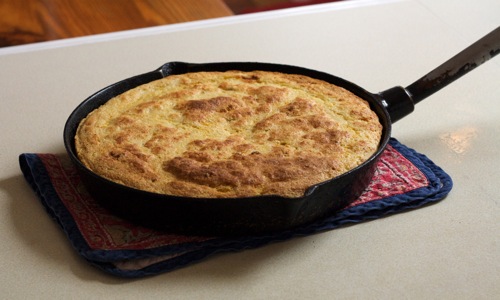
However, World Cup food blogging must carry on. And so, my USA-themed food: cornbread and creole fried shrimp. The cornbread recipe I used was this one. Partially because it’s a British recipe, so I can weigh my ingredients rather than all that measuring quantities by the cup that American recipes do. And partially because it suggests substituting yoghurt for buttermilk, which is what I was planning to do anyway. I cut down the quantity of chillies slightly and cooked it in a pre-heated cast iron frying pan, though. It turned out rather nice, I must say:

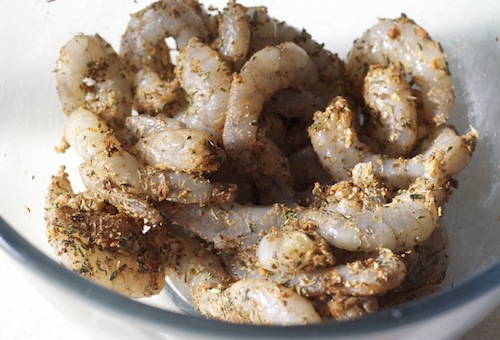
The shrimp was a bit of an improvised recipe; I covered the prawns in a homemade creole-type seasoning mix — chopped thyme, dried oregano, paprika, crushed garlic, a dribble of pepper sauce, black pepper — and left for a couple of hours (the duration of the Nigeria-Argentina game, in fact).

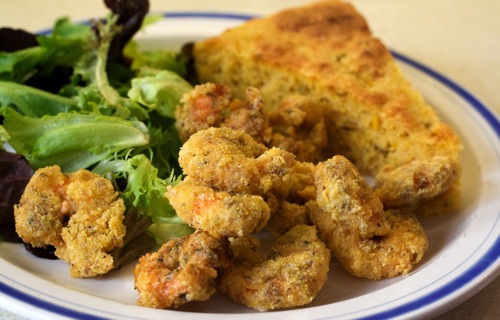
Then I basically did the standard flour-egg-breadcrumb thing except with a mixture of cornmeal and cornstarch instead of breadcrumbs, and deep-fried them. Came out looking quite impressive:

But actually, although it tasted OK, the coating was a bit coarse and not very crispy. I don’t do a lot of deep-frying, so I don’t really know why… oil not hot enough? I think if I tried to do a cornmeal based coating again, I would use a wet batter rather than dry cornmeal coating. You live and learn.

I’d definitely do the cornbread again, though. Yummy.

So, roll on Algeria!

Categories
Other

Fuck BP

I find it rather depressing that the British papers have decided to start defending BP against Barack Obama. I should have seen it coming: it’s never a surprise to see journalists and politicians rally to support the rich and powerful in their hour of need.

Personally I think it’s a good thing that BP is getting a kicking. I don’t know whether they were negligent or just unlucky, but one way or another they have created an environmental catastrophe. If they and every other big company really believed that these kind of accidents represented a genuine threat to their profitability, maybe they would all spend a little more of their vast wealth to make sure that it can’t ever happen again.

On the other hand, if Obama really wants to prove that his concern is the environment and not the midterm elections, it’s not enough to attack BP. He needs to follow it up by giving the same treatment to Chevron, the company that poisoned the inhabitants and fucked up the environment of thousands of square miles of Ecuadorean rainforest. And then he and rest of us need to look at the situation in Nigeria.

The way these companies crap all over the third world shows that they will cut any corner in the search for profit, as long as they can get away with it. Well, this time, BP managed to shit on the doorstep of the most powerful country on earth, and they’re getting the response they deserve.

Categories
Culture

The Fortunes of Wangrin by Amadou Hampaté Bâ

The Fortunes of Wangrin is my book from Mali for the Read The World challenge.

It’s a novel — or at least it seems to be universally described as a novel, despite the fact that Hampaté Bâ says in the Afterword:

I don’t know why, even is spite of the specific assertions contained in the Foreword, some people continue to ask themselves whether this narrative is fiction, reality, or a clever mixture of both…

I’ll repeat once more, then, for anyone who might still be in doubt, that I heard everything related to the life of the hero, from the account of his birth (a story told by his parents), through the relationship with the animist world, the various predictions, and so forth, all the way to the downfall caused by commercial bankruptcy, from Wangrin himself, in a Bambara often poetic, full of verve, humour, and vigour, to the soft musical accompaniment of his griot Diele Maadi. To this very day I recall with emotion Wangrin’s voice against the background of a guitar.

[…] I rounded off the information already at my disposal by visiting everyone who had frequented him… I have made up no event or circumstances whatsoever. Every single story was told by the people in question or by someone in their circle, either griot, houseboy, or friend.

Which is interesting case. Because it does read like fiction, stylistically; I certainly read it that way and was surprised to learn that it wasn’t. It is told as a single coherent narrative with the kind of omniscient third person narrator normally associated with fiction. To use a television analogy, it is more like a dramatisation of real events than a documentary. And I don’t think it is like a biography in the standard sense, a work of history intended to establish the true events of a person’s life.

Rather, it is a work of oral history — unsurprisingly, perhaps, since Hampaté Bâ was an ethnologist and folklorist. It has the qualities of a good storyteller telling the story of their own life: not perhaps outright fabrication, but just enough massaging and selection and elision and exaggeration to turn the messiness of reality into something beautifully moulded and polished. It’s like a memoir told in the third person.

And Wangrin is certainly an interesting character; the son of a prominent family, he was sent to the colonial school to learn French and worked as an interpreter, which put him in position as the literal and symbolic intermediary between the French colonial administration and the native population, able to play off both sides against each other. Which he did, enriching himself in the process. So a bit of a crook, then, even if a likeable one.

His position between the French and the Africans makes this book a fascinating look into the functioning of colonial life; one of the more striking things for me was how thin the layer of bureaucracy seems to have been: a very small number of French administrators on their own out in the bush, in charge of a large population of people of various languages and religions with whom they share neither culture nor language. And that makes the interpreter a rather more important figure than the title suggests.

I certainly recommend the book. Like so many of these books in translation, it had a few too many endnotes for my taste, and the edition I read had some truly awful typography inflicted on it* — but I can hardly blame Hampaté Bâ for that.

* The front cover and the page headers are set in Lithos Bold, a typeface which is a typographic cliché for black/African literature, despite being based on Greek inscriptions, so that’s at the very least unimaginative; but worse, the chapter headings use a numeral in Lithos Bold and then a chapter heading and an ornamental initial in Papyrus, another typeface used to give a generic impression of the exotic, and a rather ugly one at that.

» The masks are from the Réunion des Musées Nationaux. I just found themby putting ‘Mali’ into the search engine, and thought they were particularly striking.