Categories
Nature

Damselflies

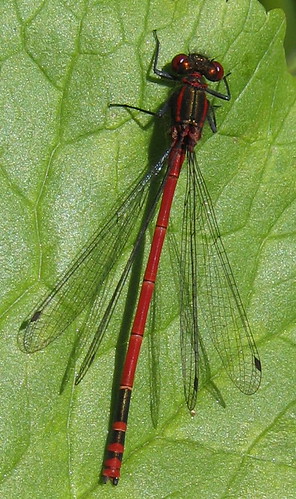
It’s remarkable how many different insect species there are around if you go and look, and notice the various colours and sizes instead of just thinking ‘butterfly’ or ‘bumblebee’. Damselflies are the smaller, more delicate relatives of dragonflies. There were at least three species, and possibly four, in the garden today. I got pictures of some of them. This is a Large Red Damselfly:

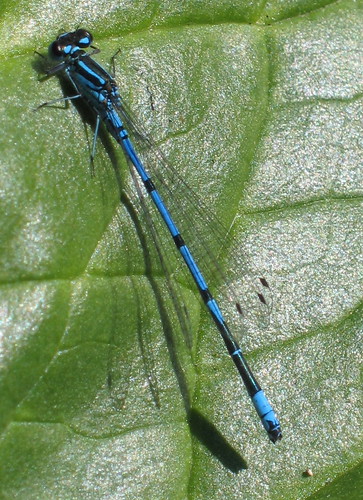
A Common Blue An Azure Damselfly:

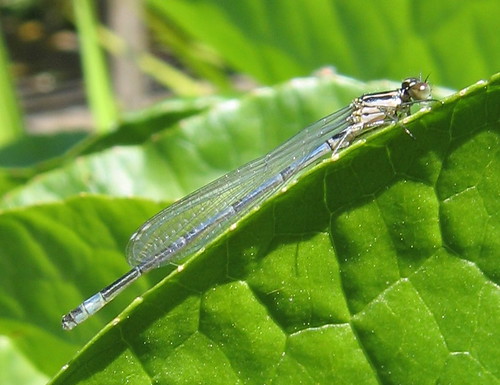
I’ve always assumed this one, which has distinctive grey/silver wings, was a different species, but looking around on Google it may possibly be an alternative colour form of the female Azure:

EDIT: apparently grey wings are typical of newly hatched dragonflies – ‘teneral’ in the jargon – so this is probably a teneral Azure Damselfly.

Pretty, aren’t they.

As well as those, and the Blue tailed Damselfly which I didn’t get a photo of, I’ve also seen at least one other species in the garden in the past – the Red Eyed Damselfly. And that’s without counting the ‘proper’ dragonflies.

Categories
Other

countdown: 6 giorni, 16 ore, 24 minuti, 41 secondi

You will have noticed my incredible self control in not yet mentioning the World Cup.

But I was just watching a program called ‘World Cup Goals Galore’ featuring, well, lots and lots and lots of goals (top 10 free kicks; top ten goals scored by defenders; top ten goals scored by players with moustaches etc etc). Even just watching a couple of hundred goals one after another, without the context of the game and with a rather laboured jokey commentary, was joyous.

The great moments in football, more than any other sport I watch, are just wonderful. I think perhaps it’s just the extraordinary implausibility of the fact that they’re doing it with their feet. The human foot is not designed for manipulating objects, and even after years spent watching the game, I don’t think I’ve ever quite lost the sense that it just shouldn’t be possible to intentionally kick a ball into the corner of the goal from 25 yards. Even without defenders and a goalie to worry about.

And yet when it all comes off, it looks so easy and natural that you find yourself thinking “if you can dribble past three people, swivel and whip the ball into the corner of the net, why don’t you do it more often?”

Categories
Culture

‘Undercover Surrealism’ at the Hayward

Going to them one after the other, it’s hard not to see the Undercover Surrealism exhibition at the Hayward as some kind of riposte to the Modernism exhibition at the V&A.

The Hayward exhibition (full title: Undercover Surrealism – Picasso, Miró, Masson and the vision of George Bataille) is about a magazine called Documents which Bataille ran from 1929-30. Bataille was most closely associated with the Surrealists – he had a falling out with the ‘official’ surrealists and was never really a surrealist himself, but that was the circle he moved in. Documents was notable for juxtaposing articles about high culture, popular culture and ethnography. So you get coverage of Stravinsky, Duke Ellington, Picasso, Dali, Buñuel, Hollywood, trashy novels, African masks, Ethiopian iconography, and the development of the horse imagery from Roman coins into the coins of the Dark Ages. To be honest I was unexcited by the prospect of an exhibition devoted to a magazine, but the curators have done a good job of tracking down plenty of the objects that were covered; so there are Miros, Picassos, Giacomettis, as well as African masks, Dark Age coins; all sorts of stuff. Including some music and film, which was a good move. Apart from the intrinsic interest of most of the exhibits, it did a good job of evoking a particular artistic moment. You can see some of the work here.

Documents existed bang in the middle of the period covered by the V&A Modernism exhibition, but while Corbusier and the Bauhaus were building their airy white machines for rational hygienic living, the Surrealists were more interested in violence, sex, fetish, blood, transgression and distortion. Here’s a typical bit of Bataille:

The slaughterhouse is linked to religion in so far as the temples of bygone eras (not to mention those of the Hindus in our own day) served two purposes: they were used both for prayer and for killing. The result (and this judgement is confirmed by the chaotic aspect of present-day slaughterhouses) was certainly a disturbing convergence of the mysteries of myth and the ominous grandeur typical of those places in which blood flows. In America, curiously enough, W. B. Seabrook has expressed an intense regret; observing that the orgiastic life has survived, but that the sacrificial blood is not part of the cocktail mix, he finds present custom insipid. In our time, nevertheless, the slaughterhouse is cursed and quarantined like a plague-ridden ship. Now, the victims of this curse are neither butchers nor beasts, but those same good folk who countenance, by now, only their own unseemliness, an unseemliness commensurate with an unhealthy need of cleanliness, with irascible meanness, and boredom. The curse (terrifying only to those who utter it) leads them to vegetate as far as possible from the slaughterhouse, to exile themselves, out of propriety, to a flabby world in which nothing fearful remains and in which, subject to the ineradicable obsession of shame, they are reduced to eating cheese.

That’s one of the entries from the Critical Dictionary that was a feature of Documents. Somehow I don’t think Bataille would have agreed that less is more. Even the ethnographic stuff feels rather fetishised – even though it is a serious and intelligent effort of early ethnography, there are enough hints through the exhibition to suggest that Bataille’s interest in black people was basically sexual. Mind you, he seems to have found most things sexual. The surrealists, of course, were also a key part of de Sade’s reinvention as an important literary figure; it was that moment when Freud was seen as validating everyone’s sexual quirks, and the quirkier the better.

It’s tempting to see the two things – Corbusier on the one hand and Dali on the other – as somehow two sides of the same coin, or each as necessitating the other. Or at the least as products of the same forces; of the Great War, and a moment of cultural and historical instabiity when everything was up in the air and no-one quite knew where the world was going. As Yeats put it in 1920: The best lack all conviction, while the worst are full of passionate intensity. Perhaps it’s unwise to insist too much on the historicity of it, though. There are probably always some people who are minimalists by temperament and others who are surrealists.

Categories
Nature Other

Creepy-crawly goodness

If you like invertebrates (and who doesn’t?) check out the Circus of the Spineless at Burning Silo.

I take a casual interest in insects and other invertebrates, but one thing you quickly realise is that they’re really hard. I first really appreciated this when, quite pleased with myself for recognising something as a ‘scorpionfly’, I tried to look it up in a book and discovered there are something like 28 species just of scorpionflies in the UK. And that’s relatively modest compared to the beetles and things. So I mainly stick to birds.

Since I’m on natural history, check out the dioramas at Pruned; it’s worth clicking through the links in that post as well.

Categories
Me

Rain, rain, go away

We’re currently having a ‘drought‘ in the south-east of England, despite the fact that it’s been raining for the past week. The argument is that a few days of rain don’t compensate for the past year which has been unusually dry, although it seems pretty clear that if the water companies were better at maintaining their infrastructure there wouldn’t be a problem.

Anyway, a meteorologist has taken a close look at the water companies’ statistical claims and shows that they are selective to the point of being misleading. That’s not terribly surprising in itself, but I found the specifics interesting.

It’s nice to see an attempt in the media to actually look at some statistics and explain what’s wrong with them.

Categories
Culture Other

Big Chief Elizabeth

I just read Big Chief Elizabeth – How England’s Adventurers Gambled and Won the New World, by Giles Milton. As the title suggests, it’s an account of the earliest attempts to set up an English settlement in America. As the title also suggests, the general tone of the thing is ‘rollicking yarn’ rather than ‘nuanced and careful investigation into the ethics of colonisation and colonialism’.

That’s fine by me. I refuse to feel any ancestral guilt over anything countrymen of mine did over four centuries ago. Or indeed feel any ancestral outrage over things done to them, since there seems to have been plenty of brutality on all sides.

I was slightly startled to realise how little I knew about the subject. In a curious way it’s become part of American history rather than British. Not that gaps in my historical knowledge are so unusual they need a special explanation.

Odd how hard it is to shift the idea of the Elizabethan period as glamorous. I mean, the clothes were pretty fab, and there was Shakespeare of course, and pirates and gold and stuff, but Elizabeth was just another capricious despot in a string of despots.

Sir Walter Ralegh features heavily, of course. Which seems as good a reason as any to post a favourite poem.

As you came from the holy land
Of Walsinghame,
Met you not with my true love
By the way as you came ?

How shall I know your true love,
That have met many one,
As I went to the holy land,
That have come, that have gone ?

She is neither white nor brown,
But as the heavens fair ;
There is none hath a form so divine
In the earth or the air.

Such a one did I meet, good sir,
Such an angel-like face,
Who like a queen, like a nymph, did appear,
By her gait, by her grace.

She hath left me here all alone,
All alone, as unknown,
Who sometimes did me lead with herself,
And me loved as her own.

What’s the cause that she leaves you alone,
And a new way doth take,
Who loved you once as her own,
And her joy did you make ?

I have loved her all my youth,
But now old, as you see,
Love likes not the falling fruit
From the withered tree.

Know that Love is a careless child,
And forgets promise past ;
He is blind, he is deaf when he list,
And in faith never fast.

His desire is a dureless content,
And a trustless joy ;
He is won with a world of despair,
And is lost with a toy.

Of womankind such indeed is the love,
Or the word love abusèd,
Under which many childish desires
And conceits are excusèd.

But true love is a durable fire,
In the mind ever burning,
Never sick, never old, never dead,
From itself never turning.