Categories
Culture

The First Movie

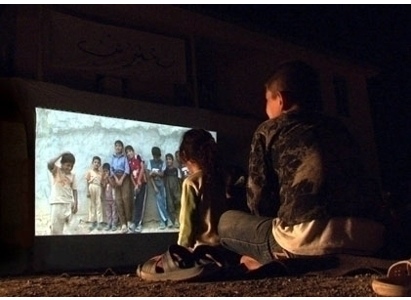
Just a little plug for The First Movie, which I went to see on Friday. It’s a documentary by Mark Cousins; he visits a Kurdish village which is remote enough that none of the children have ever been to the movies, and puts on a showing of a selection of films in a makeshift outdoor cinema; then he gives the children little digital movie cameras and waits to see what footage they bring back.

It’s a film which looks beautiful and is in turns funny and moving, with a narration provided by Cousins in a very attractive Belfast accent. As I was watching it, I was thinking that, by comparison, nearly everything you see in the cinema has incredibly little faith in the audience’s intelligence or attention. Not that this is some kind of ultra-difficult film, but it’s not afraid to be poetic, to talk about aesthetic issues, to be slow, to hold shots for a long time and let the audience look at them. I really thought it was excellent.

During October it’s on a tour of independent cinemas around the UK. I happened to see the first of these showings because it was at my local cinema. So if you’re in the UK and happen to live near the kind of cinema that might show arty documentaries, check the showing dates and give it a go. And if you’re not in the UK… I don’t know, it might appear at a film festival? Or on Netflix in due course? Well worth a look.

Categories
Culture

Things posted to Tumblr: Gandhara bodhisattvas

I’ve been enjoying posting stuff to A London Salmagundi, and I find the convention of posting pictures without commentary rather liberating, because I am a relentless tweaker of my own prose and constitutionally incapable of being brief. But sometimes I find myself wanting to explain why I think a particular image is so interesting or beautiful. So this is the first of what may be a series: ‘things I posted to Tumblr’.

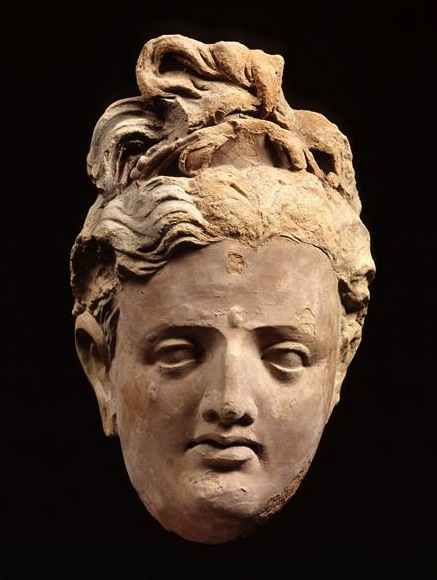
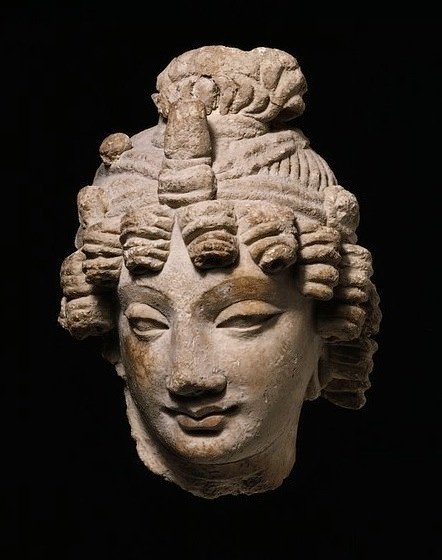
These bodhisattvas are from the part of the world that US foreign policy types refer to as ‘AfPak’; the top one, the older of the two, is from Hadda, now on the Afghan side of the border; the other is from Peshawar in Pakistan. But when these were made, and for over a millennium, it was the location of the Gandhara kingdom.

I only know that because I just looked it up on Wikipedia. But what I did already know was that these are in a tradition called ‘Greco-Buddhist’. This is art from a place where two worlds meet. Alexander the Great conquered the area from the Persians in the 4th century BC; hundreds of years later, the Hellenistic influence was still powerful enough to result in works like these.

That top one, from 1st-3rd century AD, is particularly extraordinary and particularly beautiful, I think. The style is recognisably Greek; the hair, the sculpting of the features. But the face looks Indian, and he has the long ears of the bodhisattva.

The other, slighter later (3rd-5th century) is less remarkable, less strikingly classical; more what one expects a bodhisattva to look like. But it’s still a lovely thing.

Just the existence of Greco-Buddhist art was amazing to me, because Alexander the Great and Buddhism lived in completely different parts of my brain. It’s like reading one of those counter-factual novels — what would modern Britain have been like if the Nazis had won the war? —  except, you know, it’s actually real. There really was somewhere where Buddhist monasteries were decorated in the style of ancient Greek temples.

The fact that the resulting art is beautiful just makes it even better.

» The Hadda bodhisattva at the Musée Guimet; the Peshawar bodhisattva at the V&A.

Categories
Culture

Of Water and the Spirit by Malidoma Patrice Somé

Full title: Of Water and the Spirit: Ritual, Magic and Initiation in the Life of an African Shaman. Somé was kidnapped at the age of four and taken first to a Jesuit-run boarding school and then a seminary, where he was a victim of physical and sexual abuse. At the age of 20 he fled the seminary and walked back to his home village. When he saw his family for the first time in 16 years, he could no longer speak his native Dagara and had lost touch with his native culture; so he underwent the long, harrowing ritual initiation that boys normally go through at 13.
He then realised that his calling was to go out and teach the western world about traditional wisdom; the book ends with him leaving the village again. He went to university and earned a few degrees, and he now seems to work on the New Age lecture circuit and in the men’s movement.

I have to say, as I read the introduction which explains this stuff, my heart sank. The cocktail of academic jargon, self-help, the supernatural and purple prose could have been specifically designed to annoy me. But, to be fair, once he gets going, it is pretty interesting. He never completely shakes off the tendency to flowery prose…

The sun had already risen. A few scattered clouds were speeding across the empty zenith as if running away from the threat of the burning disc.

… but the academic and self-help stuff is much less intrusive. And the supernatural is after all the main subject of the book. As I was reading his descriptions of magical experiences he had before his abduction, all of which happened before he was four, I wondered whether all the impossible things he was witnessing were explicable by his extreme youth, and the embellishing powers of memory. But his experiences during the initiation as an adult are every bit as remarkable.

Assuming that he’s not just a professional bullshitter who made all this stuff up because he knows it is marketable — and I’m not really suggesting that’s the case, although it did occur to me as a possibility — his visions/experiences were extraordinarily complex, specific and precise. Since I’m not a believer in the supernatural, I couldn’t help speculating about what kinds of psychological and physiological effects might have created these experiences — quite fruitless, of course, since we only have one very specific perspective on what happened and I don’t have that kind of expertise anyway.

Really, that’s not the point, anyway; I’m not reading with the book to argue with it. What I would hope to get out of this kind of book is some kind of insight into the traditional culture of the Dagara. And there certainly is some interesting material about the rituals, about the use of divination, the decision making of the elders and so on. But the magical experiences themselves weirdly didn’t ring true to me.

I know I’m the worst person in the world to judge the authenticity of shamanic experience, but when I’ve read stories from oral cultures before I’ve always been struck by the genuine weirdness of them, a lack of the kind of narrative logic I expect. I don’t get that from this book; for all the impossible things happening, they sort of read like a version of shamanic experience as imagined by a westerner. Perhaps that’s unsurprising, given the relatively small proportion of his life Somé actually spent in his home village compared to the time spent elsewhere. He is inevitably as much a product of French colonial education and western universities as he is of Dagara culture. Or perhaps he is consciously targeting it at a western readership. Or, very likely, my idea of what a shamanic experience ought to be like is completely wrong.

One way or another, it’s certainly interesting. Of Water and the Spirit is my book from Burkina Faso for the Read The World challenge.
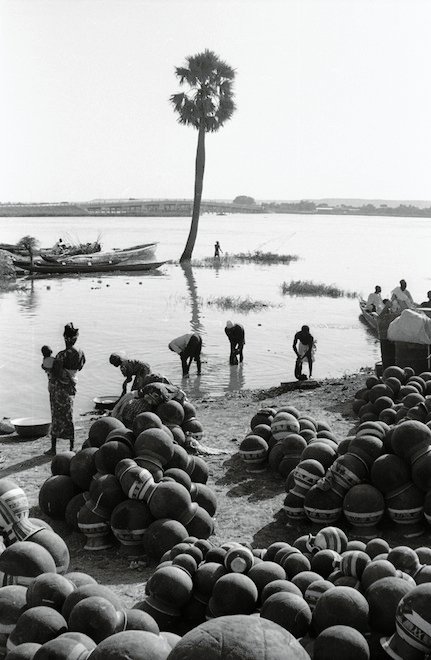
» The photo, ‘decorated potteries for sale at the market along the Niger riverbanks near Ouagadougou, Burkina Faso’ is from the Smithsonian. There’s not much connection to the book, but I liked the picture.

Categories
Culture

Physical tumbling

I went along to the V&A today to check out the second phase of their new ceramics display. The first phase was arranged by technique and theme; the new bit is by place and date. Some of the displays have helpful information, but much of it is effectively the collection being stored in plain view: all-glass cabinets with shelf after shelf of ceramics packed five or six objects deep.

It means that they’re not always as easy to see properly, and there’s no accompanying information, but it’s a way of making as much of the collection visible as possible: over 26,500 pieces in the new section, apparently.

I’ve actually spent a lot of time recently browsing the V&A’s collection online find things to post to A London Salmagundi. It was a healthy reminder that, although it’s marvellous that they are making such an effort to digitise their collections, and no matter how endlessly fascinating it is searching through museum collections online, there’s nothing quite like being close enough to appreciate the actual physicality of an object: the textures, the way it catches the light.

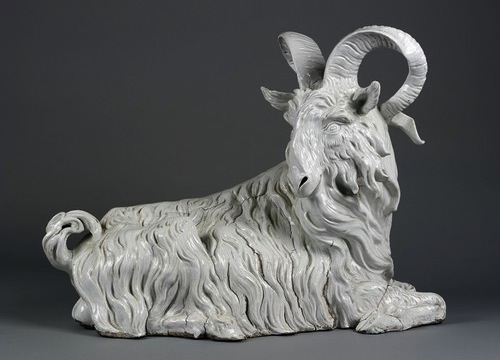
Or even more basic, the size. I posted this picture of a porcelain goat made by Meissen in 1732, and it’s a striking image; but nothing about that picture prepares you for the fact that it is over two foot long. Nearly life size — for rather a small goat, at least. Apparently it weighs 25kg.

Unfortunately the technology is not yet there for me to have a physical tumblelog. Although having an image blog is a kind of curation, I can’t, sadly, actually choose real objects and put them in front of my readers.

I suppose the closest I could come would be if the V&A gave me a long display case and the licence to roam the museum, picking out objects. Then I could put each new choice at one end of the case and shift all the rest a few inches further along; and as each one reached the other end, I would take it out and put it back where it belonged.

In fact, if anyone from the V&A is reading this: have your people call my people. Let’s see if we can work something out.

Categories
Culture

Born in Tibet by Chögyam Trungpa

Born in Tibet is the story of Chögyam Trungpa’s early life in Tibet, as told to Esmé Cramer Roberts. He was a year old when some monks turned up and announced he was the eleventh Trungpa Tulku and hence the supreme abbot of the Surmang monasteries in eastern Tibet; at twenty he managed to escape the Chinese occupation and make his way to India.

So the book really has three main subjects: his traditional religious education, the increasing impact of the Chinese on Tibetan life, and the adventure/survival story of escaping cross-country into India. The escape is remarkable, since it involves dozens of people trying to secretly cross some of the most difficult terrain in the world; but the portrayal of traditional life in a Tibetan monastery is what interested me most.

It is slightly ironic that many westerners treat Buddhism as a kind of antidote to organised religion, because this was organised, institutional religion on the grand scale: an elaborate formal hierarchy, large, expensively appointed buildings with hundreds of people, elaborate rituals, explicitly supernatural practices like divination, all supported by large scale land ownership and tributes offered by the local population. It’s rather how I imagine the middle ages in Europe must have been: a basically peasant population loomed over both by the houses of feudal aristocrats and by the abbeys and monasteries of the great religious orders.

The fact that comparison sounds like a criticism says something about the glowing image of Tibetan buddhism — mainly I guess down to the personal qualities of the current Dalai Lama — and the bad image of medieval Catholicism. The reasons for which are more tangled, although the largely Protestant history of the English speaking world is clearly relevant. Personally I have a soft spot for medieval monasticism; and my scepticism about human nature means I bet there were a few Tibetan monks over the centuries who were, let’s say, more worldly than they should have been.

Though it has to be said that Chögyam Trungpa was not living the life of a Medici pope. His life in Tibet seems to have been austerely lived and completely devoted to spiritual practice. The childhood in particular sounds tough; being taken away to a monastery at three and spending pretty much all his time from then on in study and devotion.

Anyway, it is fascinating stuff.

Our travelling party was organized with a good deal of pomp. There were thirty monks on horseback and eighty mules to carry the baggage. I was still only twelve and, being so young, I was not expected to preach long sermons; mostly I had to perform rites, read the scriptures aloud, and impart blessings. We started from the highlands and traveled down to the cultivated land; I was able to see how all these different people lived as we passed through many changes of scenery. Of course I did not see the villagers quite as they were in their everyday lives, for wherever we went all was in festival, everyone was excited and looking forward to the special religious services, so that we had little time for rest. I missed the routine of my early life, but found it all very exciting.

When we visited Lhathog, the king had to follow the established tradition by asking us to perform the religious rites according to ancient custom. We were lodged in one of the palaces, from where we could look down on a school that the Chinese had recently established. A Communist flag hung at the gate, and when it was lowered in the evenings the children had to sing the Communist national anthem. Lessons were given in both Chinese and Tibetan, including much indoctrination about the benefits China was bringing to Tibet. Singing and dancing were encouraged and I felt that it was a sign of the times that the monastery drum was used to teach the children to march. Being young myself I was keenly interested, though this distortion worried me; a religious instrument should not have been used for a secular purpose, nor for mere amusement. A detachment of Chinese officials sent from their main headquarters at Chamdo lived in the king’s palace together with a Tibetan interpreter, while various teachers had been brought to Lhathog to organize the school, which was one of many that the Chinese were setting up in all the chief places in Tibet. The local people’s reactions were very unfavourable. In the town the Communists had stuck posters or painted slogans everywhere, even on the walls of the monastery; they consisted of phrases like ‘We come to help you’ and ‘The liberation army is always at the people’s service.’

Born in Tibet is my book from Tibet for the Read The World challenge. Chögyam Trungpa wasn’t actually born in what is now the Tibet Autonomous Region; when the Chinese took over Tibet, large chunks which were culturally Tibetan were assigned to different provinces.
We ourselves always considered that the people who speak Tibetan and ate roasted barley (tsampa) as their staple food are Tibetans.

Which is good enough for me.

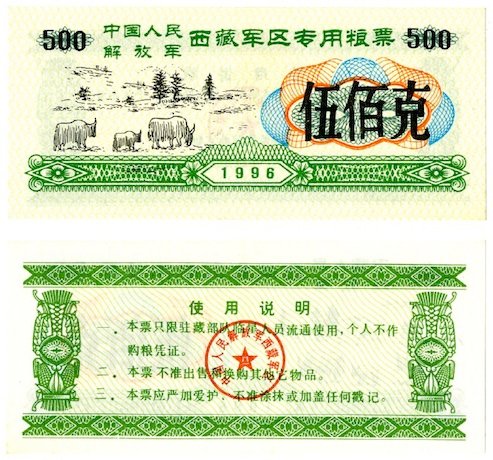
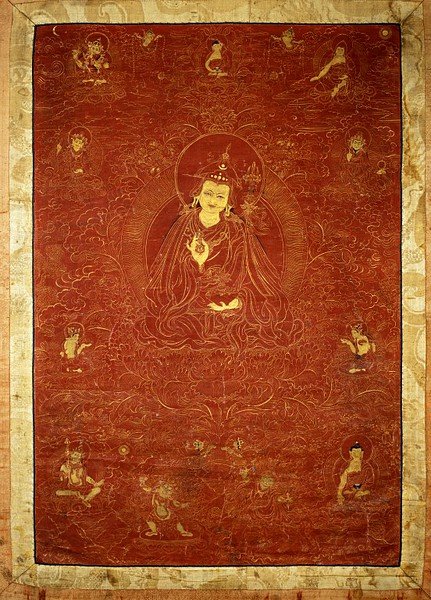
» The top thing is a ration ticket for 500 g of cereals, issued by the People’s Liberation Army – Tibet Military Region. It’s from 1996, so not even remotely contemporary with this book, but sort of an interesting object, I think. From the British Museum. The C18th Tibetan scroll painting is from the V&A.

Categories
Culture

‘Picasso: The Mediterranean Years (1945-1962)’ at the Gagosian Gallery

Or ‘Picasso: The Cheerful Years’. I have no idea how cheerful or otherwise Picasso really was during the late 40s and 50s, but that’s the impression given by this exhibition.

The style which is most famously used in his earlier work, in paintings like Guernica and the Weeping Woman, to express something about the darker sides of the human experience, is here used in cheery, brightly coloured pictures of children playing.

A painting certainly doesn’t need gloomy subject matter to have artistic merit, but even so, this felt like Picasso-Lite; enjoyable enough, but more decorative, less intense. And why not, after all. He didn’t have anything to prove by that point.