Matsuo Bashō is selling pencils. Sort of.
Categories
Matsuo Bashō is selling pencils. Sort of.
‘Wassily Kandinsky’; what a great name. Tate Modern currently has an exhibition Kandinsky: The Path To Abstraction, which traces Kandinsky’s development from a painter of Fauvist/post-Impressionist type landscapes to a ‘pure’ abstract painter. It’s confined to the early part of his career, but then I wasn’t very familiar with his work beforehand, so I didn’t have much to compare it to.
The early works use sizzling colours and distorted perspective but are still obviously representational. This is Murnau – Kohlgruberstrasse:

That reproduction possibly makes the colours look even more sizzling than they actually are, but it gives you the idea. Then you get increasingly abstracted landscapes like Landscape With Factory Chimney:

Then you get paintings full of symbolism, which are abstracted but still have recognisable objects in them. In this painting, for example, it wasn’t all immediately obvious, but you can pick out, going anti-clockwise from the dog, a cannon, a row of men firing guns, a cloud with a lightning-bolt, two men waving blue sabres behind the smoke from another cannon, and a boat with a yellow sail carrying four figures, one of which is rowing. The painting is just called Improvisation 11; the titles stop being very useful at this point.

The process of increasing abstraction continues, but the paintings still have content. Certain motifs recur – men on horseback, boats, mountains, waves, cannons – even if they wouldn’t necessarily be recognisable to a viewer who was unfamiliar with Kandinsky’s work. Apparently he was keen on the idea that a new better, more spiritual age was approaching, so there’s a lot of Deluge and Apocalypse going on. For example, this is Composition VI, and in the context of Kandinsky’s work, it’s fairly clearly a deluge painting. The real thing is 10 foot across, so this really doesn’t do it justice:

By the end of the exhibition, Kandinsky had started to produce some of the completely abstract, more geometrical work which apparently was typical of the rest of his career. By this stage he is, as far as I can tell, no longer even using representation or meaning as a starting point for the work. This is Circles On Black:

The exhibition was enjoyable for exactly the reason suggested by the name – seeing the process by which he gave up representational painting. If you’ve been brought up with abstract art, it doesn’t seem like an inherently difficult idea, but obviously at the time, artists had to arrive at it through a process. It’s not just Kandinsky, of course; you can see different versions of the same process in Miro and Mondrian and so on. As so often in artistic and literary development, it feels like there’s a process of building up in complexity as the artist develops and explores new ideas and techniques, and then a stripping back down as they pick out what seems most important and create works which are simpler, sparer and more focussed.
I was unsure, looking at Kandinsky’s paintings, whether he always had in mind that the goal was a complete divorce from representation, but that he had to feel his way towards it, or if that was just the direction his work took him. I daresay an art historian might be able to tell me. Either way, it’s worth going to just to see all the colourful paintings. Kandinsky liked his blues cobalt, his pinks fuchsia and his yellows daffodil; no fannying around with indecisive colours like ochre and olive.
Nuff said.
Tate Britain currently has an exhibition Constable: The Great Landscapes. It focusses on the ‘five-footers’, which are landscapes five foot across and include his most famous works like The Haywain and Salisbury Cathedral From The Meadows. Not only have they collected togther all of the paintings, but also nearly all of the full-size oil sketches he did for them.

View on the Stour near Dedham, 1822
The sketches are included not just because it enables you to see the development of the painting, but because it’s rather unique to do such large preparatory sketches. If nothing else it provides a new way of looking at potentially over-familiar work. There’s also, I think, a feeling that the sketches are more to modern taste than the actual paintings. Certainly I found that in some cases. If you’ve been brought up on the Impressionists, the less finished quality isn’t a problem, and the looser, livelier brush-strokes have their own appeal. They also often have a more dynamic use of colour and tone than the finished painting. In a couple of cases the slightly lurid effect even reminded me of El Greco, something I really wasn’t expecting at a Constable exhibition.

View of Toledo, El Greco, 1597
I couldn’t help wondering what Constable would think if he knew people preferred the sketches to the originals. Peeved, I expect. But there was a tendency for the later paintings to be sketchier and to use more dynamic colour and tone, so perhaps it’s something he would have understood. Although some of the sketches were duller and muddier than the final paintings, so perhaps one shouldn’t understand them as anything other than compositional exercises. Who knows. Unfortunately the Tate exhibition website only has quite small images of most of the works, so I can’t really illustrate the difference between the sketches and the paintings. The picture above is one of the finished works.
I wasn’t a huge fan of Constable and the exhibition hasn’t persuaded me, but it was an enjoyable enough way to spend an hour or so. I guess the fact I preferred some of the sketches suggests my problem with the work – it’s too well behaved, too orderly. I can admire it, but I just find it a tiny bit boring. Mind you, I suspect I’d find landscapes by his contemporaries (except Turner!) even more boring.
Rake art, photographed from the air with a kite (click on the picture to see the whole set):
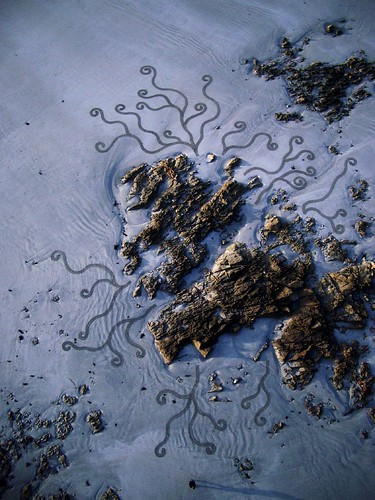
© Lenny. Via the always-excellent BLDGBLOG.
it’s still Michael Allen – and he scores a girl!
I was watching the football build-up with the sound off and the subtitles on.