Categories
Culture Other

Jonathan Ive and the post-gadget aesthetic

Some more thoughts on design in the tech industries. This time, the slow death of what I think of as the ‘gadget aesthetic’. The gadget aesthetic was a product of the novelty and glamour of electronics; it fetishizes the look of hi-tech gizmos. Lots of buttons, lots of LEDs, curvy moulded plastic, metallic-looking silver plastic:

This is the same approach as the set-designers for Star Trek: if you’re going to have some actor peering at a panel and saying “Captain! The dilithium crystal containment field is coming out of phase!”, then you really need the panel to look important. So you cover it in glowing panels and screens and buttons.

But now I think people have got past that; they want their consumer electronics to look stylish, but not necessarily in the Star Trek manner. One of the reasons Jonathan Ive has won all those awards for Apple is that he completely understands that. I’m writing this on an iMac which has less buttons visible than just about any other electrial product in the room – the clock/radio, the camera, even the fan. It is less visibly complex than the Anglepoise next to it.

Apple only have about 5% of the personal computer market, so perhaps you can’t look at their computers and assume that the design taps into a profound cultural shift. But they do have an overwhelming market share in mp3 players, and the iPod has that same post-gadget aesthetic. It’s not that it’s somehow trying to look anti-technology, but it isn’t trying to look ‘hi-tech’. It’s not trying to look like it fell through a wormhole from 2037. It has no LEDs or glowing buttons; the controls it does have are reduced to a circle of a slightly different colour on the front of the machine.

None of this is exactly rocket-science, and there have been thousands of words written about Apple’s cool minimalism. But on the specific point of a post-gadget aesthetic, Apple’s competitors either don’t get it, don’t know how to do it, or aren’t trying.

Here’s an iPod competitor, the 20GB Creative mp3 player:

I’m sure it does a good job of playing music. Ad someone has put some thought into making it look attractive. But look at the styling. The glowing buttons, the glowing outline, the moulded plastic, and the futuristic typeface on ‘Creative’ —  it looks like a communicator from Star Trek.

And here’s the ‘iriver H320 Lite 20GB MP3 Player’, which is, i anything, even more mired in the same culture of making products look futuristic:

You’ve got shiny glowing buttons, another futuristic typeface, the use of techy jargon (‘multi-codec jukebox’). It’s quite a cool thing and I’m sure a lot of people will look at it and want it, but it’s cool in a gadgety way. Next to the iPod it looks like it’s trying too hard.

One more example. Compare the silvery, swooshy Microsoft Wireless Laser Mouse 6000 to Apple’s plain white wireless Mighty Mouse. They have nearly the same functionality (both have four-way scrolling; the Mighty Mouse has four buttons to the MSLM6000’s five), but the Mighty Mouse doesn’t feel the need to advertise how sophisticated it is.

At the moment all this stuff is so closely associated with Apple that it’s just perceived as Apple branding. In fact, the Nintendo DS Lite, which has a very similar kind of simple, ungadgety style, is often described as looking like it was designed by Apple.

But my feeling is that these companies are just ahead of the curve. There will probably always be a market for techy geek chic, for games consoles, computers and mobile phones decorated with das blinkenlichten. But electronic hardware is not the sole preserve of geeks anymore, and I think tech companies are slowly starting to understand that. Apple has always been the less geeky alternative to Microsoft, and Nintendo have always been more family-oriented and less focussed on hardcore gamers than their competitors. And generally speaking, both of them have been outcompeted, and have had rather poor market share.

But the runaway dominance of the iPod, and the fact that the DS is outselling the more powerful but more traditionally gamer-orientated PSP, raise the possibility that the non-geek dollar is finally starting to have a serious impact. I think we’re in an interesting time when a lot of companies know that they need to make their products more desirable to a broader range of customers, but there’s a lot of groping around to work out how to do it. The mobile phone companies have had to deal with this quicker than anyone, and they haven’t done a bad job; from the time that mobile phone use exploded, it probably only took them about five years to come up with a proper girly phone, for example. And there is a huge range of designs available, even if they often tend to be somewhat similar in overall look. So if the much-rumoured iPhone does ever materialise, it’ll be interesting to see what Ive and Apple can do when competing in an already well-developed market where the importance of design is understood. I’m sure there’s scope for a much better UI, for a start, but what really interests me is whether he can come up with a look for the phone which stands out from the crowd. If he does I’m sure it’ll be the least futuristic looking mobile on the market.
Categories
Other

Summer days driftin’ away

Flicking channels the other day, I was horrified to come across ‘Live Champions League Football’ – a pre-qualifier between Arsenal and Zagreb. Much as I like football, the start of the season marks the start of winter. It always seems especially grim to see football before the end of the cricket season.

Despite the realities of the English weather, I always visualise cricket bathed in sunshine. As long as the cricketers haven’t fluttered away like swallows in search of warmer climes, I can pretend it’s still summer; and as far as I’m concerned the footballers could do the decent thing and wait until after the Oval test against Pakistan. I’m sure everyone in Zagreb will be watching the cricket anyway.

Categories
Culture Other

Stereotyping, cultural appropriation and such

Alan Sullivan has posted a poem called Long Bay Jump, both to his blog and to Erato, which is in a West Indian voice. It starts:

Sun drop down with a flash of green.
Moon lift up, and the palm tree lean.

Jack fish bake in banana wrap.
Pi-dog snatch all the table scrap.

Ganja and rum, ganja and rum–
Long Bay jump ’til the morning come.

Not surprisingly, some people were uneasy with it. Or, as Alan put it:

I posted this reggae-style lyric at Eratosphere today and got a face full of PC, just as I expected.

Full disclosure: I haven’t read the whole thread at Erato because, well, other people’s pissing matches get dull fairly quickly. But I was somewhat struck with this comment:

Although I can see why someone might be offended by the association of a whole group of people with ‘ganja’ and a careless demeanor, the practice of friendly caricature is generally accepted. No one would bat an eye at a poem that portrayed a British man with a cup of tea in one hand, a cane in the other, and a ‘Jolly good day’. No one would be shocked at a poem about a racist Southerner who irresponsibly uses Biblical quotations to justify cruelty — a far more offensive caricature, in my opinion, because it is a negative and unsympathetic stereotype. No one would even blink at a poem about fat and boisterous Americans visiting foreign nations. So what’s wrong with a friendly caricature of a non-white group of non-European descent?

Nothing, in my opinion.

Now there are various cans of worms there which I think I’ll leave unopened, and just comment on the bit which jumped out at me. “No one would bat an eye at a poem that portrayed a British man with a cup of tea in one hand, a cane in the other, and a ‘Jolly good day’.” Umm, well actually, speaking as an Englishman, that would annoy the fuck out of me. It’s outdated, inaccurate and patronising. So I guess that’s one point – you may not be as good a judge as you think of whether a caricature comes across as ‘friendly’.

I’m not going to try to judge how Alan’s poem would come across to someone from the BVI . But actually it makes me uneasy without having an opinion about whether it’s inaccurate and/or insulting.

It’s not the fact that it’s ventriloquising a West Indian voice, although that’s certainly relevant. Nor is it related to post-colonialism or the legacy of slavery or any other specific political issue associated with the region, though those are also relevant. It’s that it’s a stereotype. Not just a stereotype, but the stereotype of the Caribbean – rum, ganja, palm trees and music. Alan says, in response to some of the comments:

I tried to avoid a POV in the poem. It bears witness. It does not judge. Every detail is true, and known to me at first hand.

I have no doubt that every detail is true. And yet somehow all they manage to add up to is the obvious stereotype. That’s the thing about stereotypes – they usually have some basis in truth. There really are effeminate gay man and Nigerian con artists. The reason stereotypes are insidious is precisely that they are somewhat true; that you can look at the person and just see the stereotype. It’s a short-circuiting of thought.

I think I’d have been happier if he had offered a POV, if he had judged. That would at least be an explicit attempt to engage with the culture. Attempting to neutrally portray a culture which is not your own strikes me as fraught with difficulty, not from any kind of cultural relativism but because the perspective of the visitor is so partial.

This is perhaps an over-analysis of a light poem that doesn’t seem to be attempting much more than local colour. I just wanted to try to articulate my sense of unease.

Categories
Culture Other

FSotW: sleazy reads

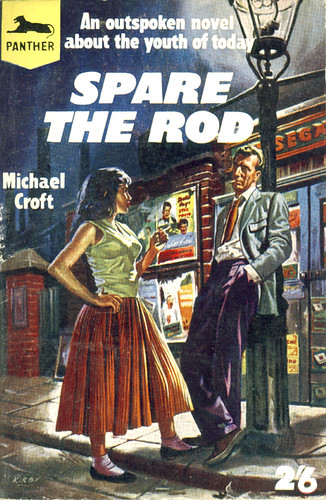
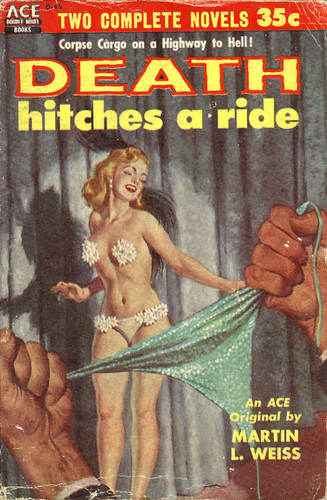
Flickr set of the week is sleazy reads by trevira. I particularly love the tagline on the second one.

Categories
Culture Other

form vs. function — a stupid false dichotomy.

Core77’s design blog led me to this article about form vs. function in mobile phone design. The title of the article says it all: Is the ‘dumb blonde’ phone here to stay?

In this context, a ‘dumb blonde’ phone is one which looks pretty but lacks functionality. I can understand why someone thought that was a good gag, but it completely misses the point. It assumes that people actually want all the added functionality of web-browsing, email, multimegapixel cameras, Bluetooth, music playback and God knows what else; that they’ve sacrificed something by choosing a stylish phone instead. But perhaps they haven’t. Perhaps they just want to make phone calls and send texts. Here’s a paragraph whose stupidity makes it worth quoting in full:

Andrew Brown, IDC’s European mobile devices programme manager, said the operators and manufacturers have played their part in the dumbing down. “Everyone gets very excited about aesthetics. It’s easier to sell design than it is to sell feature functionality – it’s laziness.” Good looks are immediately apparent to the average buyer – the benefits of having 3G connectivity or a smart operating system are not.

Which inevitably reminds me of the equally stupid quote from Sim Wong Hoo I blogged about earlier. Sim, as the CEO of Creative, was completely failing to learn the obvious lesson about iPod thrashing his products in the marketplace. The same lessons apply to mobile phones.

Here’s the first point: to choose a simple, attractive phone over an ugly but hi-tech one is not an irrational choice. It seems like such an obvious point that I can’t quite believe I have to explicitly say it, but I suspect I do. There’s a bizarre prejudice against aesthetics in the tech community, as though the pleasure in using an object you actually like is somehow an illusion, a deceit, and something of no value. Now if that’s how you feel, then fair enough. Good luck to you. Go and buy the most function-filled gadget, or the one which gives you most oomph per dollar, and ignore design issues completely. But if you want to sell gadgets to the non-geek community, you have to learn that people like to own nice things.

We’re not talking about a once-in-a-lifetime purchase: a mobile phone costs about as much as a handbag. Why on earth shouldn’t it be a fashion item?

Here’s the second bizarre prejudice: that added functionality adds value. This is the mentality that produced the much-mocked ballpoint pen with clock that used to be a staple of Innovations catalogues. Functionality you don’t want doesn’t add value, it reduces it. Even if it doesn’t interfere with the main function of an object, it makes it more complicated, which is a Bad Thing. I only use my mobile for phone calls and texting; so for me, all the other menu options are just unnecessary rubbish I have to scroll past to find what I want. By all means make a Swiss Army Knife phone with a tool for getting the stones out of horses hooves; just don’t expect me to buy one.

But the real problem, the one that underlies the others, is a belief that design is something you put on at the end, a lick of paint to pull in the stupid, style-obsessed consumer who somehow doesn’t appreciate the wonderful functionality you’re giving them. But design, properly, is not superficial. It deals with every aspect of the user’s experience of the product, down to the number of button-presses to perform an action and the obviousness or otherwise of how to do it. If a product is badly designed (or just as likely, not really designed at all), if it doesn’t try to make it easy for the user, then it’s a bad product, however many features it has.

My father has a PVR/DVD recorder that makes the perfect case study. When he got it a couple of years ago, it was the bleeding edge of the technology. And to be fair, it has proved itself to be a brilliant step forward from the VCR – no more scrabbling around for blank tapes, no difficulty trying to find what you recorded earlier. The basic concept of recording TV on a hard drive is superb. But despite that, I’ve come to actively dislike it. Because it was obviously put together by people who put all their effort into providing a certain set of features none of it into the user experience.

First example: pretty much everything you would need to do with the machine can be done, as you’d expect, by pressing buttons on the remote and using onscreen menus. But if you want to stop a timer recording, you have to press the stop button on the front of the machine twice. That’s completely unguessable, and easily improved upon; when someone presses ‘stop’ on the remote, just give them an ‘are you sure?’ message. Second example: despite the fact that even slightly complicated functions are managed through onscreen interfaces, the remote has 76 buttons. I don’t know what the right number is, but I’m damn sure it’s less than that. It also came with three separate manuals — an outline of the basic functions, a hideously complicated full manual that explained every possible function badly, and something in-between because, presumably, they realised the other two were both crap.

I’m conflating two meanings of ‘design’ here, attractiveness and usability, and of course they aren’t the same thing. Indeed, products often sacrifice usability for aesthetic appeal. What they have in common, though, is that they both make the product more likeable. They give pleasure. But pleasure is intangible and unmeasurable, so it’s all too easy for people to undervalue it, or just to pay lip-service to it. Because the thing is – good design is hard. It takes a lot of time, effort and commitment, an endless appetite for details and a deeply stubborn perfectionism. A company is never going to get it right if, deep down, they think of design as superficial.

Categories
Culture Other

The V&A online

The V&A seems to have put lots more of their stuff online since I last looked, and it’s all searchable. I wondered if there was a photo of the terracotta Virgin Mary and Child I wrote a poem about a few years ago, but it seems not. Lots of other good stuff though, like this C15th English alabaster carving of Saint Michael Attacking the Dragon and Weighing a Soul that was lucky enough to survive the vandalism of the Reformation.