Categories
Culture

Gauguin at Tate Modern

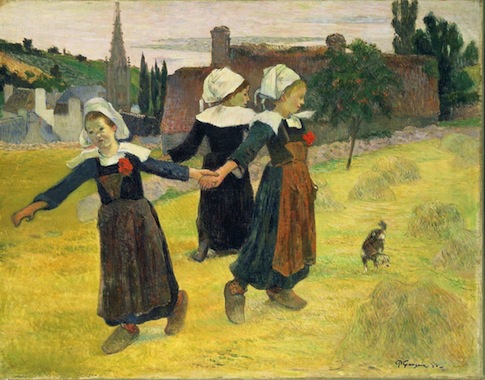
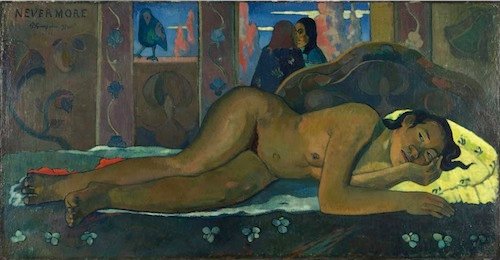
So, I went along to the Tate’s big Gauguin show the other day… which to be honest was slightly disappointing. Not least because nothing seemed very surprising; I wouldn’t have said I knew Gauguin’s work very well, and I would have expected to learn more or see something new, but not really.

Obviously I hadn’t seen every piece of work before, although quite a few of them had turned up in previous exhibitions, like ‘From Russia’ or ‘Rebels and Martyrs’, or were from the Tate or the Courtauld anyway. But even those which were new to me generally felt like more of the same. Not just because he developed a fairly distinctive style and stuck to it, but because his hit rate isn’t that great: the best of his paintings are genuinely gorgeous things, but they seem to be heavily outnumbered by ones which are just a bit underwhelming.

And at the risk of sounding like a complete philistine: they are also disappointingly small. I think one reason they are almost work better in reproduction is that you can see a photograph and imagine the original painting as a large, impressive piece, when in reality they are rather small and cramped. I guess I wouldn’t expect him to be painting huge, wall-filling canvases in his hut in Tahiti, but fair or not, that was my reaction.

There is also of course the uneasy politics of the work: Gauguin was a colonial sex tourist who painted the Tahitians in his own version of traditional Polynesian myths, even though they had in fact long since converted to Christianity. One myth is as good as another as far as I’m concerned, but the fact he completely ignored the reality of Tahitian life in favour of preconceived images of the innocent noble savage, even while living with his thirteen-year old ‘wife’ — it’s all a bit icky.

Since this review has been so negative, I guess I should reiterate: I still think the best of his work is pretty great. I just didn’t enjoy the exhibition as much as I thought I might.

Categories
Culture

This Earth of Mankind by Pramoedya Ananta Toer

This Earth of Mankind is the first novel of the Buru Quartet, so called because it was composed when Pramoedya Ananta Toer was a political prisoner on Buru Island in the 60s. I say ‘composed’ rather than ‘written’ because the first version of it was told orally to his fellow prisoners. He had apparently just about finished the research and planning when he was arrested and all his notes and books were destroyed.

Which is an immediately intriguing back-story, although the relationship between the novel and his imprisonment is not particularly direct, in that Pramoedya was imprisoned by Suharto’s military dictatorship as part of an anti-Communist purge, whereas the novel is set at the very end of the C19th — 1898, in fact — in a Java which is part of the Dutch East Indies.

Still, it is, among other things, a clearly political novel; it deals with the political awakening of a young man growing up in a society structured as a formal racial hierarchy, with ‘Natives’ at the bottom, ‘Pures’ (i.e. Europeans) at the top, and a layer of ‘Indos’ (Indo-European, mixed race) stuck in the middle, operating as a local elite.

The hero of the novel is a Native, but an unusually privileged one; because of the importance of his family, he is the only Native* at an elite high school for Europeans and Indos. So he’s awkwardly positioned in between worlds, brought up to believe that his European education makes him better than other Natives. But of course when he comes into conflict with the establishment, he discovers how fragile his privilege is, and how much he is dependent on the goodwill of the colonial powers.

I enjoyed it; it reminded me rather of one of those European novels from between the world wars, with a whiff of melodrama, and characters having long wordy conversations about ideas. Slightly old-fashioned, but in a good way. I’m certainly tempted to pick up the second in the quartet.

This Earth of Mankind is my book from Indonesia for the Read The World challenge.

* it feels very weird to keep capitalising ‘Native’ like that, but I’m following the practice of the novel, or the translation, which capitalises the racial terms to emphasise their formal legal status.

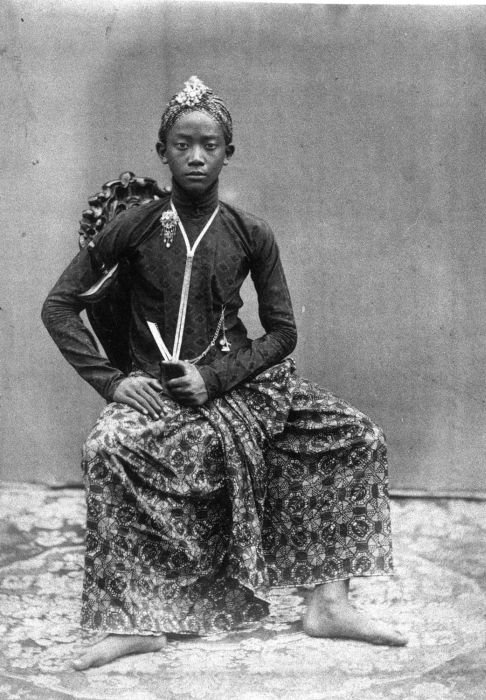
» The photo, by Isidore van Kinsbergen, is from Wikimedia, and according to Google Translate, it is Raden Mas Kotar of the court of Sultan Hamengkoe Buwono VI of Djogkakarta. it’s from 1870, so it’s about 30 years too early, but hey-ho.

Categories
Culture

The London Film Festival

I went to the last of three films I had booked at the London Film Festival yesterday (notes on which at the end of the post). The LFF, for those who don’t know, is the antithesis of a festival like Cannes: instead of being a big jamboree for people in the film business and the media, it is aimed squarely at the public. Basically, it’s a lot of films being shown at a selection of London cinemas.

And it is a LOT of films; 197 features and 112 shorts this year, apparently. All kinds of films: new British films, world cinema, restored classics, documentaries, gala screenings of big forthcoming releases to provide a bit of glamour. Which is great, but what usually happens is that I think ooh, the film festival, I should book some tickets and then I forget to do it.
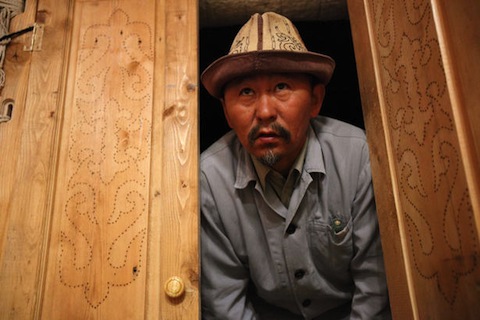
But this year, I remembered. My instinct was to look for the stuff which was unlikely to get a wide release, so I went to some fairly obscure films, and I found it interesting how full the cinemas were. You might think that showing nearly 200 different films in a fortnight would spread the audience a bit thin. After all, there are cinemas in London that show less commercial films all year round, and I reckon that normally on a Friday afternoon, a Kyrgyz movie would play to largely empty seats; but they had sold out a medium-sized cinema. I guess it’s similar to the way that in a big city, you often find a place where a whole load of, say, shoe shops are clustered together; the value of being somewhere where people go for shoes outweighs the disadvantage of the extra competition.

Anyway, the films; the first was The Light Thief. The ‘light thief’ is an electrician in a village in Kyrgyzstan who we start at the start if the film stealing electricity for villagers who can’t afford it. Without wanting to provide too many spoilers — what is the spoiler etiquette for a film I don’t actually think any of my readers are likely to see? — he gets caught up in village politics. And the film strongly implies that it is an allegory for the wider political situation in Kyrgyzstan, although that’s only an informed guess, given how little I know about the country.

The film looks beautiful; the dusty, windblown, mountainous central Asian landscape looks amazing in it. And there are some very nice embroidered felt hats and wall hangings and things. And it is funny and touching. So that’s a thumbs up.

Winter Vacation is a Chinese film about a group of youths killing time while waiting for their winter vacation to end in some battered, grimy, anonymous Chinese city. It’s well shot, and it has some genuinely funny dialogue, but it was a tiny bit soporific because it communicates the characters’ boredom and disaffection via the medium of long pauses:

Cut to shot of three people standing in the snow, looking at each other. Nobody speaks for a couple of seconds. Someone says something. Pause for another couple of seconds. Someone else replies. Pause again.

Which is quite effective, but it carries on like that for every scene in the whole movie, and it does wear a bit thin after a while. Slow is one thing, but actual stasis tests my patience. Still, there was a lot good about it, and it was listed in the ‘experimental/avant garde/artists’ films’ section, so I knew it might be hard work.
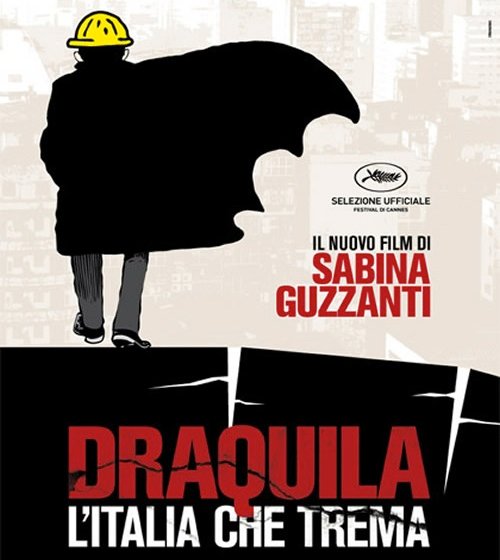
And finally I saw Draquila – Italy Trembles, which is a polemical documentary about Silvio Berlusconi’s handling of the aftermath of the earthquake in L’Aquila in 2009. I would strongly recommend you see this film if it comes to a cinema near you. It is funny and ferocious, and it paints a picture of a completely  acquiescent, neutered Italian media, largely owned by Berlusconi, of an increasingly authoritarian government abusing the law to run roughshod over normal legal processes and rights, and massive, widespread corruption linked to the mafia. It’s not just a damning portrait of Berlusconi and Italy; what I found scary is that it provides a real sense of how a modern democratic country like Italy could slide towards fascism.

I should be clear about that: I’m not saying that Berlusconi’s government is fascist, or is likely to become so. But it does provide a sense of the slippage of normality. Already there is the confluence of government with crony capitalism and (I guess I should say: allegedly) organised crime; there is the eroding of civil liberties, the declaration of states of emergency as a way of bypassing the law, the increasing militarisation of the response to normal events. It is scary stuff.
Categories
Culture

‘Venice: Canaletto and his Rivals’ at the National Gallery

On to more cheerful subjects — I went to see the Canaletto exhibition at the NG the other day. Which i enjoyed, entirely predictably; because I’m not sure Canaletto is one of the very greatest painters in the European tradition, but he is one of the most likeable. I’ve never seen a Canaletto I wouldn’t like to own. He clearly had a bit of conveyer belt going on at one stage, producing standard views of Venice for English tourists, but even at their most formulaic, his paintings are cheerful, decorative and full of engaging details.

This exhibition puts his career in the context of other painters of Venetian view paintings at the time, which makes for interesting comparisons. For example, there are three paintings displayed alongside each other of regattas on the Grand Canal, one by Canaletto and the others by, I think, Michele Marieschi and Bernardo Bellotto. The stylistic differences are interesting, but the most striking thing is how differently they portray the physical reality of the scene; the canal is about half as wide in the Marieschi* as the Canaletto, presumably to create a livelier, more crowded scene.

The other two most notable things, for me, were Canaletto’s early style and the works of Francesco Guardi. Canaletto’s earliest paintings of Venice were rather looser, with much broader brushstrokes; but they are also greyer and a bit grittier. They don’t have that amazing glowing Mediterranean light which is so much part of the later works, but also they make Venice look a bit shabby, a bit dirty; a city of faded glories. There’s a painting of St Mark’s square with market stalls clustered around the bottom of the basilica and campanile, and the size of the building makes the rather ragged stalls and people look paltry and insignificant, while the stalls in turn undercut the grandeur of the basilica.

I wouldn’t want to read too much into it — I daresay he was aiming for straightforward realism rather than biting social commentary — but it does make you realise how much more flattering his later paintings are. They are all glowing and sparkly, and while they do still have disreputable looking characters in them, they now look like lively local colour rather than slightly seedy. I have to say I rather liked the early paintings, but I can see why it was the later work that was so commercially successful. I don’t know whether he consciously changed his style specifically to make his work more marketable: it seems quite likely. And why not, after all.

And the Francesco Guardi paintings were interesting to me just because I was unfamiliar with his work. It’s much more stylised than Canaletto, with suggestive little brushstrokes and curious little pin-headed figures. You can see why his work was rediscovered and celebrated by C19th artists as being ahead of his time; he’s clearly moving in the direction of painters like, to make the obvious Venice comparison, Turner. Like Turner, he favoured scenes with a lot of water and sky — boats on the lagoon, rather than, or as well as, more architectural subjects.

* I think. I suppose I could try taking notes at these exhibitions if I’m going to blog about them later… nah.

» The picture is a detail from Francesco Guardi’s Venice: The Giudecca with the Zitelle.

Categories
Other

The chill wind of austerity

Gosh, it’s been a depressing week in British politics. Austerity is such a grey, foggy, Victorian sort of word. They’ll be talking about retrenchment next.

And you don’t have to be an expert in the fine details of the budget to realise that there’s no way the government can cut total spending by 20% without making the country a harder, nastier place in a whole lot of ways, some obvious and some subtle.

I was at a party the other day where parents were swapping tips about places to take young children, and they were commenting that London’s parks all seem rather nice these days. They’re well-maintained, and clean, they have nice facilities, and they’re making an effort to be better for wildlife. Well, with a 30% cut in local government funding, I think it’s a safe bet that those parks are going to become grottier, grimmer, a little bit less of an escape from the city around them. Which seems like a good symbol for what’s going to happen to the whole country.

And since 85% of the debt was run up bailing out the banks, most of this pain is being inflicted in the name of saving the bankers from the consequences of their own incompetence.

But that’s not the really depressing part. It might be possible to take a deep breath and face the cuts as stoically as possible, if I was actually sure that they were going to have the desired effect. If I believed that they were the only thing keeping Britain from becoming the next Greece, if I was sure that the cuts were going to lay the foundation for a more stable and more prosperous economy in the longer term… but meanwhile there are Nobel prize winning economists like Krugman and Stigliz saying that, on the contrary, this is the worst thing the government could possibly be doing. The killer quote from the most recent Stigliz article:

Austerity converts downturns into recessions, recessions into depressions.

Now I don’t know whether they’re right. I suppose I have to hope not. But it really would be the vomit garnish on a shit sandwich if the effect of all these cuts was to take a weak economy and give it a good kicking.

Meanwhile Cameron, Clegg and Osborne seem to be rather enjoying themselves. Partially perhaps because of a pre-existing ideological commitment to the idea of small government, but I think mainly because they’re rather enjoying the vision of themselves as dynamic men of action, men with the leadership qualities to make the hard decisions.  Of course the British economy is where it is because a group of decisive, dynamic go-getters in very expensive suits decisively and dynamically cocked up on a catastrophic scale. The politicians have obviously been watching and learning.

Categories
Culture

From Tajikistan to the Moon by Robert Frimtzis

From Tajikistan to the Moon is a self-published memoir. Rather glamorously self-published, too, compared to the current trend for self-publishing via print-on-demand, in that it’s a proper hardback with an embossed cover. Frimtzis was born in Beltz (i.e. Bălţi) in what is now Moldova, although when he was born there it was part of Romania and from 1940 onwards it was part of the Soviet Union.

Frimtzis was ten when Germany attacked the Soviet Union in 1941. Although of course they couldn’t know the full scale of the Holocaust, they knew enough about the anti-semitism of the Nazis that his family took the decision to flee eastwards. After hundreds of miles on foot, keeping ahead of the German army and under aerial attack, they got onto the train network in Ukraine and carried on to Tajikistan, where they had relatives.

After the war they managed to get themselves smuggled out of the USSR through Romania and Austria to Italy, and then after some time in the refugee camps, to immigrate to America. There he studied hard, became an engineer, and eventually contributed to the Apollo programme — hence the moon part of the title.

So he has an interesting story to tell. He’s not the world’s greatest prose stylist, but at least it’s plain, straightforward prose; if it’s occasionally a bit clunky, at least it’s not painful in the way that bad literary prose can be. It kept my attention.

For me, the most interesting part of it is the refugee narrative; his experience as an internal refugee within the Soviet Union, then in an Italian refugee camp, and continuing with his struggles to adapt in the US, where he was self-conscious about his outsider status and his bad English as he worked to carve out a place for himself within American society. Which he eventually did very successfully. The more stable his life becomes in America, the less interesting the book becomes; even though he worked on some truly fascinating projects in his professional life, I don’t think he really brings that to life. He doesn’t manage to explain what was interesting about the work itself.

From Tajikistan to the Moon is my book for Moldova for the Read The World challenge.

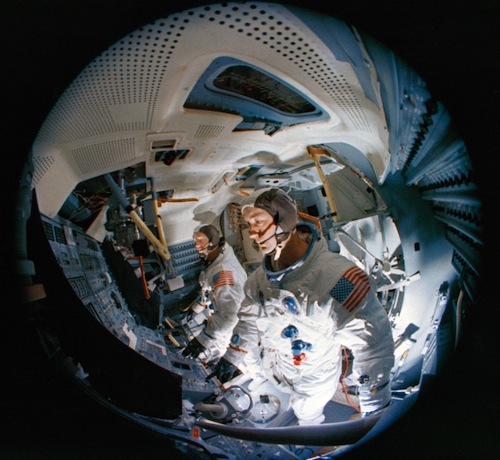
» The photo is of crew in the Apollo Lunar Module Mission Simulator… which I think is actually the wrong bit of equipment. Frimtzis was in charge of the team working on the Apollo Mission Simulator, which I think is the simulator for the command module rather than the lunar lander. But I really like the picture, so  it’s close enough.