Categories
Culture

Shadows of your Black Memory by Donato Ndongo

As part of my ongoing quest to read a book from every country, I picked up Shadows of your Black Memory as a book from Equatorial Guinea. It is a childhood/coming of age novel that sets up the conflict between traditional and western cultures: particularly in this case between traditional religion and Catholicism.

Which, at this point in the exercise, is not a description that fills me with excitement; because nearly all the literature of the post-colonial world seems to be about the conflict between tradition and western culture and/or modernity. Certainly the stuff which makes it into English translation. And it’s also pretty common to tell it as the story of a young person growing up caught between two worlds.

So I didn’t pick it up with much enthusiasm, but actually it’s a really good novel. It is simply very well written: vivid, fresh and engaging.

Here’s one of the Catholic bits:

When I was eight, I knew Father Claret’s catechism by heart, and my favourite book was his Straight and Sure Path to Heaven. The horror of eternal condemnation didn’t allow me to be a child. I didn’t go to the Wele River with Ba any more, I couldn’t learn how to make those bamboo toy cars that I loved so much even though cousin Asumu offered to teach me many times. I didn’t carve arrows to shoot at birds anymore, I didn’t go swimming in the Nganga River with my friend Otunga or my cousins Anton and Mbo. Even today I don’t know how to swim. I didn’t have a hunting dog, and I didn’t know how to make a cage for trapping fish. All this was for other children now, for the ones who weren’t fortunate enough to be touched by the grace of God. What’s the use of all that fun and idleness if in the end your soul is damned forever? Father Claret, the saintly one, asked me this as I read his book, and I had no choice; I had to acknowledge that the most important part of my life was my soul, and to be saved I had to avoid useless amusements, the silly games of my friends, my cousins, the brothers in my tribe. It was shortly before I was nine when I got into the habit of saying Mass from a little altar I made for myself in my room in front of the crucifix Father Ortiz had given me and under the religious things I had on the wall: the Eye-of-God triangle and some prints that were brought to me by my father’s white friends; the Little Prayer Book served as missal. Alone in my room, when no one was looking, when my little brothers succumbed to the midday sun, I got all dressed up in a bed sheet and pretended it was a priest’s chasuble and started to say Mass, in nomine Patris et Filii et Spritus Sancti, and I made the sign of the cross: I, a sinner, confess to Almighty God and the Blessed Mary Ever Virgin, Saint Michael the Archangel, John the Baptist, and to Apostles Peter and Paul and all the saints, and I beat my little breast in contrition, mea culpa, mea culpa, mea maxima culpa, and I almost forgot the kyrie eleison kyrie eleison Christe eleison Christe eleison, then the intraito, oremus, and I turned my head ceremoniously; then in silent fervor I genuflected, gloria in excelsis Deo, and I recited it all without knowing what I said in a Latin I learned from listening to Father Ortiz so much.

So, yup, I really enjoyed this one. Well worth picking up. I’d be quite interested in reading the sequel if it was available in English. And I often forget to mention translators, but credit is certainly due in this case, so: the translation is by Michael Ugarte.

» The photo is of a Reliquary Guardian Figure (Eyema-o-Byeri) in the Brooklyn Museum. It is actually from Gabon rather than Equatorial Guinea, but it’s the right ethnic group (Fang).
Categories
Culture

The Land Without Shadows by Abdourahman A. Waberi

The Land Without Shadows is my book from Djibouti for the Read The World challenge. There are a few options available in French, but Waberi seems to be the only choice in English. Having read a few underwhelmed reviews of his novel, In The United States of Africa, I thought I’d try this collection of short pieces.

It seems to be broadly true that Francophone literature from Africa is much more overtly ‘literary’ than the English-language stuff; more playful, more given to formal and stylistic flourishes. Which says something about the influence of French culture and French academia.

Some of these are fairly conventional short stories, others are more like essays or parables or long prose poems. They add up to a sort of portrait of Djibouti — the land without shadows — both in the present and historically.

It’s quite inventive and well-written, but the plain truth is that it never really held my attention. Shrug.

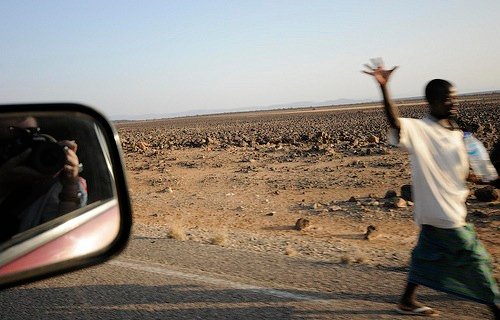
» Djibouti is © Stéphane Pouyllau and used under a CC by-nc-sa licence.

Categories
Culture

Why I hate the Pre-Raphaelites*

When I was at university I overheard a conversation when someone said:

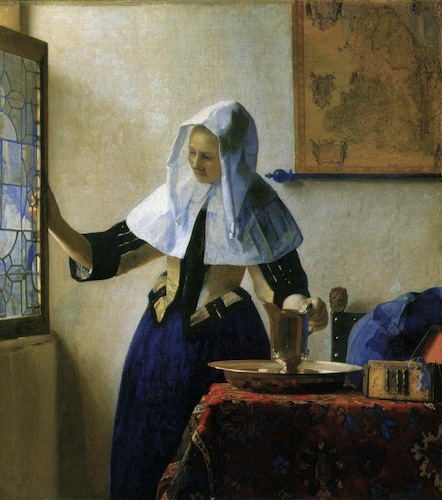
I just don’t understand how you can say you like both the Pre-Raphaelites and Vermeer.

It has stuck with me ever since. It’s just a perfect one-line bit of art criticism. It always seemed like it ought to make a great parlour game†: ‘I just don’t understand how you can say you like both x and y… fill in the blanks.’ But actually I’ve never been able to find a pair which seems as perfect as Vermeer and the Pre-Raphs.

Vermeer basically painted accurate pictures of his own time and place; carefully composed, tidied up and idealised, perhaps, but realistic, small scale, domestic. The Pre-Raphaelites‡ chose to retire to a silly fantasy world of knights and maidens which avoided the difficult complex reality of the nineteenth century — but avoided the difficult complex reality of the medieval world as well.

And Vermeer is sensual but austere; sensual in his representation of surfaces, textures, light and shadow, but stylistically austere in his classically perfect compositions and controlled, precise brushwork. While the Pre-Raphaelites are the opposite: stylistically they are lush and decorative, but the result is bloodless. Their paintings are full of decorative young men and women posturing and looking glamorous, but it’s all surface. There’s no flesh to it, not a whiff of filth.

In one of Aldous Huxley’s early novels, which are satirical portraits of London bohemia, there’s a character called Casimir Lypiatt who sees himself in the Renaissance tradition of painter-poet-thinkers, full of bombastic rhetoric about Art and Beauty and moral significance. Not everyone is as impressed with him as he is:

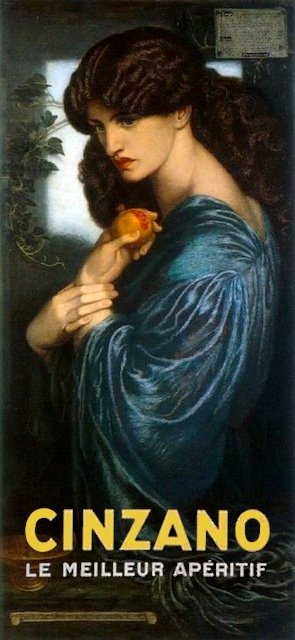
‘Number seventeen,’ said Mrs Viveash, ‘is called “Woman on a Cosmic Background.”’  A female figure stood leaning against a pillar on a hilltop, and beyond was a blue night with stars.  ‘Underneath is written: “For one at least, she is more than the starry universe.”’  Mrs Viveash remembered that Lypiatt had once said very much that sort of thing to her.  ‘So many of Casimir’s things remind me,’ she said, ‘of those Italian vermouth advertisements.  You know – Cinzano, Bonomelli and all those.  I wish they didn’t.  This woman in white with her head in the Great Bear….’ She shook her head.  ‘Poor Casimir.’

Presumably Huxley, writing in 1923, was not thinking of the pre-Raphaelites. But that description is brutally spot on.

Vermeer took the small and mundane and made it something hypnotic; the Pre-Raphaelites took a grand mixture of ideas, ideals, myth and history, and made a lot of pretty posters.

* OK, maybe ‘hate’ is a bit strong. But, you know, linkbait innit.

† Actually, thinking about it, a truly dreadful parlour game. A mildly interesting intellectual exercise, maybe.

‡ Yes, I know, I’m lumping them all together in a rather lazy way. But although the exact details varied from painter to painter, and some were better than others, I think the broad argument applies to all of them.

Categories
Culture

Watercolour at Tate Britain

I actually went to see this exhibition about a week or so ago, but I’ll just jot down some belated impressions. It is, as the title suggests, a historical survey of watercolour painting, from the medieval to the present.

There are only a handful of medieval pieces, bits of illuminated manuscript, which just serve as a reminder that, although they are not what we usually think of as ‘watercolour’, that is technically what they are.

The exhibition makes the interesting point that originally watercolour was mainly seen as an adjunct to drawing: a work would be drawn in pencil or ink and then effectively coloured in, sometimes just with a few hint of colour to liven the drawing and sometimes in a more thorough way. So many of the early pieces are technical works of one kind or another: costume designs for Elizabethan masques, maps, plans of fortifications, as well as a few specific uses like portrait miniatures.

That technical aspect leads on to what is probably my favourite room of the exhibition, a room of scientific illustrations; especially botanical illustrations but also birds and mammals. Many of these were lent by the Natural History Museum or Kew, which is a clear sign that they were not originally created as Art, but they are gorgeous things. It even included some lovely C19th paintings of rock types — each one is a lump of rock on a plain white background, and they look like an elegantly minimalist conceptual art project.

After that we get into watercolour as an artistic medium in its own right. This includes plenty of ‘typical’ watercolours — landscapes, basically — but also a variety of paintings chosen at least partially to challenge that stereotype. So we have a room of war paintings, a room of ‘visionary’ paintings, a room of exhibition watercolours (i.e. large-scale C19th narrative paintings designed to compete with oil paintings for gravitas), and a room of contemporary work using watercolour.

My single biggest problem with the exhibition is that C19th British painting is not something I particularly enjoy. And that was the golden age of watercolour. So the aesthetic of the paintings was more off-putting than anything to do with watercolour as a medium. The exhibition watercolours seemed particularly pointless. I don’t like Victorian narrative painting and find the Pre-Raphaelites exceptionally noxious; seeing them painted in watercolour instead of oils didn’t make them any more likeable. Especially since there was no obvious attempt to make a virtue of the different medium: rather they seemed to be straining to make watercolours look as much like oil as possible.

And some of the paintings had clearly faded, which is the great technical problem of watercolour as a medium. There’s nothing much you can do about that, but it is a pity. There was a painting of some sun-drenched imperial outpost (Egypt? India?) which just didn’t look very hot, and I think it had probably faded a bit. So the shadows weren’t as dark, and the tones weren’t as warm.

As you can tell, I wasn’t blown away. But every room had something of interest and something covetable. And every so often there was a painting which was gorgeous and which could only have been done with watercolour: liquid and light and translucent. So it’s well worth a visit.

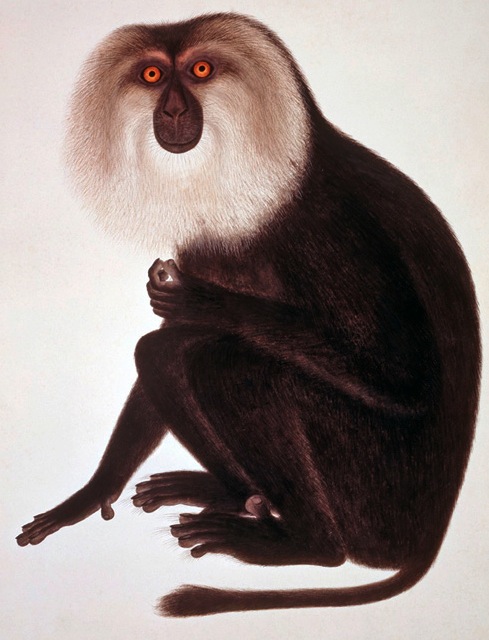
» The painting of the Lion-haired macaque, Macaca silenus, is by an unknown Chinese artist working for John Reeves, who employed locals to paint the specimens he was collecting while working in Canton from 1812-1831. That particular work is not in the Tate, though they do have a different monkey from the Reeves collection, lent by the NHM.

Categories
Culture

Warrior King by Sahle Sellassie

Warrior King is one of several books in English by Sahle Sellassie, all now apparently out of print. It wasn’t easy to find much information about them so I just went for the one which was available cheapest second-hand.

It is a historical novel, telling the story of the rise of Kassa Hailu, who starts as an outlaw but eventually conquers the whole of Ethiopia and establishes himself as Emperor Tewodros II of Ethiopia.

The obvious comparison for me is with the brilliant Chaka by Thomas Mofolo, also a historical novel about the rise of an African emperor. Mofolo captured something of the brutality and darkness inherent in a man’s rise to power through conquest, and the novel has a real literary heft to it.

Warrior King is a much less interesting book. It’s not a complete whitewashing of history — Kassa Hailu is presented as a ruthless figure, even if he is rebelling against an even more brutal regime. If anything, though, it just doesn’t see that interested in engaging with the morality of it, or the psychology. It reminds me of the kind of history books parodied by 1066 And All That: history as a sequence of memorable anecdotes strung together into a basic narrative. It’s certainly not very interesting as literature, but it’s not really very interesting as history either; their just isn’t enough context or detail to make it come to life. There’s surely enough material in the rise of Tewodros II to make either a really interesting history book or a rattling good yarn. This is neither.

Warrior King is my book from Ethiopia for the Read The World challenge.

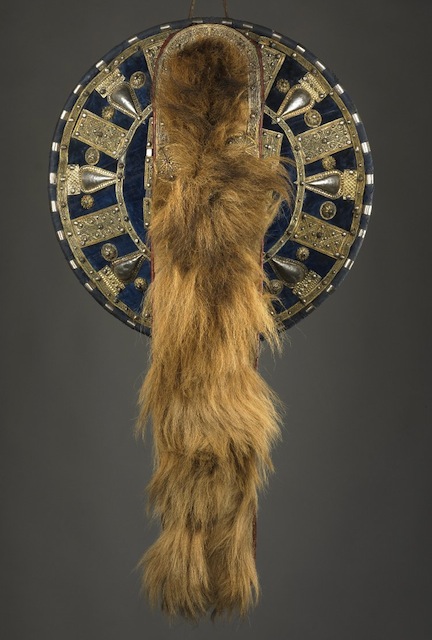
» The shield decorated with filigree and a lion’s mane is the royal shield of Tewodros II which, like quite a lot of his stuff, ended up in the British Museum.

Categories
Culture

Cave of Forgotten Dreams 3D

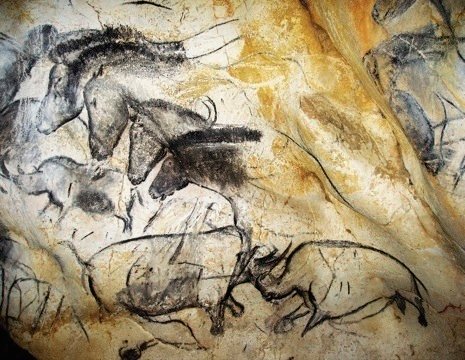
This is the Werner Herzog documentary about the Chauvet cave paintings in France. It was definitely worth seeing, but mainly, I think, for the incredible paintings themselves, rather than anything Werner Herzog brought to the project.

It is probably the best use of 3D I’ve seen, because although I’ve seen photos of the paintings at Chauvet and Lascaux, the photos tend to flatten out the image; you get very little sense of the highly irregular shape of the cave walls and the way that the paintings are shaped around the contours of the rock. The 3D film really did make all the difference and was very effective.

Which is an unusual view for me, because I basically think that 3D is a rubbish technology. In most circumstances it’s little more than a gimmick, and it seems to be technically rather bad anyway: I find that it looks unnatural and exaggerated, it’s often slightly shimmery or glitchy, it doesn’t work properly if you tilt your head to one side, and it tends to give me a headache. I don’t know if the problem is that I’m wearing prescription glasses under the 3D ones, but that seems to be a lot of downside for very little upside.

Even in this film, I think it would have been better to save the 3D for the places where it really mattered — i.e. looking at the cave paintings. An interview with a paleontologist sitting in an office does NOT need to be in 3D, thank you very much.

And even in the scenes inside the cave, it became clear that some of the film had not been filmed in 3D, but faked up as 3D in post-production. This was particularly egregious in a scene where two scientists were standing in front of a cave painting and talking about it, and something looked very weird; I suddenly realised that when they had faked the 3D, they had cut out the two figures rather carelessly and cut out a big chuck of the surrounding wall as well; so there was a big blob of cave wall which was in completely the wrong visual plane, floating in front of the wall around it.

Such technical gripes aside, the paintings were beautiful and fascinating. And there were all sorts of snippets of fascinating information, like the great scratches on the walls which had been left by cave bears sharpening their claws. Or the two stags painted on top of each other which carbon dating revealed were painted 5000 years apart. I mean, really, 5000 years! What does it mean that there was such staggering cultural continuity?

I was also interested that there was no sign of human habitation in the cave; presumably they used it as a ritual site, or something. It’s all guesswork, of course. There also no humans among the paintings, apart from one image apparently of a woman’s pubic triangle and legs, similar to the famous ‘Venus’ figurines. And no pictures of birds, incidentally; it’s all big game: cave bears, cave lions, horses, antelope, woolly rhino, mammoth, hyena, aurochs.

Of course we have so little of their lives to draw on, so what does survive gains enormous, inflated importance. The paintings are the most vivid connection we have to those people 35,000 years ago, and so we can’t help having them as central to our idea of their lives; but we don’t know whether they were similarly important to the people who painted them. The film did show a few objects found at other sites of the same period that provide a few hints at a broader life; Venus figurines, animal carvings, and most extraordinarily a flute which had been meticulously reconstructed from over 30 tiny fragments of ivory. But mainly we are left with a lot of stone tools and the cave paintings. Anything made of wood, or gut, or hide is long gone, let alone the stories they told, the music they played, the food they cooked.