Categories
Culture

Jan Gossaert at the National Gallery

I went along to this with little knowledge and few preconceptions and on the whole was pleasantly surprised. I’ve said before I particularly like the Northern Renaissance for its more medieval aesthetic compared to the Italians. That’s actually less true of Gossaert; a lot of his figures have that contorted quality that I associate with, say, Michelangelo; of being posed in rather uncomfortable-looking positions with pronounced foreshortening. They also have a kind of fleshiness which relates to the Italians but also seems to make him a precursor of painters like Rubens and Jacob Jordaens.

The portraits stood out for me; which, come to think of it, is often the case in these exhibitions. I guess that’s partially because of their human interest — they are the most gossipy kind of painting — and partially because the relatively constrained format strips away many of the things modern audience find off-putting about older paintings. I think there are various reasons why religious paintings and history paintings are not to modern taste, some of it to do with the subject matter, but also the style. Whereas a straightforward head-and-shoulders portrait, the subject looking out of the canvas, is probably the single genre of painting which carries through most directly from the Renaissance to now.

So there was certainly stuff to enjoy — not least some fantastic Dürer engravings and woodcuts which were in there for context — but I can see why Gossaert’s not as well known as some of his contemporaries. He was clearly a wonderful painter, but he just lacks the extra something to make him stand out. And the ways in which he is different from his contemporaries probably make him less to modern taste rather than more. Certainly less to my taste.

Categories
Culture

The Hooligan Nights by Clarence Rook

Interesting one, this. Lee Jackson of victorianlondon.org decided to use some of his archive of digitised Victoriana to raise a bit of money to help support the site and put this for sale as a Kindle book for the minimum price of 86p. So I thought I’d give it a try.

Rook was apparently a Victorian journalist and this book claims to be a true account of his conversations with a young Lambeth criminal called Alf — a ‘hooligan’ when that word was new. It is what you might expect from a journalist writing about a colourful lowlife for a popular audience; that sensationalism makes it a genuine page-turner, but it comes with the usual scepticism about writers who seem more interested in a good story than accuracy. It seems pretty safe to say that it’s not actually ‘true’; it’s harder to judge whether it’s a realistic portrayal of that way of life.

However, read as a novel, it’s entertaining stuff. Alf is a classic anti-hero, charismatic and largely amoral, displayed for the prurient pleasure of the reader. It must have been fairly racy stuff in 1899; sex is only really hinted at with references to the number of Alf’s romantic entanglements, but there’s a plentiful supply of violence, crime, colourful slang and a general lively seediness.

It’s also fun for me personally that it’s all south London: the action all takes place in Clapham, Vauxhall, Elephant and Castle, Peckham Rye. The centre of this particular universe is Lambeth Walk, which was then a street market and is presented as a place where all human life is present — his descriptions of it read like a tourist visiting a middle eastern souk. The road called Lambeth Walk is still there, but the market is gone, and judging by Google street view, what is left is a very quiet and undistinguished local street. You can still see the Victorian buildings along one side, but thanks to some combination of the Luftwaffe and Lambeth planning department, the other side of the road is all large housing developments and so the feel of the street is quite gone.

It’s odd to think about how some of these places have changed. I was surprised to learn once that earlier in the C19th the roughest, most dangerous ghetto in London, where the police would only go in groups, was… Seven Dials. Which is now part of the overflow of Covent Garden, mainly consisting of quirky little fashion outlets, cafes and the like.

Anyway, at this point I’m just rambling. So I will stop.

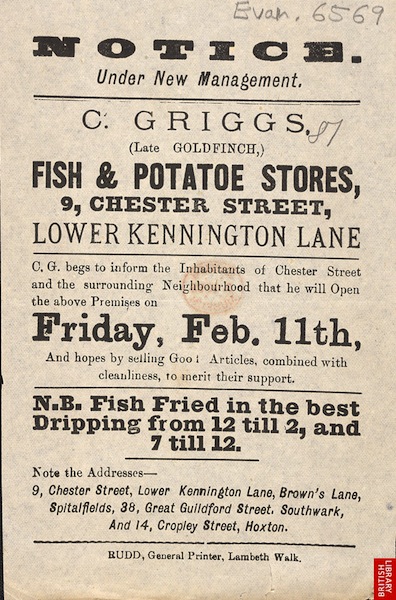
» The image, from the British Library, is only loosely relevant, but I chose it in honour of a greengrocer I used to see from the 37 bus somewhere between Brixton and Clapham. It had a nice, swirly hand-painted sign saying ‘Mr Cheap Potatoe’. It used to cheer me up every time I saw it; sadly it doesn’t exist any more.

Categories
Culture

Bad Google! Naughty Google!

This is interesting; apparently The Complete Review has fallen foul of Google’s revised search algorithm:

Apparently the complete review is exactly the kind of “low-quality site” that is “just not very useful” they were targeting, as search result positions have plummeted for most of the review-pages at the site.

I do have some sympathy with Google; providing good search results would be a very difficult problem even if there weren’t a lot of people trying to game the system. But The Complete Review, far from being a content farm, is one of the best literary resources on the web, particularly for translated literature. So the system is not working properly in this case.

The problem is that Google provides such a huge chunk of all traffic around the web, so anyone who runs a website is at their mercy. And while they don’t seem to abuse their position too much — they seem to approach the business of providing search results in an honest and well-meaning way — they still have a great deal of power and no accountability.

Categories
Culture

The King of Kahel by Tierno Monénembo

The King of Kahel is my book from Guinea for the Read The World challenge. It is the first book printed by AmazonCrossing, Amazon’s own publishing imprint specialising in translated literature. They say ‘AmazonCrossing uses customer feedback and other data from Amazon sites to identify exceptional works that deserve a wider, global audience.’ So this book was presumably picked up because it was a big hit in French.

It’s rather unusual among all the post-colonial literature I’ve read for the Read The World challenge, because the hero is a European colonialist. Specifically, it’s about Olivier de Sanderval, a real person, a man from a wealthy family of provincial French industrialists who did some exploring in what is now Guinea and wanted to set himself up as an African king.

And he’s not just the hero in the narrow sense of being the central character; it is very much his story and he is presented as a sympathetic character.

It’s always interesting to have your expectations confounded, if only because it reveals what those expectations are. Because there’s nothing terribly radical about this novel. If it had been written by a white French novelist I wouldn’t have thought anything of it; Monénembo has lived in France for nearly 40 years; and yet I was in fact surprised.

That aside, this is an enjoyable if unexceptional literary novel. It is light and cheery in tone; the back cover claims that ‘Monénembo has created nothing short of a jovial Heart of Darkness‘, which is about as baffling a description as I’ve ever encountered. The book reads to me like a playful re-imagining of history, so I assumed it was only based lightly on the historical Sanderval. Apparently, though, Monénembo did a lot of research and had access to the Sanderval family archives, so there may be more history in it than I realised… perhaps if I’d realised that I would have enjoyed it more. Or maybe I’d rather have read a straight biography.

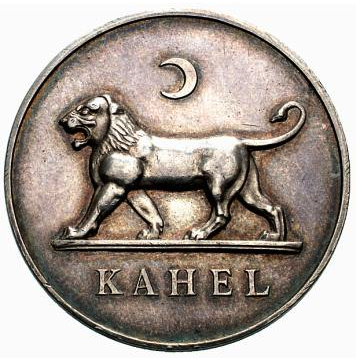
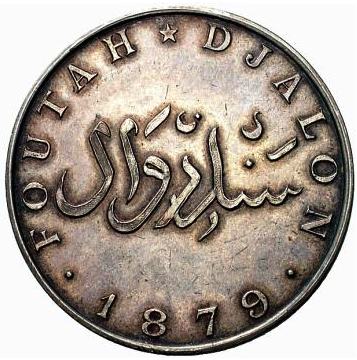
As an example the book being unexpectedly accurate, Google found me these pictures: the two sides of a real coin produced by the real Olivier de Sanderval to serve as currency for his kingdom of Kahel. The Arabic script reads ‘Sanderval’. Which is sort of amazing, actually.

Categories
Culture

The Sands of Oxus by Sadriddin Aini

The Sands of Oxus is my book from Tajikistan for the Read The World challenge. Which is a bit of a cheat, in fact. Aini’s Tajikistan credentials would seem to be impeccable: according to Wikipedia, he is ‘regarded as Tajikistan’s national poet’. He wrote the first Tajik novels and a Tajik dictionary. He was a member of the Central Executive Committee of the Tajik SSR, the president of the Writer’s Union of Tajikistan, and the president of the Tajikistan Academy of Sciences. However, rather annoyingly for my purposes, he didn’t actually live there. He was born, and spent his whole life, in what is now Uzbekistan. He was ethnically Tajik, but not geographically.
This seems rather typical of Central Asia; my book from Uzbekistan, The Railway, was written by someone who was actually born in Kyrgyzstan. The Day Lasts More than a Hundred Years is my book from Kyrgyzstan, but it’s set in Kazakhstan. I guess it’s partially because the Silk Road historically created a mixed, mobile population; and more recently because it was all part of the Soviet Union, and people moved from one SSR to another for all kinds of reasons, sometimes by choice and sometimes under duress.

If I come across a book which is a more perfect fit for Tajikistan, I might read that as well, I suppose. But The Sands of Oxus will do for now. It is the first volume of Aini’s autobiography; it covers his childhood in rural Uzbekistan — in what was then (1878-90) the Emirate of Bukhara. The book ends with him leaving to study at a madrasa at the age of twelve.

It’s a straightforward chronological autobiography told, at least in this translation, in fairly plain prose, but I found it very interesting; mainly for what you might call historical/ethnological reasons. It’s a vivid portrayal of life in a small village in Central Asia in the 1880s; the farming, the food, the customs. It’s occasionally a bit didactic — there are a few incidents which carry a suspiciously neat message — but not annoyingly so. The broadly political stuff, about venal magistrates, ignorant village mullahs, ruthless tax collectors and the arrogant aristocracy, might I suppose be influenced by his revolutionary politics as an adult and indeed the fact he was writing in Stalin’s USSR. Not that any of it is inherently implausible.
Reading it, it seems like an incredibly timeless world: the cycle of planting and harvest, Ramadan, a summer festival, circumcisions, marriages, funerals. There is no mention of any modern technology at all, not even the telegraph or the steam engine. It must have already seemed ancient by the time this book was written in 1949.

Here’s a fairly random sample:

Each year when the mulberries began to ripen, my father used to move us from Mahallayi Bolo to Soktaré. The year that the Shofirkom canal was choked with sand and Mahallayi Bolo was left without water, we moved to Soktaré early, even before the mulberries began to fruit.

In Soktaré my brother and Sayid-Akbar Khoka began to study with the village khatib, and I played in the many streams and canals with other boys my age. My father decided not to move back to Mahallayi Bolo that winter, since drinking water was scarce there and had to be drawn from a village well and carried to the house. Accordingly, he demolished our tumbledown living quarters and built a new house of mud brick, with a storeroom, a kitchen porch, a cattle stall and a barn for hay. Usto Khoja assisted him with the construction, and Ikrom Khoja and Muhyiddin helped as far as they could in mixing the mud; but despite his father’s pestering, Sayid-Akbar refused to help, claiming that he wanted to be a calligrapher and if he soiled his hands with mud and bricks they would be spoiled for the pen.

That year I and my playmates Haid Khoja, the nephew of Ibrohim Khoja, and the daughters of Usto Khoja, spent most of our spare time with Tūto-posho, who would tell us strange and wonderful tales. She knew by heart the stories of Rustam, Isfandiyar, Siyavush, and Abu Muslim, and would repeat them for us endlessly. We would each bring her bread, mulberry raisins, or some other delicacy to entice her to talk. She would lie back with pillows under her head and legs, and tell us stories.

Certainly worth a read.

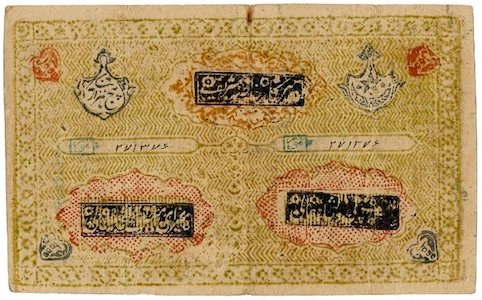
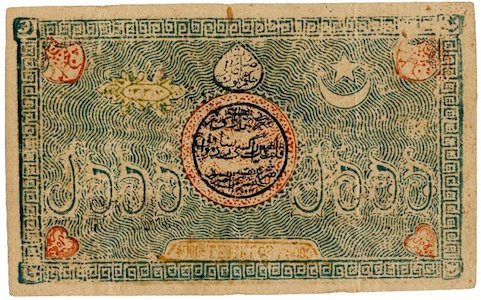
» The images are two sides of a 5000 tenga note from Bukhara in 1920. So the period isn’t quite right, but I like the pictures, so why not. From the British Museum.

Categories
Culture

Qatari Voices

Qatari Voices is an anthology edited by two people — Carol Henderson and Mohanalakshmi Rajakumar — who organise a writing workshop at a Qatar university, supported by a grant from the US State Department. And the book is essentially a result of that project.

So it is not a book put together by someone who, seeing a vibrant natural growth of Qatari writing, was excited enough to organise an anthology. It is a collection of undergraduate essays written by students who are actually studying engineering, or law, or medicine, or whatever. And I guess there’s no reason why an engineering student shouldn’t have a glittering prose style and a penetrating social insight… but, as it turns out, these ones don’t.

To be fair, whatever the purpose of this book is — which isn’t clear to me — it’s not something they were expecting random people halfway round the world to buy and read for pleasure. It’s not really appropriate to judge it by fierce literary standards.

And it isn’t completely without interest; you do get some sense of the whiplash speed of change in Qatar over the past 60 years, from a poor desert country of fishermen and pearl divers, where girls were expected to get married at about 14, to a fabulously oil-rich nation where women can study to be doctors. But although those changes make Qatar and the other Gulf states one of the most fascinating parts of the world at the moment, these essays do not have the kind of insight necessary to go beyond the obvious.

But it serves as a book from Qatar for the Read The World challenge, so it meets my requirements at least.

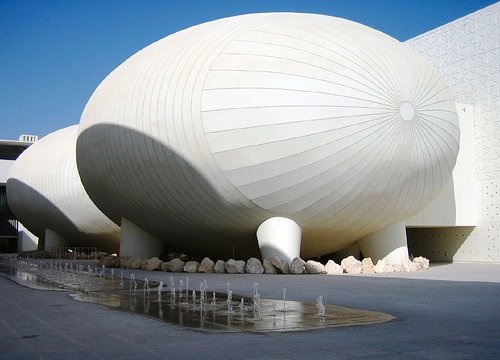
» WCMC-Q is a photo of West Cornell Medical College in Qatar. © vobios and used under a CC-by licence.