Categories
Culture

Cranach at the Royal Academy

Now this is my kind of exhibition. I don’t what it is I find so appealing about the Northern Renaissance; obviously, artists like Dürer, Van Eyck and Breugel are among the all-time greats of European art, but I love it all: van der Weyden, Memling, Bosch, Holbein, and indeed the star of this show, Lucas Cranach the Elder.

I like the Italian stuff as well, but there’s something about these northern painters I can’t get enough of. Maybe, as someone with a soft spot for the medieval, it’s because the continuity with the medieval is in some ways more obvious in the north. Maybe it’s because I am myself northern European; maybe there really is a northern sensibility — a gothic sensibility, if you like — which runs a great deal deeper than one might imagine. Or not.
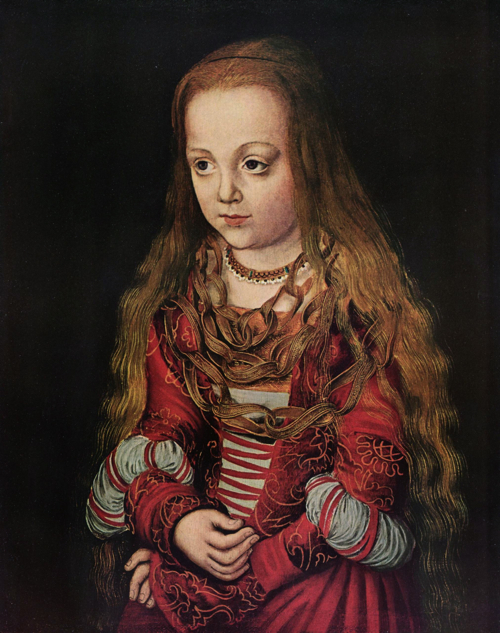
portrait of a Saxon Princess, Lucas Cranach the Elder

Whatever the reason for them, it’s amazing how much difference these preferences can make. The other day I went up to see the Cranach, but the ‘From Russia‘ exhibition was still running at the Royal Academy and the queues were horrendous, so I popped in to the Pompeo Batoni at the National instead. Batoni was an C18th Italian artist who did history paintings and portraits, many of them English aristos doing the Grand Tour. I didn’t bother to blog about it because I just found it so boring. In the Cranach, on the other hand, I liked every single work, even the ones were it didn’t seem like he was really trying.

And there are a few like that; apparently he was famous at the time as a quick man with a brush, the person to go to if you’d just built a new castle and needed a dozen paintings on assorted themes to brighten up the place. He had a big workshop and churned out lots and lots of work, including many repetitions of the same themes. Compare, for example, these portraits of Martin Luther, all in different galleries: 1, 2, 3, 4, 5.

Cranach was a friend of Luther’s, and as well as portraits of Luther he painted biblical scenes illustrating Protestant themes, illustrations for Luther’s German translation of the bible, and other Protestant propaganda material; yet that didn’t stop him taking commissions for prominent Catholics. There was a marvellous portrait of Cardinal Albrecht of Brandenburg who was working on a Catholic version of the bible in German, painted as St Jerome, the man who translated the bible into Latin. He’s sitting in his suitably German-looking study, wearing his red cardinal’s robes, surrounded by animals, including a lion, a parrot, a squirrel and a family of pheasants.

Adam and Eve, Lucas Cranach the Elder

And I don’t suppose Luther would have approved of the sexy pictures of naked, pot-bellied, weaselly-faced blonde girls, who all look the same whether they are supposed to be Lucretia, Eve or Venus. One of these features on the posters for the exhibition, and the National managed to gain a bit of free publicity when it was initially rejected by London Underground as being too racy for them.

As you can tell, I give the show a big thumbs-up. I just don’t understand why it should be so much less popular than ‘From Russia’. It’s just as well it was, though, because these are the kind of paintings you want to get right up to, and take in the details.

» The RA’s exhibition website is pretty rubbish, as usual. Both the paintings above featured in the exhibition but I got the images from Wikimedia Commons. The portrait of a Saxon princess (they know she’s a princess by what she’s wearing, but don’t know which one) is from the National Gallery in Washington. Adam and Eve are in the Courtauld in London.

Categories
Culture

Peter Doig & the Camden Town Group at the Tate

I went to Tate Britain today, mainly to see the Peter Doig, but while I was there I also had a quick look round the Camden Town Group exhibition.

Doig is a contemporary painter, born in Edinburgh in 1959 but brought up in Trinidad and Canada, who went to art school in London and now lives in Trinidad. So he certainly qualifies for an exhibition at Tate Britain — he’s at least as British as Greg Rusedski and a lot more British than Kevin Pietersen — but many of his paintings feature Canadian or West Indian landscapes. Or at least most of them are apparently composite scenes rather than pictures of anywhere in particular, but the influence is there.

Jetty, Peter Doig

He does large, rather beautifully coloured paintings which are largely landscapes, using that term broadly. The earlier ones are built up of lots of layers of different paint textures: washes, speckles, a few big globs, dry brushwork and so on. But each layer is very light; they’re not encrusted with paint, and in fact the texture of the canvas tends to show through. The total effect is subtle and atmospheric; almost kind of misty and ambiguous. The paintings really don’t translate well to small jpegs, so it doesn’t do it justice, but fwiw, the picture above is Jetty.

His more recent paintings tend to be much less elaborately textured, and overall I didn’t like them quite as much, but the best ones are still lovely. It’s always nice to go an art exhibition where most of the works are attractive objects. I’m not suggesting that it’s either necessary or sufficient that art is attractive, but the basic pleasure of looking at beautiful things is worth celebrating.

Country Rock, Peter Doig

The exhibition website is full of stuff — yay for the Tate, who always do a good job of that — and there’s a nice little video interview by the artist. I found it froze a couple of times when I tried to watch it online, but there’s a link to download it at the top-right of the page.

The Camden Town Group were less exciting, for me. They were a group of Edwardian artists, with Walter Sickert the most famous, who lived in Camden (obviously) and were interested in urban subjects: cityscapes, the music hall, working class life. They painted rather drab Impressionisticky pictures which are sort of interesting but without much in the way of snap, crackle or pop. I think if I found one of these pictures in a second-hand shop, I’d think it was by one of the many many fairly talented but conventional painters who still churn out Impressionisticky landscapes all over the place. Obviously the work was a bit more radical at the time, but still… it didn’t do much for me. Here’s one of the few I really did like, a painting by Sickert of pierrots performing on an outdoor stage in Brighton in 1915.

Brighton Pierrots, Walter Sickert

Generally, though, it was most interesting as history and sociology rather than for the art itself. I think the gallery almost admitted as much by the amount of contextual material included: archive film, Suffragette pamphlets, music hall fliers, advertisements for the Underground. Perhaps that’s unfair.

» All pictures are taken from the Tate’s exhibition websites and are © accordingly.

Categories
Culture

Coming of Age: American Art 1850-1950

This is a touring exhibition of paintings from the Addison Gallery of American Art in Andover, Massachusetts that is currently at Dulwich Picture Gallery. Though it will be going to Venice and then Fort Lauderdale later in the year, if that’s more convenient for anyone.

The West Wind - Winslow Homer

I didn’t have hugely high expectations, because the DPG exhibition space is fairly modest in size for a review of a whole century of art, but actually the show works well. It may not be the definitive exhibition of late 19th and early 20th century American art, but it has enough material to suggest an overall narrative, including plenty of enjoyable work. With a very few exceptions it’s one painting per artist, so there’s a kind of lucky dip feeling about the whole thing; especially since it’s hung without too much editorial commentary. It’s like: here’s a load of paintings; see what you think.

Wave, Night - Georgia O'Keeffe

There are plenty of big names represented — Winslow Homer, Sargent, O’Keeffe, Hopper, Whistler, Pollock — but with the one-painting per artist thing, they are very much in the context of other peoples’ work. I don’t know enough to judge how representative that context is, but it worked pretty well for me.

Acrobat in Green - Walt Kuhn

Here and there on the walls between paintings there are quotes from the artists about art and, often, Americanness. I think it’s quite a nice device: it provides some context, some connection to the painters, but again without too much curatorial commentary.

So all in all, not a life-changing exhibition, but well worth popping in and having a look.

» The Addison website has photos of all the work in the exhibition. Those I’ve picked out are The West Wind by Winslow Homer, Wave, Night by Georgia O’Keeffe and Acrobat in Green by Walt Kuhn.

Categories
Culture

‘Breaking the Rules’ at the British Library

I realised that Breaking the Rules: The Printed Face of the European Avant Garde 1900 – 1937 was about to close, so I popped in today for a quick gander. As ever at the BL, the range of material was impressive: they really do own a lot of stuff. Eliot, Bretton, Man Ray, Lorca, Mayakovsky, Ernst, Rodchenko… you name it, they’ve got it.

I started out carefully reading all the labels and conscientiously looking at each item, because I thought it was probably the kind of exhibition where background information and context would make all the difference. And it was interesting, but I still started to speed up fairly soon. There were some items that were nice pieces of design in their own right and had an immediate appeal even for the non-specialist; but rather more that didn’t. Particularly as they were all in languages I don’t read.

Mayakovsky's For The Voice

The material was mainly grouped by city; Paris and Moscow/St Petersburg had the biggest displays, but 30 cities were included, from all over Europe — Milan, Belgrade, Vienna, Barcelona, Brussels, Warsaw, Kiev, and so on — which did give a strong sense of this as a genuinely widespread movement. Or group of movements. Mind you, I didn’t pay that much attention to the dates, but they weren’t all active simultaneously. The exhibition covered a 37 year period, which is plenty of time for artistic fashions to sweep from one side of Europe and back again several times over.

They even made a case for London as an avant garde city, but it wasn’t completely convincing, somehow. For example, there were successful exhibitions of the Surrealists and the Futurists in London: but that’s not the same as producing the stuff ourselves. Perhaps I’m being unfair. Perhaps I just find it easier to take all these Frenchmen and Russians seriously because they’re French and Russian. Still, there was a good gag from Wyndham Lewis: apparently he supported his application for a British Army commission by saying that he had masterminded the Cubist invasion of Britain ‘without losing a single cube’.

» The picture is the cover of Для голоса (‘For the Voice’) by Mayakovsky, designed by El Lissitzky.

Categories
Culture

More modernism and art

One obvious point to make in passing: even if there is some kind of profound connection between someone’s political leanings and the form they choose when they write a poem*, that connection is not stable over time.

It meant something different to be writing sonnets in 1520 than to be writing them in 1820 or 1920. And something different again in 2008.

Or at least, if anyone wanted to suggest otherwise, I’d need to hear some pretty convincing arguments.

* Or paint a picture, or build a house…

Categories
Culture Other

‘From Russia’ at the Royal Academy

This is a seriously impressive exhibition. The full title is ‘From Russia: French and Russian Master Paintings 1870-1925 from Moscow and St Petersburg‘. It starts with a little room of Russian paintings from the start of that period; then you get a whole load of French paintings that were collected by two Russian art collectors, Ivan Morozov and Sergei Shchukin, and are now divided between various Russian state museums; then the rest of the show is of Russian paintings again, which are more or less heavily influenced by the French work.

The French section includes major works by most of the biggest names in French art — Renoir, Monet, Cézanne, Van Gogh, Gauguin, Matisse, Picasso, Rousseau, Bonnard — whereas with a couple of major exceptions in Chagall and Kandinsky the Russian artists are less familiar. It makes for a good combination; the French artists are immediately enjoyable while the Russians, simply because they are less familiar, require a bit more evaluation.

My favourite painting was probably Matisse’s Harmony in Red:

Harmony in Red by Matisse

Apparently, when the collector bought it at a Paris show, it was all blue instead of red, but Matisse asked to hang on to it for a few weeks because he wanted to tweak it. It must have been a bit of a shock to open it up and find it had completely changed colour.

Of the Russians: there were lots I quite liked including, unusually for me, the two Chagalls. Among the people I was with the most popular choice for a painting to take home would be Altman’s portrait of Anna Akhmatova. I think I’d probably take one of the three Malevich paintings called Black Square, Black Circle and Black Cross which are just black shapes on white backgrounds. That kind of geometrical minimalism is a bit mysterious: sometimes it works and sometimes it doesn’t. Those ones worked, for me, though I’d be hard pressed to explain why.

This exhibition has an obvious relevance to the whole modernism and politics discussion, since Russia went through an immensely creative period in art and architecture for the first two decades of the C20th, and for a while after the revolution this radical art was embraced by the party; but then the regime ruthlessly crushed it. Artists may have supported radical politics, but politicians didn’t necessarily support radical art. A dislike of ‘decadent’ art was one of the things Hitler and Stalin had in common.

» The Matisse image is from the Artchive.