Categories
Culture

‘Points of View’ at the British Library

I just visited the slightly uninspiringly titled ‘Points of View’ exhibition at the British Library, which is an exhibition of nineteenth century photography. I’ve been very impressed with the BL’s temporary exhibitions since they moved to the new site; they obviously have an absolutely staggering amount of stuff in their collections and they do a good job of displaying it, with a thoughtful selection of material and lots of interesting information.
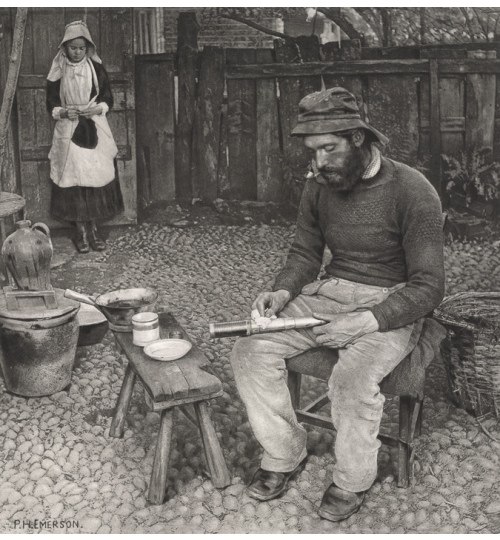
fisherman

Not all subjects are equally interesting, of course — I glazed over a bit going round their exhibition of modernist pamphlets — but C19th photography has a broader appeal. It starts with the early history, Fox Talbot and all that, and then the rest of the exhibition is arranged thematically: travel, portraits, science, industry and so on. I liked the way they manage to provide plenty of variety: some pictures chosen for artistic merit, others for historical, social or technical interest, and some a bit quirky, like spirit photographs taken by spiritualists. Or the staged picture taken by an Indian Army officer of an officer being woken by his manservant after a drunken night before.

mussucks

One thing that is striking is the explosive speed with which photography became popular: from Fox Talbot’s early experiments in the early 1840s, it was a major commercial enterprise within ten years, and being used in every conceivable way all across the world, from Brazil to the Himalayas, within twenty. Perhaps that isn’t surprising — the advantages are obvious — but when photographs were taken with fragile glass plates which had to be chemically prepared immediately before use in a portable darkroom, it is still remarkable.

The exhibition is kind of huge, but it’s also free, so you could always take a break halfway round and go for a cup of tea and a bun.

» ‘A Fisherman at Home‘ is from Peter Henry Emerson’s Pictures From Life In Field And Fen, a photographic record of life in East Anglia published in 1887.

The other picture is a section of ‘Mussucks for crossing the Beas River, Kulu‘, taken in India by Samuel Bourne in 1865. The ‘mussucks’ are inflated bullock hides used to cross the water.
Categories
Daily Links

Links

Categories
Other

A passing thought on the Nutt business

Politicians are always quick enough to invoke ‘scientific advice’ when they want to deflect responsibility for an unpopular policy decision, like the availability of different treatments on the NHS, or the mass slaughter of animals during a foot and mouth outbreak. And as long as they actually are acting on good scientific advice, fair enough.

But if you’re going to hide behind scientists when it’s convenient… well, the flip side of that is that if you later choose to ignore the advice of your carefully chosen independent scientific advisors, you should have the guts to stand up and explain why.

» If you don’t know what I’m talking about: a government minister sacked an (unpaid) senior drugs advisor, a professor of psychopharmacology called David Nutt, for giving a lecture saying that the government’s drug policy ignored the scientific evidence. You can download the lecture as a PDF here; it is worth reading.

Categories
Daily Links

Links

Categories
Culture

‘The Sacred Made Real’ at the National Gallery

To quote their own blurb:

The Sacred Made Real’ presents a landmark reappraisal of religious art from the Spanish Golden Age with works created to shock the senses and stir the soul.

Paintings, including masterpieces by Diego Velázquez and Francisco de Zurbarán, are displayed for the very first time alongside Spain’s remarkable polychrome wooden sculptures.

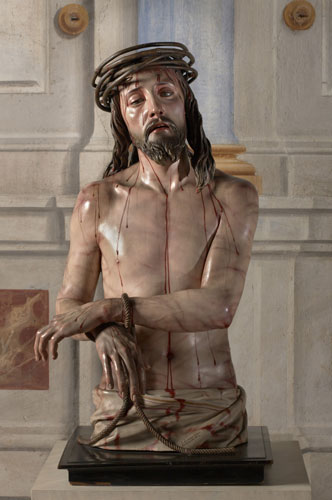
By ‘polychrome wooden sculptures’ they mean things like this, Christ as the Man of Sorrows, 1673, by Pedro de Mena (I’ve had to take the picture from the Guardian, which has a good selection, because the NG has got no images on the exhibition website at all):

Sacred-Made-Real-Christ-a-016

I find this business of coloured sculpture intriguing, because of course if you’re aiming for verisimilitude it makes perfect sense; and yet, largely by historical accident, we have come to expect sculpture in the fine art tradition to be in the bare material, whether marble, bronze or whatever.

These works looks especially foreign from a Protestant perspective. And yes, I know I keep going on about being an atheist, but I’m clearly a Church of England atheist when it comes to my religious sensibilities. And the Protestant aesthetic of whitewashed churches and plain glass is explicitly intended to contrast with this kind of art; it is sculptures like these that are processed through the streets of Seville in Holy Week by masked penitents, which must be the apotheosis of the bells and smells side of Catholicism. Protestants over the years have found that either tawdry and vulgar or solemn, dignified and mysterious, according to taste, but one way or the other it has a fascinatingly exotic quality for those of us brought up with the tea and biscuits kind of Christianity.

My initial reaction to these sculptures was ambivalent; there was something spooky or creepy or just a bit odd about them. And I don’t mean the gore; the head of John the Baptist where the cross section of the neck looks like something from the butcher’s, or Christ bruised and dripping with blood. No, even the statues of saints and the Virgin seemed a bit creepy at first encounter. St Ignatius Loyola, with his dark robes, looks like something that might lurch out of the dark at a carnival ghost train.

I’m tempted to invoke the uncanny valley, but actually I think it’s mainly simple unfamiliarity. The sculptures only seem like something from Madame Tussauds — something other than fine art — because of my expectations. Eventually, once I had been in the exhibition for a while, that sense of novelty wore off a bit; and eventually I was able to stop overthinking it and start to respond to the works as pieces of art.

And once that happened I did start to appreciate them and find them quite effective. They are not my new favourite thing, and I’m still not sure I’d say I really like them, even. But I’m certainly glad I went. Thought-provoking stuff.

There are also some fine paintings in the show as well, incidentally, by Velázquez and Zurburán particularly; but those were more familiar and less interesting to me, except in the way they provide a context for the sculptures. It is interesting, for example, that although they are recognisably part of the same religious culture, the paintings are immediately and obviously ‘art’, while my reaction to the sculptures was so much more difficult.

Categories
Daily Links

Links