Categories
Other

Riots, again

There was a story on the front of the Times today (I’d link to it, but it’s behind a paywall), about a young woman, recently graduated from university, who was passing a looted store on the way to get some McDonald’s, and on impulse went and stole a TV. And then three days later, unable to live with the guilt, she went and turned herself into the police. So she had a degree, she was planning to be a social worker, she didn’t even need a TV… and yet in that moment she couldn’t resist a bit of looting.

I find it a very intriguing story, and the lesson I am tentatively inclined to draw from it is this: the stuff that happened over the weekend in London, the mob craziness; these are not normal events. And if you assume you can understand people’s behaviour according to your normal, everyday expectations — if you apply ‘common sense’ — you are likely to mislead yourself.

But perhaps that’s not surprising. If there’s one thing that experimental psychology has demonstrated over the years, it’s that our intuitions about human behaviour are surprisingly rubbish at the best of times. Our intuitions about behaviour in the middle of a mob are sure to be even worse.

Not that you even need that much of a mob, really; there’s always what you might call the Bullingdon effect. David Cameron would no doubt say it was cheap political point-scoring to draw a parallel between smashing up a restaurant in the course of a riotous evening out with the Bullingdon, and smashing the window of JD Sports in the middle of an outbreak of looting; but it’s not exactly radical to point out that young people under the influence of alcohol, adrenaline and peer pressure will do things — stupid, reckless, anti-social, criminal things — which in the calm, sober light of day, they would like to think were completely out of character.

I don’t know what point I’m trying to make, really. I guess I’m still irritated by David Cameron’s line ‘this is criminality, pure and simple’. When has human behaviour ever been pure or simple?

Categories
Other

London riots

I suppose I ought to make some kind of comment about the fact that London seems to have suddenly gone nuts. But I don’t know what the fuck to say. I certainly didn’t see this coming, so I can hardly claim any insight into the causes.

I mean, it’s possible to step back and paint a broad picture which makes rioting seem inevitable: the third year of a shitty economy, a financial system bailout paid for by cutting benefits and services, a country with terrible social mobility where the gap between rich and poor has been increasing for decades, the most unequal city in the western world, where we help Russian oligarchs to avoid tax while cutting spending on homeless shelters and youth clubs, the rightward shift of the Labour party leaving the poor with even less of a mainstream voice in British politics, an Old Etonian prime minister from a family of bankers… these seem like the kinds of things that create the conditions for social unrest.

But all that was true last week, and I certainly didn’t expect to see London in flames. And maybe it isn’t all that stuff anyway. Smashing in the windows of Curry’s and nicking a TV isn’t exactly an overtly political gesture. It’s just too easy to spin a narrative and think it’s an explanation.

Maybe it’s better understood as a failure of policing, whether community policing before the event or the response once it started. Maybe new-fangled communications really are important, at least in terms of how it spread and gained momentum. Maybe the country really is in a moral decline. Maybe it’s just some random confluence of events, the flap of a butterfly wing in China. The hardest thing to do in situations like this is to try and remain open-minded, to hold on to the fact that actually you just don’t know.

» Ealing riots – the aftermath is © Erik Hartberg and used under a CC by-nc-nd licence.

Categories
Tumblr

Tumblr round-up, August 8th

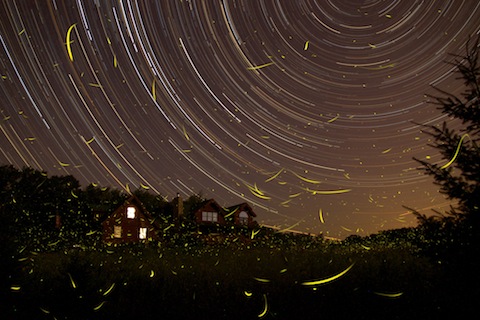
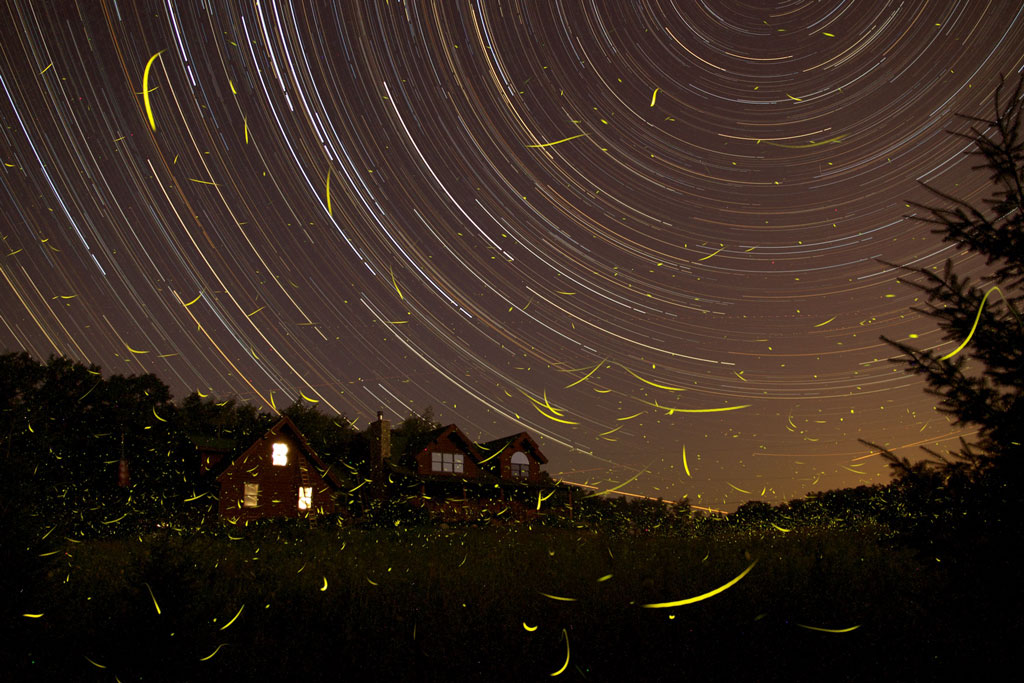
It’s that time of the week again. Let’s start with what might be my favourite image of the year, a long-exposure shot of star trails with fireflies. Go to NASA’s Astronomy Picture of the Day to see it larger or super-big.

Two ancient Persian drinking horns: shaped like a wild cat — shaped like a wild goat [maybe a Nubian Ibex?]. A Greek wine-cooler decorated with soldiers riding dolphins. A medieval Russian church gate. A C14th painting of a Tibetan abbot.

Acrobatic weaver birdstunicatesshark with lionfish — a flashy bustard.

Articles: Sperm whales have culture. Fish form shoals the size of Manhattan.

Beautiful corsets: C18th SpanishC19th American. A Jean-Paul Gaultier jacket. American typography: Lectures on Ventilationlibrary pastered stamping ink. Curious buildings: LaosMaliPortugal.

All at Sea, Claire Partington 2011. Egon Schiele’s bedroom, 1911. Aurora Borealis, Frederic Edwin Church 1865. Île-Saint-Denis, Willy Ronis 1956. Allegory of the Planets and Continents, Giovanni Battista Tiepolo 1752.

Categories
Other

C19th email scams & adulterated booze

Some less political stuff from P.T. Barnum’s The Humbugs of the World. This is one of several mail scams:

The six letters all tell the same story. They are each the second letter; the first one having been sent to the same person, and having contained a lottery-ticket, as a gift of love or free charity. This second letter is the one which is expected to “fetch.” It says in substance: “Your ticket has drawn a prize of $200,”—the letters all name the same amount—“but you didn’t pay for it; and therefore are not entitled to it. Now send me $10 and I will cheat the lottery-man by altering the post-mark of your letter so that the money shall seem to have been sent before the lottery was drawn. This forgery will enable me to get the $200, which I will send you.”

And Barnum on booze:

It is a London proverb, that if you want genuine port-wine, you have got to go to Oporto and make your own wine, and then ride on the barrel all the way home. It is perhaps possible to get pure wine in France by buying it at the vineyard; but if any dealer has had it, give up the idea!

As for what is done this side of the water, now for it. I do not rely upon the old work of Mr. “Death-in-the-pot Accum,” printed some thirty years ago, in England. My statements come mostly from a New York book put forth within a few years by a New York man, whose name is now in the Directory, and whose business is said to consist to a great extent in furnishing one kind or another of the queer stuff he talks about, to brewers, or distillers, or wine and brandy merchants.

This gentleman, in a sweet alphabetical miscellany of drugs, herbs, minerals, and groceries commonly used in manufacturing our best Old Bourbon whisky, Swan gin, Madeira wine, pale ale, London brown stout, Heidsieck, Clicquot, Lafitte, and other nice drinks; names the chief of such ingredients as follows:

Aloes, alum, calamus (flag-root) capsicum, cocculus indicus, copperas, coriander-seed, gentian-root, ginger, grains-of-paradise, honey, liquorice, logwood, molasses, onions, opium, orange-peel, quassia, salt, stramonium-seed (deadly nightshade), sugar of lead, sulphite of soda, sulphuric acid, tobacco, turpentine, vitriol, yarrow. I have left strychnine out of the list, as some persons have doubts about this poison ever being used in adulterating liquors. A wholesale liquor-dealer in New York city, however, assures me that more than one-half the so-called whisky is poisoned with it.

Besides these twenty-seven kinds of rum, here come twenty-three more articles, used to put the right color to it when it is made; by making a soup of one or another, and stirring it in at the right time. I alphabet these, too: alkanet-root, annatto, barwood, blackberry, blue-vitriol, brazil-wood, burnt sugar, cochineal, elderberry, garancine (an extract of madder), indigo, Nicaragua-wood, orchil, pokeberry, potash, quercitron, red beet, red cabbage, red carrots, saffron, sanders-wood, turmeric, whortleberry.

In all, in both lists, just fifty. There are more, however. But that’s enough. Now then, my friend, what did you drink this morning? You called it Bourbon, or Cognac, or Old Otard, very likely, but what was it? The “glorious uncertainty” of drinking liquor under these circumstances is enough to make a man’s head swim without his getting drunk at all.

Actually the list is quite interesting, because although some of those are definitely scary things to have in your food, like sulphuric acid, lead, turpentine and tobacco, others are still used as food additives, like annatto, burnt sugar, and cochineal. Although there shouldn’t actually be any need to add extra colour to things like bourbon and stout. And some of the additives are normal ingredients in gin, like orange peel, coriander, liquorice, and grains of paradise.

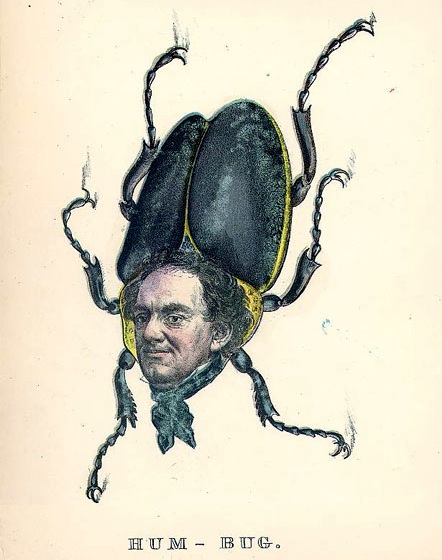
» The beetle is a caricature of P.T. Barnum.

Categories
Other

‘The Miscegenation Hoax’

I was browsing around Project Gutenberg and stumbled on a book with this magnificent title: The Humbugs of the  World. An Account of Humbugs, Delusions, Impositions, Quackeries, Deceits and Deceivers Generally, in all Ages. And it’s by none other than P. T. Barnum.

So I thought, that could be interesting. And one of the things that caught my eye from the contents was ‘The Miscegenation Hoax‘. Barnum explains:

the history of Ancient and Modern Humbugs would not be complete without a record of the last and one of the most successful of known literary hoaxes. This is the pamphlet entitled “Miscegenation,” which advocates the blending of the white and black races upon this continent, as a result not only inevitable from the freeing of the negro, but desirable as a means of creating a more perfect race of men than any now existing. This pamphlet is a clever political quiz; and was written by three young gentlemen of the “World” newspaper, namely. D. G. Croly, George Wakeman, and E. C. Howell.

The design of “Miscegenation” was exceedingly ambitious, and the machinery employed was probably among the most ingenious and audacious ever put into operation to procure the indorsement of absurd theories, and give the subject the widest notoriety. The object was to so make use of the prevailing ideas of the extremists of the Anti-Slavery party, as to induce them accept doctrines which would be obnoxious to the great mass of the community, and which would, of course, be used in the political canvass which was to ensue. It was equally important that the “Democrats” should be made to believe that the pamphlet in question emanated from a “Republican” source.

This is in 1864, during the Civil War, so of course the Republicans are the abolitionist party. It carries on a bit later:

The first stumbling-block was the name “amalgamation,” by which this fraternizing of the races had been always known. It was evident that a book advocating amalgamation would fall still-born, and hence some new and novel word had to be discovered, with the same meaning, but not so objectionable. Such a word was coined by the combination of the Latin miscere, to mix, and genus, race: from these, miscegenation—a mingling of the races. […] Next, it was necessary to give the book an erudite appearance, and arguments from ethnology must form no unimportant part of this matter. Neither of the authors being versed in this science, they were compelled to depend entirely on encyclopedias and books of reference. This obstacle to a New York editor or reporter was not so great as it might seem. The public are often favored in our journals with dissertations upon various abstruse matters by men who are entirely ignorant of what they are writing about. It was said of Cuvier that he could restore the skeleton of an extinct animal if he were only given one of its teeth, and so a competent editor or reporter of a city journal can get up an article of any length on any given subject, if he is only furnished one word or name to start with.

I won’t quote the whole thing, intriguing though it is, but I can’t resist this bit:

Although, of course, the mass of the Republican leaders entirely ignored the book, yet a considerable number of Anti-Slavery men, with more transcendental ideas, were decidedly “sold.” The machinery employed was exceedingly ingenious. Before the book was published, proof-copies were furnished to every prominent abolitionist in the country, and also to prominent spiritual mediums, to ladies known to wear Bloomers, and to all that portion of our population who are supposed to be a little “soft” on the subject of reform.

Apparently spiritual mediums and ladies known to wear bloomers were the 1860s equivalents of latte-drinking tree-hugging Volvo drivers.

Anyway, archive.org has the original pamphlet online: Miscegenation: The Theory of the Blending of the Races, Applied to the American White Man and Negro. It’s hard to recapture the sense of shock apparently provoked at the time, although I suppose even now it would be fairly radical to suggest that we should be actively working to eliminate black and white as distinct entities. In fact far from being shocking, a lot of it is frankly boring, especially all the C19th racial pseudoscience; but it has its moments, like this bit of mischief:

THE SECRET OF SOUTHERN SUCCESS

The North is wondering — the world is wondering — at the marvelous success of the Southern people in statesmanship and war. The discretion, endurance, energy, and heroism they have shown in sustaining for so long a time a rebellion supposed to be feeble and short-lived, have elicited the admiration even of their enemies […] The truth may as well be understood, that the superiority of the slaveholding classes of the South arises from their intimate communication, from birth to death, with the colored race. Like Anteus, sent to his mother earth, they have risen reinvigorated. […]

On this point we might quote many pro and anti-slavery authorities, but the extracts would scarcely be fit for general reading. It is a notorious fact, however, that, for three generations back, the wealthy, educated, governing class of the South have mingled their blood with the enslaved race. These illicit unions, though sanctioned neither by law nor conscience, and which, therefore, are degrading morally, have helped to strengthen the vitality and add to the mental force of the Southerner. The emotional power, fervid oratory and intensity which distinguishes all thoroughbred slaveholders, is due to their intimate association with the most charming and intelligent of their slave girls. The local history of New Orleans, since its occupation by the Union army, proves what has often been suspected, that unions between the slaveholders and their slaves have often had, in the eyes of the parties themselves, all the sanctities of marriage. These facts give us an inkling of some of the sources of Southern power.

If you can ignore, just for a moment, the high stakes of the political issue at hand, and the many decades of overwhelming human misery caused by the slavery and segregation which the pamphlet was surreptitiously supporting… well, you almost have to admire bits of it as an example of proper, old fashioned trolling. These guys would feel right at home on the internet.

AN OMEN.

The statue of Liberty which has just crowned the capitol at Washington, stands as a symbol of the future American of this continent. It was meet and proper that while slavery exercised its baneful sway at the seat of Government, that the great dome of the capitol should have been unfinished, and that the figure of Liberty should not have unveiled its awful form upon the topmost summit. The maker of that statue has “builded better than he knew.” In order to insure it against the storms and variable temperature of a Virginia atmosphere, it has been washed with an acid which has caused a slight oxidation, producing a rich and uniform bronze tint, which no rains can discolor and no sun bleach. When the traveler approaches the city of magnificent distances, the seat of what is destined to be the greatest and most beneficent power on earth, the first object that will strike his eye will be the figure of Liberty surmounting the capitol ; not white, symbolising but one race, nor black typifying another, but a statue representing the composite race, whose sway will extend from the Atlantic to the Pacific ocean, from the Equator to the North Pole—the Miscegens of the Future.

Anyway, I just thought it was a fascinating little historical detour, not least the origin of the word ‘miscegenation’ as a faux-politically correct euphemism for ‘amalgamation’. It’s striking that ‘miscegenation’ is still a very loaded term, while ‘amalgamation’ has, as far as I know, lost any association with racial mixing at all. And also: isn’t it amazing how much stuff you can find on the internet these days.

Categories
Culture

Voices from Chernobyl by Svetlana Alexievich

Voices from Chernobyl was written in 1996, ten years after the reactor meltdown. It is an oral history of the disaster; that is, it’s presented as a series of ‘monologues’ by people who were involved in some way, with titles like ‘Monologue about War Movies’, ‘Monologue about the Shovel and the Atom’, ‘Monologue about Expensive Salami’. I’m actually a bit curious about exactly how they were collected; they are presented as verbatim transcripts, although I’m sure they’ve been tidied up somewhat. What you don’t get is any idea of what questions or prompting came from the interviewer. It’s quite an effective device, keeping the journalist out of the spotlight and letting the voices speak for themselves, but I assume there’s an element of artifice to it. I don’t think it detracted from the book, I’m just curious about the process.

The result is, anyway, an extraordinary book. The stories come from all kinds of perspectives: local farmers, soldiers, scientists, officials, construction workers, wives, children. And the material is fascinating: people’s accounts of being evacuated, of working on the reactor site, of nursing dying relatives. There are people who refused to leave, and people who came back because it was home, and people who, having fled conflicts elsewhere, moved to the area because there were houses lying empty. And overlying it all is the extraordinarily inept and chaotic government response, which included, for example, failing to distribute iodine or breathing masks because they thought doing so might cause panic.

And as well as the material being so interesting, it has a very literary quality; bleak and fatalistic, but laced with dark humour and absurdity, sometimes earthy, sometimes poetic. That poetry comes both from the real poignancy of the human situations and the surreal quality of many things that happened: the soldiers sent into the Zone to kill all the cats and dogs; the people whose job it was to dig up soil and bury it in pits; the fact that they were told that drinking vodka would help fight radiation poisoning, so everyone seems to have been rolling around in an alcoholic haze.

It really is a fabulous book. Here’s a little excerpt, from a man who has moved to live in the evacuated zone:

It’s easy to find books here. Now, an empty clay pitcher, or a spoon or fork, that you won’t find, but books are all over. The other day I found a volume of Pushkin. “And the thought of death is sweet to my soul.” I remember that. Yes: “The thought of death.” I am here alone. I think about death. I’ve come to like thinking. And silence helps you to prepare yourself. Man lives with death, but he doesn’t understand what it is. But I’m here alone. Yesterday I chased a wolf and a she-wolf out of the school, they were living there.

Question: Is the world as it’s depicted in words the real world? Words stand between the person and his soul.

And I’ll say this: birds, and trees, and ants, they’re closer to me now  than they were. I think about them, too. Man is frightening. And strange. But I don’t want to kill anyone here. I fish here, I have a rod. Yes. But I don’t shoot animals. And I don’t set traps. You don’t feel like killing anyone here.

And here’s a bit by someone else, who moved back:

Sometimes I turn on the radio. They scare us and scare us with the radiation. But our lives have gotten better since the radiation came. I swear! Look around: they brought oranges, three kinds of salami, whatever you want. And to the village! My grandchildren have been all over the world. The littlest just came back from France, that’s where Napoleon attacked from once—”Grandma, I saw a pineapple!” My nephew, her brother, they took him to Berlin for the doctors. That’s where Hitler started from on his tanks. It’s a new world. Everything’s different. Is that the radiation’s fault, or what?

Voices from Chernobyl is my book from Belarus for the Read The World challenge. If you’re thinking ‘hang on, Belarus, that doesn’t sound right’, well, you’re right, the plant itself is in Ukraine, but it’s just by the border with Belarus and so Belarus was one of the worst affected places.

A quick namecheck for the translator, Keith Gessen, who I’m sure deserves a lot of credit for how well the book reads in English; and just to reiterate, I think this is a really good book and I strongly recommend it.

» There’s a whole load of photos around the web taken by tourists to the contaminated zone. Lots of pictures of the deserted town of Pripyat, particularly of peeling, empty schoolrooms. But after reading the book, they just seem too unpleasantly voyeuristic, so instead I grabbed a map of the contaminated area from Wikipedia.