Categories
Culture

Reading on my phone

Life of Pi by Yann Martel was a free download from Apple as part of a Christmas promotion, and as such it’s the first full-length novel I have read on my iPhone. I’m almost as interested in the reading experience as the book itself.

The major conclusion is that the experience is at least good enough. The high-resolution display of the iPhone 4 makes a difference, I think, not least because you can set the type size as small as your eyesight can stand without compromising the readability.

Perhaps it’s not as immersive as a book; I find I need quiet to read these days more than I used to, but it’s especially true with the iPhone, I think, that I need good reading conditions to concentrate. I noticed a slightly increased tendency to find myself skipping a bit, a slight tendency to anticipate the end of the ‘page’ and go ahead without fully processing the last few words. It may be that I do that anyway, but that it’s more obvious when the pages are shorter. I think a bigger screen would be better as a reading experience, but it’s a great advantage not having to carry an extra device; the phone is ideal for snatching a few minutes of reading during the day.

As for the novel itself: I enjoyed it, but I can see why some people find it quite annoying. It is very high-concept and I don’t know that its cleverness manages to avoid being glib.

Categories
Culture

Black Swan

I have been looking forward to seeing Black Swan for months; I don’t think I’ve ever been so certain I wanted to see something based solely on the trailer. If I’m sure I want to see a film, I try not to read any reviews beforehand, and it was getting difficult to avoid encountering people’s reactions, so I went to see it yesterday.

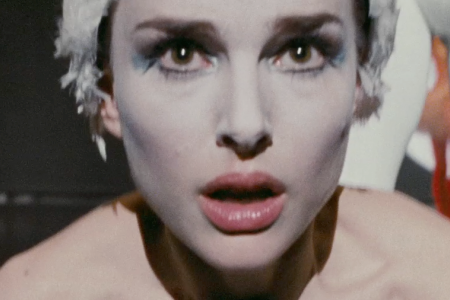
I think it might be the campest movie ever made. It’s not just the themes — it’s a film about ballet, and mummy issues, and suffering for your art, and the grubby reality behind the glamorous surface, and jealousy and fear of ageing — it’s the fact that it is a trashy melodrama acted and filmed as though it was the Most Serious Thing In The World. It is played absolutely straight, as high drama; I don’t think there’s a single joke in the whole film. Natalie Portman acts the central role with a high-strung intensity that actors normally reserve for films about genocide. It’s a great performance.

I assume that everyone involved knew exactly what they were doing, but because there is never a knowing wink to the audience, the bizarre possibility is just about left open that they really meant it. That they really thought they were making a serious, penetrating psychological drama.

Either way, it is completely bonkers. In the end, as it reached a feverish climax, it didn’t quite take me with it, it didn’t quite pull it off, but I still enjoyed it. It was the perfect antidote to The King’s Speech.

Categories
Culture

The Running Man by Gilbert Tuhabonye

I bought The Running Man* as my book from Burundi for the Read The World challenge. I can’t say I was particularly looking forward to reading it, though, because the blurb on the cover — How the voice in my heart helped me survive genocide and realise my Olympic dream — just sounds a bit TV movie of the week. Clearly there’s an interesting story there, but it doesn’t inspire confidence that it will be a well-told story.

I’ve read enough boring sporting autobiographies that I approach the genre with scepticism. Admittedly, it should be pretty hard to make genocide boring, but then you might think the same about playing in the World Cup, and plenty of footballers have managed that.

But I was pleasantly surprised. It is interesting and engagingly written (with the help of ghost writer Gary Brozek); and not just the more dramatic stuff, but about growing up in rural Burundi. It’s not a literary masterpiece, and I don’t think it offers any startling insights into either genocide or elite middle-distance running, but it’s a good story simply and well told.

The blurb is slightly misleading, in that Tuhabonye never actually competed in the Olympics, although he came attended an Olympic development training camp in Atlanta prior to the 1996 games and came very close to qualifying. On the other hand, if the Olympic part is slightly overplayed, the genocide bit is even more remarkable than you might imagine; he was the only survivor of a particularly brutal massacre and the details of his experience are just staggering.

* US title: This Voice in My Heart: A Runner’s Memoir of Genocide, Faith, and Forgiveness. I assume it’s the same book otherwise despite the different emphasis, although I suppose they may have toned down the religious content for the UK edition.

» The photo of Gilbert Tuhabonye meeting Chuck Norris is from his own website. Because, well, why not.

Categories
Culture

The King’s Speech

I can’t say I was excited by the prospect of seeing The King’s Speech, because I think the British film and TV industry is usually at its least interesting when making middlebrow costume dramas about posh people in country houses.

The genre seems to have a completely unearned prestige which serves as a substitute for things like originality and ideas. And all Britain’s favourite thesps get to stick on some facial hair and a frock coat — or a stiff gown, as appropriate — and do a slightly hammy turn, and everyone oohs and aahs at the costumes and the locations, and it’s all very cosy and boring.

But everyone has been raving about this film, and when someone suggested a trip to see it I thought I might as well. And generally speaking I think it was a good movie. Even a very good one. The prince who has to have speech therapy is a good hook to hang a film on, the script is  often clever and funny and only occasionally resorts to heavy handed historical exposition, and Colin Firth’s performance is excellent, as are most of the supporting cast — although I wasn’t as impressed as some people by Geoffrey Rush as the speech therapist Lionel Logue. And I thought it looked great; I particularly enjoyed the rooms full of old fashioned radio equipment with giant microphones and big dials.

On the other hand it felt like a very basic, meat and potatoes piece of story-telling. It does have a good story to tell, and that is half the battle, but it takes you through it in a very predictable, unadventurous way. And it did feel too emotionally manipulative sometimes. Film is an emotionally manipulative medium anyway; in some ways that is one of its strengths. And this is a thoroughly mainstream film, and I don’t demand that it should be abrasively intellectual and spare and minimalist… but sometimes when the swelling background music was a bit too obvious at telling me what to feel, or when some scene had been too obviously crafted to ram home some message or other, I started to get a bit irritated.

Perhaps the problem is that Colin Firth’s character is just too sympathetic. The whole film is structured around poor prince Bertie and his terrible burdens, and there’s never a hint that he has a nasty or selfish bone in his body. He may have been a good man with a profound sense of duty, but presumably he wasn’t actually a saint.

Anyway, I did basically enjoy it and do basically recommend it. With a few reservations.

Categories
Culture

This is Paradise! by Hyok Kang

Or to give it its full, bookshop-friendly title: This is Paradise! My North Korean Childhood, written by Hyok Kang with the French journalist Philippe Grangereau, and translated by Shaun Whiteside.

When I was looking for books from North Korea for the Read The World challenge, I was quite surprised I could only find two actually by North Koreans. The DPRK is such a bizarre Cold War relic that you might think there would be more interest in it. I guess reading about North Korea just doesn’t seem as important as reading about the Soviet Bloc did back in the old days.

Reading the reviews, it sounds like the other book, The Aquariums of Pyongyang: Ten Years in the North Korean Gulag, is probably the better of the two, but it seems to be focussed on life inside the labour camps. I decided to read This is Paradise! because it is about a more normal childhood in rural North Korea. Normal in North Korea being batshit insane by the standards of anywhere else.

Still, it wasn’t quite what I expected; I thought it would mainly be about the political aspects of living in a communist personality cult: the parades, the synchronised gymnastics, the patriotic hymns, the giant floodlit statue of the Dear Leader, the propaganda. All of which does feature, particularly at the start of the book, but because of the period it covers (Kang was born in 1986), it is overwhelmingly about the famine. Even a mad personality cult struggles to maintain its energy in the face of millions of deaths. Not that there is much sign of the state losing its iron grip on the population, but everyday life becomes completely dominated by the famine, which is apocalyptic in scale. It is like reading Solzhenitsyn’s descriptions of scrabbling for nourishment in the gulag, except it’s not a gulag, it’s a whole town, a whole community — except of course for the party officials.

The official slogans changed as the famine ravaged the country. At the very beginning, in 1995, the cadres encouraged us o accept what was called a ‘forced march towards victory’. The term referred to the ‘forced march’ undertaken by Kim Il-Sung and his partisans during the war against the Japanese occupying forces. The following year, the battle-cry was ‘Let us speed up the forced march towards the final victory.’ When the hunger had reaches its worst, another new slogan appeared: ‘Let us not live today for today, but let us live today for tomorrow’. By now, the poorest people had been reduced to eating boiled pepper leaves or bean leaves. Some families came to us to beg us for left-over tofu that my mother cooked, or even the whitish liquid produced when it was being made. They drank it mixed with saccharine. After a certain period of time their faces swelled up. When I saw people with puffy faces tottering towards the house, I knew that was what they were coming for. Shortly after that we too had to start eating pine bark.

The end of the books is about the family’s escape, firstly into China and then through Vietnam and Laos to Cambodia, from which they went to South Korea.

It is a remarkable story. It’s not especially well written, though. It would be unfair to call the prose ‘bad’, but it is a very plain, methodical recital of events. It has very little in the way of descriptive detail and very little emotional content or insight. Definitely worth reading for the content, though, if not for the prose.

Categories
Culture

Books [and films] of the year 2010

I’ll keep this brief, because if you want to know what I thought of them you can read what I said at the time, but glancing back over the books I read in the past year, I would pick out these five as ones which, for whatever reason, stand out in my memory:

Cities of Salt by Abdelrahman Munif
Gomorrah by Roberto Saviano
The Fortunes of Wangrin by Amadou Hampaté Bâ
The Big Death: Solomon Islanders Remember World War II
The Bleeding of the Stone by Ibrahim Al-Koni

The first two in particular are books I would strongly recommend if you’re looking for something to read.

And while I’m here, some film recommendations, some of which may be a little difficult to get hold of, but hey-ho:

Draquila — Italy Trembles
[which serves as quite a good companion piece to Gomorrah, incidentally]
The First Movie
Skeletons
A Prophet

EDIT: oops, almost forgot:
Four Lions