Categories
Culture

Across Arctic America by Knud Rasmussen

Across Arctic America: Narrative of the Fifth Thule Expedition is Rasmussen’s account of his 1921 expedition from Greenland to Siberia by dog sled. Or to be exact, his 1921-24 expedition, because this was an epic three year trip. They went a long way — 20,000 miles — but they certainly could have done it faster if it was one of those expeditions done for their own sake. Rather, this was a scholarly expedition; for the first year there were a large group of specialists in different disciplines based in Eastern Canada. Then Rasmussen set off with just two companions, Greenland Eskimos* called Miteq and Anarulunguaq, to continue his anthrolopogical investigations across the whole continent.

puppies

I went to quite a lot of trouble to get this book, but when I received it my heart sank a bit, because it’s fucking huge, the kind of book you could club seals with. I imagined I would be trawling through dry, old-fashioned prose for weeks. Actually it’s an anti-Tardis book, smaller on the inside; it’s a reprint edition, and they’ve obviously enlarged the original print considerably and then surrounded it with lots of white space. It makes for quite a short 400 pages. And the narrative romps along at a very respectable pace; the scientific report of the Fifth Thule Expedition filled ten volumes (not all written by Rasmussen), and his popular account of the trip in Danish was two volumes, which he edited down considerably in translating it into a one-volume English version. So it’s not carrying any excess weight.

Rasmussen’s interest was in comparing the Eskimo cultures from his native Greenland and the various Eskimo groups of North America. I didn’t realise that there was such a cultural continuity across the whole region; Rasmussen’s first language was Greenlandic and he was able to talk with Eskimos all the way across Canada, until finally in one part of Alaska he found some with a dialect sufficiently different from his own that he required an interpreter.

Every wizard has a belt, which often plays a great part in his invocations of the spirits. I was fortunate enough to acquire one of these belts from a woman who was herself a witch doctor, named Kinalik. It consisted of an ordinary strap of hide on which were hung or strung the following items: a splinter from the stock of a gun worn in recognition of the fact that her initiation had taken place by means of visions of death; a piece of sinew thread, which had formerly been used to fasten tent poles with, and had on some occasion or other been used for a magic demonstration; a piece of ribbon from a packet of tobacco; a piece of an old cap formerly beginning to her brother — the brother was now dead, and was one of her helping spirits — a piece of white caribou skin, some plaited withies, a model of a canoe, a caribou’s tooth, a mitten and a scrap of sealskin. All these things possessed magnetic power, by virtue of their being given to her by persons who wished her well. Any gift conveys strength. It need not be great or costly in itself; the intrinsic value of the object is nothing, it is the thought which goes with it that gives strength.

Kinalik was still quite a young woman, very intelligent, kind-hearted, clean and good-looking, and spoke frankly, without reserve. Igjugarjuk was her brother-in-law, and had himself been her instructor in magic. Her own initiation had been severe; she was hung up to some tent poles planted in the snow and left there for five days. It was midwinter, with intense cold and frequent blizzards, but she did not feel the cold, for the spirit protected her. When the five days were at an end, she was taken down and carried into the house, and Igjugarjuk was invited to shoot her, in order that she might attain to intimacy with the supernatural by visions of death. The gun was to be loaded with real powder, but a stone was to be used instead of the leaden bullet, in order that she might still retain connection with earth. Igjugarjuk, in the presence of the assembled villagers, fired the shot, and Kinalik fell to the ground unconscious. On the following morning, just as Igjugarjuk was abou to bring her to life again, she awakened from the swoon unaided. Igjugarjuk asserted that he had shot her through the heart, and that the stone had afterwards been removed and was in the possession of her old mother.

The emphasis of the book is very much on the anthropology; there’s relatively little of the Boys’ Own adventure stuff about what it’s like to travel by dog sled across the Arctic — it’s there, but it’s not the point. He spends far more time talking about his interactions with the locals, relaying songs, folk stories and religious beliefs, talking about hunting techniques, building methods and clothing. All of which I found fascinating. He is keenly observant and clearly has a sympathy with the Eskimo. On the other hand, it’s amazing how much more careful we have become about the language we use in the past hundred years; Rasmussen is about as well-informed, sympathetic and enthusiastic an observer as any people could want, and yet by modern standards there are times when his phrasing comes across as mildly patronising and paternalistic.  I don’t say that as a criticism of him, and I don’t imagine that a modern observer would necessarily be any less patronising in their real attitudes; I just think a modern writer would be very self-conscious about that risk and would bend over backwards to avoid any hint of it.

blizzard

If all this anthropological stuff sounds a bit dry, well, I guess if it’s really not the kind of thing that interests you it might be. But Rasmussen writes well and has a sense of humour, as with this exchange, after he has been told a fable about the Fox and the Wolf:

This seemed an odd sort of ending, and I said as much. “What is it supposed to mean exactly?” I asked.

“H’m, well,” answered Netsit, “we don’t really trouble ourselves so much about the meaning of  story, as long as it is amusing. It is only the white men who must always have reasons and meanings in everything. And that is why our elders always say we should treat white men as children who always want their own way. If they don’t get it, they make no end of a fuss.”

I left it at that.

Across Arctic America is my book from Greenland for the Read The World challenge. I found it absolutely fascinating; it offers a glimpse of a people living in quite extraordinarily harsh conditions at a time when many of them were largely untouched by the modern world.

*Yes, I know, ‘Eskimo’ is no longer the preferred term, but it is the term used by Rasmussen. I considered using Inuit instead, but I for all I know there is some further nuance and I would still end up getting it wrong… so I thought I’d stick to being consistent with the book. No offence is intended.

» The images, ‘Eskimo Puppies‘ and ‘Approaching Blizzard‘, are from a set of cigarette cards called ‘Sights of the Arctic’ which I found in the New York Public Library Digital Gallery.

Categories
Culture

Equal to the Earth by Jee Leong Koh

I know Jee on the internet — originally via PFFA, the online poetry forum, but also now through his blog, Song of a Reformed Headhunter — so I already knew I liked his poems. And as a bonus, Equal to the Earth serves as my book from Singapore for the Read The World challenge.

Jee is, to quote the blurb on Lulu, ‘a gay poet born and bred in Singapore, educated at Oxford, now living and teaching in New York.’ Which gives you an idea of some of the major themes: ethnicity, sexuality, the immigrant experience and so on. But that list of topics sounds worryingly like the poems might be painfully earnest, which they are not; they have a delicacy of touch, both in handling the material and the verse.

I’ve read quite a lot of them before, sometimes I think in earlier versions, but it was a pleasure to sit down and revisit them.

Categories
Culture

The Cherry Orchard at the Old Vic

As part of a joint Anglo-American project with the Brooklyn Academy of Music, the Old Vic is currently running two plays in parallel with the same cast in both: The Winter’s Tale and The Cherry Orchard. It’s a fairly starry enterprise, directed by Sam Mendes, with acting from Simon Russell Beale, Sinead Cusack, Ethan Hawke and so on; even the text of the Cherry Orchard is a new translation by Tom Stoppard.

I’d never actually seen or read The Cherry Orchard — or indeed any other Chekhov; quite a few of my most embarrassing cultural ignorances are related to drama — so it was interesting to go to it without any very specific preconceptions. Would I have guessed from watching it that it was one of the most-performed classics by one of the great dramatists? Short answer: um, no, but I don’t necessarily blame that on the play.

I do think the play feels quite dated. In one sense, of course, as a Russian play from 1904, it was dated pretty rapidly by events. The central social dynamic of the play, of a declining aristocracy and a rising merchant class, seems trivial compared to the changes brought by the Revolution. But more generally — stylistically, I guess — it feels like a bit of a period piece. It should not, I suppose, come as a surprise that a play which is over a hundred years old feels, um, old, and I’m quite certain that it will have aged better than most of its contemporaries, but there you go.

But I don’t think it was helped by the production, which also felt a bit old-fashioned but has less excuse for it. There were a few too many pregnant pauses, some slightly manipulative atmospheric musical effects, and a general sense of actors struggling to bring the material to life. I’m sure they’re all talented actors — my sister saw the other production, The Winter’s Tale, and said it was brilliant — but it all felt a bit self-conscious. Maybe they were just having a bad day.

» Obviously the photo doesn’t have much connection to Chekhov, I just thought it was cute. ezra-cherries-driveway is © Jeremy Hiebert and used under a CC by-nc licence.

Categories
Culture Nature

The Earth: An Intimate History by Richard Fortey

The Earth: An Intimate History is big, fat (480 page) book about geology. Richard Fortey writes extremely well and it’s an impressive attempt to make a fairly dense subject exciting.

I have to admit though I nearly didn’t finish it; by about halfway though I’d had about as much as I could take of schist, gneiss, nappes and the endless litany of different places, geological periods and minerals that every new page seemed to require. So I put it down for a few weeks.

But eventually I built up the willpower to finish it off, and I’m glad I did; there’s plenty of interesting stuff in there, like the fact that the rocks of England and Scotland were formed on different sides of the Atlantic — or at least a previous ocean that lay between previous versions of Europe and America. Or the fact that in university laboratories, geologists have built vast machines that can squeeze minute samples of rock to the point where they mimic the temperatures and pressures found hundreds of kilometres below the earth’s surface.

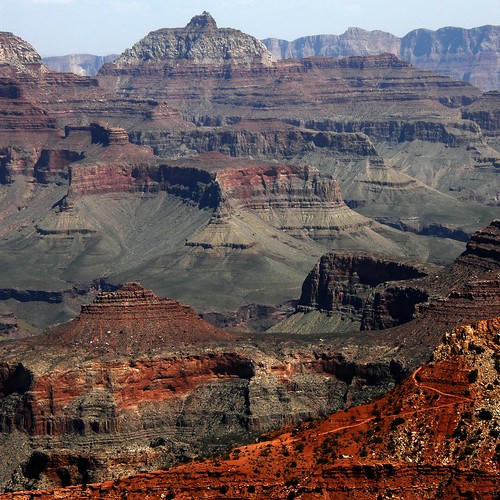
» The Grand Canyon is possibly a rather unoriginal choice of photo to illustrate geology, but wotthehell, it’s relevant and looks spectacular. Couleurs de la Terre / Colours of the Earth is © Olibac and used under a CC by-nc-nd license.

Categories
Culture

Troilus and Cressida at the Globe

When I saw they were putting on Troilus and Cressida I thought it was about time I finally got round to seeing some Shakespeare at the Globe; previously the only thing I’d seen there was, randomly enough, a play about the writing of the US constitution.

I was about to say that Troilus and Cressida was one of favourite Shakespeare plays, but actually that’s putting it too strongly. It did make a particular impression on me when I read it, though: it’s funny and cynical and just interesting as a piece of literature.

The cynical/satirical aspect of it was probably particularly striking for me at the time because I must have read it fairly soon after reading Chaucer’s version, Troilus and Criseyde. Chaucer presents the story as a grand courtly romance; the telling of it is not without humour, but it is ultimately a serious story of love and loss and betrayal.

Troilus and Cressida is much more ambiguous, and there’s an interesting argument to be had about what exactly Shakespeare meant by it, but one thing it clearly isn’t is a grand romantic epic. One early edition of Shakespeare classified it with the histories, although it isn’t historical; another with the tragedies, although it doesn’t end with Troilus and Cressida lying dead among a heap of corpses either. Mind you, I suspect you could make an argument that that single editorial decision, 400 years ago, to divide the plays into three genres has been hugely unhelpful to our understanding of them.

For those of you who don’t know the play, it is set during the Trojan War and intertwines two stories: on the Trojan side, Troilus’s attempts to seduce Cressida, using her uncle Pandarus as a go-between, while in the Greek camp, Achilles is sulking in his tent and the Greek generals are trying to get him to start fighting again.

The Greek side of the story is unavoidably cynical: the generals treat Achilles and Ajax as useful idiots, tools to be manipulated into fighting. Ajax clearly is an idiot, Achilles slightly less so. The generals themselves are not much better. Agamemnon is given an opening speech of startling pomposity, in such a high style that it is completely opaque, Nestor is one of Shakespeare’s long-winded old men, and Ulysses is a scheming, manipulative cynic. When Achilles finally does come out to fight, he finds Hector unarmed and sets his men on him to kill him in cold blood, then takes the credit.

The programme for the Globe production made the plausible claim that T&C, which was previously largely neglected, has become more popular in the C20th because, since the Great War in particular, that kind of cynicism about the idea of military heroism has become more acceptable to us. And they played it for all the dark humour you might expect.

What surprised me a bit, though, was the treatment of the Troilus and Cressida part of the story, which was played relatively straight; they did their best to wring some emotion from it and give it the star-crossed lovers vibe. I have to say I didn’t read it that way on the page; their relationship consists of one night in bed, arranged by her uncle, and she is being unfaithful to him within 24 hours of being sent over to the Greek camp. There is never a hint of marriage, which is unsurprising in the medieval version but very unusual in Shakespeare. Yes there is some high-flown lovers’ rhetoric, but it is constantly undercut by the busy-bodying and innuendo of Pandarus. Even at their first expressions of love, she admits to having played hard to get and then worries that by admitting it she will have lost power over him — not the profoundest kind of deceit but not exactly Romeo and Juliet either.

For me, just as the war parts of the play read as a parody of the grand heroic style of Homer and of medieval chivalric romance, the love story is a parody of medieval romance — or indeed of Romeo and Juliet.

Anyway. Questions of interpretation aside, I did enjoy the production. One of the nice things about the Globe is seeing theatre performed without the aid of lighting, amplified music and elaborate mechanised sets: just performers on a fairly plain stage in daylight having to hold the audience by, you know, acting.

Matthew Kelly played a rather camp Pandarus with a bit of a thing for Troilus, which I thought worked well to provide some explanation as to why he was setting him up with his niece. And it fitted in with the general homoeroticism of all those buff, bare-chested Greek warriors, and the possible relationship between Achilles and Patroclus.

Thersites, the fool character who spends the play providing barbed commentary on the action, was played rather too broadly as a clown for my taste. It wouldn’t surprise me if the clowns and fools gave pretty broad performances in Shakespeare’s time as well — the fact that they were treated as specialist roles certainly suggests it — but I find I have a limited tolerance for gurning.

The battle scenes were a bit laboured, but I don’t know if there’s a simple solution to that, given that you don’t want the actors to actually hurt each other. I also went to see the play early in the run, and the sword-swinging may start looking a bit more natural when they’ve spent more time doing it.

Categories
Culture

Exhibition round-up

Sorry for the slight hiatus; it was a combination of the cricket and Dragon Quest: the Chapters of the Chosen. But there’s a pause in the cricket*, so I’ll just quickly round up a few of the things I’ve been to see recently.

Firstly, the big Baroque exhibition at the V&A, which I went to see a few weeks ago and actually closed yesterday. This is exactly the kind of exhibition that the V&A does a superb job with, and I was glad I went, but I couldn’t work up much enthusiasm for it because, well, it’s the Baroque. It’s the aesthetic of wealth and power, of an exquisitely crafted, gilded boot stamping on a human face forever. I didn’t warm to it.

There were interesting items and impressive ones, but not many were likeable; almost none triggered the acquisitive itch in me. The slight exception was actually a video reel of Baroque buildings. Craftsmen obviously struggled to capture the grandeur, ambition and megalomania of the Baroque in something like a  candlestick or a side-table — although it didn’t stop them trying — but if you’ve got a whole church to work with, or a palace or an opera house, you can produce something magnificent.

And I suppose you can argue that once you’ve got your church or your palace, you need some suitably pompous candlesticks and side-tables to match the decor. I still can’t get excited about going to look at them in a museum.

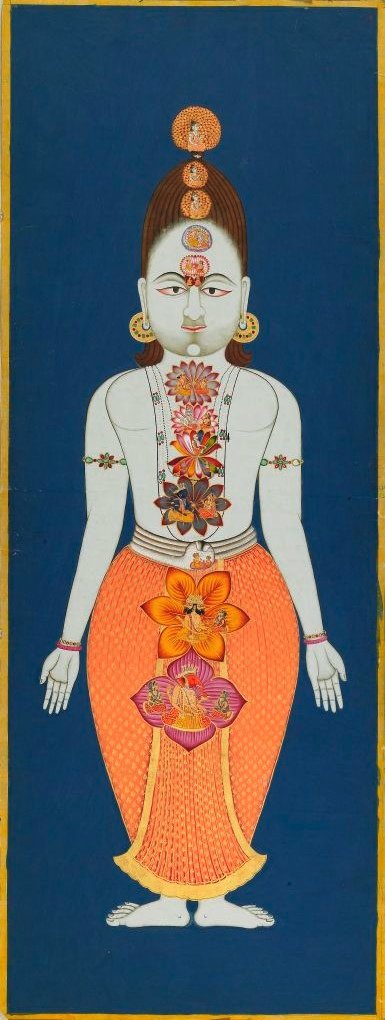
yogi

A more enjoyable exhibition was BM’s Garden and Cosmos: The Royal Paintings of Jodhpur. These are paintings that are in a style that I associate with Persian miniatures — and of course the Mughals were Persians, more or less — but on a much large scale.

Different Maharajas commissioned different works. The exhibition starts with paintings of court life, mainly represented here as lounging around in the palace garden surrounded by scantily clad women. Then as, we move into scenes from Hindu mythology — some of them looking remarkably like the first paintings except with Shiva sitting in a garden instead of the Maharaja of Jodhpur, but others with more dramatic subjects from the Ramayana. And then it shifts into a more esoteric, mystical tradition within Hinduism, with paintings of the creation of the universe from nothingness, spiritual maps of the universe, symbolic maps of the human body with chakras and so on.

The pictures were attractive, never a bad thing, as well as being interesting. And the attempts to represent the unrepresentable were beautiful and more successful (whatever that means) than most Western equivalents I can think of.

I also went to the Royal Academy Summer Exhibition (“now in its 241st year!”). It’s always slightly more enjoyable than I expect; apart from anything else, it’s always interesting to go to an art exhibition where everything has a price marked on it. Vulgar of me, I know. But there’s just so much of it that you’re suffering from fried brain by two thirds of the way through.

And on the subject of art prices, check out this link: ‘If Famous Architecture Were Priced Like Paintings, a Le Corbusier Would Cost the Same as the Entire American GDP‘.

*after a heroic win for England at Lord’s, the first time we’ve beaten the Aussies there for 75 years. I could probably find quite a lot to say about the first two matches in the series — that 75-year losing streak is a fascinating subject in itself — but let’s stay on topic.

»The picture is Chakras of the Subtle Body, 1823, © Mehrangarh Museum Trust.