Categories
Culture Other

One Day In History and At Home In Renaissance Italy

I think this is quite a fun idea — One Day In History.

Make history with us on 17 October by taking part in the biggest blog in history.

‘One Day in History’ is a one off opportunity for you to join in a mass blog for the national record. We want as many people as possible to record a ‘blog’ diary which will be stored by the British Library as a historical record of our national life.

Write your diary here reflecting on how history itself impacted on your day – whether it just commuting through an historic environment, discussing family history or watching repeats on TV.

Anyone who reads Pepys online will know that the interest lies as much in the minutiae – what he ate, the plays he went to, and just recently (or at least at this time of year 343 years ago), his doctor’s attempts to cure his constipation. So the material collected today genuinely might be of interest to future historians. There was a somewhat similar thing done over a longer period in the UK during the 40s and 50s called the Mass Observation Project, where people were encouraged to keep diaries, and the results have been made into a couple of books that I know my father enjoyed.

I’m afraid that any historians of the future wanting to know what people had for breakfast in the carefree days before the Great Squid Wars will have to manage without my input, though. But if any HotF is reading this: I had marmite on toast. ‘Marmite’ is a brand name for yeast extract sold as food. ‘Toast’ is what we call a slice of bread which has been grilled or ‘toasted’ in a special-purpose machine called a ‘toaster’. ‘Bread’ is a foodstuff made by powdering the seeds of a species of grass, mixing the powder with yeast and water, and…

In all seriousness, there would have to have been a truly mammoth cataclysm for some future historian not to know what bread is. Perhaps if the squid win the war and we all end up living underwater. Who knows what other things might seem interesting, though. It’s tempting to pick on stuff which seems shiny and new and typical of our age, like the internet, but actually it would take almost as profound a cataclysm to destroy the internet as to eradicate bread. Of course even if there’s still a network of connected computers, I daresay the user experience will be radically different. One of these days someone is going to get a working 3D display, for a start. Internet Explorer 36 will no doubt still be lagging behind the competing browsers in terms of implementing the latest technology. Sorry, that’s a very lame joke. In fact, it would be amazing if Microsoft was still a dominant company in 30 years, let alone a few centuries. By that time, Microsoft and Bill Gates will only survive as a faint memory as synonymous with money, like Standard Oil and Rockefeller and Carnegie.

The idea that the stuff of everyday life is sometimes more interesting than the Big Historical Events makes a neat connection with the exhibition I went to see at the V&A today, called At Home In Renaissance Italy. I vaguely had it in my mind before I went that it was going to be about everyday life for ordinary people. It wasn’t, of course; it was about everyday life for the mega-rich. ‘Home’ sounds so cosy, but in this case it refers to huge palazzos (palazzi?) full of all the most fabulous and luxurious stuff that money could buy. For example: the exhibition was divided up according to the different rooms of the Renaissance house, and the scrittoio (study) was illustrated using stuff from the study of Lorenzo de’ Medici. Apparently Lorenzo distanced himself from the family business, but his grandfather really was the Gates or Rockefeller of his day. Although Gates, bless him, doesn’t strike me as much of an aesthete, so I doubt if his own mansion is full of the kind of beautiful objects on display here.

The reason they focussed on Lorenzo for that part of the exhibition is that the V&A owns the ceramic panels from the ceiling of his study, although they’d borrowed stuff from other collections to complement it, including a lavish copy of Pliny’s Natural History which must be the most elaborately decorated secular text I’ve ever seen. Not surprisingly, a large proportion of the stuff in the show comes from the V&A collection, but the act of curating it into a well-organised exhibition easily justifies an entrance fee to see stuff that would be on show in the permanant display anyway. And there are lots of things which they’ve borrowed from elsewhere as well.

I felt that the exhibition made a bit of a statement when you walked in and were confronted by a pair of grand Veronese portraits, displayed together for the first time since they were moved from the room where they originally hung, and in front of them is a case with a sword like the one carried by the husband and a gold marten head like that carried by the wife (above). Which seemed a bit like saying ‘we’re so grand we can use a Veronese just to illustrate a sword’. And on the other side of the room was a Botticelli which served to illustrate the layout of a Renaissance house. This is presumably the curatorial equivalent of name-dropping. As well as some other fine paintings, including a couple of Lippis and a Crivelli, there was loads of interesting stuff — fireplaces, furniture, ceramics, glassware, board games, instruments, clothes, inkwells, spectacle frames, wafering irons — and I thoroughly enjoyed it.
Categories
Culture Other

FSotW: Fibre “Quick on the Draw” Drawings

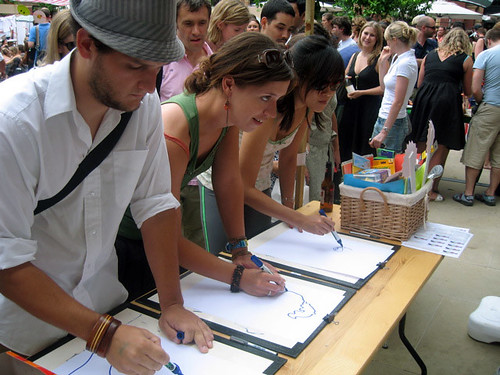
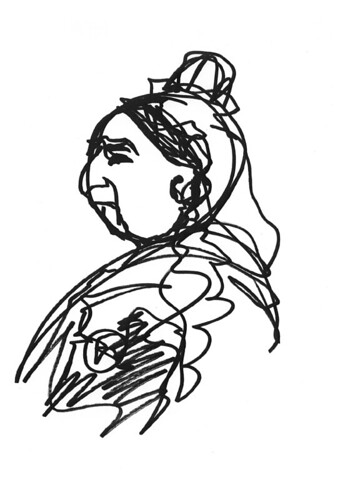
Flickr set of the week is actually two sets; Fibre “Quick on the Draw” Drawings and Fibre “Quick on the Draw”. ‘Quick on the Draw’ was “Fibre’s stall at the 2006 V&A Village Fete. Each artist had one minute to draw a picture of Queen Victoria without taking their pen of the paper.” As usual, you can click on any picture to get to the relevant Flickr page.

Categories
Me Other

comment spam

The first comment waiting in my spam filter just now reads “May I borrow some articles from your site? Who should I contact?” And just for a moment I thought it might be a genuine comment which had been mistakenly identified as junk, even though it was apparently posted by someone called ‘daivaufeijau’.

Then I noticed that the next comment (from deawisy, saying “I just want to say THANKS to all people in this community”) linked back to the same webpage. And so did the comments from vujei and ajauxiseag. In total there were 241 comments all linking back to the same address, ranging from “Can you make pages for foreign people? For example Spanish” to “The greatest homage we can pay to truth is to use it.” These fake comments would really be more plausible if there were only one or two of them.

Thank fuck for Akismet, which somewhere in the middle of all that lot caught its 5000th spam comment since I installed it about last November.

Categories
Other

Colonial troops in WWII

I found this article in the Independent interesting. There’s a film coming out in France called Indigènes about “the 300,000 Arab and north African soldiers who helped to liberate France in 1944.” Apparently about half the French army in 1944 was African or Arab. The director and producer, both French of North African descent, “hope the film will remind the majority population of France that the country owes a deliberately obscured debt of blood to colonial soldiers with brown and black skins. They also hope the film will persuade young French people of African origin that they belong in France.”

In one respect, the film has already succeeded where years of complaints have failed. Last week, just before it reached the cinema, the French government was shamed into paying belated full pensions to 80,000 surviving ex-colonial soldiers who, since 1959, have been paid a fraction of what French veterans receive.

All of which is quite interesting, but I was mainly struck that the article managed to get all the way through exuding a sense of superiority to those racist French without commenting on the British parallel. There were really quite a lot of colonial troops fighting for the British in the war, most notably the Indian Army, which in WWII was the largest all-volunteer army ever assembled. Unsurprisingly, the Indian Army was important in the Burma campaign, but they also fought in North Africa, the Middle East and Italy. I think I read once that a third of troops at the battle of El-Alamein were Indian. There aren’t too many Indian faces in all those old war films, though, and I really don’t think most British people know anything about their role. And given that the Ghurkas who are current members of the British army still don’t get the same pensions as their British counterparts, it seems a fair bet that Indian veterans of El-Alamein and Monte Cassino don’t either.

This particular blindspot in the British view of history isn’t simply a race thing, of course. Only a minority of the ‘British’ Eighth Army at El-Alamein was actually British; apart from the Indians, there were troops from Australia, Canada, New Zealand, South Africa and Rhodesia; and even a few Free French and Poles. But I only know that because I just looked it up in Wikipedia, and I imagine that most people in this country would have assumed, like me, that the British Army was, basically, British.

Quite apart from the fact that le fairplay demands these things be better known, the French example makes me think – there must be a good film in this somewhere. Or novel. Or even poem, at a pinch.

Categories
Other

The Sun on the North Korean nuclear test

The Sun may be an awful sexist homophobic reactionary rag, but it has its moments. Today’s front cover: a photo of the Kim Jong-il puppet from Team America:World Police, with the headline ‘HOW DO YOU SOLVE A PROBLEM LIKE KOREA?’

Categories
Me Other

Militant Atheism

I’ve just finished The God Delusion by Richard Dawkins, which I enjoyed more than I expected, since generally I prefer Dawkins when he’s writing about biology. I might blog about the book later, but for now it got me thinking about religion.

My own opinions are uncompromising: I don’t believe there is anything beyond the material universe, so that means no gods, no fairies, no ghosts. I think that theism and deism are just about intellectually defensible, but the details of particular religions, whether Christianity, Islam, Scientology or whatever, are about as plausible as crystal healing; only their cultural importance gives them a spurious sense of reasonableness.

I used to enjoy arguing with believers for the sake of it, but I largely stopped that at university when I came to the conclusion that I was just upsetting them for no good purpose. And on the whole, despite the occasional internet argument, I’ve stuck to that. I tend to think of religion in much the same way as I think of the monarchy. The status of the royal family is undemocratic, anachronistic and generally intellectually indefensible, but as long as they don’t seem to be doing any harm, and as long as they keep out of politics, trying to get rid of them doesn’t seem like a battle worth having; there’s very little popular support of it, the process of working out a system to replace the status quo would be interminable and painful, and in the end I don’t think we’d have gained much.

The same applies to religion. As long as religions keep themselves to themselves and don’t obviously do much harm to others, I’m generally willing to live and let live. And in the UK, it’s pretty easy to take that attitude. Growing up as a middle-class Londoner, agnosticism was the default position, and if there was any social pressure it was that Christianity was desperately unfashionable. In that environment, rejecting belief is easy, socially and intellectually. And while London is probably exceptionally godless, especially outside the various immigrant communities, the same is broadly true of the UK as a whole. Although 72% of people identify themselves as ‘Christian’ on the census, when asked the question ‘Do you believe in God?’ only 44% of people actually say ‘yes’, with another 21% not being sure. Presumably that leaves another 7% who describe themselves as ‘Christian’ while definitely not believing in God. And even among the believers, only 10% go to church ‘in most weeks’. Fortunately, the Church of England is so theologically open-minded that it’s hardly necessary to believe in God to be a member.

Even more important, perhaps, is that enthusiastic religion is not really very socially acceptable. Certainly for politicians, being overtly religious is more likely to attract mockery than support. So there’s no prospect of anything like the American ‘religious right’ appearing any time soon over here (or indeed, the CofE being what it is, a ‘religious left’).

And yet, recently (and even before reading the Dawkins) I’ve been feeling more militant about my atheism, and less willing to be tolerant of people’s religious beliefs. Partially that’s because of the growth of extremist Islam. Not just the terrorism, which is an unwelcome development but is in the end a fairly minor threat. It’s the intrusion of Islam into politics; the prominence of Islamic organisations as a part of the anti-war movement, the protesting and flag-burning at any perceived slur, the election of George Galloway, the issue of faith schools. It’s not that I necessarily disagree with all of the politics; I’m not a big fan of the war, for example. But I don’t like to see politics infected by religion.

There’s also the increasingly religionised nature of US politics. As I say, I can’t see the same thing happening here; but the prospect of religious zealots in control of the world’s largest ecomony and military isn’t exactly reassuring either. And as worrying as both Islam and the religious right are individually, the most worrying thing of all is the idea of them validating and motivating each other. I’m deeply troubled by the idea that people who talk about a ‘clash of civilisations’ don’t mean a clash between aggressive religion and post-Enlightenment secular democracy, but between two competing religions. I’m troubled by the possibility that, in wishing to define Britishness in opposition to Islamism, people will increasingly talk about the UK as ‘a Christian country’, and Christianity will once again start to seem like a defining part of what makes Britain British. Personally, I can’t see how British history is any kind of advertisement for Christian virtues, since from the Reformation right up to the current situation in Northern Ireland, Britain has repeatedly been torn apart by violent clashes between competing Christian sects; but I know some people see it differently.

Where does this increased militancy lead me? I don’t know, really. It’s not like there has ever been a period in my lifetime when religion wasn’t a source of oppression or conflict somewhere in the world, but somehow at the moment the damage done by religious belief seems particularly vivid. It makes me less inclined to show any respect to someone’s faith just because it’s well-meaning and sincere.

And as irritating as I tend to find militant atheism in others, I have an uncomfortable feeling that I should proselytise, that it’s important to assert that religious beliefs are not simply false but harmful. Even the anaemic Christianity of the CofE represents the victory of superstition and inertia over evidence and logic, and if it does little harm it’s only because it is generally ineffectual. Forceful religion, impassioned religion, campaigning religion: these are Bad Things. Perhaps it needs to be said more often.