Categories
Culture

‘Diaghilev and the Ballets Russes’ at the V&A

I went along to the Diaghilev exhibition at the V&A. He’s kind of an interesting figure to name an exhibition after, since he was an impresario, rather than an artist or designer, or even a composer or choreographer. But under his stewardship, the Ballets Russes really does seem to have been an extraordinary focal point for European culture. I’m a complete philistine about music and ballet, so none of the choreographers meant anything to me, and the only dancer I’d heard of was Nijinsky; but even I’ve heard of composers like Prokofiev, Satie and of course Stravinsky. And even I know that the first performance of The Rite of Spring is one of the significant cultural moments of the twentieth century.

And I’m slightly less of a philistine about art, so I’ve definitely heard of some of the people who designed sets and costumes for him: Pablo Picasso, Henri Matisse, Georges Braque, André Derain, Giorgio de Chirico, Natalia Goncharova, Coco Chanel. And apparently Joan Míro and Salvador Dalí as well, although neither of them featured in this exhibition. And that’s apart from some, like Léon Bakst, who are specifically known for their design work for the ballet. It is a hell of a list.

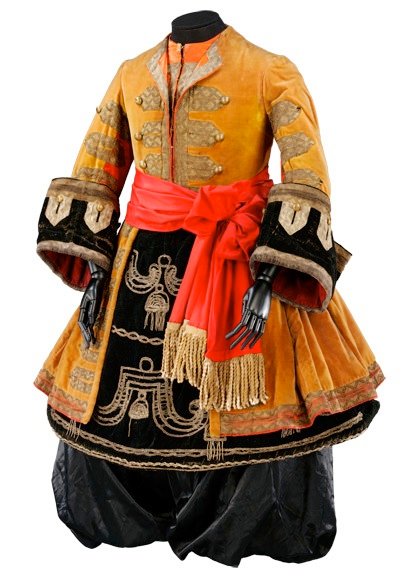
And it’s a fun exhibition: lots of cheery colours, and gorgeous costumes that have a battered glamour to them; and costume designs, which are often even more appealing than the costumes themselves. And the single largest item in the V&A collection: the back cloth for one of their ballets.
I also checked out the Raphael tapestries. Pope Leo X commissioned Raphael to design a set of tapestries with scenes from the lives of St Peter and St Paul, to hang in the Sistine Chapel, and one of the treasures of the V&A is the Raphael cartoons: i.e. the full size painted designs which the weavers worked from. To coincide with the current Pope visiting the UK, the Vatican has lent four of the actual tapestries to hang alongside the paintings for a bit.

And they’re quite interesting to see, although they have rather fallen victim to changing tastes. The Raphael cartoons have always been regarded as some of the most important bits of Renaissance art in Britain, but I don’t think I’m alone in finding them a bit unsympathetic. It’s not just the subject matter, although that doesn’t help; there’s something about these monumental groups of posed figures that is just a tiny bit, um, boring. Maybe it’s the self-conscious grandeur of them; these really are the Catholic equivalent of Socialist Realism. Then again, if Stalin had had people like Raphael and Michelangelo available, Socialist Realism might have been pretty fabulous.

» Top: costumes for female dancers in The Rite of Spring. Designed by Nikolai Roerich, 1913. Bottom: costume for a ‘Negro Lackey’ from The Sleeping Princess. Designed by Léon Bakst, 1921.
Categories
Culture

The First Movie

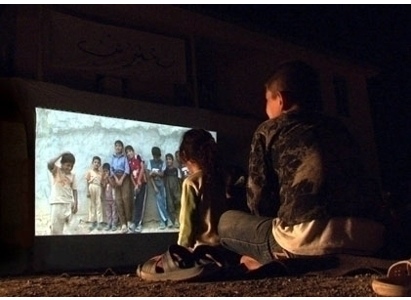
Just a little plug for The First Movie, which I went to see on Friday. It’s a documentary by Mark Cousins; he visits a Kurdish village which is remote enough that none of the children have ever been to the movies, and puts on a showing of a selection of films in a makeshift outdoor cinema; then he gives the children little digital movie cameras and waits to see what footage they bring back.

It’s a film which looks beautiful and is in turns funny and moving, with a narration provided by Cousins in a very attractive Belfast accent. As I was watching it, I was thinking that, by comparison, nearly everything you see in the cinema has incredibly little faith in the audience’s intelligence or attention. Not that this is some kind of ultra-difficult film, but it’s not afraid to be poetic, to talk about aesthetic issues, to be slow, to hold shots for a long time and let the audience look at them. I really thought it was excellent.

During October it’s on a tour of independent cinemas around the UK. I happened to see the first of these showings because it was at my local cinema. So if you’re in the UK and happen to live near the kind of cinema that might show arty documentaries, check the showing dates and give it a go. And if you’re not in the UK… I don’t know, it might appear at a film festival? Or on Netflix in due course? Well worth a look.

Categories
Culture

Things posted to Tumblr: Gandhara bodhisattvas

I’ve been enjoying posting stuff to A London Salmagundi, and I find the convention of posting pictures without commentary rather liberating, because I am a relentless tweaker of my own prose and constitutionally incapable of being brief. But sometimes I find myself wanting to explain why I think a particular image is so interesting or beautiful. So this is the first of what may be a series: ‘things I posted to Tumblr’.

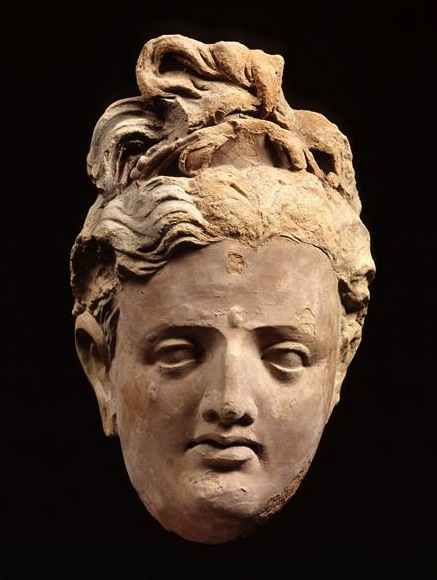
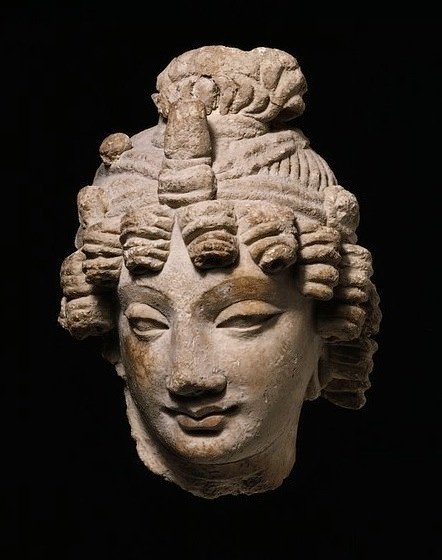
These bodhisattvas are from the part of the world that US foreign policy types refer to as ‘AfPak’; the top one, the older of the two, is from Hadda, now on the Afghan side of the border; the other is from Peshawar in Pakistan. But when these were made, and for over a millennium, it was the location of the Gandhara kingdom.

I only know that because I just looked it up on Wikipedia. But what I did already know was that these are in a tradition called ‘Greco-Buddhist’. This is art from a place where two worlds meet. Alexander the Great conquered the area from the Persians in the 4th century BC; hundreds of years later, the Hellenistic influence was still powerful enough to result in works like these.

That top one, from 1st-3rd century AD, is particularly extraordinary and particularly beautiful, I think. The style is recognisably Greek; the hair, the sculpting of the features. But the face looks Indian, and he has the long ears of the bodhisattva.

The other, slighter later (3rd-5th century) is less remarkable, less strikingly classical; more what one expects a bodhisattva to look like. But it’s still a lovely thing.

Just the existence of Greco-Buddhist art was amazing to me, because Alexander the Great and Buddhism lived in completely different parts of my brain. It’s like reading one of those counter-factual novels — what would modern Britain have been like if the Nazis had won the war? —  except, you know, it’s actually real. There really was somewhere where Buddhist monasteries were decorated in the style of ancient Greek temples.

The fact that the resulting art is beautiful just makes it even better.

» The Hadda bodhisattva at the Musée Guimet; the Peshawar bodhisattva at the V&A.

Categories
Culture

Of Water and the Spirit by Malidoma Patrice Somé

Full title: Of Water and the Spirit: Ritual, Magic and Initiation in the Life of an African Shaman. Somé was kidnapped at the age of four and taken first to a Jesuit-run boarding school and then a seminary, where he was a victim of physical and sexual abuse. At the age of 20 he fled the seminary and walked back to his home village. When he saw his family for the first time in 16 years, he could no longer speak his native Dagara and had lost touch with his native culture; so he underwent the long, harrowing ritual initiation that boys normally go through at 13.

He then realised that his calling was to go out and teach the western world about traditional wisdom; the book ends with him leaving the village again. He went to university and earned a few degrees, and he now seems to work on the New Age lecture circuit and in the men’s movement.

I have to say, as I read the introduction which explains this stuff, my heart sank. The cocktail of academic jargon, self-help, the supernatural and purple prose could have been specifically designed to annoy me. But, to be fair, once he gets going, it is pretty interesting. He never completely shakes off the tendency to flowery prose…

The sun had already risen. A few scattered clouds were speeding across the empty zenith as if running away from the threat of the burning disc.

… but the academic and self-help stuff is much less intrusive. And the supernatural is after all the main subject of the book. As I was reading his descriptions of magical experiences he had before his abduction, all of which happened before he was four, I wondered whether all the impossible things he was witnessing were explicable by his extreme youth, and the embellishing powers of memory. But his experiences during the initiation as an adult are every bit as remarkable.

Assuming that he’s not just a professional bullshitter who made all this stuff up because he knows it is marketable — and I’m not really suggesting that’s the case, although it did occur to me as a possibility — his visions/experiences were extraordinarily complex, specific and precise. Since I’m not a believer in the supernatural, I couldn’t help speculating about what kinds of psychological and physiological effects might have created these experiences — quite fruitless, of course, since we only have one very specific perspective on what happened and I don’t have that kind of expertise anyway.

Really, that’s not the point, anyway; I’m not reading with the book to argue with it. What I would hope to get out of this kind of book is some kind of insight into the traditional culture of the Dagara. And there certainly is some interesting material about the rituals, about the use of divination, the decision making of the elders and so on. But the magical experiences themselves weirdly didn’t ring true to me.

I know I’m the worst person in the world to judge the authenticity of shamanic experience, but when I’ve read stories from oral cultures before I’ve always been struck by the genuine weirdness of them, a lack of the kind of narrative logic I expect. I don’t get that from this book; for all the impossible things happening, they sort of read like a version of shamanic experience as imagined by a westerner. Perhaps that’s unsurprising, given the relatively small proportion of his life Somé actually spent in his home village compared to the time spent elsewhere. He is inevitably as much a product of French colonial education and western universities as he is of Dagara culture. Or perhaps he is consciously targeting it at a western readership. Or, very likely, my idea of what a shamanic experience ought to be like is completely wrong.

One way or another, it’s certainly interesting. Of Water and the Spirit is my book from Burkina Faso for the Read The World challenge.

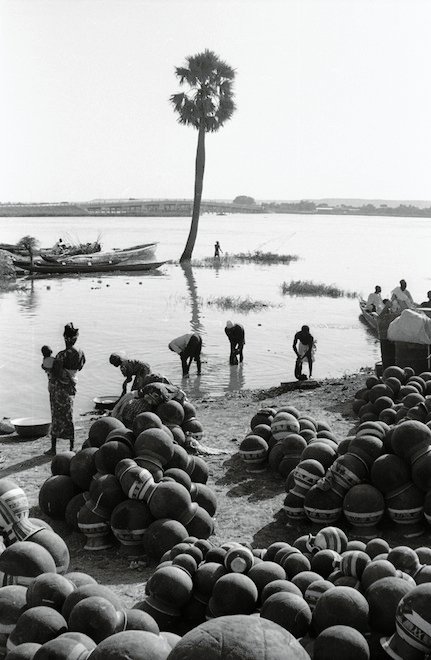
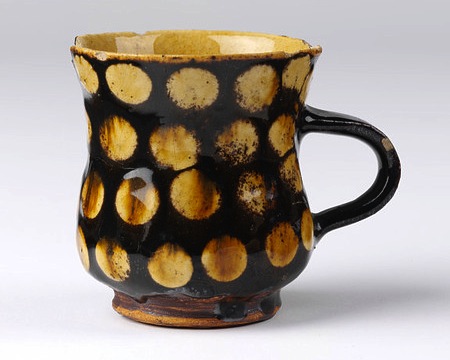
» The photo, ‘decorated potteries for sale at the market along the Niger riverbanks near Ouagadougou, Burkina Faso’ is from the Smithsonian. There’s not much connection to the book, but I liked the picture.

Categories
Other

A rising tide of whatever

I’ve noticed a tendency recently for religious commentators to refer to ‘secularism’ as a force in British society. There was even someone on the radio who, discussing the Pope’s upcoming visit to Britain, referred to ‘a rising tide of secularism’. But I think that’s completely wrongheaded. We don’t have a rising tide of secularism: we have an ebbing tide of religion.

Certainly there’s not much political momentum behind secularism in the specific sense of the separation of church and state. Thanks to the tangled history of the British constitution, there’s a lot of scope for reform in this area. Off the top of my head, I’d want to get rid of: the monarch’s position as head of the Church of England, the bishops’ seats in the House of Lords, the Prime Minister’s role in appointing bishops, the legal requirement that schools have regular acts of ‘collective worship’ which are ‘wholly or mainly of a broadly Christian character’, and the government funding of faith schools. Not to mention the ridiculous fact that members of the royal family are specifically barred from marrying catholics. But none of those are exactly hot political topics. The only one likely to get much political traction is faith schools; but it’s schools which are the fiercely contested issue, not religion.

But it’s broader than that: I don’t think secularism in Britain deserves to be called an ‘ism’. It’s not a system of thought or an organised political movement; it’s just a whole lot of people not going to church.*

Mind you, I don’t think it needs to be an organised anti-religious movement; a widespread lack of interest is probably enough. Everything else follows from there. When you have enough people who have simply never had religion as an important part of their lives — people who might, if pressed, claim to believe in some sort of higher power, but have never attended a church service by choice unless it’s a wedding or a funeral — well, the authority is gone. Social authority is like paper money, or fairies: it only works when everyone believes in it. If people have no emotional attachment to the idea of religion, they start judging religious beliefs by the same standard as other beliefs, and religious organisations by the same standards as other organisations.

At its root I don’t think that the hostile reaction to the Pope’s visit is based on anti-religious sentiment, although that is clearly present for some people.† I think it’s more that the absence of religious feeling means people approach him in a different way. I think a few decades ago, many people who were offended by catholic teachings on contraception and homosexuality, and even the child abuse cover-ups, would still have been less direct in their criticisms, because of who he is and what he represents. But now, it’s more like he’s a visiting politician with a bad human rights record… which, among other things, he is.

* Or at least, organised secularism does exist in Britain — you can follow the British Humanist Association on Twitter, ffs — but the BHA has existed under one name or another since 1896, and I’m sure they’d be honest enough to admit that their activities come a long way down the list of reasons for falling church attendance.

† And read this article by Padraig Reidy (formerly an editor at New Humanist magazine), who sees it as part of the long British history of anti-Catholicism.

Categories
Culture

Physical tumbling

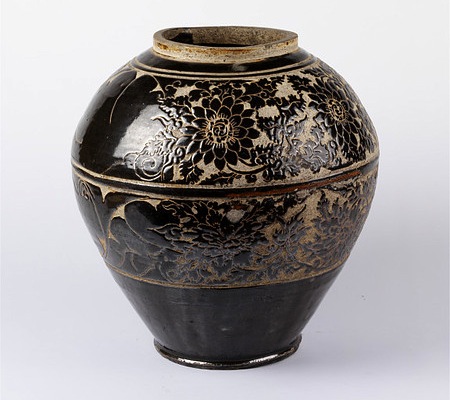
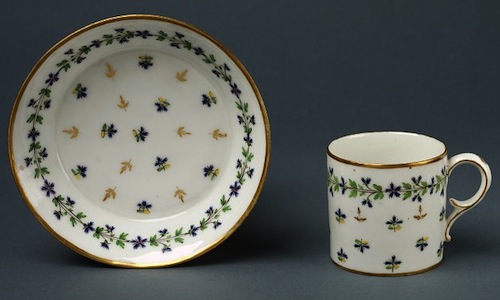
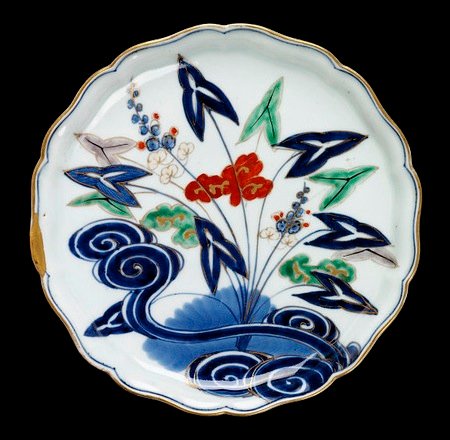
I went along to the V&A today to check out the second phase of their new ceramics display. The first phase was arranged by technique and theme; the new bit is by place and date. Some of the displays have helpful information, but much of it is effectively the collection being stored in plain view: all-glass cabinets with shelf after shelf of ceramics packed five or six objects deep.

It means that they’re not always as easy to see properly, and there’s no accompanying information, but it’s a way of making as much of the collection visible as possible: over 26,500 pieces in the new section, apparently.

I’ve actually spent a lot of time recently browsing the V&A’s collection online find things to post to A London Salmagundi. It was a healthy reminder that, although it’s marvellous that they are making such an effort to digitise their collections, and no matter how endlessly fascinating it is searching through museum collections online, there’s nothing quite like being close enough to appreciate the actual physicality of an object: the textures, the way it catches the light.

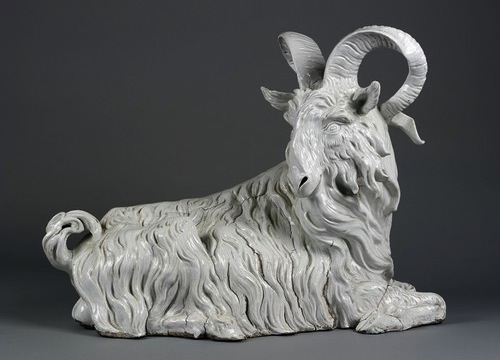
Or even more basic, the size. I posted this picture of a porcelain goat made by Meissen in 1732, and it’s a striking image; but nothing about that picture prepares you for the fact that it is over two foot long. Nearly life size — for rather a small goat, at least. Apparently it weighs 25kg.

Unfortunately the technology is not yet there for me to have a physical tumblelog. Although having an image blog is a kind of curation, I can’t, sadly, actually choose real objects and put them in front of my readers.

I suppose the closest I could come would be if the V&A gave me a long display case and the licence to roam the museum, picking out objects. Then I could put each new choice at one end of the case and shift all the rest a few inches further along; and as each one reached the other end, I would take it out and put it back where it belonged.

In fact, if anyone from the V&A is reading this: have your people call my people. Let’s see if we can work something out.