Categories
Culture

Kick-Ass

So I went to see Kick-Ass, the generally well-reviewed superhero film. And I enjoyed it, it’s a clever, well-made film. But it did remind me of a quote I posted to Salmagundi the other day:

‘And then I realised that Watchmen was in no way extraordinary but perfectly symptomatic: we are, after all, living through an age in which the fabulous ingenuity of craft is being lavished upon the realisation of a pathologically adolescent imagination.’

You can read the whole of that article (from the games magazine Edge) here.

I don’t know. I actually do think that cinema is often at its best in a populist mode, and I’m quite sure it’s possible to make a superhero movie that transcends the genre, just as it’s possible to make a western that transcends that genre. But I’m not entirely thrilled to be living in the Age Of The Superhero Movie, somehow. Hell, at least SF usually attempts to create a whole new world: superhero movies, set in a contemporary setting, is a form of imaginative fiction that seems strong on wish fulfilment and weak on real imagination.

Having said all that, if you fancy an entertaining evening at the cinema, you could certainly do worse than Kick-Ass. I enjoyed it. I’m just being grumpy.

Categories
Nature

Birds, birds, birds

Just a little catch-up of last week’s birding action. I went for a walk on the Isle of Sheppey, in the Thames estuary. It’s a transitional time of year: still plenty of wintering ducks and geese — some lovely brent geese still apparently unable to face flying back to the high arctic to breed, as well as white-fronted goose, wigeon, gadwall, teal and so on — but the skylarks were singing, and I saw wheatear and my first swallows of the year. And the lapwings were making those extraordinary calls which are just about my favourite noise in the world.

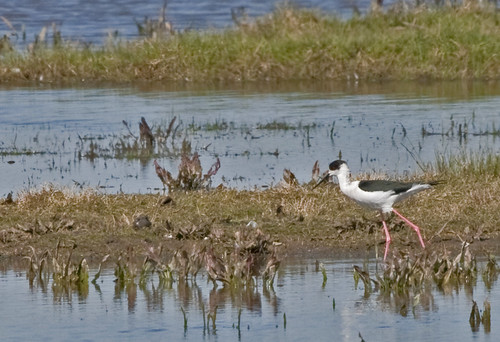
Also marsh harrier, little egret, linnet, meadow pipit, curlew, oystercatcher, redshank… and two really good sightings. The more visually stunning of the two was a great view of a pair of bearded tits, which are gorgeous birds and not the easiest to see well. But the other one was probably the closest thing to a proper rarity I’ve ever found for myself in the UK: black winged stilt.

That’s not actually my photo but it may well be my bird: it turned up the following day at Rainham Marshes, about 30 miles west of where I saw it. And I have to admit I didn’t see it as well as that: it was quite a long way away and I didn’t have my scope with me. Still, it’s a distinctive bird which I’ve seen before in the Mediterranean, and I recognised it immediately.

It’s not an extraordinarily rare visitor to the UK — typically about 5 records per year —  and it’s not actually a British tick for me; I saw the offspring of a pair that bred in Norfolk back in 1987. But still, by my standards as a casual birder, a pretty good sighting.

» Black-Winged Stilt is from Flickr and is © Hawkeye2011.

Categories
Culture

Thirsty River by Rodaan Al Galidi

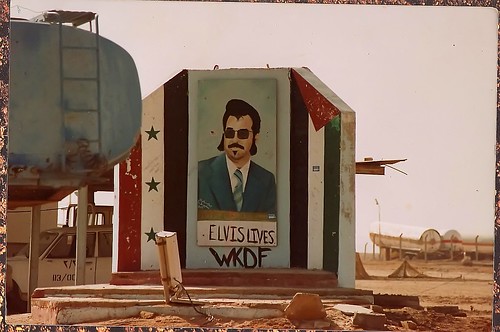
This is the second book in a row for the Round The World challenge which I can say, without any caveats, that I straightforwardly enjoyed. So that’s good. Thirsty River is my book for Iraq, though Rodaan Al Galidi fled Iraq for the Netherlands in 1998, so it’s actually translated from Dutch.*

It’s a multi-generational family story tracing the history of Iraq from before the Saddam years to after the American invasion. One of the blurbs says “García Márquez for Colombia and Al Galidi for Iraq”, and the book is in that kind of magical realist tradition; although as with a few books I’ve read recently, I find myself wanting to refer to ‘magical realism’ even though there isn’t actually much magic in them. A book like One Hundred Years of Solitude has genuinely impossible, supernatural events in it; Thirsty River has some unlikely, striking events, but they are not generally supernatural. But there’s a similar mood, a kind of theatricality, with odd things happening to slightly odd people.

Of course there’s nothing exclusive to magical realism about exaggerated characters and slightly implausible plots; you could say the same about Dickens. And I wonder if I would even think of referring to it as ‘magical realism’ if it was set in Surrey rather than southern Iraq. But there’s still something that seems to connect these books into a sort of genre; perhaps it’s a slightly detached attitude to the central characters?

Anyway, such taxonomical considerations aside: I did enjoy it. By the end of the novel the enjoyment was of a slightly mixed kind, because Iraq’s recent history has not been all unicorns and rainbows, and the book’s characters have a pretty brutal time of it.

Here’s a little excerpt.

Hadi the Rocket was a middle-aged man. He had a thick black moustache, from which he always plucked the grey hairs with tweezers. In his chest pocket was a comb and a miror, with which he kept his moustache in shape. Hadi the Rocket came from a poor family in Boran, whose members sold ice in the summer, and coal and oil in the winter. His father had owned a cart and an old horse. After primary school, Hadi began to work with his father. He had thought at was his lot to get old sitting int he street, until he became a member of the Ba’ath party.

“God in heaven, the party on earth,” he always said when the Ba’ath party was still underground.

“The party in heaven, Mr President on earth,” he said when the Ba’ath party seized power and was the only party remaining.

“Mr President is the heaven of the fatherland, the party his ground,” was the slogan when Saddam seized power.

Sometimes Hadi the Rocket forgot  his own house, which the party had given him, his wives, which he had also received from the party, and his children and he slept in his uniform in the party’s house. Every time people became more afraid of him, he felt safer and became friendlier. Little photos of Saddam Hussein were pinned to his clothes and he wore watches bearing his image. he gave the photos to everyone, and the watches to people who were higher up in the party then himself, as if it were an offering to the gods. No one was as attached to anything as Hadi the Rocket was to the Ba’ath party; not medieval suitors to their lovers, nor knights to their swords, nor believers to their gods.

* Incidentally, full marks to Luzette Strauss, the translator, for her sparing use of endnotes: just 12 for a 300 page novel. Since I’ve been reading a lot of translated fiction over the past couple of years, distracting and unnecessary endnotes have become a real pet hate of mine.

» saddam elvis, originally uploaded to Flickr by and © rakkasan69.

Categories
Culture

Exhibition roundup: Nash, quilts, Moore

Dulwich Picture Gallery currently has an exhibition of the English painter Paul Nash, best known I guess for his work as a war artist in both world wars. I know I first encountered him at school, when we were doing Wilfred Owen or Robert Graves or someone.

This exhibition did include some of that work, but also provided a bit of context for me. It was certainly interesting to see the kind of surrealist/symbolist paintings he did, often of the English landscape, when it wasn’t wartime. But it wasn’t really to my taste; it didn’t trigger that acquisitive urge. All else being equal, I am drawn to paintings which use strong, clear colours and sharply defined forms: Vermeer, El Greco, Matisse. Provençal Van Gogh rather than Flanders Van Gogh. Paul Nash is kind of the opposite: grey-brown tones and splodgy brushwork.
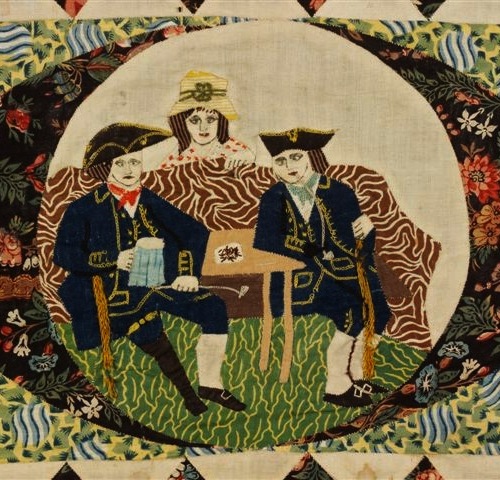
Meanwhile, the V&A has its first exhibition of British quilts, Quilts 1700-2010. I went to see it at an evening event in aid of Fine Cell Work, a charity that teaches prison inmates to do needlework as a rehabilitation exercise. There’s a quilt in the exhibition made by inmates with FCW; it is given context by a quilt made in a Japanese POW camp and one made by inmates on a prison ship who were being transported to Australia in 1841. Not surprisingly, the exhibition is keen to tease out this kind of social history from the quilts, but the other pleasure of it is just the extremely high quality of work on show. I’m fairly familiar with this stuff — my mother is a keen quilter — but they really have put together some great pieces.

The curator of the exhibition has managed to seriously annoy my mother by coming out with stuff like this in the Guardian:

Curator Sue Prichard thinks this enthusiasm is partly due to the global downturn. “I started on this project in 2004. Now there is a huge revival of interest in traditional crafts. There are a lot of women out there who are really keen to learn new skills and step away from their computer and their Blackberry.”

or in the Times:

Ms Pritchard said she hoped that the museum would inspire a revival of the craft through workshops that would teach people traditional techniques.

Because if there’s one traditional craft which didn’t need a revival, it’s quilting. That’s what appeals to me about quilting; it’s a genuinely living tradition, a vernacular art form which is thriving. It doesn’t need to be supported by government grants, it’s not the preserve of a handful of obsessive enthusiasts. Quilt shows are big business; indeed, the V&A’s exhibition is their most successful ever in terms of advance ticket sales. If there’s one criticism I have of the exhibition, it’s that it doesn’t give much sense of the liveliness of that current tradition. That gripe aside, it’s well worth visiting.

And finally Henry Moore at Tate Britain. Henry Moore was perhaps the biggest name in British art in the mid-C20th century, but he’s probably been rather out of fashion for a couple of decades, so it’s quite interesting to see this big show at the Tate.

Rather like the Paul Nash, I can’t say this particularly excited me, though it had its moments. Moore’s sculptures are often quite appealing as objects, with their curves, and the textural qualities of the materials; but it often feels like they are attractive in the same way as a weathered tree stump. Don’t get me wrong, I like a weathered tree stump as much as the next person, but I kind of feel that art could aim a bit higher than that.

The most interesting bits were probably the famous drawings of people sheltering in the Underground during the Blitz. Even though he makes the people look so much like his own sculptures, they have more impact than the sculptures themselves. They seem to hit a sweet spot between sculptural dignity and living humanity. There were some fine pictures of coal miners at work that managed the same trick.

Some of his post-War sculpture had some of the same human vulnerability and oddness, a bit of edge to it; but generally he seems to have reverted to weathered tree stump territory. Perhaps his greatest strength was a knack for producing sculptures that really worked as public art: large scale, impressive, and just about modern enough while unlikely to offend anyone.

Categories
Nature

Exotic birds (ooh err matron)

Richmond Park laid on a feast of introduced bird species yesterday. By far the most visible were the bazillions of ring-necked parakeets screeching from every tree, but there seemed to be Mandarin ducks on every patch of water and I also saw about half-a-dozen pairs of Egyptian geese as well as the usual Canada geese. And my two best birds of the day were red kite, which is a native species but the subject of a reintroduction program using Swedish birds, and little owl, which oddly enough was introduced from Holland in the nineteenth century.

The subject of exotic species seems to provoke an unexpectedly strong reaction in some people. It reminds me a bit of the pro-songbird lobby, whose campaigns are built around a message of ‘let’s kill all the sparrowhawks/squirrels/magpies’ and who complain that the RSPB only seems to be interested in protecting the ‘nasty birds’ and not the ‘nice birds’.

Don’t get me wrong, there’s a good reason why conservationists worry about the impact of introduced species: there’s a litany of disastrous examples from the past, like rabbits and cane toads in Australia, snakes in Guam, and rats, pigs and goats on oceanic islands all over the world. And the best known British example, grey squirrels replacing the native red squirrel. But there’s something slightly creepy about the hostility which people aim at these animals which, after all, didn’t choose to come here.

There’s an obvious glib comparison to the hostility towards human immigrants, but I don’t know if it’s really very valid… perhaps there’s an emotional similarity, even if there’s not necessarily an overlap of the people involved.

» ‘Not just a pretty face‘ © Keven Law and used under a CC by-sa licence.

Categories
Culture

The Whistler by Ondjaki

I have read several books recently that felt like a bit of a chore, so the first point to make about The Whistler is that it is gloriously short. With the help of generous amounts of white space the publishers have padded it out to 100 pages, but it’s probably more like 60 pages of actual text. I’m not a fan of short stories and I’m usually suspicious of very short novels, but this time I was in the mood for it: how nice to get a book finished in a couple of short sittings.

It’s about a man with an extraordinary whistle; except actually the whistler himself hardly appears. It’s really the story of a village reacting to the whistler’s arrival; and his whistling has a remarkable effect on people. We’re in magical realism territory here.

The story is light on plot but strong on atmosphere; it’s dreamy and wistful and gently funny. I guess in the end it might be a tiny bit insubstantial, but I found it very likeable. And it’s nice to read African fiction which isn’t about civil war or dictatorship or colonialism, important though those subjects are, but instead about people’s normal desires and concerns on a human scale.

He arrived in October, at the same time as the enduring and silent rains of that village. His hair fell along the thin sides of his face, his clothes were completely soaked and heavy, his eyes barely open from such amazement: it was a rain as soaking as any other, but without the natural gift of making a noise as it fell. He believed he was in the midst of an intense snow storm, and opened his mouth. He had never experienced a rain like this.

He put his bag on the steps. He looked, still with that soaked gaze, at the pigeons that surrounded the church. They flapped around him, alighted n the windows and took to the air again. It was only them that made a noise; only their noise could be heard. Further in the distance was a donkeys’ retreat. It is true, gathered donkeys: grey, fat, content and ambling.

He went into the church with a small step, without making a noise. The day was still young and the first mass had already taken place. He breathed the air around him, felt a delicate religiousness penetrate his lungs and his heart. The beauty of the architecture, the light filtering through the stained-glass windows, the morning and the moment, the absence of the Padre, led him to begin whistling. He discovered, with the end of the first notes, that this was one of the best places in the world for the whistling of melodies.

The Whistler by Ondjaki (trans. Richard Bartlett) is my book from Angola for the Read The World challenge.

» The photo is © Jose and used under a CC by-nc-sa licence. It has no particular relevance except that it was taken in Angola and I like it.