-
Fun tool: 'We extracted the colours from 10 million of the most “interesting” Creative Commons images on Flickr. Using our visual similarity technology you can navigate the collection by colour.'
-
Good news from the BBC. I like a lot of Banksy's work: he's a witty satirist. But he's not the second coming of Botticelli, and we need to nip in the bud the idea that his work is so artistically important that it should be preserved at all costs.
In a wailful choir the small gnats mourn
Is it just me, or do these market crashes always seem to happen in the autumn?

Maybe the current crisis isn’t the result of years of cheap credit and over-leveraged banks. Maybe it’s actually an atavistic response to the nights getting longer. Too many bankers go for a few days in a row without seeing daylight, and their deeply-buried lizard brain starts whispering to them that the world is ending.
» The photo, days get darker… by Mathias Erhart is from Flickr and used under a CC by-sa licence.
In which my irritation boileth over
Gerard Baker, the United States Editor of the (London) Times, has been gamely sticking up for the Republicans during this election. Even among the employees of that relatively conservative paper I imagine he feels like a bit of a beleaguered minority, so it’s perhaps not surprising that the tone of his articles has started to get a bit hysterical and defensive.
Still, this bit from an article about Sarah Palin really annoyed me:
As for the anti-intellectualism she seems to represent, this is a favourite old saw not only of the Left but also of the whole Establishment crowd. There’s an unshakeable view among the coastal elites that real wisdom is acquired only by circulating between the ivy-encrusted walls of scholarship and the Manhattan and Hollywood cocktail set.
But there’s real wisdom among those derided Americans who have never even ventured to the coasts, but whose steady consistent voice and values have been truly responsible for America’s many successes.
Now, I’m quite sure that there is genuine snobbery aimed at rural America by people from ‘the Establishment crowd’, and that the hostility towards Palin is partially fuelled by that snobbery. And I’m sure there’s real wisdom among landlocked Americans, and I even think it’s important that any culture has a strand of conservatism: stability and continuity are real and important political virtues.
But the real story is not that stereotypes about small-town America have undermined Sarah Palin; it’s that Sarah Palin has done great damage to the image of small-town America. Of course there should be many routes to political power; it shouldn’t be necessary to go to an Ivy League university — or any university at all — to qualify for high office.
But however you get there, once you’re running: you have to be able to talk coherently about politics. This is not an unreasonable demand. Palin’s Couric interview was genuine car-crash TV, and although her performances are getting less panicky, she still answers questions with a freeform stream of low-content babble.
She doesn’t have to be an expert on every subject, or speak in elegant, delicately wrought paragraphs. In fact, given her populist image, that would be a mistake. But she’s not even very good at being a populist. She’s no Ronald Reagan. She’s not even a Mike Huckabee. All those folksy colloquialisms are a good start, but she needs to develop a line in snappy, memorable bullshit for all the bits in between.
Thankfully, it looks like the Democrats are going to win this one, so I’ll soon be able to return to that happy state I was in before, when the only Palin I ever had to think about was the ex-Python, and Gerard Baker can be left to cry into his beer and nourish that sense of victimhood on behalf of the poor oppressed people of the Real America™.
Links
-
New York circa 1908. "Campus, College of City of N.Y. Academic building, Mechanical Arts building, Chemistry building."
-
via Pruned, photos of African-American storefront churches in Chicago.
Main Street by Sinclair Lewis
I made a vaguely dismissive comment about Sinclair Lewis in the comments to the Halldór Laxness post, questioning whether he deserved a Nobel Prize. But not long afterwards, in reference to the Wall Street vs. Main Street theme that has been running in US elections, a journalist mentioned the novel Main Street by Sinclair Lewis. Hang on a minute, I thought, that doesn’t sound right… and about 30 seconds of research revealed that I hadn’t been thinking of Sinclair Lewis at all. I was thinking of Wyndham Lewis. A really quite different writer.
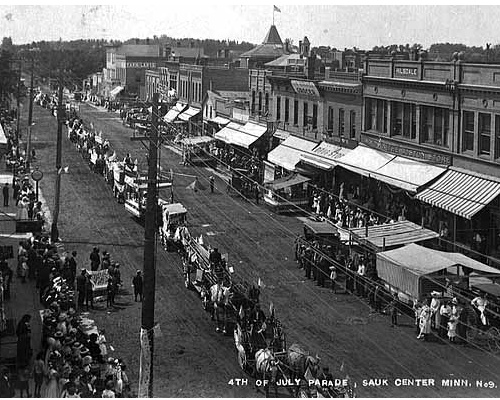
So I read Main Street. And actually, it was surprising how often it seemed relevant to the kind of culture war rhetoric that has been coming up on the campaign trail. Especially for a book published in 1920. There was even an argument about whether or not it’s patriotic to pay taxes.
The book is about Carol, a liberal, bookish girl who is non-specifically ‘artistic’; she marries a country doctor and moves with him to his home town of Gopher Prairie, Minnesota, which is part of what Sarah Palin would call ‘the real America’. She goes there with vague but idealistic hopes of improving the town, with beauty or culture or architecture, which founder in the face of the gossipy, judgemental, conservative, hypocritical, prejudiced, narrow-minded, coarse, prudish and generally unsympathetic locals.
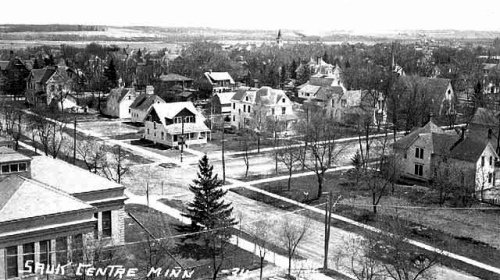
It is a fiercely satirical portrayal of small-town America which confirms all the worst fears of an arugula-eating, latte-drinking liberal like myself*. Lewis came from a small town himself (Sauk Centre, Minnesota), so he was writing from experience, although it does seem possible that he had a few biases of his own.
This is Carol’s first Gopher Prairie party:
Sam Clark had been talking to Carol about motor cars, but he felt his duties as host. While he droned, his brows popped up and down. He interrupted himself, “Must stir ’em up.” He worried at his wife, “Don’t you think I better stir ’em up?” He shouldered into the center of the room, and cried:
“Let’s have some stunts, folks.”
“Yes, let’s!” shrieked Juanita Haydock.
“Say, Dave, give us that stunt about the Norwegian catching a hen.”
“You bet; that’s a slick stunt; do that, Dave!” cheered Chet Dashaway.
Mr. Dave Dyer obliged.
All the guests moved their lips in anticipation of being called on for their own stunts.
“Ella, come on and recite ‘Old Sweetheart of Mine,’ for us,” demanded Sam.
Miss Ella Stowbody, the spinster daughter of the Ionic bank, scratched her dry palms and blushed.
“Oh, you don’t want to hear that old thing again.”
“Sure we do! You bet!” asserted Sam.
“My voice is in terrible shape tonight.”
“Tut! Come on!”
Sam loudly explained to Carol, “Ella is our shark at elocuting. She’s had professional training. She studied singing and oratory and dramatic art and shorthand for a year, in Milwaukee.”
Miss Stowbody was reciting. As encore to “An Old Sweetheart of Mine,” she gave a peculiarly optimistic poem regarding the value of smiles.
There were four other stunts: one Jewish, one Irish, one juvenile, and Nat Hicks’s parody of Mark Antony’s funeral oration.
During the winter Carol was to hear Dave Dyer’s hen-catching impersonation seven times, “An Old Sweetheart of Mine” nine times, the Jewish story and the funeral oration twice; but now she was ardent and, because she did so want to be happy and simple-hearted, she was as disappointed as the others when the stunts were finished, and the party instantly sank back into coma.
The scathing portrayal of Gopher Prairie is pretty relentless, but the book is more than just 400 pages of mocking the rubes. Carol is hardly perfect herself: she’s just a touch too highly-strung and prickly. And her husband may be more interested in motor cars and land deals than Yeats, but he is shown to be a hard-working, resourceful and skilful doctor.
Mainly, though, I thought it was an enjoyable read: I really got caught up in it as a story, which isn’t true of everything I read these days. The details, both social and physical, are well observed; it’s funny; it has just enough of the soap opera about it to keep me turning the pages. Good stuff.

*Actually, that’s not true, I can’t see the point of latte. But I don’t suppose my organic, single estate coffee grown on a Guatemalan co-operative wins me any Real America points either. And not being American can’t help, of course.
» The pictures of Sauk Centre are from the enormous collection you can find at the Minnesota Historical Society website.
The reason I quoted such a long passage is that it’s out of copyright, so I could just copy and paste it from the Electronic Text Center at the University of Virginia LIbrary.
Links
-
'Our forebears considered casting a “secret ballot” cowardly, underhanded, and despicable; as one South Carolinian put it, voting secretly would “destroy that noble generous openness that is characteristick of an Englishman.”'